

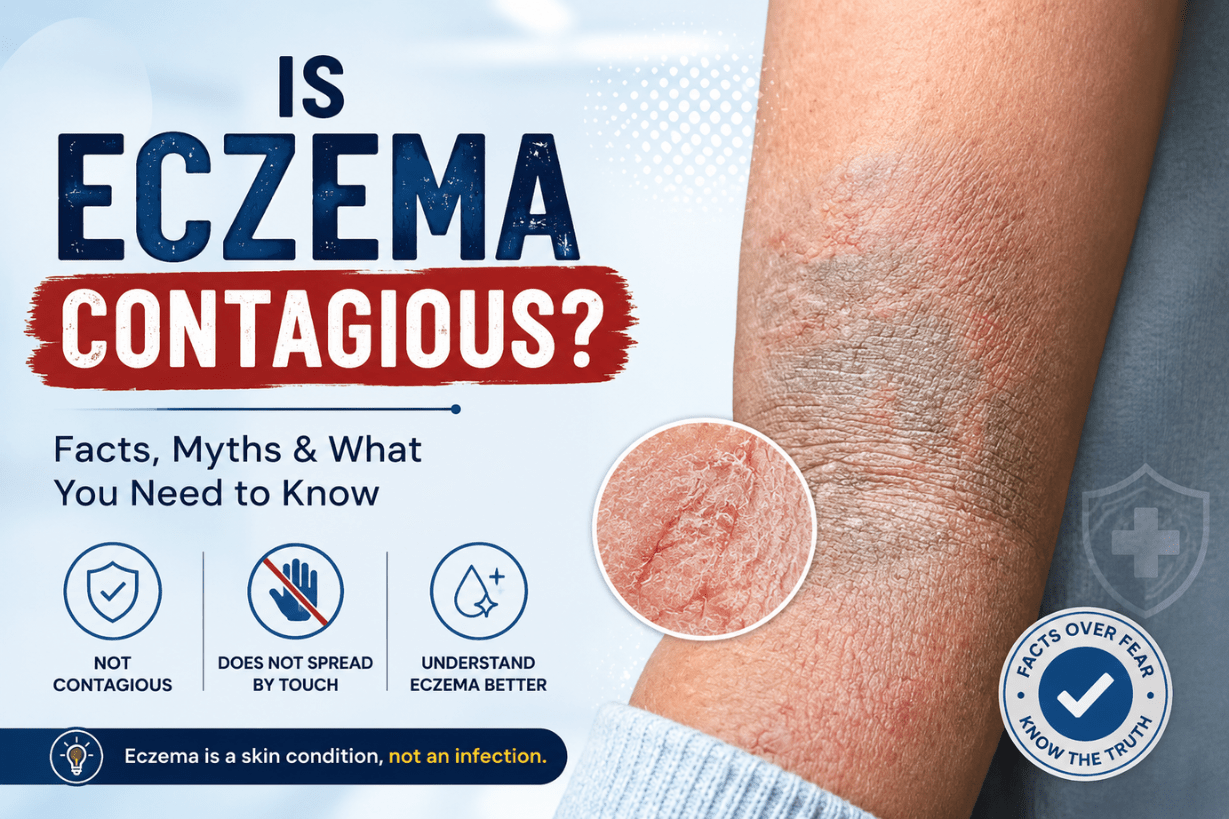
Quick answer: No — is eczema contagious is a question with one clear, evidence-backed answer: eczema cannot spread from person to person through touch, sharing items, or close contact. It is a chronic inflammatory skin condition rooted in genetics, immune function, and a weakened skin barrier, not in germs that jump from one body to another.
If you’ve ever pulled your sleeve down at school, flinched when a coworker stared at your hands, or watched a stranger take a small step back on the train because of a red, scaly patch on your arm — you already know how much confusion surrounds this condition. People assume that anything that looks inflamed, weepy, or unusual on the skin must be “catching.” It’s an understandable assumption. It’s also wrong.
This guide breaks down exactly why is eczema contagious is a myth, what actually causes eczema, when it can look contagious even though it isn’t, and how to manage flare-ups so you can stop worrying about spreading something you were never capable of spreading in the first place.
Is Eczema Contagious? The Short, Direct Answer
Let’s settle it immediately: is eczema contagious? No. Not even slightly. You cannot catch eczema by hugging someone who has it, sharing a towel, sleeping in the same bed, or touching their irritated skin. Eczema, also called atopic dermatitis, is not caused by a virus, bacterium, fungus, or parasite. It’s a non-communicable inflammatory condition, which means the immune system and skin barrier are reacting to internal and environmental triggers, not to an infectious agent that can be passed along.
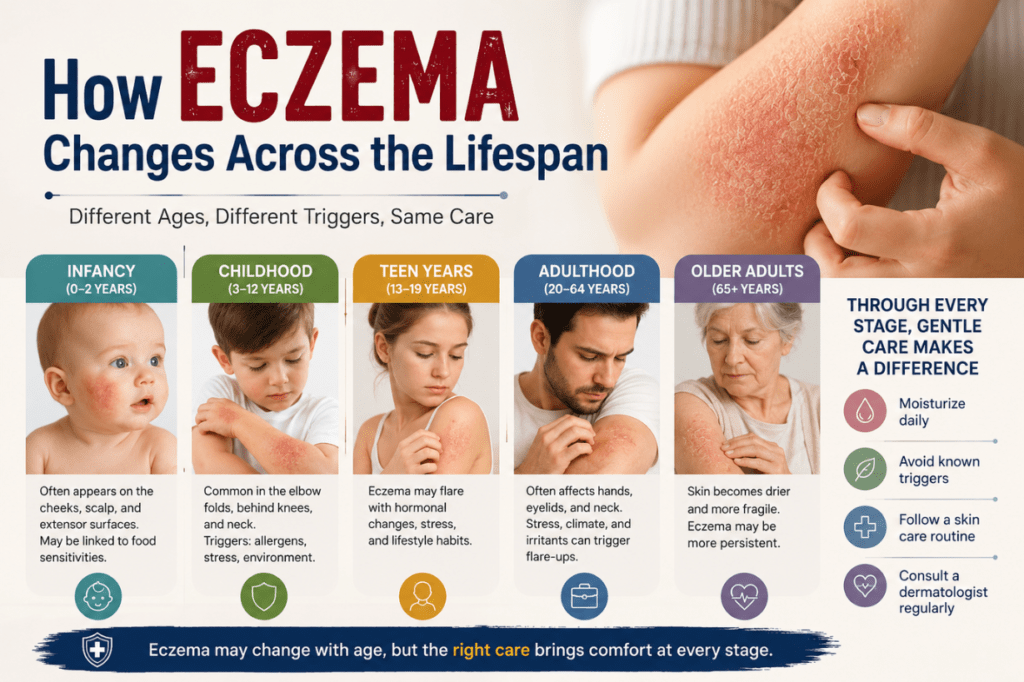
Dermatologists across major clinics confirm this consistently. A healthcare provider diagnoses eczema after a physical exam of the skin, and most people receive their first diagnosis as children, since the condition is especially common in that age group. Nowhere in that diagnostic process is there a concern about exposure to another person, because there’s no mechanism for transmission to begin with.
So when someone asks is eczema contagious during a flare-up, the honest answer is that the visible redness, dryness, and irritation you’re seeing is your own immune system overreacting — not a transferable infection. Eczema is not contagious, which means you cannot catch it and you cannot spread it to someone else.
Why People Keep Asking “Is Eczema Contagious?”
The question keeps surfacing for understandable reasons. Eczema can look alarming — cracked skin, oozing patches, crusty areas, or clusters of small bumps. Visually, those symptoms resemble things that genuinely are contagious, like ringworm, impetigo, or cold sores. When the brain sees inflamed, broken skin, it triggers a protective instinct: stay away, just in case.
There’s also a social layer to this. Children at school sometimes tease classmates with visible eczema, assuming incorrectly that it’s “catching.” Adults occasionally avoid shaking hands or sharing equipment at the gym. None of this caution is based in medical reality, but it persists because eczema is common, visible, and still widely misunderstood.
Cleveland Clinic data cited by multiple dermatology practices notes that roughly 31 million Americans live with this condition, so the chances of encountering someone with eczema — at work, school, or in your own family — are high. That visibility, combined with limited public education on what eczema actually is, keeps the contagious myth alive generation after generation.
What Eczema Actually Is (And Why It Can’t Spread Between People)
To fully understand why is eczema contagious is the wrong framing, it helps to understand what eczema actually is at a biological level.
Eczema is an umbrella term for a group of inflammatory skin conditions. It is sometimes referred to as dermatitis and covers several types, including asteatotic eczema, atopic dermatitis, nummular eczema, dyshidrotic eczema, contact dermatitis, stasis dermatitis, and seborrheic dermatitis. Atopic dermatitis is the most common form, and it’s usually what people mean when they simply say “eczema.”
At its core, eczema develops because of a combination of three things:
- A compromised skin barrier. The outer layer of skin, called the stratum corneum, normally locks in moisture and blocks out irritants. In people with eczema, this barrier doesn’t function as well, allowing moisture to escape and irritants, allergens, and microbes easier entry.
- An overactive immune response. The immune system treats relatively harmless triggers — dust, certain fabrics, mild allergens, even temperature changes — as threats, producing inflammation, redness, and itching.
- Genetic predisposition. Eczema tends to cluster in families. If a parent has eczema, a child has a noticeably higher chance of developing it too, simply due to inherited genetic patterns affecting skin barrier proteins like filaggrin.
None of these three factors involve a transmissible pathogen. There is no virus to inhale, no bacterium to absorb through a cut, no parasite to pick up from contact. Eczema is an inflammatory skin condition triggered by a combination of genetic factors, immune system responses, and environmental irritants — internal and environmental, not interpersonal.
This is exactly why dermatologists answer is eczema contagious with such confidence. The disease process simply doesn’t include a step where it could jump from one immune system to another.
What Causes Eczema, If Not Germs?
If eczema isn’t caused by something contagious, what actually triggers it? The honest answer is that eczema results from an interaction between your genes and your environment, and the specific combination differs from person to person.
Genetic Factors
Family history plays one of the biggest roles. If one parent has eczema, a child has roughly a one in four chance of developing it, and when both parents or a sibling have it, that risk rises to about one in two. This hereditary pattern is one of the clearest pieces of evidence that eczema is about inherited biology, not contagious exposure.
Skin Barrier Dysfunction
Some people are simply born with a thinner, more porous skin barrier. This allows moisture to evaporate faster and lets irritants penetrate more easily, setting off inflammation.
Immune System Sensitivity
Eczema is closely linked to the “atopic triad” — eczema, asthma, and allergic rhinitis (hay fever). People with one of these conditions often have, or develop, the others, because they share an underlying tendency toward heightened immune reactivity.
Environmental Triggers
Once the genetic and immune groundwork is in place, external factors can set off flare-ups, including:
- Dry or cold weather, which strips moisture from skin
- Harsh soaps, detergents, and fragranced products
- Wool or synthetic fabrics that irritate sensitive skin
- Stress, which can amplify inflammatory responses
- Sweat, heat, and sudden temperature shifts
- Certain foods in sensitive individuals, particularly in children
Microbiome Imbalance
Most people with eczema have an imbalance of bacteria on their skin microbiome, often involving an overgrowth of Staphylococcus aureus. This imbalance contributes to inflammation, but it is a shift in the person’s own resident bacteria — not an infection caught from someone else. This distinction matters when people ask is eczema contagious, because microbiome imbalance sounds like it could be transferable, when in fact it reflects an internal disruption unique to that individual’s skin environment.
Eczema vs. Conditions That ARE Contagious
Part of why the question is eczema contagious refuses to go away is that several genuinely contagious skin conditions can resemble eczema at a glance. Telling them apart matters, both for peace of mind and for proper treatment.
Ringworm (Tinea)
Ringworm is a fungal infection, not related to worms at all, that produces a circular, often scaly, red rash with a clearer center. Unlike eczema, ringworm is contagious and spreads through direct skin contact or contaminated surfaces like towels and gym mats.
Impetigo
Impetigo is a bacterial skin infection, usually caused by Staphylococcus or Streptococcus bacteria, that produces honey-colored crusted sores. It is highly contagious, especially among children, and spreads through direct contact with sores or contaminated objects.
Scabies
Scabies results from microscopic mites burrowing into the skin, causing intense itching and small bumps, often in skin folds. It spreads through prolonged skin-to-skin contact and is genuinely contagious — a sharp contrast to eczema.
Cold Sores (Herpes Simplex)
Cold sores, caused by the herpes simplex virus, are contagious through direct contact, including kissing or sharing utensils.
The confusion deepens because eczema can sometimes overlap with these contagious conditions, which brings us to one of the most important nuances in this entire topic.
The One Exception: When Eczema Skin Becomes a Doorway for Infection
Here’s where the conversation gets more nuanced, and where most simplified answers fall short. While eczema itself is not contagious, the broken, cracked skin it causes can become a doorway for genuinely contagious infections to enter and, in some cases, spread to others.
Having eczema increases the chances of germs entering the body through cracks in the skin, raising the risk of viral, bacterial, and fungal skin infections. This is an important distinction: it isn’t eczema that becomes contagious — it’s a secondary infection riding on top of damaged skin that can be.
Eczema Herpeticum
One of the more serious examples is eczema herpeticum, a complication that occurs when the herpes simplex virus infects skin already compromised by atopic dermatitis. Eczema herpeticum is a disseminated cutaneous infection with herpes simplex virus that develops in a patient with atopic dermatitis, typically presenting as a sudden eruption of uniform blisters and punched-out erosions with hemorrhagic crusts, sometimes alongside fever, swollen lymph nodes, or general malaise. Severity ranges from mild and self-limiting in healthy adults to potentially life-threatening in infants, young children, and people with weakened immune systems.
This is the scenario where the answer to is eczema contagious genuinely shifts. The underlying eczema is still not contagious, but the herpes virus causing eczema herpeticum absolutely is, and it requires prompt antiviral treatment.
Bacterial Superinfection
Research has found Staphylococcus aureus infection in roughly 30% of pediatric patients hospitalized with eczema complications, with a notable share involving methicillin-resistant strains and bloodstream infection. Because eczema makes skin more porous, it can facilitate bacterial infections like impetigo, which carry a real risk of transmission through direct contact.
Fungal Infections
Compromised skin from eczema can also increase vulnerability to fungal infections such as dermatophytes and candidiasis, which can spread through close contact or contaminated objects.
The practical takeaway: if your eczema patches suddenly look different — more painful, blistered, weeping with pus, accompanied by fever, or rapidly worsening — that’s a signal to see a healthcare provider quickly, because you may be dealing with a secondary infection rather than ordinary eczema.
“But It Looks Like It’s Spreading Across My Skin” — What’s Really Happening
Many people who ask is eczema contagious are actually responding to something else entirely: they’ve noticed their own eczema expanding to new areas of their body and assumed that means it’s transmissible, even within themselves, let alone to others.
This is a different phenomenon, and it has nothing to do with contagiousness. Eczema rashes can spread to different areas of the body, including the hands, face, and neck, because the skin barrier is already compromised, making it more susceptible to ongoing inflammation. Scratching plays a major role in how eczema spreads across a person’s own body, since breaking the itch-scratch cycle is one of the most important steps in preventing further spread.
In other words, eczema can expand across your own skin through a self-contained inflammatory and mechanical process — scratching damages the barrier further, which triggers more inflammation, which increases itchiness, which leads to more scratching. Atopic dermatitis is a chronic condition that comes and goes throughout a person’s life, common in childhood but able to persist into adulthood, and during active periods, it’s normal for patches to grow or appear in new locations on the same person — without involving anyone else.
How Eczema Is Diagnosed
Because eczema mimics other skin conditions so convincingly, proper diagnosis matters. Tests a provider might use to confirm an eczema diagnosis and rule out other conditions can include allergy testing, blood tests to check for unrelated causes of the rash, and occasionally a skin biopsy to distinguish one type of dermatitis from another.
A dermatologist will typically ask about family history, when symptoms started, what seems to trigger flare-ups, and whether anyone else in the household has similar symptoms — not because eczema could have spread between family members, but because shared genetics and shared environmental triggers (like the same detergent or the same dry indoor heating) commonly affect multiple people in one household at once. That overlap is genetic and environmental, never infectious.
Managing Eczema: Practical, Evidence-Based Steps
Since the answer to is eczema contagious is a firm no, the real focus for anyone living with this condition should be management rather than worrying about exposing others. A few consistent habits make a measurable difference.
1. Moisturize Strategically
Applying moisturizer within three minutes of bathing helps seal in moisture, and choosing creams or ointments over lotions provides better hydration because of their higher oil content. Moisturizing at least twice daily, even during symptom-free periods, helps maintain the skin barrier and reduces the frequency of flare-ups.
2. Adjust Bathing Habits
Short, lukewarm showers or baths lasting five to ten minutes, paired with gentle, fragrance-free cleansers, help avoid stripping natural oils from the skin, and patting the skin dry rather than rubbing it reduces irritation.
3. Identify and Avoid Personal Triggers
Common household products, including soaps, detergents, and harsh cleaning supplies, frequently compromise the skin barrier and contribute to flare-ups. Keeping a simple journal of flare-up timing alongside diet, stress levels, weather, and products used can help identify personal triggers.
4. Break the Itch-Scratch Cycle
Since scratching worsens inflammation and increases the spread of eczema across the body, strategies like keeping nails trimmed, using cold compresses on itchy areas, and wearing breathable cotton clothing can reduce the urge to scratch.
5. Use Medical Treatment When Needed
Treatment for eczema can include gentle sensitive-skin moisturizers, topical medications such as topical steroids, oral anti-inflammatory medicines, antihistamines or corticosteroids to reduce itchiness and swelling, and immunosuppressant drugs that help regulate immune system function. For moderate to severe cases, a dermatologist may prescribe stronger options including topical calcineurin inhibitors, oral corticosteroids, or newer biologic medications like dupilumab and tralokinumab that target specific inflammatory pathways.
6. Watch for Infection Warning Signs
It’s important to see a healthcare provider if symptoms worsen after treatment, don’t improve within a few weeks, or if signs of infection, fever, or severe pain appear. These symptoms suggest a secondary infection has developed on top of eczema-affected skin, which — unlike the eczema itself — may actually require infection-control precautions.
Living With Eczema Without the Stigma
One of the most damaging side effects of the is eczema contagious myth isn’t medical — it’s social. People with visible eczema sometimes face unnecessary isolation, awkward conversations, or assumptions that they’re somehow unclean or carrying something transmissible. None of that reflects the reality of the condition.
Eczema doesn’t cause permanent damage to the body, and even though it can appear at any age, including showing up for the first time in adulthood, it remains manageable with the right approach. Understanding and explaining that eczema is not contagious — clearly and confidently — can help reduce the stigma that so many people quietly carry along with their flare-ups.
If you’re a parent, teacher, coworker, or friend of someone with eczema, the most helpful thing you can do is treat their skin the same way you’d treat any other private medical matter: with normal physical contact, normal closeness, and zero hesitation, because there is genuinely nothing to catch.
What Doctors Wish More People Understood
Dermatologists who field this question regularly say the same thing in different words: eczema is a barrier and immune issue, not an infection. A primary care provider may recommend a visit to a dermatologist to confirm an eczema diagnosis and rule out other skin conditions, but at no point in that process is contagiousness on the table, because there’s simply no infectious mechanism to test for.
What tends to confuse patients most is timing. Eczema often develops during childhood, sometimes resolving by adulthood and sometimes persisting or returning years later. When it reappears unexpectedly in an adult who hasn’t had symptoms since childhood, it’s natural to wonder whether something was “caught” recently. In reality, dormant genetic and immune tendencies can resurface due to new stressors, hormonal shifts, climate changes, or a weakened skin barrier from aging — not from any recent contact with another person.
It’s also worth noting that eczema can look like many other dermatological conditions, which is part of why self-diagnosis is risky. Someone might assume their rash is “just eczema” when it’s actually a fungal infection, or assume a fungal infection is eczema and avoid people unnecessarily. Getting an accurate diagnosis resolves both problems at once: it confirms whether the right management plan is moisturizers and trigger avoidance, or whether antifungal or antiviral treatment is genuinely needed.
Frequently Asked Questions
Is eczema contagious through skin-to-skin contact?
No. Touching someone’s eczema-affected skin, even directly, cannot transmit the condition. Eczema is not caused by a transmissible organism.
Can eczema spread by sharing towels, clothing, or bedding?
No. Since eczema isn’t infectious, sharing personal items with someone who has it carries no risk of developing eczema yourself.
Is eczema contagious during a flare-up?
No. Flare-ups simply mean the inflammation is more active, not that the condition has become transmissible at that moment.
Can children pass eczema to each other at school or daycare?
No. Children cannot catch eczema from a classmate, even with close, repeated contact.
Is the fluid from an oozing eczema patch contagious?
The fluid itself isn’t infectious from eczema alone. However, if a secondary bacterial or viral infection has developed on the skin, that infection — not the eczema — could potentially be contagious, which is why medical evaluation matters when oozing is accompanied by pus, fever, or rapid worsening.
Why does eczema run in families if it’s not contagious?
Family clustering happens through inherited genetics and shared environmental exposures, not transmission between household members.
The Bottom Line
After examining the biology, the dermatological consensus, and the conditions that genuinely do spread between people, the answer to is eczema contagious remains unchanged: it is not. Eczema develops from a mix of genetics, immune system sensitivity, and environmental triggers acting on an individual’s own skin barrier — there is no infectious agent involved, and no pathway for it to pass from one person to another.
The only nuance worth remembering is that eczema-damaged skin can sometimes become vulnerable to secondary infections, like eczema herpeticum or bacterial superinfections, and those specific infections can be contagious even though the underlying eczema never is. Recognizing that distinction helps people seek the right treatment quickly while letting go of unnecessary fear around ordinary contact with someone who has eczema.
If you or someone you love is managing eczema, focus your energy on identifying triggers, maintaining a consistent skincare routine, and working with a board-certified dermatologist rather than worrying about whether the condition could spread to others. It simply can’t.
Scientific and Medical Sources
- Cleveland Clinic — Eczema: Symptoms, Causes, Types & Treatment
- NCBI Bookshelf, National Institutes of Health — Eczema Herpeticum, StatPearls
- PubMed, National Library of Medicine — Eczema Herpeticum in Atopic Dermatitis
- PubMed, National Library of Medicine — Eczema Herpeticum: Pathogenesis and Therapy
- ClinicalTrials.gov, NIH/NIAID — Etiology of Eczema Herpeticum (EH)
- ClinicalTrials.gov, NIH/NIAID — Identifying Genetic Determinants of Eczema Herpeticum and Other Viral Infections in Individuals With Atopic Dermatitis
Disclaimer: This article is for general informational purposes only and does not constitute medical advice, diagnosis, or treatment. Always consult a board-certified dermatologist or qualified healthcare provider regarding any skin condition, including eczema, before starting or changing a treatment plan. This content, including information referenced or shared on homehealthyremedy.com, should not be used as a substitute for professional medical guidance.
Previous Blogs links– Jellyfil
The One Organ That Controls Fat-Burning

Natural home remedies, skincare secrets, dental & eye health tips, and real product reviews to help you stay healthy the natural way.