

In today’s fast-paced world, most people wait until something feels seriously wrong before paying attention to their health. We schedule meetings, check emails, and scroll social media daily—yet rarely pause for even a minute to check in with our own bodies. The truth is, many health problems begin with tiny warning signs that appear long before major symptoms show up. A slight change in energy, mood, breathing, sleep, or heart rate can quietly signal that your body needs attention.
The good news? Staying aware of your health doesn’t require complicated routines, expensive devices, or long appointments. In fact, just 60 seconds each day can make a meaningful difference. A short daily health check helps you notice patterns, catch early warning signs, and build a stronger connection with your body. Over time, this simple habit can improve your energy, reduce stress, and even help prevent long-term health issues.
Think of this routine as a daily system check for your body—similar to how you check your phone battery or car fuel before starting the day. It’s quick, easy, and designed for real life. No medical background required, no pressure, and no overwhelm.
Why a 60‑Second Daily Health Check Matters
We spend minutes every day checking our phone notifications, but how often do we check our own ‘internal’ notifications? While global health stats can feel overwhelming, the first line of defense against the world’s biggest health threats often starts with a single minute of your time.
According to the WHO, Noncommunicable Diseases (NCDs) like heart disease, stroke, cancer, chronic lung disease, and diabetes were responsible for at least 43 million deaths in 2021, around 75% of all non‑pandemic‑related deaths worldwide. Preventable risk factors like tobacco use, physical inactivity, unhealthy diets, and harmful alcohol use link to many of these deaths.
At the same time, around half of the world’s population lacks access to essential health services. This shows the importance of simple, safe self-care practices as a primary preventive measure. WHO defines self-care as the ability of individuals, families, and communities to promote health, prevent disease, maintain health, and cope with illness with or without a health worker’s support.
This short daily health check-up is a practical self-care habit. It will not diagnose diseases, but it can help you notice changes earlier, decide when to rest, when to call a doctor, and when to seek urgent medical help.
What This Routine Actually Is
Self-care, not self-diagnosis
WHO emphasizes that self-care interventions are evidence‑based tools that support, but do not replace, the health system. Examples include self-monitoring of blood pressure for hypertension and self-monitoring of blood glucose for diabetes, which the WHO notes are effective and recommended interventions in many contexts.
Your 60‑second check fits into this same idea: it is a structured self‑awareness exercise that helps you recognize symptoms earlier and seek timely care, not a way to “treat yourself” or delay professional help when it’s needed.
Why 60 seconds is enough to start
In one focused minute, you can quickly review:
- Breathing and chest comfort
- Pain or strange sensations
- Energy, mood, and clarity of thinking
- Skin color and visible swelling
- A simple pulse check, if you’re comfortable doing it
This is not a full body examination, but it is more than most people do on a typical busy day. If done consistently, it helps you spot patterns—like slowly worsening breathlessness, new headaches, or mood changes—that are easy to ignore until they become serious.
Before You Start: A Few Ground Rules
Know your personal “normal.”
Normal vital signs can vary from person to person, and what is “usual” for you matters when interpreting any changes in your body. For healthy adults, the typical range is:
- Temperature: about 97.8–99.1 °F (36.5–37.3 °C)
- Blood pressure: around 90/60 to 120/80 mm Hg
- Pulse (heart rate): about 60–100 beats per minute at rest
- Respiratory rate: roughly 12–18 breaths per minute at rest
It is said that the normal resting heart rate for adults is 60 to 100 beats per minute. Tachycardia is when the heart rate is quicker, and bradycardia is when it is slower.
If you have chronic conditions (like heart disease, lung disease, or diabetes), are pregnant, or are on regular medications, ask your doctor what “normal” looks like for you and which specific warning signs you should watch for.
Keep emergency numbers and key info ready.
Getting medical help quickly during an emergency can save a life. Keep the information easily accessible, such as:
- Your local emergency number
- Contact details for your main doctor or clinic
- A list of your regular medicines and diagnoses
- Any allergies
You do not need this list to do your 60‑second check, but it helps you act faster if you notice a serious health issue.
The 60‑Second Daily Health Check: Step-by-Step
You can perform this health checkup daily at the same time—many people find it easiest right after waking up or before going to bed. You can take whatever position is comfortable for you, breathe normally, and perform these steps.
Seconds 0–10: Notice your breathing and chest
Ask yourself:
- Is my breathing easy, or am I unusually short of breath for this level of activity?
- Do I feel any tightness, heaviness, or pain in my chest?
Trouble breathing and chest discomfort are two of the most important warning signs for serious illness. Breathing problems and chest pain lasting more than a couple of minutes are two of the key signals that you may need urgent medical care. The U.S. Centers for Disease Control and Prevention (CDC) also highlights trouble breathing and persistent pain or pressure in the chest as emergency warning signs in the context of COVID-19.
If you feel sudden or severe chest pain or severe shortness of breath, or you cannot complete a sentence without gasping during the health check routine, stop it and seek emergency care immediately.
Seconds 10–20: Scan for pain or unusual sensations
In the next 10-20 seconds, do a quick scan from head to toe:
- Do I have any new or unusually severe headaches?
- Any sharp, severe, or persistent pain anywhere (chest, abdomen, back, joints, limbs)?
- Any numbness, tingling, or weakness that is new or one‑sided?
Any sudden or severe pain, such as stomach pain or pressure, as well as symptoms such as being unable to talk or experiencing sudden weakness, are indications that you should seek medical attention right away. Sudden weakness on one side of the body, difficulty speaking, or facial drooping are all symptoms of a stroke and require quick emergency care.
Mild, familiar aches (for example, muscle soreness after exercise) can usually be noted and rechecked later, but new, intense, or rapidly worsening pain should not be ignored.
Seconds 20–30: Check your energy, mood, and thinking
According to the WHO, self-care includes mental health and emotional well-being, not just physical health. In these 20-30 seconds, ask yourself:
- Do I feel unusually exhausted today compared with recent days?
- Is my mood noticeably lower, more anxious, or more irritable than usual?
- Do I feel confused, “foggy,” or slow to think or respond?
Changes in mental status—such as unusual behavior, confusion, difficulty waking, or loss of consciousness—are major warning signs of a medical emergency. The CDC similarly includes new confusion and inability to wake or stay awake among emergency warning signs in its COVID-19 guidance.
You don’t need to rush to the hospital for every low‑energy day. Still, great or sudden changes in mood, thinking, or energy—especially if they are occurring with other symptoms like fever, chest pain, or stiff neck—require immediate medical attention.
Seconds 30–40: Look at your skin, eyes, and swelling
Take a quick visual check in good light:
- Does my skin look its usual color, or does it appear more pale, gray, or bluish than normal?
- Are my lips or nail beds unusually pale, gray, or blue?
- Do I notice any new swelling in my legs, ankles, feet, hands, or face?
The CDC says that changes in skin color, lips, nail beds, and skin turning pale, gray, or blue can be signs of low oxygen levels that need to be taken care of right away. Bluish or gray skin (cyanosis) and sudden swelling of the face, eyes, or tongue are other serious warning signs.
Please consult a doctor promptly if you observe new or rapidly increasing swelling, particularly if it is accompanied by shortness of breath or chest pain.
Seconds 40–50: Quick pulse check (optional but useful)
If you feel comfortable and have no known symptoms, checking your pulse a few times a week can help you learn your normal resting heart rate. An adult’s normal resting heart rate range is 60–100 beats per minute. Many medical institutions support this range.
To check your pulse quickly:
- Put two fingers (not your thumb) on your neck or wrist.
- Then count beats for 15 seconds and multiply by 4 to estimate beats per minute.
If your pulse is regularly significantly faster or slower than your normal resting range, or if it feels like it’s skipping or racing unexpectedly, go to a doctor, especially if you also feel dizzy, have chest pain, or have trouble breathing.
Seconds 50–60: Decide what to do next
Use the final 10 seconds to make a simple decision:
- Everything feels normal → carry on with your day.
- Something feels “a bit off” but not severe → note it and recheck later or contact your usual clinician for advice.
- Something feels clearly wrong or severe (especially breathing trouble, chest pain, sudden weakness, confusion, severe pain, or uncontrolled bleeding) → seek urgent or emergency care right away.
If you see any of the symptoms mentioned above or anything else, you should seek medical attention immediately.
Red-Flag Symptoms: When to Seek Help
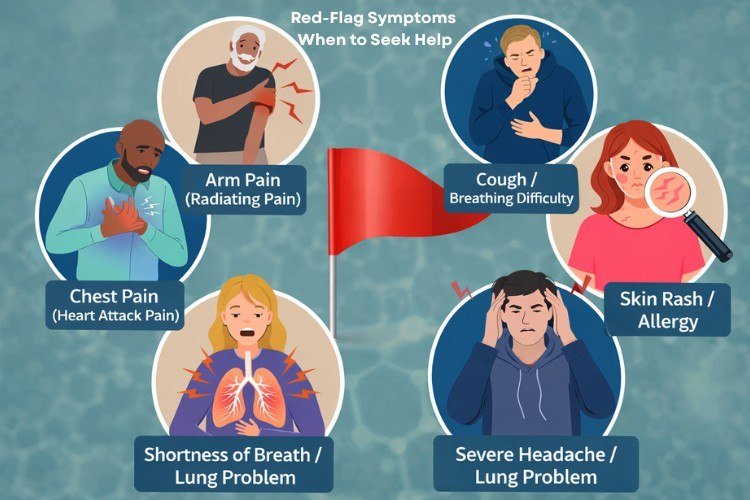
A key benefit of a daily health check is that it trains you to recognize danger signs quickly. Below are several symptoms that should be treated as immediate medical emergencies:
- Breathing problems or shortness of breath that is new, severe, or worsening
- Chest pain or discomfort lasting more than a couple of minutes, or that comes and goes
- Change in mental status: unusual behavior, confusion, difficulty waking up, or loss of consciousness
- Severe abdominal pain or pressure
- Uncontrolled bleeding or coughing/vomiting blood
- Severe or persistent vomiting or diarrhea
- Sudden injury from accidents, burns, smoke inhalation, or deep wounds
- Inability to speak, sudden difficulty walking, or loss of balance may indicate a stroke.
The CDC also warns that trouble breathing, persistent chest pain or pressure, new confusion, inability to wake or stay awake, and pale, gray, or blue‑colored skin, lips, or nail beds are emergency warning signs in infectious illnesses such as COVID‑19.
If you notice any of these during your 60‑second check—or at any other time—treat it as urgent. Call your emergency number, and do not attempt to drive yourself if you feel very unwell.
When “Watch and Wait” Is Reasonable
Not every symptom and issue needs emergency medical care. WHO says on self-care that individuals can often safely manage minor symptoms at home, as long as they have access to accurate information and knowledge of when to get medical help.
It is often reasonable to monitor at home when:
- Symptoms are mild (for example, a slight headache or a mild sore throat).
- You have no major red‑flag signs like severe pain, breathing trouble, chest discomfort, confusion, or uncontrolled bleeding.
- The symptom is not rapidly getting worse from hour to hour.
- You can eat, drink, and move around more or less normally.
Even in these situations, your daily 60‑second check is useful. You can ask yourself, “Is this symptom the same, better, or worse than yesterday?” and decide whether it is time to call a clinician for non‑urgent advice or an appointment.
How This Simple Daily Routine Protects Your Health for Years
Noncommunicable diseases (NCDs) are a significant global problem. In 2021, NCDs caused approximately 43 million deaths, or nearly 75% of all non-pandemic deaths, according to the WHO.
Cardiovascular disease, cancers, chronic respiratory diseases, and diabetes were the most common NCDs. Some of the most important behavioral risk factors are smoking, not getting enough exercise, drinking too much alcohol, eating unhealthy foods, and being exposed to air pollution.
Heart disease and stroke are major causes of death globally. In the US, heart disease accounts for about one in four deaths, and stroke is a leading cause of death and disability. Almost half of all adults in the US, about 127.9 million people over the age of 20, are living with some type of heart problem, like high blood pressure, stroke, or heart failure.
According to the World Health Organization (WHO), exercising regularly, eating a healthy diet, not smoking, and drinking less alcohol are essential for lowering health risks. In fact, increasing physical activity alone has the potential to save millions of lives every year.
Your 60‑second health check routine connects directly to these big-picture issues by helping you:
- Notice early signs of problems related to heart, lung, or metabolic health (like breathlessness, chest tightness, or swelling).
- Stay more aware of your energy, mood, and stress levels, which are related to both mental health and chronic disease risk.
- Notice small changes such as increasing resting heart rate or breathing problems, which could be signs of new health issues.
While early attention does not guarantee disease prevention, it increases the likelihood of identifying and treating problems before they cause major damage.
Final Thoughts
This 60‑second daily health check routine is simple: pause once a day to notice your breathing, chest, pain levels, energy, mood, skin, swelling, and maybe your pulse, then decide whether you need to take any actions or not. This small daily routine is in line with WHO’s broader vision of self-care—helping individuals promote health, prevent disease, and cope with illness alongside, not instead of, professional care.
In a world where chronic diseases cause tens of millions of deaths each year and many people struggle to have timely health care, early awareness and quick responses to warning signs can be very helpful. When combined with proven self-care behaviors like regular physical exercise, healthier eating, and avoiding harmful substances like alcohol and tobacco, this 60‑second daily health check routine becomes a realistic way to take an active role in protecting your health for the long term.
Frequently Asked Questions
How do I know if something I notice is serious enough to call a doctor?
Trust your gut feeling. If something really feels off, like chest pain that won’t stop, difficulty in breathing without doing anything, or sudden weakness on one side of your body, don’t wait; call for immediate medical help. And if signs are not severe, like a normal headache or low energy, monitor it for a couple of days, and if there is still no improvement, consult your doctor. It’s better to get checked and sit confused.
Is it possible for me to learn my own normal pulse or breathing rate at home?
It’s surprisingly simple. Just spend a week regularly checking your pulse, following the steps in the blog, and jotting down the numbers in your phone. Before you know it, you’ll discover your normal resting pulse—maybe it’s 70 beats a minute or perhaps 14 breaths.
What if I’m super busy—will I actually stick with this 60-second thing?
Life gets hectic for all of us, but this quick 60-second health check is super simple to fit in. Just do it when you wake up or right before you go to sleep. There’s nothing complicated about it, and hey, if you skip a day, no issue—start back tomorrow.
Can kids or older adults do this health check too?
Yes, anyone can do this 60-second health check routine. You have to adjust it according to individuals. The process is the same: take some of your time, notice changes, and get medical care if needed.
Why do this if I can use apps or wearables to track my health?
Apps and gadgets deliver useful information. But this habit helps you become more conscious of your body. It helps you pay attention to your real feelings, not just what a screen says. The best way to use them is combined.
I now use home remedies like turmeric tea and ginger every day. These simple, plant-based solutions help my body heal itself. Nature gives us all we need to stay healthy, without complicated formulas.