

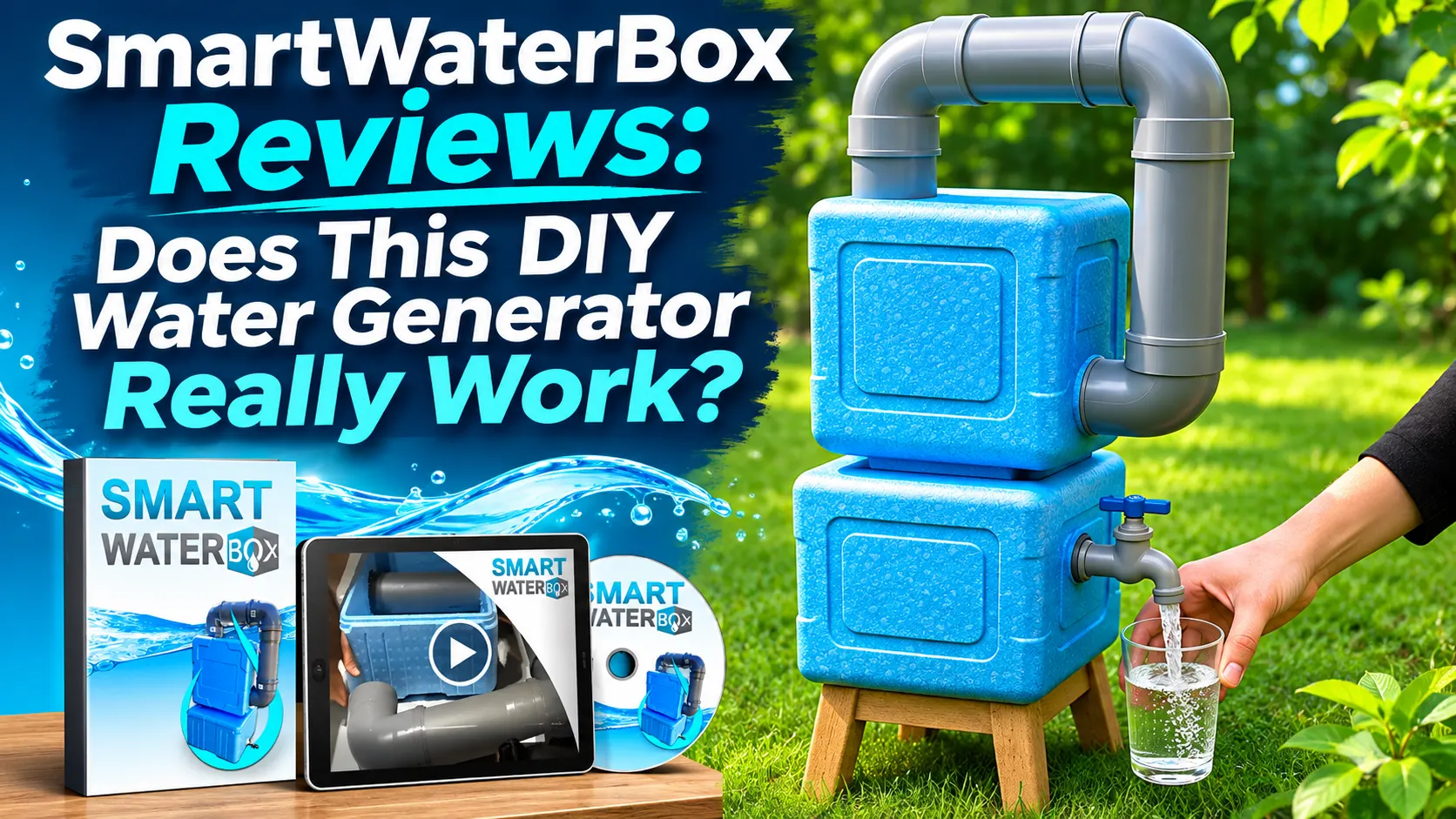
Clean drinking water is an essential part of everyday life, but getting reliable water can become challenging during emergencies, while living off-grid, or in areas with limited access to municipal supplies. This has encouraged interest in alternative water technologies, including atmospheric water generation, which captures moisture from the air and converts it into liquid water.
SmartWaterBox is marketed as a DIY water-generation solution for people interested in off-grid living, emergency preparedness, and greater water independence. Its promotional material describes a system that uses atmospheric moisture, condensation, and water-purification methods to produce water for household use.
But does SmartWaterBox actually work as advertised? Can it produce enough water for daily drinking, and is the resulting water safe? Is the advertised $39.69 offer for a complete physical machine or a set of instructions for building one?
The aim is to help US consumers understand what is established, what remains unverified, and what they should check before purchasing.
Quick Product Glance
| Product Detail | Information |
|---|---|
| Product Name | SmartWaterBox |
| Product Category | DIY water-generation solution |
| Intended Audience | Homeowners, off-grid enthusiasts, emergency-preparedness users, and DIY hobbyists |
| Main Technology Described | Atmospheric Water Generation (AWG) |
| General Concept | Collect moisture from air and convert it into water |
| Advertised Features | Condensation, filtration, UV treatment, possible solar integration, and water storage |
| Product Format | The supplied information describes a DIY system, but the exact deliverable should be confirmed before purchase |
| Advertised Regular Price | $149 |
| Advertised Promotional Price | $39.69 |
| Claimed Setup Cost | Promotional copy also states that a DIY setup may cost less than $110 in parts; this is not independently verified |
| Advertised Refund Policy | 60-day money-back guarantee |
| Advertised Support Email | support@smartwaterbox.com |
| Daily Water Output | No independently verified SmartWaterBox-specific output data supplied |
| Drinking-Water Safety | Not independently verified for this specific product |
| Official Product Information | Smart Water Box website |
| Purchase Link | View the SmartWaterBox offer |
What Is SmartWaterBox?
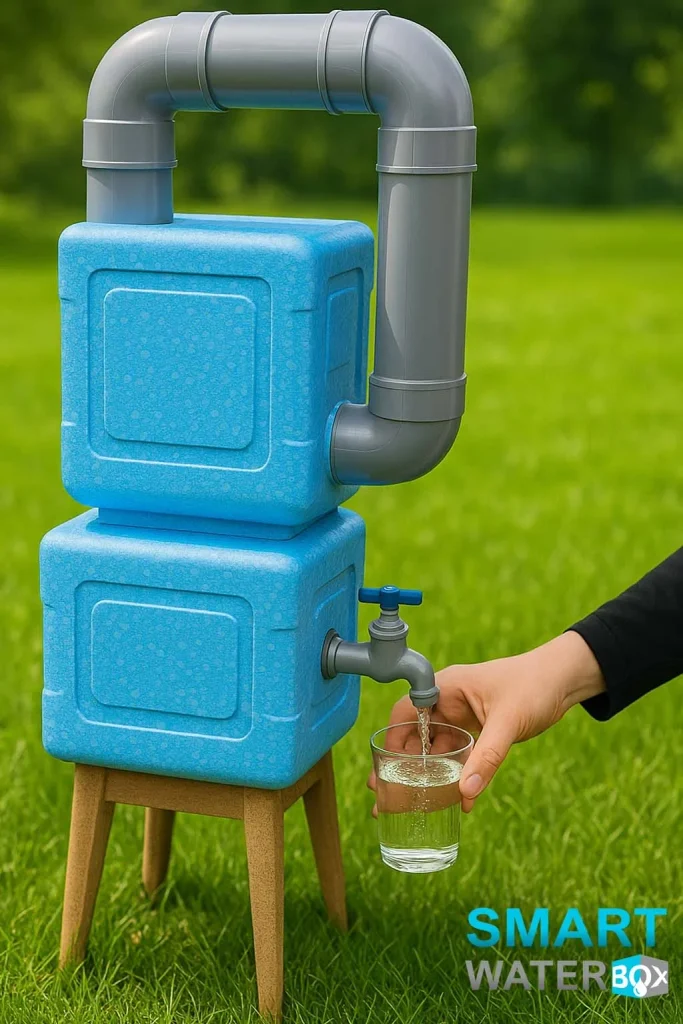
SmartWaterBox is promoted as a solution for generating water from moisture in the surrounding air. The supplied product description presents it as a compact system designed for people who want an alternative to conventional water supplies.
The marketing focuses on several potential uses, including remote homes, cabins, farms, emergency preparation, and sustainable living. It also describes filtration and disinfection features intended to improve the quality of the collected water.
However, there is an important distinction to understand before purchasing.
The supplied product information does not clearly establish whether the offer includes a fully assembled physical water generator, a kit of physical components, or digital instructions for building a DIY system. Product descriptions for similarly named Smart Water Box offers describe the product as a guide for constructing an atmospheric water generator. Buyers should therefore verify the exact deliverable on the checkout page rather than assuming that a complete machine is included.
This distinction matters because a guide, a parts list, a DIY kit, and a ready-to-use water generator have very different costs, capabilities, and maintenance requirements.
SmartWaterBox Visit The Latest Offer
What Is Atmospheric Water Generation?
Atmospheric Water Generation, or AWG, is a real technology that captures water vapor from the atmosphere.
One approach uses cooling. Air is drawn over a sufficiently cold surface, and when the surface temperature falls below the air’s dew point, moisture condenses into liquid droplets. The collected water can then undergo appropriate treatment and storage.
Another approach uses moisture-absorbing materials that capture water vapor and release it through a separate process.
Both approaches are subjects of scientific and engineering research. The US Department of Energy describes atmospheric water generation as a method of extracting water vapor directly from air through processes such as condensation and moisture capture.
Read the US Department of Energy’s guide to alternative water sources for background information.
The existence of this technology does not automatically prove that every DIY product can produce safe drinking water efficiently. Results depend on the design, local weather, energy supply, collection surfaces, treatment process, and maintenance.
How Does SmartWaterBox Work?
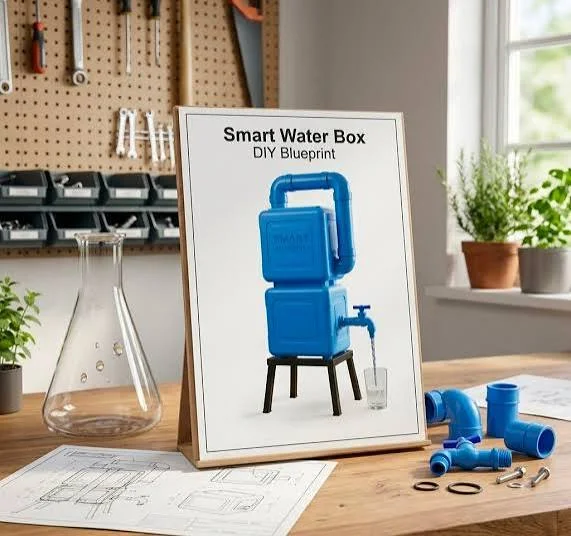
According to the supplied promotional description, SmartWaterBox follows a process involving air intake, moisture collection, purification, and water storage. The following explanation separates the general science from features that have not been independently verified for this particular offer.
Air Intake and Moisture Collection
A conventional active atmospheric water generator draws air into a system using a fan or similar mechanism. The amount of moisture available depends on the air’s temperature and relative humidity.
Warm, humid air generally contains more water vapor than cool, dry air. A system operating in a humid Florida summer may therefore behave differently from one operating in a dry Arizona winter.
The seller describes SmartWaterBox as suitable for a range of climates. However, no independent performance measurements were supplied to show how much water this specific product collects under different conditions.
Condensation
In a condensation-based system, air passes over a cold surface. When the air reaches its dew point, water vapor condenses into liquid droplets.
This is a genuine physical process. The challenge is making it practical: cooling surfaces, moving air, collecting water, and managing heat all require an appropriate design.
If the product is a DIY guide, its real performance will depend on the components used, their specifications, and how accurately the instructions are followed.
Water Filtration and Disinfection
The supplied marketing material mentions several possible treatment stages:
- Pre-filtration to capture airborne particles.
- Activated carbon to reduce certain odors and contaminants.
- Ultraviolet (UV) treatment to inactivate susceptible microorganisms.
- Optional mineral enhancement.
- Storage in a collection tank.
These are recognized categories of water-treatment technology, but the exact configuration in SmartWaterBox has not been independently verified.
A filter’s effectiveness depends on its design, certification, flow rate, and the contaminants it is intended to remove. UV disinfection also depends on factors such as water clarity, exposure, and correct operation. Neither activated carbon nor UV treatment should be assumed to remove every possible contaminant.
The seller’s description alone is not proof that the finished system meets drinking-water standards.
Water Storage
Collected water must be stored in a clean, suitable container. Poorly maintained reservoirs, tubing, or collection surfaces can introduce contamination after treatment.
Regular cleaning, appropriate materials, and maintenance instructions are important for any system intended to supply drinking water.
Solar Power and Off-Grid Operation
The promotional material refers to solar operation and off-grid use. Solar power can support some atmospheric water-generation systems, but the required panel capacity, battery storage, power consumption, and daily water production must be established for the specific design.
A solar-powered system is not necessarily energy-independent at all times. Cloud cover, nighttime operation, battery capacity, and local conditions can affect output.
No verified SmartWaterBox-specific energy requirements or solar specifications were supplied for this review.
The Science Behind SmartWaterBox
The underlying concept of collecting water from atmospheric moisture is scientifically established. The more important question is whether a particular device can produce enough water at an acceptable cost and with verified drinking-water quality.
Humidity Has a Major Effect on Water Output
Atmospheric water generators do not produce the same amount of water in every climate.
A 2022 study published in Case Studies in Chemical and Environmental Engineering examined the performance of an atmospheric water generator under different temperature and humidity conditions. The researchers reported substantial changes in water production and energy consumption across the year, including days when no water was generated.
The study demonstrates why environmental conditions must be considered when evaluating AWG systems.
Read the study: Performance analysis of atmospheric water generator under hot and humid climate conditions.
The study investigated a particular generator, not SmartWaterBox. Its results should not be used as a prediction of SmartWaterBox’s output.
Energy Consumption Matters
Cooling air to extract moisture requires energy. Fans, pumps, treatment components, and control systems can also consume power.
A device that produces a small quantity of water may be useful in a particular situation but expensive to operate if it requires substantial electricity per gallon.
A recent review in Nature Reviews Clean Technology discusses the energy challenges facing atmospheric water-harvesting technologies and the ongoing work to improve their efficiency.
Read: Breaking the thermal limit of atmospheric water harvesting technologies.
This research supports the general conclusion that water harvesting from air is a legitimate area of technology development. It does not establish that SmartWaterBox achieves a particular output, energy efficiency, or cost saving.
SmartWaterBox Visit The Latest Offer
Is the SmartWaterBox Science Proven?
The general science behind atmospheric water generation is real. However, the following SmartWaterBox-specific claims remain unverified based on the supplied information:
- Its actual daily water production.
- Its electricity consumption per gallon.
- Its performance at low humidity.
- Its ability to run entirely on solar power.
- Its water-treatment effectiveness.
- Its suitability for continuous household drinking-water use.
- Its claimed savings compared with bottled water or other water sources.
For a meaningful evaluation, the seller would need to provide a clear product specification, operating conditions, independent performance results, and relevant water-quality testing.
SmartWaterBox Features and Specifications
The promotional description mentions a number of features. Because no independently verified technical specification sheet was supplied, the table below distinguishes between advertised features and confirmed performance.
| Feature | Seller’s Description | What Buyers Should Verify |
|---|---|---|
| Atmospheric water collection | Captures humidity from air | The actual collection method and tested output |
| Condensation system | Converts vapor into liquid water | Cooling method, power requirements, and operating conditions |
| Pre-filtration | Removes dust and particles | Filter type, replacement schedule, and performance data |
| Activated carbon | Reduces certain odors and contaminants | Media specifications and contaminant-removal claims |
| UV treatment | Intended to inactivate microorganisms | UV specifications, exposure conditions, and testing |
| Mineral enhancement | May add minerals to water | Whether it is included and what minerals are added |
| Water storage | Stores collected water | Reservoir capacity, materials, and cleaning requirements |
| Smart sensors | Advertised monitoring of humidity and output | Whether sensors are included in the purchased product |
| Mobile connectivity | Mentioned in promotional descriptions | App availability, compatibility, and included hardware |
| Solar compatibility | Marketed for off-grid use | Required panels, batteries, controller, and expected runtime |
| Modular construction | Described as adjustable and upgradeable | Exact parts, compatibility, and replacement costs |
| Daily water output | Some promotional text refers to high output | Independent testing for the actual product and climate |
These features should not all be assumed to be included in the advertised purchase. Some may describe a general design concept, a possible configuration, or a product version that differs from the offer being sold.
SmartWaterBox Benefits: What Could Be Useful?
SmartWaterBox is marketed around convenience, independence, and sustainable water access. Some of these advantages are plausible for appropriately designed atmospheric water generators, but the benefits depend on the actual system.
Potential Alternative Water Source
Atmospheric water generation can provide an additional source of water in suitable conditions. This may be useful where conventional supplies are unreliable or where a remote property has limited infrastructure.
However, the output of SmartWaterBox has not been independently measured in the information supplied. It should not be treated as a guaranteed household water supply.
Interest for Off-Grid Living
People living in cabins, rural homes, or other remote settings may be interested in reducing dependence on water deliveries.
A functioning AWG system could potentially complement other water sources. Yet off-grid use requires careful planning for power, storage, maintenance, and changing weather conditions.
If the advertised product is a DIY guide, buyers must also account for the time, tools, components, and technical work required to build the system.
Possible Reduction in Bottled-Water Use
If a properly designed generator consistently produces safe water, it could reduce the need to buy some bottled water.
Whether this produces financial or environmental savings depends on the system’s purchase price, component costs, energy consumption, water output, and maintenance. No independently verified SmartWaterBox cost analysis was provided.
Flexible DIY Learning
A DIY water-generation guide may appeal to people who enjoy learning about condensation, air moisture, filtration, and off-grid engineering.
For this use, the quality of the instructions, completeness of the parts list, clarity of the diagrams, and accuracy of the safety guidance matter more than marketing claims about unlimited water.
Emergency Preparedness
An alternative water source may be useful during some emergencies, but atmospheric water generators depend on suitable environmental conditions and, in many designs, electricity.
During an emergency, water production could be affected by low humidity, power loss, equipment failure, or limited access to replacement parts.
The product should not be the sole emergency water plan unless its actual capacity, power requirements, and reliability have been demonstrated under the conditions in which it will be used.
Potential Long-Term Cost Considerations
The seller presents SmartWaterBox as an affordable option compared with more expensive water systems. The advertised price is relatively low, but the total cost of obtaining usable water may include additional hardware, filters, electrical components, storage, testing, and ongoing energy use.
Without a complete bill of materials and verified performance figures, it is not possible to determine whether the system will save money over time.
How to Use SmartWaterBox
The exact setup procedure depends on whether the purchase includes a physical kit, a finished machine, or digital instructions. The following is a general checklist for evaluating a DIY atmospheric water-generation system, not a substitute for the product’s actual instructions.
Review the Complete Package
Before purchasing, determine exactly what will be delivered. Confirm whether the offer includes:
- A physical machine or only a digital guide.
- A complete parts kit or a list of parts to buy separately.
- Filtration and disinfection components.
- A storage container or reservoir.
- Solar panels, batteries, or power equipment.
- Assembly instructions and technical support.
Do not assume that every feature described in the marketing material is part of the advertised price.
Confirm the Required Components
If the offer is a DIY guide, check the materials list and estimate the cost of all necessary components before beginning the project.
Pay attention to the quality and suitability of parts that contact water. Use materials intended for the application and follow the manufacturer’s instructions for any electrical equipment.
Assemble the System Carefully
Follow the actual product instructions and relevant safety guidance. Do not improvise electrical connections, UV enclosures, pressure-bearing parts, or other components that could create safety risks.
If you are unfamiliar with electrical systems, seek qualified assistance where necessary.
Maintain and Inspect the Equipment
A water-generation system requires regular inspection. Depending on its design, maintenance may include cleaning the air intake, replacing filters, sanitizing the reservoir, inspecting tubing, and checking the treatment system.
The exact schedule must come from the equipment specifications rather than a general marketing description.
Test the Water Before Drinking
Do not assume that water is safe to drink simply because it has condensed from air or passed through a filter.
Before using a DIY system for drinking water, obtain appropriate water-quality testing and follow the recommendations of a qualified water professional or local public-health authority. Testing requirements depend on the design, materials, location, and potential contaminants.
Until safety is established, use a known safe drinking-water source.
Is Water Produced by SmartWaterBox Safe to Drink?
This is one of the most important questions for anyone considering the product.
The supplied promotional material describes the water as clean, safe, and purified. However, no independent laboratory report or product-specific drinking-water certification was supplied to confirm those claims.
Atmospheric water is not automatically safe to drink. Air can contain particles and airborne contaminants, while water can also come into contact with collection surfaces, tubing, filters, and storage containers.
A treatment system must be designed and maintained appropriately for the contaminants that may be present.
SmartWaterBox Visit The Latest Offer
Why Filtration Claims Need Verification
Different treatment technologies address different problems:
- Particle filters can capture certain suspended particles.
- Activated carbon can reduce particular contaminants, depending on the media and operating conditions.
- UV treatment can inactivate susceptible microorganisms when the system is properly designed and operated.
- Mineral addition may alter mineral content or taste, but it does not independently prove microbiological safety.
A system may need more than one treatment stage, and the appropriate combination depends on the water source and risks.
The US Environmental Protection Agency provides information about drinking-water treatment and water quality through its Drinking Water resources.
What Should Buyers Ask For?
Before using SmartWaterBox water for drinking or cooking, ask for:
- Independent laboratory testing of the produced water.
- Information about the materials that contact the water.
- Details of the filtration and disinfection components.
- Maintenance and sanitization instructions.
- Testing that reflects the finished system under representative operating conditions.
No verified test results specific to SmartWaterBox were supplied for this review. Therefore, its drinking-water safety cannot be confirmed from the promotional description alone.
SmartWaterBox Customer Reviews: What Do Buyers Say?
The supplied marketing material includes three testimonials attributed to customers in the United States. They are reproduced here as seller-provided statements, not as independently verified reviews.
| Name and Location | Supplied Feedback | Verification Status |
|---|---|---|
| David P., Texas | Says the setup was easy and customer service was helpful, but would like more humidity data | Not independently verified |
| Michael S., Florida | Reports favorable water taste and mentions a solar-heating guide | Not independently verified |
| Robert M., Arizona | Says the instructions were simple and notes that output was lower in dry winter conditions | Not independently verified |
These testimonials describe positive experiences, but they do not provide enough technical information to evaluate the system’s performance.
For example, the supplied reviews do not include independently measured daily water output, relative humidity, energy consumption, laboratory water-quality results, or a detailed parts list.
The testimonial attributed to Robert M. mentions lower production in dry winter conditions. That statement is consistent with the general principle that atmospheric water generation depends on humidity and temperature, but the individual account does not establish SmartWaterBox’s actual performance.
Are SmartWaterBox Reviews Reliable?
The testimonials may help illustrate how the product is promoted, but their identities, purchase histories, and experiences have not been independently verified here.
Before relying on customer feedback, look for reviews hosted by independent platforms, clear descriptions of the product actually purchased, and technical evidence that supports claims about water output and quality.
Star ratings alone cannot establish that a water generator produces safe drinking water or provides a reliable supply.
SmartWaterBox Price and Special Offer
The supplied promotional information lists a regular price of $149 and a limited-time offer of $39.69.
These figures should be treated as advertised prices, not independently confirmed final checkout totals. The complete contents of the offer and any additional costs were not provided.
| Pricing Detail | Advertised Information |
|---|---|
| Regular Price | $149 |
| Promotional Price | $39.69 |
| Advertised Discount | Approximately 73% off the stated regular price |
| Additional DIY Setup Estimate | The seller’s material refers to a possible setup cost below $110 for parts; this is unverified |
| Shipping | Not supplied |
| Taxes | Not supplied |
| Additional Hardware | Depends on the actual deliverable and system configuration |
| Refund Period | Advertised as 60 days |
The stated discount is calculated from the supplied $149 and $39.69 prices. It does not establish that the regular price is a typical market price or that the promotion will remain available.
Is $39.69 the Cost of a Complete Water Generator?
That is not established by the supplied information.
The marketing material describes SmartWaterBox as a DIY solution, and a similarly named product website describes a guide for building an atmospheric water generator. This raises an important purchasing question: does the offer provide instructions and plans, or does it include the physical equipment?
Confirm this before paying. If the offer is primarily a guide, you may need to purchase the components separately.
Is SmartWaterBox Good Value for Money?
Value depends on what the buyer receives.
For someone seeking a DIY learning project, a clear and complete guide may have value if the instructions are accurate and the required components are reasonably priced.
For someone seeking a ready-to-use drinking-water machine, a guide alone may not meet their needs. They would need to account for parts, assembly, maintenance, energy use, and water-quality testing.
The available information does not support a reliable calculation of the cost per gallon produced by SmartWaterBox.
SmartWaterBox Refund Policy
The supplied product information advertises a 60-day money-back guarantee. It states that customers who are dissatisfied within 60 days of purchase can contact support for a refund.
The supplied contact email is support@smartwaterbox.com.
However, the full written terms were not independently verified. Before placing an order, confirm:
- When the 60-day period begins.
- Whether the policy applies to the exact offer being purchased.
- Whether digital guides, downloads, or opened products are eligible.
- Whether physical components must be returned.
- Whether shipping and handling charges are refundable.
- Whether customers need an order number or other documentation.
- How refunds are requested and processed.
Keep your order confirmation and a copy of the terms shown at checkout. A refund guarantee can reduce purchasing risk, but it does not prove that the product works as advertised.
SmartWaterBox Pros and Cons
Pros
- Interesting water-generation concept: Atmospheric water generation is an established field of engineering and scientific research.
- Potential DIY learning value: The offer may interest people who want to explore off-grid engineering and water collection.
- Possible alternative water source: A properly designed and tested AWG system can provide water under suitable environmental conditions.
- No conventional water line required for atmospheric collection: Systems of this type can operate without a direct connection to municipal water pipes.
- Advertised entry price: The supplied promotional price is $39.69, although the exact deliverable must be confirmed.
- Advertised refund policy: The seller promotes a 60-day money-back guarantee, subject to the applicable terms.
Cons
- Exact product format is unclear: The supplied information does not establish whether the purchase includes a machine, physical kit, or digital guide.
- No verified output figures: SmartWaterBox-specific daily production data was not provided.
- Water safety is unverified: No independent laboratory results were supplied.
- Energy requirements are unknown: Power consumption and solar-system specifications were not established.
- Additional costs may apply: A DIY setup may require separately purchased components, filters, storage, and maintenance items.
- Testimonials are unverified: The supplied customer statements do not establish typical results.
- Climate affects performance: Atmospheric water generation generally depends on temperature and humidity.
- Long-term savings are unproven: No verified cost-per-gallon comparison was provided.
Smartwaterbox Reviews: Does This DIY Water Generator Really Work ?
Is SmartWaterBox a Scam or Legitimate DIY Water Solution?
The information supplied is not enough to responsibly label SmartWaterBox a scam. The general concept of atmospheric water generation is scientifically legitimate. However, the validity of the underlying science does not prove that this specific product delivers every advertised feature or benefit.
The main issue is the difference between a real technology and a specific commercial offer.
The supplied description makes broad claims about clean drinking water, filtration, solar compatibility, smart monitoring, and off-grid reliability. Yet independent specifications, water-quality testing, energy measurements, and verified production figures were not provided.
The exact deliverable also needs clarification. A DIY guide is not equivalent to a complete physical generator, and the advertised price may not cover all components needed for a functioning system.
Before buying, verify the following:
- What exactly will be delivered after payment.
- Whether a complete parts list and assembly instructions are included.
- Whether the claimed filtration and UV features are actually part of the offered design.
- What daily output has been measured under stated temperature and humidity conditions.
- What energy source and power capacity are required.
- Whether independent water-quality testing is available.
- What the refund policy covers and how it works.
Our assessment: SmartWaterBox is based on a plausible general technology, but its specific performance, water safety, and total cost remain unverified from the information available for this review. Buyers should not assume that the offer guarantees a continuous supply of safe drinking water.
Frequently Asked Questions About SmartWaterBox
What is SmartWaterBox?
SmartWaterBox is marketed as a DIY water-generation solution based on collecting moisture from the air. The supplied description refers to condensation, filtration, and possible solar integration. The exact deliverable should be confirmed because the offer may be a guide rather than a complete physical machine.
Does SmartWaterBox really generate water from air?
Atmospheric water generation is scientifically established. Systems can capture moisture from air through condensation or other moisture-harvesting methods. However, SmartWaterBox-specific output has not been independently verified in the information supplied.
How much water can SmartWaterBox produce per day?
No independently verified daily output figure for SmartWaterBox was supplied. Production depends on the system’s design, local temperature, humidity, energy supply, and operating conditions. Do not rely on generic AWG figures as a prediction of this product’s output.
Is SmartWaterBox suitable for dry climates?
Atmospheric water generators generally produce less water when the air contains less moisture. The product’s actual performance in a dry climate is unknown because no independent SmartWaterBox-specific test data was supplied.
Is the water safe to drink?
The safety of water produced by SmartWaterBox has not been independently confirmed here. Water should not be assumed safe based only on condensation or advertised filtration. Appropriate testing and a properly designed treatment and storage process are important before drinking it.
Does SmartWaterBox run on solar power?
The supplied promotional description mentions solar compatibility, but the actual solar hardware, power requirements, and operating capacity were not verified. Confirm whether solar panels and batteries are included or must be purchased separately.
Is SmartWaterBox a physical machine or a digital guide?
The supplied information does not establish the exact deliverable. Some product descriptions for similarly named offers describe a DIY guide. Confirm whether your purchase includes a physical machine, a parts kit, digital instructions, or a combination of these.
How much does SmartWaterBox cost?
The supplied offer lists a regular price of $149 and a promotional price of $39.69. Shipping, taxes, additional parts, and the exact contents of the offer were not confirmed. Check the checkout page for the final total.
Does SmartWaterBox come with a money-back guarantee?
The seller advertises a 60-day money-back guarantee. Review the current written policy to confirm the start date, eligibility, return requirements, and refund procedure.
Are the customer reviews independently verified?
The three testimonials supplied for this review have not been independently verified. They should be treated as promotional statements rather than confirmed evidence of typical customer results.
Can SmartWaterBox replace a home’s regular water supply?
That cannot be established without verified information about daily output, water quality, reliability, storage, and energy use. Do not depend on it as your only drinking-water source until the complete system has been tested and shown to meet your needs.
Where can I find SmartWaterBox?
You can review the supplied SmartWaterBox offer. Before purchasing, confirm the product format, contents, total cost, technical specifications, and refund terms.
Scientific References and Further Reading
The following sources provide independent background on atmospheric water generation, energy requirements, and drinking-water safety. They are not endorsements of SmartWaterBox and do not prove that this specific product meets drinking-water standards.
- U.S. Department of Energy. Best Management Practice #14: Alternative Water Sources. Explains atmospheric water generation, condensation, and factors that influence water production.
- F. et al. (2022). Performance analysis of atmospheric water generator under hot and humid climate conditions: Drinkable water production and system energy consumption. Examines how weather conditions influence water output and energy use in a particular AWG system.
- Nature Reviews Clean Technology (2026). Breaking the thermal limit of atmospheric water harvesting technologies. Reviews energy-related challenges and emerging approaches to atmospheric water harvesting.
- U.S. Environmental Protection Agency. Ground Water and Drinking Water. Provides government information on drinking-water quality and related safety topics.
- Royal Society of Chemistry (2020). Energy performance and climate dependency of technologies for fresh water production from atmospheric water vapour. Discusses energy performance and climate dependence across atmospheric water-production technologies.
These sources establish relevant scientific context. They do not confirm SmartWaterBox’s advertised specifications, water output, or safety.
Final Verdict: Is SmartWaterBox Worth Buying in 2026?
SmartWaterBox may appeal to DIY enthusiasts, off-grid homeowners, and people interested in alternative approaches to water collection. Atmospheric water generation is a genuine technology, and properly engineered systems can collect moisture from air under suitable conditions.
However, the most important buying questions remain unresolved. The exact product format is unclear, no independent SmartWaterBox-specific water-production figures were supplied, and the advertised water-purification claims have not been supported by independent test results in the information reviewed.
The advertised $39.69 offer may appear affordable, but buyers should determine whether it includes a physical generator or only instructions, and whether additional components are required. Energy use, local humidity, maintenance, and water-quality testing can all affect the practical value of a DIY system.
Our conclusion: SmartWaterBox should be approached as an unverified commercial DIY water-generation offer based on a scientifically plausible concept—not as a proven, ready-to-use source of safe drinking water. Confirm the deliverable, specifications, independent testing, full setup costs, and refund terms before purchasing.
For emergency preparedness, maintain a dependable supply of known safe drinking water rather than relying on an untested DIY system as your only source.
To review the advertised offer and its current terms, visit the SmartWaterBox purchase page.
Affiliate Disclosure
This article contains an affiliate link. If you purchase SmartWaterBox through the link provided, the publisher may receive a commission at no additional cost to you. An affiliate relationship does not establish product quality, effectiveness, water output, or safety. The review distinguishes seller-provided claims from independent scientific information wherever possible.
SmartWaterBox Visit The Latest Offer
Disclaimer
This article is for general informational and educational purposes only. It is not an engineering certification, water-quality assessment, or guarantee of product performance. Atmospheric water generation depends on environmental conditions, equipment design, energy availability, and maintenance. Water intended for drinking should be appropriately treated and tested. Follow applicable electrical and equipment safety requirements, and consult qualified water-treatment professionals when necessary. Do not rely on an unverified DIY system as your sole source of safe drinking water.


Natural home remedies, skincare secrets, dental & eye health tips, and real product reviews to help you stay healthy the natural way.