

PressureCalmX is a capsule-form herbal supplement marketed to support blood pressure that is already within a normal range. It is not a drug, it is not FDA-approved to treat anything, and the brand’s own materials say it is not meant for people with diagnosed hypertension. Its botanicals have some research behind them individually, but I could not find published clinical trials on the finished formula. It may suit health-conscious adults who have already talked to their doctor. It is not a substitute for medication, a home blood pressure cuff, or a checkup.
If you landed here, there’s a decent chance you’ve just seen an ad, or a number on a blood pressure cuff that made your stomach drop. You’re not alone. The CDC reports that close to half of U.S. adults have high blood pressure by current guideline definitions, and many don’t have it under control. The brand behind this product says over 70 million American adults over 45 quietly worry about their numbers: the headaches, the racing heart, the dread at every doctor’s visit. That figure comes from the company’s marketing, not an independent source, but the worry itself is very real.
So I sat down with the product’s own claims, the ingredient list, the available research, and consumer-health guidance from trusted U.S. institutions, and wrote this PressureCalmX review the way I’d explain it to a family member: plainly, without hype, and with a clear sense of what we know and what we don’t.
What Is PressureCalmX?
PressureCalmX® is sold as a daily dietary supplement in capsule form. The brand’s tagline is simple: calm your pressure, support your heart. According to its own materials, it delivers a science-backed blend of heart-healthy botanicals that supports blood pressure already within a normal range, so you can feel calm, steady, and in control again.
A few things are worth underlining right away:
- It is a dietary supplement, which in the U.S. means it is regulated under a different framework than prescription drugs. The FDA does not approve supplements for safety or effectiveness before they go on sale.
- The language is careful: “supports healthy blood pressure already within a normal range.” That is not the same as “lowers high blood pressure.” The distinction matters legally and medically.
- Third-party write-ups describe the formula as a proprietary blend of roughly eight botanicals plus B vitamins. The ingredient text provided for this article lists six botanicals, so always check the current label before buying, because formulas and packaging change.
The target buyer, based on the brand’s positioning, is an adult who wants extra cardiovascular support, has no diagnosed heart condition, and is trying to be proactive.
How I Evaluated It (My Method)
This PressureCalmX supplement review is based on four things: the brand’s published claims, the ingredient list, publicly available research on each botanical from sources like the National Institutes of Health, and what consumer-health authorities say about supplements and blood pressure. I did not run a laboratory test on the capsules, and I have no financial relationship with the brand. I also did not treat marketing-style “review” pages as proof; several of those are written to sell, and I weighed them accordingly.
PressureCalmX Ingredients: What’s Actually in the Capsule
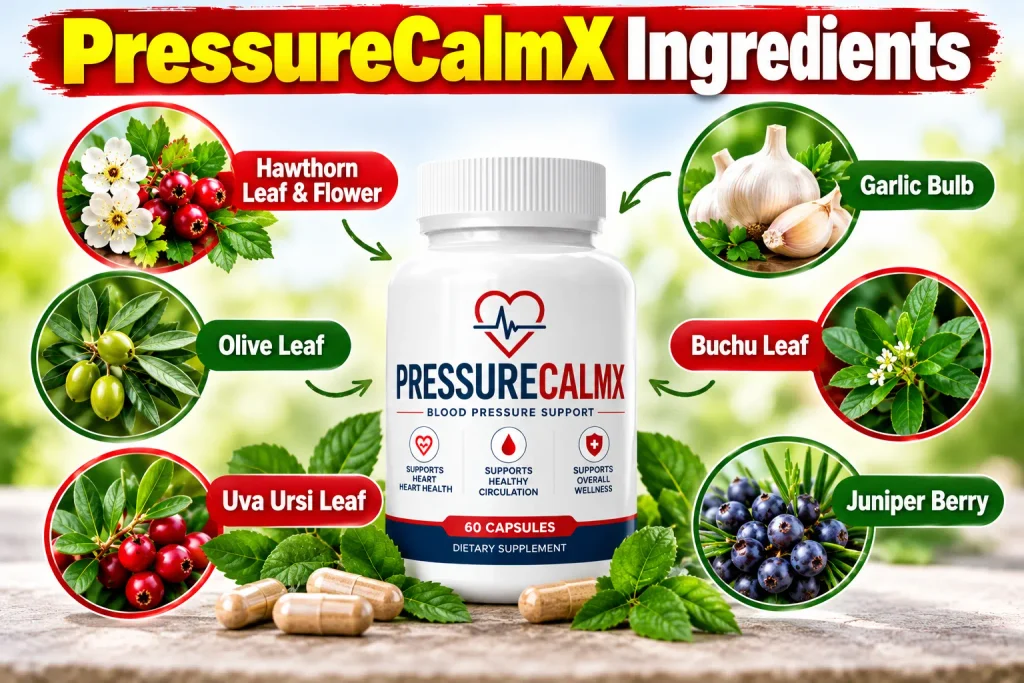
The company says each ingredient is sourced for purity and chosen for a specific role in supporting healthy blood pressure already in the normal range, healthy circulation, and overall cardiovascular wellness. Here’s a plain-English walk through each one, plus what the broader research says.
Hawthorn Leaf & Flower
Hawthorn has a long history in traditional European herbal medicine for the heart. It contains flavonoids and antioxidant compounds that may support normal blood vessel function. Some small clinical studies have looked at hawthorn for mild blood pressure changes and heart failure symptoms, but results are mixed and the NIH’s National Center for Complementary and Integrative Health (NCCIH) notes that more rigorous evidence is needed. Important flag: hawthorn can interact with heart medications such as digoxin and some blood pressure drugs.
Garlic Bulb
Garlic is probably the best-known cardiovascular botanical. It provides sulfur compounds such as allicin, which have antioxidant activity. Several meta-analyses of garlic supplementation have suggested modest blood pressure effects, mostly in people who already had elevated readings. That tells us garlic is not a magic bullet, and that the effect in someone with normal readings may be small. Garlic may also increase bleeding risk when combined with blood thinners, so surgery and anticoagulant users should be especially careful.
Olive Leaf
Olive leaf is rich in polyphenols, including oleuropein, recognized for antioxidant properties. A few small human trials have looked at olive leaf extract and blood pressure with encouraging but limited results. The studies tend to be short and use standardized extracts at specific doses, which may differ from what’s in a proprietary blend.
Buchu Leaf
Buchu has been traditionally used in South African herbal practice for urinary and fluid balance. Its role in a blood pressure formula is mostly about promoting normal fluid regulation. Human clinical data on buchu is thin.
Uva Ursi Leaf
Uva ursi (bearberry) is traditionally used for urinary tract health. It contains compounds that are generally recommended for short-term use only, and it isn’t recommended for pregnant women or people with kidney disease. Because the label may not make the dose of each botanical obvious, that’s a question worth asking a pharmacist.
Juniper Berry
Juniper berry is a traditional botanical valued for antioxidant properties and support for fluid balance. Like uva ursi, it is generally avoided in pregnancy and with certain kidney conditions.
The Big Picture on the Formula
The formula leans heavily on three themes: heart-supportive plants (hawthorn, garlic, olive leaf), and urinary or “fluid balance” plants (buchu, uva ursi, juniper). That second group is the part I’d most want a doctor to weigh in on, especially if you take a diuretic (“water pill”), because stacking fluid-shifting herbs with prescription diuretics could, in theory, contribute to dehydration or electrolyte problems.
The main limitation: individual ingredient research is not the same as proof that this specific blend, at this specific dose, works. The brand’s own site doesn’t publish a clinical trial on the finished product that I could find.
PressureCalmX Benefits: What It Claims and What Is Realistic
The stated goals are supporting blood pressure already within a normal range, promoting healthy circulation and blood flow, and supporting overall heart and cardiovascular wellness. Here’s how I’d translate that into realistic expectations.
- Supportive, not dramatic. Botanical supplements, when they help at all, tend to produce subtle effects. Anyone expecting a medication-sized drop in numbers will probably be disappointed.
- Antioxidant support. Several ingredients provide polyphenols and other antioxidants, which fit into a heart-healthy lifestyle but don’t replace one.
- A routine anchor. Honestly, one underrated benefit of any daily supplement is behavioral. Some people who start a “heart routine” also begin walking, cutting sodium, and checking their numbers. That’s a win regardless of the capsule.
- Peace of mind. The brand speaks to the emotional side, the fear at every doctor’s visit. A sense of control is valuable, but it shouldn’t replace actual measurements.
What it cannot realistically promise: treating hypertension, preventing heart attack or stroke, or replacing prescribed therapy.
PressureCalmX Does It Work? What the Evidence Says
This is the question everyone really wants answered, so let’s be direct. There are three layers of evidence.
Layer 1: Ingredient-level research. Garlic has the strongest body of evidence among the botanicals listed, with hawthorn and olive leaf having smaller, mixed bodies of research. Buchu, uva ursi, and juniper are mostly supported by traditional use rather than robust blood pressure trials.
Layer 2: Formula-level research. I could not locate a peer-reviewed, randomized controlled trial of this finished blend. That doesn’t mean it can’t work, but it means any promise of results is a prediction, not a proven outcome.
Layer 3: Real-world results. Individual experiences vary enormously, and blood pressure itself fluctuates with sleep, stress, salt, caffeine, and even the time of day. A single “good” reading after starting a capsule doesn’t prove cause and effect.
The bottom line is that the product may offer mild supportive value for some people, but there isn’t enough published evidence to say it reliably works. If someone tells you it “cures” high blood pressure, treat that as a red flag.
What Do Shoppers Say? PressureCalmX Customer Reviews and Complaints
When I scanned what’s publicly available, here’s what stood out. A large share of the web content about this product is promotional: sponsored press-release-style pages, affiliate blogs, and marketplace listings. Those pages usually repeat the brand’s claims, push buyers toward package options, and rarely include critical detail. That’s why independent PressureCalmX customer reviews on neutral platforms matter more than glossy testimonials.
Common themes in consumer feedback for supplements in this category, and what to watch for with this one:
- “I felt calmer” stories. Often linked to starting a new health routine, not necessarily the capsule alone.
- “Nothing changed” stories. Very common with herbal blends and honestly expected.
- Billing and subscription complaints. With any supplement sold through direct-response marketing, read the refund policy and auto-ship terms before you enter your card.
- Look-alike products. Search results are also crowded with similar names (for example, “Pressure X” style products) that are different products. Make sure you’re looking at the right one.
For transparency, I can’t verify individual testimonials, and I’d encourage you to treat every anonymous review, positive or negative, with healthy skepticism.
PressureCalmX Side Effects and Safety Concerns
Herbal doesn’t automatically mean harmless. Here are the PressureCalmX side effects and safety questions to run by your doctor or pharmacist.
Possible side effects (based on the individual ingredients, not on a trial of this product):
- Digestive upset, nausea, or heartburn (common with garlic)
- Garlic breath or body odor
- Dizziness or lightheadedness if blood pressure dips too low
- Increased urination from fluid-balance herbs
- Allergic reactions in people sensitive to plants in the mint, daisy, or olive families
Possible interactions:
- Blood pressure medications (additive effect could lower pressure too far)
- Digoxin and other heart drugs (hawthorn)
- Blood thinners like warfarin (garlic)
- Diuretics (fluid and electrolyte balance)
Who should skip it or ask first:
- Anyone with diagnosed hypertension, heart disease, or kidney disease
- People who are pregnant or breastfeeding
- Anyone scheduled for surgery in the next two weeks (garlic and bleeding risk)
- Anyone taking prescription cardiovascular medication
If you ever feel faint, have chest pain, or notice shortness of breath after starting any supplement, stop and seek medical care.
A Side Note on Pain in the Back When Breathing
Blood pressure content and chest or back symptoms often get tangled together online, so let’s separate them clearly.
If you’re experiencing a pain in the back when breathing, a supplement for blood pressure is not the answer, and it’s not something to guess about. Back pain when breathing can have many causes, and some are harmless while others are urgent. Pain while breathing in back muscles can come from a strained muscle or rib joint after lifting, coughing, or poor posture. Upper back pain when breathing is also commonly linked to muscle spasms between the shoulder blades, irritation of the lining around the lungs (pleurisy), or a lung infection.
Common causes of back pain when breathing include:
- Muscle strain or spasm (very common, often after exertion)
- Costochondritis or rib joint inflammation
- Pleurisy or pneumonia
- Spinal issues such as a pinched nerve or arthritis
- Acid reflux that radiates to the back
- Anxiety and shallow breathing patterns
Get emergency help immediately if your breathing-related back pain comes with sudden shortness of breath, chest pressure, pain spreading to the jaw or arm, a racing heartbeat, fainting, coughing blood, swelling or pain in one leg, or sweating and nausea. These can signal a heart attack, a blood clot in the lung (pulmonary embolism), or another emergency. Heart-related and blood-vessel-related problems don’t always look like movie scenes, and people with high blood pressure are at higher risk, which is exactly why a supplement should never delay a proper evaluation.
Case Study: A U.S. Example
Meet “Linda,” 56, Columbus, Ohio. Linda is a school administrator who gets a physical every year. Her last two readings were 128/82 and 131/84, which fall into the “elevated” to “stage 1” boundary under American Heart Association categories. Her doctor suggests lifestyle changes first and rechecks in three months. Meanwhile, she sees an ad for a heart-support supplement and wonders if it could help.
What Linda did right:
- She brought the supplement’s label to her pharmacist, who flagged the garlic and hawthorn as items to discuss given her occasional ibuprofen use.
- She bought a validated home blood pressure monitor and tracked readings morning and evening for two weeks before starting anything, so she had a baseline.
- She made lifestyle changes at the same time: a 30-minute daily walk, cutting restaurant takeout, and following a DASH-style eating pattern.
What happened: After twelve weeks, her average readings improved by a few points. Because she changed several things at once, she couldn’t say whether the capsule contributed, her walking did, or her diet did. Her doctor’s takeaway: keep the lifestyle habits, and continue monitoring.
Lesson for U.S. readers: The real value came from measuring, talking to a professional, and changing habits. If a supplement is added, it should be one piece of a bigger plan, never the plan itself.
Pros and Cons Table
| Pros | Cons |
|---|---|
| Contains well-known botanicals (garlic, hawthorn, olive leaf) with some research behind them | No published clinical trials found on the finished formula |
| Positioned for “normal range” support, with careful wording | Not intended for people with diagnosed hypertension |
| Antioxidant-rich plant ingredients | Proprietary blend may hide individual doses |
| Easy daily capsule format | Possible interactions with blood pressure, blood thinner, and heart medications |
| Brand discusses upfront that it’s a supplement, not a drug | Much online coverage is promotional rather than independent |
| May encourage a heart-healthy routine | Fluid-balance herbs (uva ursi, juniper) may not suit everyone |
| Official site available for direct purchase | Results likely modest and vary person to person |
Where to Buy: PressureCalmX Official Website and Lookalike Risks
If you decide to try it, buy only through the PressureCalmX official website, pressurecalmx.com, rather than third-party marketplace sellers or unfamiliar resellers. Supplement lookalikes, expired stock, and repackaged bottles are a real problem on large marketplaces. Before ordering, check:
- The refund and guarantee terms in writing
- Whether you’re signing up for automatic recurring shipments
- The full supplement facts panel, including each ingredient and serving size
- Customer support contact details that actually work
Prices and package options change, so confirm the current offer directly on the site instead of trusting a price quoted on a blog (including this one).
PressureCalmX Review: Is This Blood Pressure Supplement Worth It?
PressureCalmX Honest Review: My Final Verdict
Here is my PressureCalmX honest review in a nutshell.
It’s a reasonable product for the right person. If you’re a generally healthy adult with normal or borderline-normal readings, you’ve spoken to your doctor, you’re comfortable with herbal supplements, and your expectations are modest, it’s a defensible choice.
It’s the wrong product for the wrong reasons. If you have diagnosed high blood pressure, you’re on medication, or you hope to avoid your doctor by taking a capsule, skip it, or at least talk to a clinician first.
Is it worth it? Worth is personal, but I’d put it this way: the capsule is potentially a small supporting actor. Your lead roles are sleep, movement, sodium, potassium-rich foods, stress management, limiting alcohol, not smoking, and regular blood pressure checks.
My rating logic: Ingredient quality and rationale: decent. Transparency of dosing: limited. Clinical proof for the finished formula: not found. Safety if used responsibly with medical guidance: reasonable for most healthy adults. Value: depends on price and refund terms.
Smart Habits That Do More Than Any Capsule
If you take one thing from this article, let it be this list. These are backed by major U.S. health organizations:
- Measure at home. Use a validated, upper-arm cuff, sit quietly for five minutes, and record readings for a week to share with your doctor.
- Follow the DASH pattern. Lots of vegetables, fruit, whole grains, low-fat dairy, and less sodium.
- Move your body. About 150 minutes a week of moderate activity is the standard recommendation.
- Watch sodium. Many Americans consume far more than the recommended limits, largely from packaged and restaurant food.
- Prioritize sleep. Untreated sleep apnea is strongly linked to high blood pressure.
- Limit alcohol and quit tobacco.
- Take prescribed medicine as directed. Never stop a blood pressure drug without your doctor’s guidance.
Frequently Asked Questions (FAQ)
1. Is PressureCalmX FDA-approved?
No. Dietary supplements are not FDA-approved to treat, cure, or prevent disease. The FDA regulates them as food products, and manufacturers are responsible for safety and truthful labeling.
2. Can PressureCalmX replace my blood pressure medication?
No. Do not stop or reduce prescribed medication without your doctor’s approval. The brand positions the product for blood pressure already within a normal range.
3. How long does it take to see results?
There’s no published timeline for the finished formula. Herbal supplements typically take weeks, if they have any measurable effect at all. Track your numbers with a home cuff rather than relying on how you feel.
4. Is it safe to take with other medications?
Not necessarily. Hawthorn, garlic, and fluid-balance herbs have documented interaction potential. Ask your pharmacist to check your complete medication list.
5. Who should avoid it?
People who are pregnant or breastfeeding, those with kidney disease, anyone on blood thinners or heart medications, and anyone with diagnosed cardiovascular disease unless cleared by their doctor.
6. Can a supplement cause or cure pain while breathing?
A blood pressure supplement isn’t designed to treat chest or back pain. If you have ongoing pain with breathing, especially with shortness of breath or chest pressure, see a doctor promptly or call 911.
7. Is upper back pain when breathing a sign of high blood pressure?
High blood pressure usually has no symptoms. Upper back pain with breathing is more often musculoskeletal or lung-related, but because some causes are serious, it should be evaluated if it’s severe, persistent, or paired with other symptoms.
8. Does the brand offer a money-back guarantee?
Third-party pages mention a guarantee, but terms change. Verify the current policy in writing on the official site before buying.
9. Are there natural ways to support healthy blood pressure without supplements?
Yes: the DASH eating pattern, regular exercise, weight management, reduced sodium, limited alcohol, stress reduction, and good sleep all have strong evidence.
10. How do I know if I’m buying the real product?
Buy from the brand’s own site, check the supplement facts panel, and be wary of similar-sounding names, bargain marketplace listings, and unverified sellers.
Conclusion
So, is this blood pressure supplement worth it? For some health-conscious adults with normal readings and a green light from their doctor, it may be a reasonable, low-drama add-on. But the honest answer is that its promise rests on traditional use and ingredient-level research, not on a published trial of the finished product. Treat it as a possible supporting player, not the hero.
Most importantly, don’t let any marketing, mine included, replace a real blood pressure reading, a real conversation with a clinician, or a real emergency response when your body is sending a serious signal.
Medical disclaimer: This article is for informational purposes only and isn’t medical advice. It has not been evaluated by the FDA, and the product discussed is not intended to diagnose, treat, cure, or prevent any disease. Talk to a qualified healthcare provider before starting any supplement.
References and Source Sites
- Centers for Disease Control and Prevention (CDC), Hypertension facts and statistics: https://www.cdc.gov/high-blood-pressure/
- American Heart Association, Understanding blood pressure readings: https://www.heart.org
- NIH National Center for Complementary and Integrative Health (NCCIH), Hawthorn and Garlic herbal summaries: https://www.nccih.nih.gov
- NIH Office of Dietary Supplements, Dietary supplement fact sheets: https://ods.od.nih.gov
- U.S. Food and Drug Administration, Dietary supplements overview: https://www.fda.gov/food/dietary-supplements
- National Heart, Lung, and Blood Institute (NHLBI), DASH eating plan: https://www.nhlbi.nih.gov
- Mayo Clinic, Chest pain and pleurisy symptoms and causes: https://www.mayoclinic.org
- Cleveland Clinic, Back pain with breathing and when to seek care: https://my.clevelandclinic.org
- PressureCalmX official website (brand claims and product description): https://pressurecalmx.com
- Third-party press-release style product pages reviewed for context (treated as promotional): Newswire and Webull News listings on PressureCalmX

Natural home remedies, skincare secrets, dental & eye health tips, and real product reviews to help you stay healthy the natural way.