


You’ve seen it everywhere — someone on social media pressing a frozen spoon under their eyes and filming their “before and after” in under a minute. The comment section explodes: “Does this actually work?!” I decided to stop scrolling and start testing. I tried the most popular viral puffy eyes hacks, dug into the science behind why they work (or don’t), and put together the most comprehensive breakdown you’ll find anywhere — covering real causes, proven home remedy, the truth about screen time and digital eye strain, what OTC products are actually worth buying, and when it’s time to stop Googling and call a doctor.
If your puffy eyes have become a daily ritual you’d rather break, this guide is for you.
What’s Actually Happening When Your Eyes Puff Up?
Before we get to the hacks, let’s talk about the “why.” Puffy eyes — clinically called periorbital edema — happen when excess fluid builds up in the thin, delicate tissue surrounding your eye sockets. And I mean thin. The skin under your eyes is roughly 0.5mm thick — about ten times thinner than the skin on your cheeks — which is why even a tiny amount of fluid retention shows up immediately in the mirror.
When the lymphatic and circulatory systems aren’t draining fluid efficiently from the periorbital area, that fluid sits. Gravity, inflammation, salt, sleep deprivation, allergies, hormonal changes, aging — all of these disrupt drainage in different ways. The result is the swollen, heavy, “I-got-zero-sleep” look that no amount of concealer can fully fix.
Here’s the key insight most articles miss: puffy eyes and swollen eyelids are not the same thing. Puffy eyes are usually bilateral (both eyes), temporary, and tied to lifestyle. Swollen eyelids often affect one eye, last longer, feel uncomfortable, and may signal an infection or underlying medical condition. This distinction matters — because the fix for one is completely different from the fix for the other. More on that later.
The Viral 60-Second Hack — And the Science Behind It
The hack that’s taken over eyes and vision communities on social media is simple: take a metal spoon, put it in the freezer for five minutes, then hold the curved side gently under each eye for 30 seconds. People swear it works. But does it?
Yes — and here’s why. The cold temperature causes immediate vasoconstriction: your blood vessels narrow, blood flow to the periorbital area slows, and fluid is pushed away from the swollen tissue. It doesn’t eliminate the underlying cause, but it genuinely reduces visible puffiness fast. Ophthalmologists confirm that cold application is one of the most effective short-term interventions for puffy eyes.
The 60-second claim isn’t far off. Vasoconstriction happens within seconds of cold contact. But the results last roughly 30 minutes to a couple of hours — long enough to look fresher for a meeting or a photo, not long enough to call it a cure. What the viral videos don’t tell you is what causes the puffiness in the first place, or how to address it at the root. That’s what this guide is for.
Why Do You Actually Have Puffy Eyes? The Real Causes
1. You Didn’t Sleep Enough (or Slept Wrong)
This one tops the list for a reason. When you’re sleep-deprived, blood vessels around the eyes dilate, cortisol levels rise, and fluid pools in the periorbital tissue while you lie flat. The result greets you every morning in the bathroom mirror. Sleeping on your stomach makes it worse — gravity directs fluid toward your face and eye area all night.
Poor sleep quality is as much of a problem as short sleep duration. If you toss and turn, wake up repeatedly, or go to bed stressed, your cortisol stays elevated and your lymphatic system stays sluggish — both of which worsen overnight puffiness. The fix isn’t just “sleep more” — it’s sleeping better, on your back, with your head slightly elevated.
2. Last Night’s Dinner Is Showing Up Under Your Eyes
A high-sodium meal — sushi, chips, takeout, restaurant food — is one of the fastest ways to guarantee swollen eyes the next morning. Salt triggers water retention as your body tries to dilute excess sodium in the bloodstream. That retained fluid gravitates toward areas with the thinnest, loosest tissue — namely, under your eyes.
The same logic applies to alcohol. It initially acts as a diuretic, but the body’s compensatory response is fluid retention and vasodilation — both of which show up as puffiness by morning. If you’ve ever looked significantly worse after a night out even when you got seven hours of sleep, this is why.
3. Allergies Are Inflaming Your Eye Tissue
Allergic reactions — to pollen, dust, pet dander, cosmetics, or food — trigger histamine release, which dilates blood vessels and makes them more permeable. Fluid leaks into surrounding tissues, including the periorbital area, causing the classic combination of itching, redness, tearing, and puffy eyes. Seasonal hay fever is particularly notorious for this, peaking in spring and autumn when pollen counts are highest.
Contact dermatitis from a new eye cream, mascara, or facial cleanser is another common culprit. If your puffiness appeared after you started using a new product, stop using it and see if the swelling resolves.
4. Your Eyes and Vision Are Suffering From Screen Overload
This one is increasingly important in modern life, and it’s directly tied to digital eye strain — something that affects an estimated 65% of adults who regularly use screens for more than two hours a day.
When you stare at a phone, laptop, or TV screen for extended periods, your blink rate drops dramatically — from a normal 15–20 blinks per minute to as few as 5–7. This causes the tear film to evaporate unevenly, leading to dryness and irritation. Your eyes compensate by producing more tears, your ciliary muscles (which focus the lens) become fatigued, and the orbicularis muscles surrounding your eyes tighten from prolonged squinting.
The result: by the end of a long workday, your eyes and vision are strained, the surrounding muscles are fatigued and inflamed, and the periorbital area looks visibly puffier and heavier than it did that morning. Digital eye strain doesn’t just cause headaches and blurry vision — it’s a legitimate and underappreciated driver of daily eye puffiness that most people never connect to their screen habits. We’ll get to what you can do about it in the home remedies section.
5. Aging Is Doing What Aging Does
As we move through our 30s, 40s, and beyond, the collagen and elastin fibers supporting the skin around our eyes begin to break down. The thin membrane that holds the orbital fat pads in place weakens, and that fat migrates forward and downward — creating the permanent-looking bags under the eyes that no amount of cold compress will fully fix.
This process is entirely natural and is the most common reason for persistent, structural puffy eyes in older adults. Sun exposure accelerates it. Smoking accelerates it dramatically. And genetics largely determines at what age you’ll start to notice it.
6. Crying, Hormones, and Other Temporary Culprits
Emotional crying triggers two separate puffiness mechanisms: the lacrimal glands produce large volumes of fluid, some of which absorbs into periorbital tissue, and crying stimulates facial blood flow, which dilates vessels and amplifies swelling. Most post-crying puffiness resolves within two to four hours with cold compresses and keeping your head elevated.
Hormonal fluctuations — particularly the rise in progesterone before menstruation — cause whole-body water retention, with the periorbital area often being among the first places it shows. Pregnancy amplifies this significantly. These forms of puffiness are predictable and typically manageable with the home remedies below.
7. Underlying Medical Conditions
Though most puffy eyes are cosmetic and lifestyle-driven, some cases point to something more systemic:
- Hypothyroidism causes whole-body fluid retention, and periorbital edema is often one of the earliest visible signs.
- Kidney dysfunction impairs the body’s fluid regulation, allowing excess water to accumulate in soft tissues including around the eyes.
- Liver problems affect protein synthesis and fluid balance, sometimes manifesting as facial and eye puffiness.
- Sinusitis creates pressure and inflammation that directly affects the orbital tissues.
- Conjunctivitis and blepharitis produce localized inflammation and swelling of the eyelid margins.
- Periorbital cellulitis is a bacterial infection of the tissue around the eye — distinguished from cosmetic puffiness by its unilateral presentation, warmth, pain, and often fever. This requires urgent medical treatment.
Symptoms Beyond the Obvious Swelling
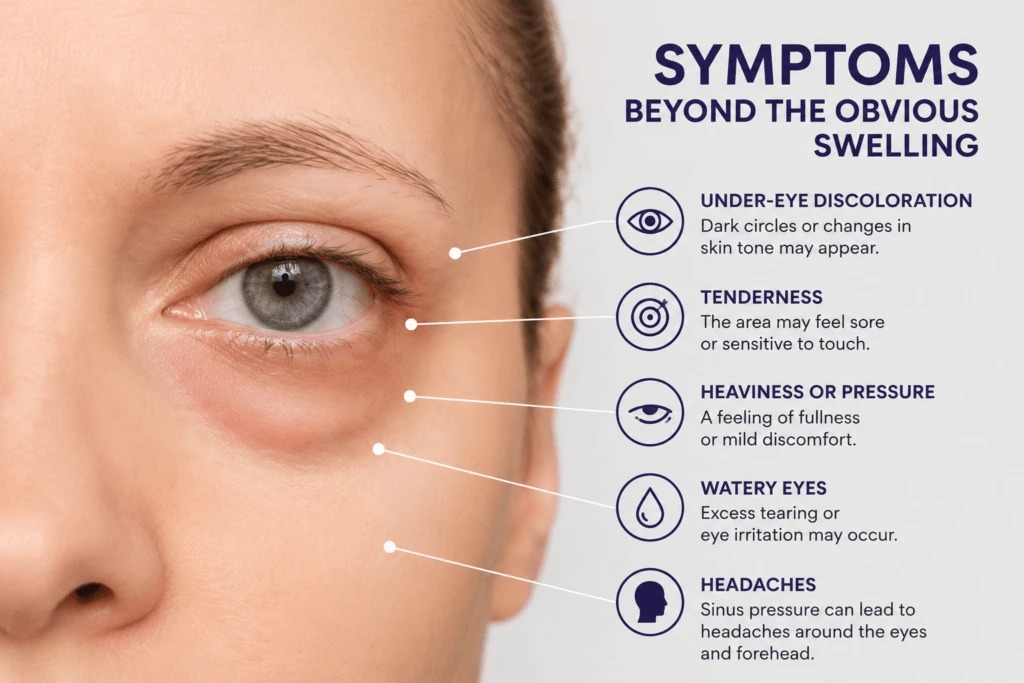
Puffy eyes rarely arrive alone. Depending on the cause, they’re often accompanied by some combination of the following:
- Visible bags or pouches under the lower eyelids
- Heaviness or pressure in the eye area
- Redness or pink discoloration of the eyelid skin
- Itching, burning, or stinging (especially in allergy cases)
- Watery eyes or excessive tearing
- Light sensitivity
- Dark circles appearing alongside puffiness — caused by blood pooling in dilated vessels beneath thin undereye skin
- Blurred or tired eyes and vision — particularly when the puffiness is driven by digital eye strain or prolonged screen use
- Difficulty opening your eyes fully first thing in the morning
Home Remedies for Puffy Eyes — The Ones That Actually Work
This is the section most people come for, and I’m not going to bury it. These home remedies for puffy eyes are the best-evidenced, most practical options — ranked roughly from fastest results to longest-lasting:
The Frozen Spoon (60-Second Viral Hack)
You already know this one. Two metal spoons in the freezer for five minutes, curved side gently pressed under each eye for 30 seconds. The cold causes vasoconstriction, pushing fluid away from the periorbital tissue. Results appear in under a minute and last one to two hours. It’s the most legit of all the viral hacks — simple physics, no gimmick. Best used as a “quick fix” before events or photos, not as a daily cure.
Cold Compress
A damp washcloth soaked in ice-cold water, wrung out, and placed over closed eyes for 10–15 minutes is the classic, reliable version of the frozen spoon trick. If you don’t want to mess with cutlery, this is your best bet. The broader surface area covers both eyes simultaneously, and the sustained cold application produces a more complete de-puffing effect than a brief spoon press.
Chilled Green Tea Bags
Steep two green or black tea bags in hot water, then refrigerate them for 15–20 minutes. Place one over each closed eye for 10–15 minutes. Green tea contains EGCG (epigallocatechin gallate), a potent antioxidant with anti-inflammatory properties. Black tea contains tannins — astringents that constrict blood vessels and tighten skin. The combination of cold temperature and active compounds makes this one of the most effective home remedies for puffy eyes, and the results typically last longer than the cold compress alone.
Cucumber Slices — Classic for a Reason
Chilled cucumber slices aren’t just a spa cliché. Cucumber contains cucurbitacins (anti-inflammatory compounds), vitamin C, caffeic acid, and silica — all of which help reduce swelling and soothe irritated periorbital skin. The high water content combined with cold temperature makes cucumber slices genuinely effective for mild to moderate puffiness. Ten minutes is typically enough.
Chilled Potato Slices
Less glamorous than cucumber but arguably more effective for dark circles and puffiness together. Raw potato contains catecholase — an enzyme with natural astringent and mild skin-brightening properties. Slice a cold raw potato, lie back, and place slices over your closed eyes for 15 minutes. Works best for morning-after puffiness driven by poor sleep or alcohol.
Cold Whole Milk
Soak two cotton pads in cold whole milk and place them under your eyes for 10 minutes. The lactic acid in milk is a gentle exfoliant, and its anti-inflammatory lipids and proteins help soothe irritated, swollen periorbital skin. It’s particularly helpful for puffiness combined with redness or dryness.
Rose Water Compresses
Chilled rose water applied on cotton pads is a gentle astringent remedy with mild anti-inflammatory properties. Rose water is especially well-suited for sensitive skin around the eyes — it’s fragrance-free in its pure form, non-comedogenic, and safe to use daily. Helps with both puffiness and the redness that often accompanies allergy-driven eye swelling.
Aloe Vera Gel (Used Very Carefully)
Pure, fresh aloe vera gel — not the grocery store variety with additives — has genuine anti-inflammatory and cooling properties that can reduce mild periorbital swelling. Apply a tiny, pea-sized amount to the orbital bone area (not on the eyelid itself or near the lash line), let it absorb for 10 minutes, then rinse off. Use with caution if you have sensitive skin, and always patch test first.
Lymphatic Drainage Massage
This is the home remedy that produces real, lasting improvement when done consistently — and it’s backed by anatomy, not just anecdote. Using your ring fingers (lightest pressure), start at the inner corners of your eyes and sweep very gently outward toward your temples. Then sweep downward along your jaw toward your lymph nodes near your collarbone. This motion encourages the lymphatic system to drain accumulated fluid rather than letting it sit in periorbital tissue.
A jade roller or a gua sha tool used along the same pathway can enhance the effect. Five minutes of gentle lymphatic drainage massage each morning — particularly when combined with another cold remedy — produces results that last significantly longer than cold application alone.
Fixing Digital Eye Strain at the Source
If your puffiness consistently peaks at the end of the workday and you spend hours looking at screens, digital eye strain is likely a contributing factor — and the fix here is behavioral, not topical.
Follow the 20-20-20 rule: every 20 minutes, look at something 20 feet away for 20 seconds. This allows your ciliary muscles to relax and your blink rate to normalize, replenishing the tear film and reducing the muscle fatigue that contributes to eyes and vision discomfort and periorbital swelling. Adjusting your screen brightness to match your ambient lighting, using blue light filtering glasses in the evening, and placing your monitor at a slight downward angle (so your eyes are looking slightly down rather than straight ahead or upward) all reduce the strain that drives end-of-day puffiness.
Taking regular breaks from screens isn’t just good for productivity — it’s one of the most effective and underrated home remedies for people whose puffy eyes are driven by digital eye strain rather than sleep or diet.
Hydration — More Consistent Than Most People Expect
Drink two to three liters of water per day and watch your morning eye puffiness improve over the course of two to three weeks. This isn’t a 60-second hack — it’s a slow burn. But the logic is solid: when you’re adequately hydrated, your body stops hoarding fluid in soft tissues (including around the eyes). When you’re dehydrated, it does the opposite. Limit fluids in the hour before bed to prevent overnight pooling.
Salt Reduction
Cut back on sodium — especially at dinner — and you’ll likely see a measurable difference in morning puffiness within three to five days. This is particularly dramatic in people who eat a lot of processed foods, restaurant meals, or salty snacks. Targeting under 2,000mg of sodium per day is a reasonable starting point.
Over-the-Counter Products Worth Buying
When home remedies aren’t enough or you want to build a longer-term strategy, the right OTC products make a real difference:
Caffeine-based eye creams and gels are the gold standard. Caffeine is a vasoconstrictor — it narrows blood vessels, reduces fluid leakage, and produces a temporary tightening effect. Applied in the morning, a quality caffeine eye gel can extend the de-puffing effect of your cold compress by several hours.
Peptide eye creams are the long game. Peptides signal the skin to produce more collagen, gradually improving the thickness, firmness, and resilience of the thin periorbital skin. You won’t see results overnight, but consistent use over two to three months produces real structural improvement.
Retinol eye formulas (in concentrations appropriate for the eye area — typically 0.025% to 0.05%) accelerate cell turnover, boost collagen, and help thicken the delicate undereye skin over time. These are best used at night, since retinol increases photosensitivity.
Hyaluronic acid eye serums attract and retain moisture in the skin, temporarily plumping the hollowed-out tear trough area that creates a sunken, shadowed appearance alongside puffiness.
Cooling eye rollers and cryo tools combine the benefit of cold temperature with gentle lymphatic drainage massage in one step — convenient for desk-side use when you can’t refrigerate a spoon.
Hydrogel eye patches deliver concentrated active ingredients to the periorbital area while the gentle compression temporarily reduces swelling. They’re excellent for quick prep before events.
Medical and Cosmetic Treatments
When lifestyle changes and home remedies hit their ceiling — particularly for genetic or structural puffiness — medical options open up:
Antihistamines and allergy medications address the root cause of allergically-driven puffy eyes. Oral antihistamines like cetirizine and loratadine, as well as prescription antihistamine eye drops, can significantly reduce puffiness caused by seasonal or chronic allergies.
Laser therapy and radiofrequency treatments stimulate collagen production in the periorbital skin, improving elasticity and reducing the appearance of structural under-eye bags over a series of sessions.
Dermal fillers (typically hyaluronic acid) add subtle volume to the tear trough — the hollow groove between the lower eyelid and cheek — reducing the shadowed, baggy appearance. Results last 12–18 months.
Blepharoplasty (eyelid surgery) is the most definitive treatment for hereditary or age-related under-eye bags. A board-certified oculoplastic or plastic surgeon removes or repositions excess fat and tightens the skin through small incisions. Results are durable and often permanent.
Pros and Cons: Honest Breakdown
Pros of Home Remedies
- Free or nearly free. Frozen spoons, tea bags, cucumber, cold milk, and rose water cost nothing or almost nothing extra.
- Immediate results. Cold-based remedies visibly reduce puffiness within 60 seconds to a few minutes.
- Zero side effects when used correctly. No prescription, no recovery, no risk.
- Compound benefits over time. Lifestyle-based remedies like hydration, salt reduction, and better sleep improve eye health and general wellbeing simultaneously.
- Accessible to everyone. No appointment, no waiting room, no insurance question.
- Addresses digital eye strain. Behavioral changes like the 20-20-20 rule target the cause — not just the symptom — of screen-related puffy eyes.
Cons of Home Remedies
- Temporary relief only. Even the most effective cold compress lasts a few hours at most.
- Powerless against structural causes. Hereditary fat prolapse and age-related orbital tissue laxity won’t respond to chilled spoons or tea bags.
- Require daily discipline. Salt reduction, hydration, and sleep hygiene require sustained consistency — not a one-time effort.
- Don’t treat medical causes. If a thyroid disorder, kidney problem, or eye infection is driving your puffiness, no home remedy will fix it.
- Risk of product irritation. Applying the wrong ingredient too close to the eye can cause chemical irritation or an allergic reaction.
Pros of OTC Eye Creams and Products
- Accessible without a prescription and available in a wide price range.
- Formulated for periorbital safety — most quality products are dermatologist and ophthalmologist tested.
- Targeted active ingredients — caffeine, peptides, retinol, and hyaluronic acid each address a different aspect of puffiness.
- Builds cumulative improvement with consistent daily use over weeks and months.
- Complements other treatments — works well alongside home remedies and lifestyle changes.
Cons of OTC Eye Creams and Products
- Primarily surface-level effects — can’t address structural causes of persistent bags.
- Slow results — most require 4–12 weeks of consistent use before visible improvement.
- High variability — what works brilliantly for one skin type may do nothing for another.
- Ongoing cost — premium products require continuous repurchase to maintain results.
- Marketing gap — many products make exaggerated claims backed by very limited clinical evidence.
Pros of Medical and Cosmetic Treatments
- Durable, sometimes permanent results — particularly blepharoplasty and laser therapy.
- Effective for genetic and structural puffiness that lifestyle and creams can’t touch.
- Treats underlying medical conditions when those are the root cause.
- Personalized to your anatomy by a qualified specialist.
- Significant boost to confidence for people who’ve struggled long-term with under-eye puffiness.
Cons of Medical and Cosmetic Treatments
- High cost — blepharoplasty runs several thousand dollars; filler sessions add up over time.
- Surgical risks — infection, scarring, asymmetry, and anesthesia complications are possible.
- Recovery downtime — surgical procedures require days to weeks of healing.
- Not covered by insurance — virtually all cosmetic eye treatments are elective.
- Temporary for non-surgical options — fillers and laser results fade and need repeat sessions.
- Requires expert hands — poorly performed procedures can worsen the problem significantly.
When to Stop Home-Treating and See a Doctor
Most puffy eyes respond well to the approaches in this guide. But certain signs tell you it’s time to get a professional opinion:
- Puffiness that doesn’t improve within 24–48 hours despite rest and home remedies
- Swelling affecting only one eye
- Eye area that feels warm, tender, or painful to touch
- A drooping eyelid you can’t fully open
- Vision changes — blurriness, double vision, or light sensitivity beyond typical digital eye strain
- Fever alongside eye swelling
- Sudden dramatic onset of swelling with no obvious cause
These symptoms can indicate infections like periorbital cellulitis, inflammatory conditions, or systemic diseases — all of which require medical treatment, not cold spoons.
Prevention: Make the Puffiness Stop Coming Back
Treating puffy eyes after the fact is always harder than preventing them in the first place. The most effective prevention targets the most common root causes:
Sleep on your back with your head slightly elevated to prevent overnight fluid pooling. Commit to 7–9 hours of quality sleep on a consistent schedule — not just enough hours but restful, uninterrupted sleep. Keep your daily sodium intake below 2,000mg, especially avoiding salty foods at dinner. Drink 2–3 liters of water throughout the day but limit fluids in the hour before bed.
Manage allergies proactively — don’t wait for symptoms to peak. Take antihistamines before high-pollen days, use an air purifier indoors, and change your pillowcase frequently if you have dust mite sensitivity. Combat digital eye strain with regular screen breaks, proper monitor positioning, and the 20-20-20 rule — your eyes and vision will be significantly healthier for it, and end-of-day puffiness will reduce noticeably.
Apply a broad-spectrum SPF under your eyes daily — UV damage accelerates collagen breakdown and speeds up the structural changes that lead to permanent under-eye bags. Eat antioxidant-rich foods (vitamin C, vitamin E, zinc, omega-3 fatty acids) to support skin integrity from the inside. And always, always remove your eye makeup before sleeping — residual mascara and liner irritate the periorbital skin overnight and can worsen morning puffiness significantly.
Puffy Eyes vs. Swollen Eyes: Know the Difference
| Puffy Eyes | Swollen Eyelids | |
| Affects | Usually both eyes | Often just one eye |
| Cause | Sleep, diet, allergies, aging, digital eye strain | Infection, injury, underlying disease |
| Duration | Hours to days | May persist longer than 48 hours |
| Feel | Usually painless | May be tender, warm, or painful |
| Severity | Mild to moderate | Moderate to severe |
| Action needed | Home remedies + lifestyle | Medical evaluation often required |
5 Big Authoritative Resources on Puffy Eyes
1. Mayo Clinic — mayoclinic.org
One of the world’s most respected medical institutions, Mayo Clinic covers under-eye bags and puffy eyes with physician-reviewed depth — symptoms, causes, risk factors, and both conservative and surgical treatment options. Their content bridges the gap between general health guidance and specialist-level insight, making it the most reliable starting point for anyone researching persistent or unusual eye puffiness.
2. All About Vision — allaboutvision.com
Staffed by licensed optometrists and ophthalmologists, All About Vision is the go-to resource for eyes and vision health written with genuine clinical authority. Their puffy eyes guide covers the physiological mechanics behind puffiness, the important distinction between puffy and truly swollen eyelids, practical home remedies, and a clear framework for when to see a specialist. Invaluable for anyone whose puffiness intersects with vision concerns or digital eye strain.
3. Medical News Today — medicalnewstoday.com
Medical News Today offers one of the most thorough, evidence-based breakdowns of periorbital edema — the clinical term for puffy eyes — available to general readers. Their article covers both acute and chronic forms, the full spectrum of medical conditions that cause eye swelling, and the diagnostic process physicians use. Essential reading for anyone who suspects their puffiness has a systemic medical cause.
4. Johns Hopkins Medicine — hopkinsmedicine.org
The Johns Hopkins expert Q&A on under-eye bags is authored by a facial plastic and reconstructive surgeon — which means the advice on fillers, laser therapy, and blepharoplasty here is coming from someone who performs these procedures. A uniquely authoritative source for anyone seriously considering cosmetic intervention for puffy eyes.
Frequently Asked Questions
Does the viral spoon hack actually work?
Yes — for about one to two hours. The cold causes vasoconstriction that pushes fluid away from the periorbital tissue, visibly reducing puffiness fast. It’s a legitimate short-term fix, not a cure.
Why are my eyes puffiest in the morning?
When you lie flat, gravity stops assisting lymphatic drainage from the periorbital area, so fluid accumulates overnight. This is normal and typically resolves within 30–60 minutes of being upright and blinking regularly. It worsens with age, high salt intake, alcohol, and sleeping on your stomach.
Can digital eye strain cause puffy eyes?
Yes — and this is more common than most people realize. Digital eye strain reduces blink rate, causes muscle fatigue around the eyes, and leads to inflammation that contributes to end-of-day puffiness. Reducing screen time and using the 20-20-20 rule helps significantly.
Are puffy eyes a sign of kidney problems?
They can be. Persistent, unexplained morning puffiness — especially if accompanied by swelling elsewhere in the body — can indicate reduced kidney function. Kidneys regulate fluid balance, and when they’re impaired, fluid accumulates in soft tissues. Unexplained persistent puffiness warrants a blood test to check kidney function.
How long do puffy eyes last?
It depends entirely on the cause. Allergy-driven puffiness may clear within hours. Post-crying swelling typically resolves in two to four hours. Puffiness from illness may last several days. Age-related or hereditary under-eye bags are generally permanent without medical intervention.
What vitamin deficiency causes puffy eyes?
Vitamin K deficiency is most directly linked to under-eye puffiness and dark circles, as vitamin K is critical for healthy circulation in periorbital capillaries. Vitamin C deficiency weakens collagen structure, accelerating the skin changes that lead to bags. Iron deficiency can worsen dark circles alongside puffiness.
Is blepharoplasty worth it?
For people with significant hereditary or age-related under-eye bags that haven’t responded to anything else, blepharoplasty can produce dramatic, long-lasting results. It’s among the most common and highest-satisfaction cosmetic procedures when performed by a board-certified surgeon. Results often last a decade or more.
Conclusion
The viral 60-second puffy eye hack works — but it’s a Band-Aid, not a cure. Real, lasting improvement in puffy eyes comes from understanding which of the many possible causes is driving yours: poor sleep, high salt intake, allergies, digital eye strain, aging, hormonal shifts, or something that deserves a doctor’s attention.
For most people, a combination of smart home remedies — cold compresses, chilled tea bags, lymphatic drainage massage, proper hydration, and addressing digital eye strain through screen habits — will produce significant improvement without spending a dollar on products or procedures. For those with structural or genetic puffiness, OTC products and professional treatments open up genuinely effective additional options.
Take care of your eyes and vision — not just aesthetically, but as a reflection of your overall health. Your periorbital area is one of the first places your body whispers that something’s off. Pay attention, use the right tools for the right cause, and you’ll spend a lot less time wondering which filter makes you look awake.
This article is for informational purposes only and does not constitute medical advice. Always consult a qualified healthcare provider for the diagnosis and treatment of any medical condition.

Natural home remedies, skincare secrets, dental & eye health tips, and real product reviews to help you stay healthy the natural way.