

This article contains affiliate links and is promotional in nature. A commission may be earned on purchases at no extra cost to you. These statements have not been evaluated by the FDA. This product is not intended to diagnose, treat, cure, or prevent any disease. Full disclosures appear at the end of this article.
Quick Take: What You Should Know Before You Click Buy
If you’re thirty seconds away from ordering VISIVRA, read this VISIVRA quick take first. There’s one thing Vigorus, the company behind VISIVRA, doesn’t put on its own product page: the specific milligram amount of each ingredient. That’s the single number that would let you compare VISIVRA to the actual research studies referenced throughout this review, and its absence is the main reason this article exists in the first place.
What you’ll get below is everything VISIVRA’s sales page tells you, plus the parts it leaves out — an ingredient-by-ingredient look at the published research, the refund policy exactly as written on the returns page (not the shortened version in the ads), and a buyer’s checklist you won’t find anywhere on Vigorus’s site.
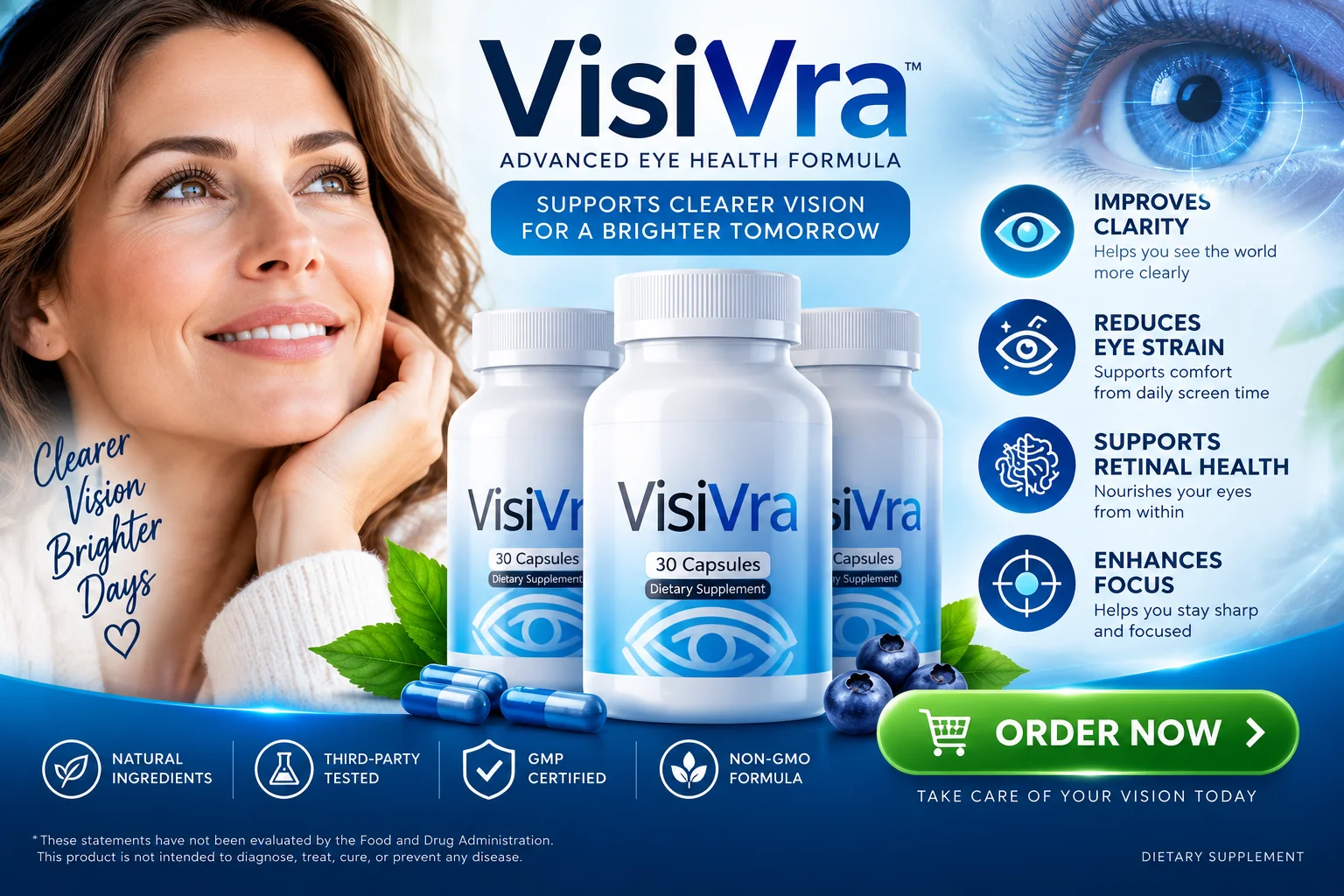
VISIVRA is a dietary supplement sold by Vigorus and processed through BuyGoods, built around six ingredients — Lutein, Zeaxanthin, Bilberry Extract, Astaxanthin, Zinc, and Vitamin A — under a branded concept Vigorus calls “The Ocular Support & Visual Clarity Matrix.” It is not a drug. It has not been reviewed or approved by the FDA. Here’s everything else worth knowing before you decide.
VISIVRA at a Glance
- Category: dietary supplement for eye health and visual comfort
- Brand operator: Vigorus, named in the company’s published Terms of Service at visivra.online
- Retailer of record: BuyGoods, a Delaware corporation headquartered at 1201 N Orange Street, Suite #7223, Wilmington, DE 19801
- Ingredients (brand-stated): Lutein, Zeaxanthin, Bilberry Extract, Astaxanthin, Zinc, Vitamin A
- Formula name (brand-created): “The Ocular Support & Visual Clarity Matrix”
- Dosage transparency: individual milligram amounts are not published as of June 2026 — this is the one gap worth resolving before you order, not after
- Manufacturing: stated as U.S.-based; no third-party certification is disclosed
- Pricing: 2 bottles for $158, 3 bottles for $207, 6 bottles for $294, all plus shipping as shown at checkout
- Refund window: 60 days from the date of purchase, not delivery
- Contact: support@visivra.com, +1 323-347-4522, returns to SHIPOFFERS, 19655 E 35th Dr #100, Aurora, CO 80011
- FDA status: not approved; not intended to diagnose, treat, cure, or prevent disease
Bottom line: VISIVRA pairs six well-known eye-health ingredients with a research history worth understanding, but VISIVRA’s page doesn’t disclose specific doses. The refund window is real, but it starts counting down the moment you pay, not the moment your package shows up.
Why This Review Goes Further Than Vigorus’s Own Page
You’ve probably already scrolled through Vigorus’s VISIVRA sales page. It lists the six ingredients, the pricing tiers, a guarantee headline, and the brand’s own pitch for why its formula matters. What it doesn’t spell out is how much of each ingredient you’re actually getting, what the return process requires step by step, or how the underlying research compares to what the marketing implies.
That’s the gap this piece is meant to close. Below, you’ll find an ingredient-by-ingredient research summary, the exact return process pulled from the brand’s own policy page, a twelve-point checklist to run through before ordering, and a fair assessment of where the science is solid and where it’s thinner than the ads suggest. Think of this as the conversation a well-informed friend would have with you — someone who’s read the eye-health literature and isn’t trying to either oversell or dismiss what’s actually here.
One note up front: if you’re managing a diagnosed eye condition — macular degeneration, glaucoma, cataracts — this article is useful context, but that decision belongs with your eye doctor, not a product review. For everyone else, here’s what to know.
Making Sense of VISIVRA’s Marketing Language
Before getting into ingredients and evidence, it helps to translate a few phrases the brand uses, because understanding them changes how you read everything else on the page.
“The Ocular Support & Visual Clarity Matrix” is a name Vigorus created for its own formula. It isn’t a recognized clinical term, a standardized supplement category, or a third-party certification — it’s simply how the brand describes its multi-ingredient approach. It tells you the company has a rationale for combining these six compounds; it doesn’t mean the specific combination has been independently tested as a finished product.
“Designed to support visual clarity” is what’s known as structure-function language under DSHEA, the Dietary Supplement Health and Education Act. Brands are allowed to describe how a supplement is intended to support a bodily function, provided they have substantiation on file and include the required FDA disclaimer. It does not mean the FDA has evaluated or confirmed the claim, and it doesn’t mean clinical visual acuity has been shown to improve.
“Premium formula” and similarly confident phrases are marketing language reflecting the brand’s own view of its product — not an independent benchmark or regulatory standard.
“Generally well tolerated” means Vigorus believes its ingredients, at their intended doses, don’t carry a high rate of adverse reactions in most healthy adults. It isn’t a clinical safety clearance for every person, and it doesn’t rule out interactions for people on specific medications or with underlying conditions.
Knowing what these phrases do and don’t promise puts you in a stronger position going into the rest of this review.
Does VISIVRA Actually Work for Eye Health?
Here’s the straightforward answer: the six ingredients in VISIVRA all have a genuine, published research connection to eye health nutrition. Lutein and Zeaxanthin sit near the top of the evidence pyramid for macular support. Astaxanthin has been studied specifically in people who spend long hours in front of screens, alongside those two carotenoids, with measurable results in at least one randomized, placebo-controlled trial. Bilberry Extract, Zinc, and Vitamin A each carry a documented role in eye tissue function within nutritional science.
What that doesn’t mean: VISIVRA is not a drug, and it isn’t approved to treat, cure, or prevent any eye disease. All of the research discussed here examines these compounds individually or in combination under specific study conditions — not VISIVRA as a finished, formulated product. No eye supplement can legally claim to treat a diagnosed condition, and this review won’t suggest otherwise. But “not a drug” isn’t the same as “not worth considering.” The real question is whether the ingredient list is grounded enough in research to justify trying it, and that requires looking at each compound individually.
At a category level, the six ingredients Vigorus chose are among the most frequently studied nutrients in eye health research. Lutein and Zeaxanthin carry a substantial research history tied to macular pigment density and blue-light filtration. Astaxanthin has specifically been examined alongside those two carotenoids in screen-heavy populations. Zinc and Vitamin A both play well-established roles in retinal biology. Bilberry Extract has a long-standing presence in this category, backed by documented antioxidant activity.
What that research does not tell you: how much of each ingredient VISIVRA actually contains, whether those amounts line up with what published trials used, or whether the specific combination in VISIVRA will produce a noticeable result for you personally. Results vary significantly from person to person.
If you’re managing a diagnosed condition — AMD, cataracts, glaucoma, or diabetic retinopathy — the research picture gets more specific than most supplement marketing lets on. The strongest evidence in this entire category comes from the AREDS and AREDS2 studies, run by the National Eye Institute, which tested specific formulas in people who already had intermediate-to-advanced AMD. VISIVRA is not presented here as an AREDS-equivalent formula, because Vigorus hasn’t published dosages that would let anyone confirm alignment.
Bottom line: VISIVRA’s six ingredients have real research relevance to eye health. That research supports trying VISIVRA — it doesn’t guarantee any specific outcome. The only real way to know if it helps you is to test it within the brand’s 60-day window, keeping in mind that window starts at purchase, not delivery.
The VISIVRA Ingredient List, One Compound at a Time
Everything below is ingredient-level research — meaning these compounds have been studied on their own or in combination, but VISIVRA itself hasn’t been through a clinical trial as a finished formula. Specific dosages aren’t published on VISIVRA’s page as of June 2026, so this section covers what each ingredient is, what the science says, what’s missing from the label, and what that means practically.
Lutein
Lutein is a carotenoid pigment that concentrates naturally in the macula, the central part of the retina. Together with Zeaxanthin, it forms the macular pigment — essentially the eye’s built-in filter against high-energy blue light.
Research referenced by the National Center for Complementary and Integrative Health (NCCIH) documents Lutein’s role in supporting macular pigment optical density and filtering blue light. The AREDS2 trial found that swapping beta-carotene for a Lutein-and-Zeaxanthin combination further reduced AMD progression risk in people already at elevated risk — a meaningful finding, though for a specific population. For the average healthy adult, there’s a real dietary gap: most people who aren’t regularly eating kale, spinach, or eggs simply aren’t getting much Lutein through food.
What’s missing: VISIVRA’s page doesn’t list the actual milligram amount of Lutein in the formula. Without that number, there’s no way to compare it to the doses used in the studies above.
Zeaxanthin
Zeaxanthin is Lutein’s partner pigment in the macula, concentrating mainly in the central fovea — the part of the retina responsible for your sharpest central vision. The two carotenoids complement each other, covering different zones of the macula.
A randomized, placebo-controlled trial examining Astaxanthin, Lutein, and Zeaxanthin together in adults who work extensively with visual display terminals found the group taking the active combination showed significantly better eye-hand coordination after eight weeks, along with a measurable increase in macular pigment optical density. That’s directly relevant to the screen-heavy audience VISIVRA is aimed at, though again, it’s research on the ingredient combination, not on this specific product.
What’s missing: the exact Zeaxanthin amount isn’t disclosed. The AREDS2 formula uses a specific 5-to-1 ratio of Lutein to Zeaxanthin — without published numbers, there’s no way to know if VISIVRA follows anything close to that ratio.
Bilberry Extract
Bilberry (Vaccinium myrtillus) is a European berry whose anthocyanin content has been studied for its connection to ocular blood flow and visual adaptation. It’s a recognized, long-standing ingredient in eye-health formulas.
The research here is real but thinner than the carotenoid literature — most Bilberry studies are smaller and more exploratory. Its antioxidant mechanism and its consistent presence across the category reflect a reasonable nutritional rationale, even if the clinical evidence isn’t as definitive as what exists for Lutein and Zeaxanthin.
What VISIVRA doesn’t disclose: neither the extraction ratio nor the milligram amount is published, and the specific form of Bilberry Extract (standardized anthocyanin content versus raw extract) makes a real difference for comparing it to published research — a detail VISIVRA’s page doesn’t provide.
Astaxanthin
Astaxanthin is a fat-soluble carotenoid with well-documented antioxidant activity, including laboratory comparisons where it outperforms other common antioxidants. In eye health specifically, it’s been studied for its contribution to visual performance in people who spend long hours on digital screens.
The same VDT-operator trial mentioned above found that the combination of Astaxanthin, Lutein, and Zeaxanthin improved eye-hand coordination and increased macular pigment density over eight weeks. That trial lines up closely with VISIVRA’s target audience — people managing screen-heavy work. Because Astaxanthin is fat-soluble, it also absorbs best when taken alongside food, which matters for how you actually use VISIVRA day to day.
What VISIVRA doesn’t disclose: the milligram amount isn’t published, so there’s no way to confirm whether its Astaxanthin content is anywhere near the doses used in that trial.
Zinc
Zinc is a trace mineral with an established role in retinal biochemistry, functioning as part of the antioxidant enzyme system that protects retinal tissue. It’s also one of the core components of the original AREDS formula, among the most studied nutritional interventions for AMD risk.
Both NCCIH and the AREDS research identify Zinc as relevant to macular health and retinal antioxidant activity, so its presence in VISIVRA tracks with established research.
What VISIVRA doesn’t disclose, and why it matters: the Zinc dose isn’t published, and Zinc shows up in a lot of multivitamins and specialty supplements. Taking in too much total Zinc over time can deplete copper and may interact with certain antibiotics — quinolones and tetracyclines specifically — as well as some diuretics. Without a published dose, anyone already taking Zinc elsewhere can’t accurately total their daily intake.
Vitamin A
Vitamin A is a fat-soluble vitamin essential to producing rhodopsin, the light-sensitive pigment in the retina’s rod cells that makes low-light and night vision possible. It also supports the eye’s surface and tear film.
Vitamin A’s role in vision is one of the most firmly established relationships in nutritional science, and deficiency remains a leading, preventable cause of vision impairment worldwide. That said, for adults who already get enough Vitamin A, extra supplementation isn’t likely to produce a dramatic improvement — the biggest benefit shows up when correcting an actual deficiency.
What VISIVRA doesn’t disclose: the amount isn’t published, and because Vitamin A is fat-soluble and accumulates in the body over time, that matters. Long-term high-dose intake carries a real toxicity risk. Anyone already taking a multivitamin or cod liver oil needs to know VISIVRA’s dose to calculate a safe combined total. Pregnant women, or anyone who might become pregnant, should talk to a healthcare provider before adding any Vitamin A supplement, since excess intake has been linked to fetal risk.
What the Research Adds Up To — and What It Doesn’t Prove
Taken together, here’s an honest read on VISIVRA’s six ingredients.
Lutein and Zeaxanthin are the most rigorously studied nutrients in this entire category, with documented roles in macular pigment, blue-light filtration, and antioxidant protection — backed by the National Eye Institute’s AREDS2 trial. For adults who don’t eat much in the way of lutein-rich vegetables, there’s a legitimate nutritional case for supplementing.
The Astaxanthin-Lutein-Zeaxanthin combination has specifically been tested in a randomized, placebo-controlled trial involving people who work at screens all day — exactly the audience VISIVRA is marketed toward. That’s a genuine differentiator compared to simpler, single-carotenoid formulas.
Bilberry Extract brings real antioxidant activity and a long history in the eye-health supplement category, though its clinical evidence base is thinner than the carotenoids’.
Zinc and Vitamin A both have well-established roles in retinal function, backed by decades of nutritional research and the AREDS studies specifically.
What none of this tells you: the actual amount of each ingredient in VISIVRA, whether this exact combination has been tested as a finished product, or whether you personally will notice any difference. Outcomes depend on your starting nutrition, diet, consistency, age, and genetics, among other factors.
The Honest Research Picture Heading Into 2026
Most reviews in this space either brush past the research limitations or bury the useful information under so many disclaimers that nothing sticks. Here’s the straight version of what the NCCIH — part of the National Institutes of Health — currently says about eye-health supplements.
The strongest available evidence comes from the AREDS and AREDS2 trials, which tested specific formulations in people who already had intermediate or advanced AMD in at least one eye. AREDS2 found that replacing beta-carotene with a Lutein-and-Zeaxanthin combination further reduced the risk of AMD progression in that particular population. Those findings are specific to that clinical context and those exact dosages — they don’t automatically extend to every adult taking any eye supplement on the market.
NCCIH also notes that current evidence doesn’t support Vitamins A, C, or E specifically for glaucoma. For the average healthy adult without diagnosed AMD, the case that supplementation measurably improves visual acuity or prevents eye disease is considerably less settled than most marketing implies.
Where the evidence holds up better: adequate Lutein and Zeaxanthin intake for people whose diets are consistently low in leafy greens and eggs, and the specific research on the Astaxanthin-Lutein-Zeaxanthin combination in screen-heavy adults.
A fair summary, one a physician would likely agree with: these ingredients aren’t harmful at typical doses for most healthy adults, the strongest evidence applies to AMD-risk populations using AREDS-specific formulas, and general supplementation makes the most sense for people with a real dietary gap in these nutrients.
Who VISIVRA Is Actually Built For
According to Vigorus’s own positioning, VISIVRA is aimed at adults looking for daily nutritional support for visual comfort, retinal health, and clarity — particularly people dealing with the demands of a screen-heavy lifestyle. The brand describes its ideal user as someone who spends long hours on digital devices, experiences eye fatigue during or after screen use, or wants a consistent nutritional approach to eye wellness as they get older.
That framing lines up reasonably well with the ingredient list. Adults who don’t regularly eat Lutein- and Zeaxanthin-rich foods have a genuine nutritional case for a supplement that fills that gap, and the Astaxanthin inclusion connects specifically to screen-use research that simpler formulas skip entirely.
Who it’s probably not for: anyone looking to replace treatment for a diagnosed eye condition. Nothing about VISIVRA’s ingredient profile supports using it in place of clinical care for AMD, glaucoma, cataracts, or diabetic retinopathy. If you’re managing any of those, loop in your eye care provider before adding this or any supplement.
Is VISIVRA a Legitimate Company?
Short answer: by the standards a buyer can actually verify, yes. Here’s what “legitimate” means in this context and what it doesn’t. It means the company is publicly verifiable — a working website, a named operator, a documented retailer, published support channels, a stated refund policy, and recognizable ingredients with a real research history. It doesn’t mean this article independently tested VISIVRA or audited every claim on the Supplement Facts panel.
Does Vigorus have real, checkable infrastructure behind VISIVRA? Yes. There’s a live website with clear contact details, a documented retailer relationship through BuyGoods (a Delaware corporation with public registration records), a published refund process tied to a verifiable return address in Aurora, Colorado, and both email and phone support that are publicly listed. That’s more transparency than a lot of brands in this space offer.
Are VISIVRA’s ingredients real? Absolutely — Lutein, Zeaxanthin, Bilberry Extract, Astaxanthin, Zinc, and Vitamin A are all commercially established compounds with real supply chains and a genuine research history in eye health. The dosage gap is real, but the ingredients themselves aren’t invented or implausible.
Do VISIVRA’s claims stay within regulatory bounds? The structure-function language Vigorus uses — phrases like “supports visual clarity” — is consistent with what’s allowed under DSHEA, provided the brand has substantiation and includes the required FDA disclaimer. Both appear to be present on the official site.
What’s still missing: specific dosages, third-party certification (USP, NSF, or similar), and clinical data on VISIVRA as a finished product. Those are real gaps, and the most direct way to close them is to email support@visivra.com and ask to see the actual Supplement Facts panel before ordering.
VISIVRA Pricing: What You’re Actually Paying
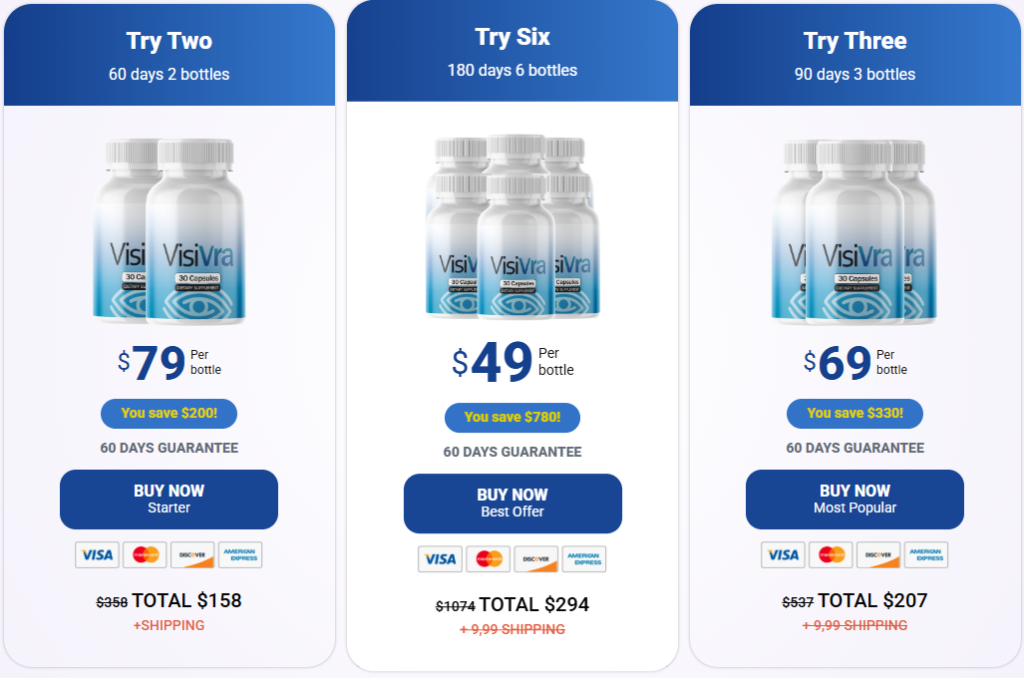
As of June 2026, Vigorus’s official VISIVRA page lists three purchase tiers. Prices are subject to change, so confirm the current total at checkout before completing your order.
- 2 bottles (60-day supply): $79 per bottle, $158 total, plus shipping. The brand lists a $358 comparison price — a figure set by Vigorus, not an independent market reference.
- 3 bottles (90-day supply): $69 per bottle, $207 total, plus shipping. Brand-stated comparison price: $537.
- 6 bottles (180-day supply): $49 per bottle, $294 total, plus shipping. Brand-stated comparison price: $1,074.
All “before” prices are Vigorus’s own reference points, and shoppers in the EU should note that the EU’s Omnibus Directive places specific requirements on how reference pricing must be disclosed — a compliance responsibility that sits with the brand, not this review. There’s no subscription model disclosed on VISIVRA’s official page; every purchase appears to be a one-time transaction.
One practical note: if you choose the 2-bottle option specifically to keep your commitment small, remember that a 60-day supply and a 60-day refund window run almost exactly parallel. That means there’s very little slack if you’re deciding late whether to send it back.
The Refund Policy: What the Returns Page Actually Requires
Here’s what VISIVRA’s returns page — reviewed directly for this article — actually says, as opposed to the shorter version implied by the marketing copy.
The refund window is 60 days from your purchase date, not from delivery and not from the day you first open the box. If shipping takes a week or two, your real trial window shrinks to something closer to six or seven weeks rather than the eight or nine implied by casual reading of the guarantee. If you’re going to try VISIVRA, start the day it arrives — don’t let it sit on the counter for a week while you decide.
Before returning anything to VISIVRA’s support team, you’re required to contact them first for return instructions — emailing support@visivra.com or calling +1 323-347-4522. Skipping that step isn’t part of the published process.
You’ll need to send back every bottle — the return policy specifies “whether empty or not” — along with your packing slip, to SHIPOFFERS, 19655 E 35th Dr #100, Aurora, CO 80011, and include your name, email, and order ID inside the package. Return shipping is your responsibility and isn’t reimbursed. Once your return is received and inspected, refunds are processed within five to ten business days back to your original payment method.
Bottom line: VISIVRA’s refund policy is real and usable, but it has specific steps that matter — contact support first, send everything back with your packing slip, and expect to cover the shipping cost yourself.
VISIVRA vs. Other Eye Health Supplements
The eye-health supplement aisle is crowded, and Lutein-Zeaxanthin pairings show up everywhere from basic multivitamins to dedicated macular-support formulas. Here’s an honest comparison.
VISIVRA’s six-ingredient approach covers more ground than a simple two-ingredient Lutein-Zeaxanthin capsule. Adding Astaxanthin is a real point of difference — it connects directly to the published VDT-operator research that simpler formulas don’t touch. Including Zinc brings VISIVRA closer to the AREDS research framework’s core mineral component, and the Bilberry and Vitamin A additions round VISIVRA out toward broader ocular nutrition.
Where it falls short of some competitors: no published dosages, no disclosed third-party testing (USP or NSF certification), and no Vitamin C or Vitamin E — both part of the full AREDS2 stack alongside Zinc and the carotenoids. If your priority is matching the exact AREDS2 formulation or buying something with independently verified doses, VISIVRA’s current disclosure doesn’t fully support that comparison.
If you’re managing AMD under a doctor’s supervision, let that relationship — not a general comparison article — determine your specific formulation and dosing.
How VISIVRA Lines Up Against the AREDS Research
The AREDS and AREDS2 studies are the most frequently cited research backbone in eye-supplement marketing, and for good reason. Funded by the National Eye Institute and run over several years with thousands of participants, AREDS2 identified a specific nutrient combination — Lutein 10mg, Zeaxanthin 2mg, Vitamin C 500mg, Vitamin E 400 IU, Zinc 80mg, and Copper 2mg — that may slow AMD progression in people already at intermediate-to-advanced risk.
VISIVRA shares three ingredients with AREDS2 — Lutein, Zeaxanthin, and Zinc — but VISIVRA doesn’t disclose whether its amounts come anywhere close to the AREDS2-studied doses, and it leaves out Vitamin C, Vitamin E, and Copper entirely. That doesn’t disqualify VISIVRA from its actual intended use — general daily nutritional support, not clinical AMD management — but it’s context worth having before you buy.
If you or someone in your family has been diagnosed with AMD and your eye doctor has already discussed the AREDS formula specifically, whether VISIVRA fits into that plan is a conversation for that appointment, not for this article. For general adults looking for everyday eye nutrition, the ingredient overlap with AREDS2 is meaningful context — not a clinical equivalence.
Twelve Things to Confirm Before You Order
Work through this VISIVRA buyer checklist before checkout. It takes about five minutes and can save you a frustrating return process later.
- Have you talked to your eye doctor if you’re managing a diagnosed condition like AMD, glaucoma, or cataracts?
- Have you requested the Supplement Facts panel from support@visivra.com if dosage matters to your decision?
- Have you totaled your daily Zinc intake from all sources, including any multivitamin?
- Have you totaled your daily Vitamin A intake, since it’s fat-soluble and accumulates over time?
- Are you on blood thinners, quinolone or tetracycline antibiotics, or diuretics? If so, talk to your prescribing doctor first.
- Are you pregnant or might you become pregnant? Discuss Vitamin A supplementation with your OB or midwife.
- Have you noted that the 60-day refund window starts at your purchase date, not delivery?
- Have you read the actual returns process at visivra.online/returns, including the requirement to contact support before shipping anything back?
- Have you confirmed your total checkout cost, including shipping, since promotional prices can shift?
- Have you saved your BuyGoods order confirmation, since that’s your primary record for support or refunds?
- Do you plan to take VISIVRA with a meal, since its fat-soluble ingredients absorb better with food?
- Do you have realistic expectations about timeline? Nutritional changes to eye tissue happen over weeks to months, not days.
Safety Notes and Interaction Considerations
Vigorus describes VISIVRA as “generally well tolerated” when used as directed, and for most healthy adults not juggling other supplements or specific medications, that’s a fair description of VISIVRA’s ingredient profile at typical doses. A few things about VISIVRA are still worth flagging:
- Zinc, taken in excess over time, can deplete copper and may interact with quinolone or tetracycline antibiotics as well as certain diuretics. Check with your prescribing doctor if either applies to you.
- Vitamin A is fat-soluble and accumulates rather than being flushed out like water-soluble vitamins. Long-term high-dose intake carries a documented toxicity risk. If you already take a multivitamin or cod liver oil, calculate your total Vitamin A before adding VISIVRA. Pregnant women and anyone who might become pregnant should talk to a healthcare provider first, since excess Vitamin A has been linked to fetal risk.
- All four fat-soluble compounds in the formula — Lutein, Zeaxanthin, Astaxanthin, and Bilberry’s anthocyanins — absorb more efficiently when taken with a meal that includes some healthy fat, like eggs, avocado, or olive oil.
- Bilberry Extract, at higher doses, may theoretically interact with blood-thinning medications. If anticoagulants are part of your regimen, check with your doctor before starting.
This is a practical starting checklist, not a full drug-interaction review. Anyone managing a complex medication list or existing health condition should talk to a healthcare professional before starting VISIVRA.
How to Take VISIVRA
Vigorus’s page doesn’t spell out an exact serving size for VISIVRA as of June 2026. The general best practice: take VISIVRA consistently, at the same time each day, alongside a meal containing some fat to support absorption of the fat-soluble ingredients. Research on carotenoids consistently shows that changes in macular pigment density build up over weeks to months of steady use, not days — so consistency matters more than any single dose. Check the Supplement Facts panel on your actual bottle, or contact support@visivra.com, for exact serving instructions.
Where VISIVRA Fits for Screen-Heavy Days
Digital eye strain, the use case VISIVRA is built around, is one of the fastest-growing complaints in modern work life. People spending six, eight, or ten hours a day on phones, laptops, and tablets commonly report dry eyes, trouble focusing, light sensitivity, and general end-of-day eye fatigue. These aren’t symptoms of one single condition — they reflect cumulative visual demand, reduced blink rate during screen use, and blue-light exposure on a visual system that didn’t evolve for this kind of use pattern.
Where does a supplement fit into that picture? Higher macular pigment density is associated with better blue-light filtration and reduced glare sensitivity, and the same randomized trial mentioned earlier found the Astaxanthin-Lutein-Zeaxanthin combination improved both eye-hand coordination and pigment density in screen-heavy adults over eight weeks. That’s real, relevant, ingredient-level evidence for exactly the population VISIVRA targets — even though it isn’t evidence about VISIVRA as a finished product.
On blue light specifically: it’s a genuine area of research, but also one that gets oversold across the supplement and eyewear markets. Lutein and Zeaxanthin do form a real biological filter against high-energy visible light in the retina — that mechanism is well documented. What’s less established is whether supplementation prevents digital eye strain as effectively as simple behavioral fixes, like the 20-20-20 rule or reducing screen brightness, or whether typical screen exposure is even causing lasting damage in healthy adults, since screens emit far less blue light than sunlight. The most defensible way to frame it: supporting macular pigment through adequate Lutein and Zeaxanthin gives your eyes their natural defense layer. It’s a nutritional piece of the puzzle, not a replacement for good screen habits.
Frequently Asked Questions
What is VISIVRA?
VISIVRA is a dietary supplement from Vigorus, processed through BuyGoods, combining Lutein, Zeaxanthin, Bilberry Extract, Astaxanthin, Zinc, and Vitamin A. It’s marketed as daily nutritional support for visual comfort and eye wellness — not a treatment for any diagnosed condition.
Is VISIVRA FDA-approved?
No. Like all dietary supplements, VISIVRA isn’t subject to FDA pre-market approval, and the FDA hasn’t evaluated it for safety or effectiveness. If you have a diagnosed eye condition, see your eye care provider rather than relying on a supplement.
What ingredients does VISIVRA contain, and in what amounts?
The six listed ingredients are Lutein, Zeaxanthin, Bilberry Extract, Astaxanthin, Zinc, and Vitamin A. Specific milligram amounts aren’t published on VISIVRA’s page as of June 2026 — check your Supplement Facts label after ordering, or email support@visivra.com beforehand.
How long before I’d notice a difference?
There’s no universal timeline. Published research on Lutein and Zeaxanthin typically shows measurable changes in macular pigment over weeks to months of consistent daily use, not days. Individual results vary based on diet, age, consistency, and overall health.
Does VISIVRA really help with digital eye strain?
VISIVRA isn’t approved to treat eye strain. Its core ingredients — particularly Lutein, Zeaxanthin, and Astaxanthin — do have ingredient-level research relevant to visual comfort and macular pigment in screen-heavy adults, including the VDT-operator trial referenced above. That’s research on the ingredients, not a clinical trial of VISIVRA itself.
Is VISIVRA a subscription?
Based on the brand’s current published terms, no — purchases appear to be one-time transactions with no auto-renewal disclosed. Confirm this at checkout, since policies can change.
What’s the refund policy?
A 60-day window from your purchase date. Contact support first for instructions, return all bottles plus your packing slip to the Aurora, CO address, cover your own return shipping, and expect five to ten business days for processing once your return is received.
Can I take VISIVRA alongside my multivitamin?
Possibly, but check your combined Zinc and Vitamin A totals first, since both accumulate and VISIVRA doesn’t publish its specific amounts. If you’re on blood thinners, antibiotics, or diuretics, check with your doctor.
Is VISIVRA the same as an AREDS2 formula?
No. It shares Lutein, Zeaxanthin, and Zinc with the AREDS2 formula but doesn’t publish matching doses and leaves out Vitamin C, Vitamin E, and Copper. For clinical AMD management, follow your ophthalmologist’s specific recommendation.
Where can I buy VISIVRA?
Through the official VISIVRA site at visivra.online, processed via BuyGoods. Vigorus specifically advises against buying from unauthorized third-party sellers, since that could affect your refund coverage.
The Honest Bottom Line
Every fair review has to include a few things that don’t show up in the ads. Here are the three that matter most for VISIVRA.
First, the dosage gap is real, and it’s the single biggest open question. The six ingredients are a genuinely sound selection for this category — but choosing the right ingredients and choosing the right amounts are two different things, and only the brand can close that gap. If it matters to your decision, ask before you order, not after.
Second, no eye supplement replaces a regular eye exam. Nutritional support for your eyes is a real, legitimate thing — but it works alongside professional eye care, not instead of it. If you’re over 40 and haven’t had a dilated eye exam in the last two years, that’s a more important step than any supplement decision. A product like VISIVRA can support your nutrition; it can’t detect early macular changes or measure eye pressure.
Third, individual response varies more than population averages suggest. The same daily intake of Lutein produces different results in different people, depending on genetics, diet, and absorption. Research describes averages across groups — your own experience will be your own.
Where does that leave things for a prospective VISIVRA buyer? VISIVRA brings together a well-documented set of eye-health ingredients, verifiable company infrastructure, and a workable — if procedurally specific — 60-day refund policy. The dosage transparency gap is the main thing worth resolving with a quick email before you commit. If you’re a screen-heavy adult whose diet doesn’t include much Lutein or Zeaxanthin, and you’re comfortable trying it within that 60-day window while keeping your eye exams current, VISIVRA is a reasonable candidate to evaluate for your own daily eye-wellness routine.
Contact Information
Company: VISIVRA
Email: support@visivra.com
Phone (order status): +1 323-347-4522
Returns Address: SHIPOFFERS, 19655 E 35th Dr #100, Aurora, CO 80011
Include your order details when reaching out about VISIVRA, and contact support before shipping any return.
References
- National Eye Institute (NIH). Age-Related Eye Disease Studies (AREDS/AREDS2): Major Findings. — https://www.nei.nih.gov/research/clinical-trials/age-related-eye-disease-study-areds/areds-background-and-results
- National Eye Institute (NIH), 2022. Dietary supplements shown to slow progression of eye disease in new study. — https://www.nih.gov/node/240286
- National Center for Complementary and Integrative Health (NCCIH), NIH. Dietary Supplements for Eye Conditions — Clinical Digest. — https://www.nccih.nih.gov/health/providers/digest/dietary-supplements-for-eye-conditions
- National Center for Complementary and Integrative Health (NCCIH), NIH. 6 Things To Know About Dietary Supplements for Eye Conditions. — https://www.nccih.nih.gov/health/tips/things-to-know-about-dietary-supplements-for-eye-conditions
- Federal Trade Commission. Guides Concerning the Use of Endorsements and Testimonials in Advertising, 16 CFR Part 255. — https://www.ftc.gov/legal-library/browse/rules/guides-concerning-use-endorsements-testimonials-advertising
Disclosures
Advertising Disclosure: This article is promotional in nature and contains affiliate links. A commission may be earned on qualifying purchases at no additional cost to the reader. This relationship does not influence the factual content of this VISIVRA review. Disclosed in accordance with FTC 16 CFR Part 255.
FDA Disclaimer: These statements have not been evaluated by the Food and Drug Administration. VISIVRA is not intended to diagnose, treat, cure, or prevent any disease. It is a dietary supplement, not a drug, and is not subject to FDA pre-market approval. Consult a licensed healthcare professional before starting any new supplement, especially if you have a medical condition or take prescription medications.
Individual Results Disclaimer: Any testimonials referenced by the brand are self-reported and have not been independently audited by this publication. Individual results vary significantly and should not be interpreted as typical or guaranteed.
Accuracy and Pricing Disclaimer: Pricing, packaging, and policy details reflect information available as of June 2026 and are subject to change without notice. Verify all current details directly at visivra.online before purchasing.
Material Limitations: This review is based on publicly available brand materials, the brand’s published policy pages, and publicly available research from government and peer-reviewed sources. No product sample was tested in a laboratory setting by this publication, and no brand personnel were interviewed for this piece.

Natural home remedies, skincare secrets, dental & eye health tips, and real product reviews to help you stay healthy the natural way.