

Why You Cannot Stop Scratching — And What It Is Really Telling You
You wash your hair, you condition it, you even bought that expensive shampoo everyone was raving about online. And yet — three days later — your fingers are buried back in your roots, scratching that same stubborn itch. Sound familiar? You are not alone. Nearly half the adult population deals with some form of scalp irritation at any given time, and the frustration it brings is very real.
Here is the problem: most people treat the symptom — the itch — without ever addressing the cause. They scratch, they switch shampoos, they try a dry shampoo, maybe rub some random oil in, and then wonder why nothing sticks. The truth is that lasting itchy scalp relief only comes when you understand why your scalp is reacting in the first place, and then respond with targeted, consistent action.
This guide is going to walk you through exactly that. We will cover the real causes behind the itch, explain what dandruff is and how it connects to the bigger picture, and then break down six tricks that genuinely deliver itchy scalp relief — including powerful home remedies you can try tonight, ways to protect your hair growth, and a complete look at which treatments work, which fall short, and when it is time to call a dermatologist.
No filler. No vague advice. Just real information that works.
What Is Dandruff? (And Why So Many People Get It Wrong)
Before we get into solutions, let us clear up one of the most misunderstood scalp topics out there. What is dandruff, really?
Dandruff is a condition in which dead skin cells are shed from the scalp at an accelerated rate — fast enough to be visibly noticeable as white or yellowish flakes in your hair or on your shoulders and collar. Technically, it is considered the mildest form of seborrheic dermatitis, and while it is more of a cosmetic and comfort issue than a medical emergency, it affects roughly 50% of adults worldwide at some point in their lives.
The primary driver of what is dandruff in most cases is a yeast-like fungus called Malassezia globosa, which is naturally present on every human scalp. In people who are susceptible, this fungus feeds on the scalp’s natural oils (sebum) and releases by-products that irritate the skin, triggering rapid skin cell turnover and visible shedding. The result: flakes, itching, and that unmistakable dry scalp feeling.
But here is where people get confused — what is dandruff versus what is a dry scalp? They are not the same thing:
- Dandruff flakes are larger, oilier, and often yellowish. They tend to stick to the hair and scalp. The scalp may also appear red or greasy.
- Dry scalp flakes are smaller, whiter, and drier. They fall off easily. The scalp feels tight and parched, not oily.
This distinction matters enormously because the treatments are different. Antifungal shampoos are the right tool for dandruff; moisturizing and gentle cleansing are what work for a dry scalp. Using the wrong approach not only wastes time — it can make things worse.
Common triggers that make dandruff flare up or worsen:
- Excess sebum production (oily scalp)
- Stress and hormonal fluctuations
- Cold, dry weather
- Infrequent hair washing
- Harsh chemical hair products (sulfates, alcohol-heavy formulas)
- Nutritional deficiencies — particularly zinc, B vitamins, and omega-3 fatty acids
- A weakened immune system or underlying inflammatory skin conditions
Understanding these triggers puts the control back in your hands. Once you know what is feeding the problem, you can start cutting it off at the source.
The Serious Side of an Itchy Scalp Most People Ignore
Every person searching for Itchy Scalp Relief deserves to know the full story — not just the surface tips.
Most people searching for Itchy Scalp Relief assume an Itchy Scalp Relief is just a minor inconvenience — annoying, but harmless. The reality is more complicated. When scratching becomes chronic, a damaging cycle begins that goes far beyond surface discomfort.
Every time you scratch your scalp aggressively, you create microscopic tears in the skin. Those tears invite bacterial entry, trigger inflammatory responses, and — critically — begin to affect the hair follicles underneath. Research published in peer-reviewed dermatology literature confirms that persistent scalp inflammation reduces hair follicle density over time. The follicles become starved of oxygen and essential nutrients as blood circulation to the area becomes disrupted.
Even more concerning is a process called telogen effluvium — a type of stress-related hair shedding where follicles are pushed prematurely into their resting phase. Chronic scalp inflammation from untreated dandruff, seborrheic dermatitis, or scalp psoriasis is a known trigger. If you have been noticing more hair on your pillow, in the shower drain, or on your brush, and you also have a persistently itchy or flaky scalp, the two are very likely connected.
The encouraging news: in the vast majority of cases, this kind of hair loss is fully reversible. Once the underlying scalp condition is brought under control and inflammation is calmed, follicles can return to their normal active growth phase. Most people see a meaningful improvement in shedding and hair thickness within three to six months of consistent, targeted treatment. But the keyword there is consistent — which is exactly what the six tricks below are designed to help you achieve.
6 Tricks for Instant Itchy Scalp Relief That Actually Work
Whether you need itchy scalp relief tonight or a long-term plan that actually sticks, these six evidence-backed tricks cover both. Finding the right approach to Itchy Scalp Relief is about matching the treatment to your specific trigger — and that is exactly what this section helps you do.
Trick #1 — Choose the Right Medicated Shampoo (And Use It Correctly)
The most common reason medicated shampoos fail people is not the formula — it is the technique. Most people lather up and rinse off within 30 seconds, giving the active ingredients virtually no time to do anything. If you want real itchy scalp relief from a medicated shampoo, the contact time is everything.
Here is what to look for in a shampoo, based on your specific issue:
- Zinc Pyrithione — best for dandruff and seborrheic dermatitis. It is antifungal, antibacterial, and controls sebum production. Found in Head & Shoulders and many drugstore brands.
- Ketoconazole — the most powerful antifungal for scalp use. Available OTC at 1% strength and by prescription at 2%. Directly targets Malassezia overgrowth.
- Selenium Sulfide — slows down skin cell turnover and kills the fungus responsible for dandruff. Effective but can slightly affect hair color with long-term use.
- Salicylic Acid — exfoliates dead skin buildup before it forms visible flakes. Especially useful for psoriasis-related scaling and thick seborrheic crusting.
- Coal Tar — slows the rate at which scalp skin cells die and shed. One of the oldest and most proven treatments for scalp psoriasis.
The correct technique: After applying shampoo, leave it on your scalp for a full 2 to 5 minutes before rinsing. This contact time is what allows active ingredients to penetrate and work. Rinse thoroughly — leftover product residue is itself a common cause of irritation and itch. Use your medicated shampoo 2 to 3 times per week and a gentle, sulfate-free shampoo on off-wash days.
For immediate itchy scalp relief between washes, a scalp serum containing zinc pyrithione or salicylic acid can extend your protection on non-wash days.
Trick #2 — Tea Tree Oil: The Best Natural Antifungal for Itchy Scalp Relief
If you are looking for home remedies that are actually backed by science, tea tree oil belongs at the top of that list. It is a natural antiseptic with proven antifungal, antibacterial, and anti-inflammatory properties — all of which directly address the most common causes of scalp itch.
Clinical studies have shown that shampoos containing tea tree oil significantly reduce dandruff symptoms including scalp itchiness, greasiness, and flakiness. The mechanism is straightforward: tea tree oil disrupts the cell membranes of the Malassezia fungus, inhibiting its growth and breaking the cycle of scalp irritation. It is one of the most effective single-ingredient home remedies for itchy scalp relief that you can use at home tonight.
How to use it safely:
Never apply tea tree oil directly to your scalp in its undiluted form. It is highly concentrated and will cause burning or contact dermatitis. Instead:
- Add 5 to 10 drops into your regular shampoo bottle and shake well. Use as normal.
- Or mix 3 to 5 drops with one tablespoon of a carrier oil — coconut, jojoba, or almond all work well. Massage into the scalp, leave for 20 to 30 minutes, then rinse and shampoo.
Use two to three times per week. Most people notice a meaningful reduction in itching within 7 to 14 days — a genuinely fast timeline for itchy scalp relief without harsh chemicals.
Trick #3 — Coconut Oil and Apple Cider Vinegar for Itchy Scalp Relief
Two of the most time-tested and research-supported home remedies for itchy scalp relief are coconut oil and apple cider vinegar. They work through entirely different mechanisms, which is why combining them into a weekly routine can be particularly powerful.
Coconut Oil: Approximately 50% of coconut oil’s fat content is lauric acid, a medium-chain saturated fatty acid that is absorbed efficiently into the skin and carries both antifungal and antibacterial properties. Warm coconut oil applied directly to the scalp and left for one hour — or overnight for deeper penetration — moisturizes dry, irritated skin, reduces flaking, and helps combat the fungal overgrowth that causes dandruff. The scalp massage required to apply it also boosts blood circulation to hair follicles, which supports healthier hair growth over time.
Important note: coconut oil may not be the best choice for very oily scalps. Since Malassezia feeds on sebum, adding more oil in an already greasy environment could potentially worsen the condition. In that case, jojoba oil — which most closely resembles the scalp’s natural sebum — is a better carrier oil option.
Apple Cider Vinegar (ACV): ACV’s antifungal and antimicrobial properties make it a genuinely useful scalp treatment, and the National Psoriasis Foundation has endorsed its use as a supportive remedy for scalp itching. It works primarily by helping restore the scalp’s natural pH balance — a healthy scalp sits at around pH 5.5. Most shampoos, particularly those with heavy surfactants, are alkaline and push the scalp toward a higher pH, which allows the Malassezia fungus to thrive more easily.
How to use ACV: For itchy scalp relief using ACV, mix two tablespoons of organic apple cider vinegar with 12 ounces of water. After shampooing, pour the diluted mixture over your scalp, gently massage in, and leave for 2 to 3 minutes before rinsing thoroughly. Use once or twice per week.
One caution: avoid ACV on any cracked, broken, or actively inflamed skin — the acidity will sting and worsen irritation.
Trick #4 — Scalp Massage with Peppermint or Neem Oil
If there is one trick that sits at the intersection of itchy scalp relief and long-term hair health, it is the regular scalp massage using the right therapeutic oils. It is simple, it costs almost nothing, and it delivers on multiple fronts simultaneously.
Why scalp massage works: Mechanically massaging the scalp increases blood circulation to the hair follicles. This improved blood flow means more oxygen and nutrients reaching each follicle — directly supporting a healthy hair growth cycle. Multiple clinical studies have found that consistent scalp massage increases hair strand thickness and reduces shedding over time. So if you want to grow hair faster while also tackling an irritated scalp, this is one of the highest-leverage habits you can build.
Peppermint Oil is the best choice for fast, noticeable itchy scalp relief. Its active compound, menthol, creates an immediate cooling and soothing sensation on contact, calming the itch almost instantly. A 2016 clinical study found that twice-daily application of peppermint oil to pruritus-affected skin significantly reduced itchiness within two weeks. It is also mildly antifungal, adding a second layer of benefit.
Mix 3 to 5 drops of peppermint oil with one tablespoon of coconut or jojoba carrier oil. Massage gently into the scalp in circular motions for 5 to 10 minutes. Leave on for 20 to 30 minutes before washing out.
Neem Oil is another excellent option — especially for those dealing with seborrheic dermatitis or psoriasis-related itch. Neem contains an active compound called nimbidin, which has demonstrated significant anti-inflammatory and antifungal effects in both laboratory and clinical settings. Combine a few drops of neem oil with a carrier oil and apply to the scalp two to three times per week. Leave for 30 to 60 minutes before rinsing with a mild shampoo.
Trick #5 — Aloe Vera and Colloidal Oatmeal: Gentle Itchy Scalp Relief for Sensitive Skin
For scalp itch that is driven by inflammation — particularly eczema-related or hypersensitive scalps — two of the gentlest and most effective home remedies available are aloe vera and colloidal oatmeal.
Aloe Vera has been used as a skin soother for centuries, and modern research confirms why it works. Its gel contains enzymes, polysaccharides, and anti-inflammatory compounds that reduce scalp irritation and redness, help exfoliate dead skin cells (reducing flake buildup), and provide deep, lasting moisture. It is also mildly antifungal and antibacterial, giving it some direct action against the fungal causes of dandruff.
For soothing itchy scalp relief, apply pure aloe vera gel — either straight from the plant or store-bought (make sure it contains no added alcohol or fragrance) — directly to the scalp. Massage in gently and leave for 30 to 60 minutes before rinsing with lukewarm water and a mild shampoo. Use two to three times per week. Most people notice reduced redness and itch within a few applications.
Colloidal Oatmeal is one of the most clinically supported ingredients for eczema-related skin itching. It contains compounds called avenanthramides, which have powerful anti-inflammatory and antioxidant properties. It also forms a protective barrier on the skin surface, locking in moisture and shielding the scalp from external irritants. For anyone dealing with atopic dermatitis on the scalp, colloidal oatmeal is among the most effective home remedies available.
To get itchy scalp relief from colloidal oatmeal, mix three tablespoons of finely ground plain oats with enough warm water or milk to form a smooth paste. Apply to the scalp, leave for 15 to 20 minutes, then rinse thoroughly. Use once a week as a preventive or soothing treatment.
Trick #6 — Nutrition and Stress: The Inside Game for Lasting Itchy Scalp Relief
This is the trick most articles skip over — and it is arguably the most important one for long-term, sustainable itchy scalp relief.
Your scalp is skin, and achieving true itchy scalp relief from the inside out starts with understanding what your body is — or is not — getting nutritionally. If you are chronically deficient in certain nutrients, no topical product in the world will fully compensate for what your follicles are not getting from within.
Nutrients that directly impact scalp health:
- Zinc — plays a central role in scalp oil regulation and skin cell renewal. Zinc deficiency is directly linked to seborrheic dermatitis and dandruff. Interestingly, zinc pyrithione — the most common active ingredient in anti-dandruff shampoos — works partly because zinc is naturally antifungal. Dietary sources include pumpkin seeds, chickpeas, beef, and cashews.
- Omega-3 Fatty Acids — found in fatty fish, walnuts, chia seeds, and flaxseed. They reduce systemic and scalp inflammation, which is a root driver of persistent itch and flaking.
- Biotin (Vitamin B7) — supports keratin production, the structural protein that makes up hair strands. Biotin deficiency leads to brittle hair and a dry, flaky scalp. Found in eggs, almonds, sweet potatoes, and sunflower seeds.
- Vitamin D — low vitamin D has been closely linked to seborrheic dermatitis and other inflammatory scalp conditions. Many adults are unknowingly deficient, particularly those in low-sunlight climates or who work predominantly indoors. Get your levels tested and supplement if needed.
- Iron — iron deficiency (especially low ferritin in women) is one of the most overlooked causes of hair shedding. If you are losing hair alongside a persistently Itchy Scalp Relief and home remedies are not working, ask your doctor to check your ferritin levels.
Stress management: Stress elevates cortisol throughout the body, and cortisol is a powerful driver of scalp inflammation. Research has shown that psychological stress can trigger or dramatically worsen seborrheic dermatitis, scalp psoriasis, and eczema flare-ups. Building even 10 to 15 minutes of daily stress reduction into your routine — whether that is walking, breathing exercises, journaling, or meditation — has meaningful, measurable effects on inflammatory scalp conditions.
Itchy Scalp and Hair Growth: Understanding the Real Connection
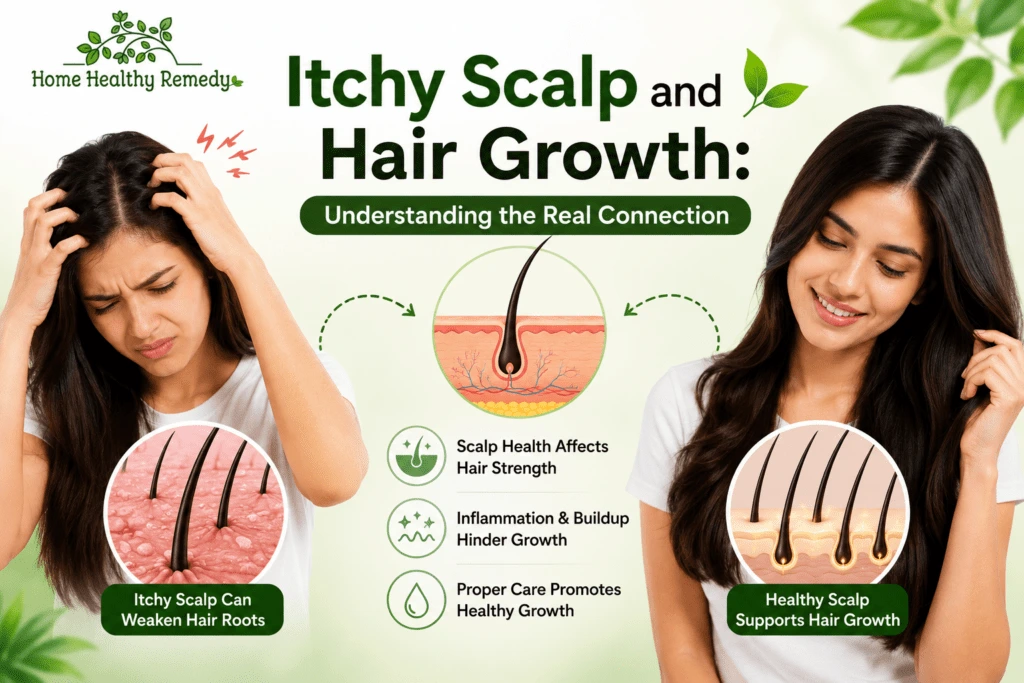
People searching for itchy scalp relief often do not realize how directly their scalp health is connected to how well their hair grows.
A question that comes up constantly: does an Itchy Scalp Relief really affect hair growth? The honest answer is yes — and more significantly than most people realize.
When the scalp is in a chronic state of inflammation, several things happen simultaneously that work against your hair:
- Blood circulation to hair follicles becomes restricted, reducing the supply of oxygen and nutrients needed to sustain the active growth phase.
- The inflammatory environment shortens each follicle’s anagen (growth) phase, producing finer, shorter hairs over time.
- In severe cases, follicle scarring can occur — particularly with conditions like tinea capitis (ringworm) or long-untreated scalp psoriasis — leading to permanent hair loss in those areas.
- The act of scratching itself creates physical trauma, weakening follicles and breaking hairs at the root.
The flip side of this is equally important: a healthy, well-nourished scalp is the single most powerful foundation for strong, fast hair growth. If you want to grow hair faster, the most overlooked lever you have is not a biotin supplement or a hair mask — it is keeping your scalp clean, calm, pH-balanced, and well-circulated.
Practical steps to grow hair faster while managing scalp conditions:
- Use a scalp serum containing rosemary oil (studies have shown it rivals minoxidil in promoting hair density), niacinamide, or peptides between washes
- Massage your scalp for 5 minutes daily to boost follicle circulation
- Avoid tight hairstyles, heat styling, and chemical treatments during active flare-ups
- Wash hair 2 to 3 times per week — enough to remove buildup without stripping the scalp’s protective oils
- Switch to a sulfate-free, fragrance-free shampoo and conditioner
- Supplement biotin, vitamin D, and omega-3s if dietary intake is low
Once your scalp condition is under control, most people notice their hair begins growing faster, shedding less, and feeling significantly stronger within 3 to 6 months.
The Complete Pros and Cons of Every Major Itchy Scalp Relief Treatment
Making the right choice for your scalp means understanding not just what each treatment offers, but where it falls short. Here is an honest, thorough breakdown:
| Treatment Method | Pros | Cons |
| Zinc Pyrithione Shampoo | Clinically proven; widely available OTC; gentle enough for daily use; controls both fungus and sebum | Can be drying with excessive use; does not address all dandruff causes; requires consistent routine |
| Ketoconazole Shampoo | Most powerful antifungal available; fast-acting; effective even on stubborn cases | Prescription strength requires doctor visit; OTC version (1%) may be slower; potential for dryness |
| Selenium Sulfide Shampoo | Dual action — antifungal and slows skin cell shedding; affordable; proven effective | Can slightly discolor lighter hair; not suitable for daily use; strong chemical smell |
| Salicylic Acid Shampoo | Excellent scalp exfoliant; removes flake buildup; boosts effectiveness of other actives | Can over-dry the scalp if overused; not antifungal on its own; may cause initial sensitivity |
| Coal Tar Shampoo | One of the oldest proven treatments; highly effective for psoriasis and eczema | Stains light-colored hair; strong odor; increases sun sensitivity on treated areas |
| Tea Tree Oil | Natural antifungal with clinical backing; affordable; easy to add to existing routine | Must be diluted — causes burns if used neat; slower than prescription actives; strong scent |
| Coconut Oil | Deeply moisturizing; antifungal; gentle; widely available | May worsen oily scalp conditions; leaves heavy residue if not fully washed out; not antifungal enough for moderate-severe dandruff |
| Apple Cider Vinegar | Restores pH balance; antimicrobial; inexpensive | Strong smell; stings on broken or inflamed skin; provides mainly temporary relief |
| Aloe Vera | Soothing and anti-inflammatory; gentle for all skin types; immediate cooling relief | Not antifungal at therapeutic levels; best for mild itch or eczema-driven irritation; needs pure gel (no added alcohol) |
| Colloidal Oatmeal | Clinically proven for eczema; repairs skin barrier; safe for babies and sensitive scalps | Best for eczema-type itch only; messy to apply; no direct antifungal action |
| Peppermint Oil | Fastest natural itch relief; cooling sensation; study-backed; improves circulation | Must be diluted; cooling feel wears off quickly; not a standalone cure for underlying fungal issues |
| Neem Oil | Strong antifungal and anti-inflammatory; effective for dermatitis and psoriasis | Very strong smell; must be diluted; less available than other oils |
| Scalp Massage | Boosts circulation; supports hair growth; pairs well with oils; free to do daily | No direct antifungal action; results take weeks; requires consistency |
| Diet and Nutrition Changes | Addresses root internal causes; permanent long-term benefits; improves overall health | Slowest approach to see results; difficult to isolate specific dietary drivers |
| Stress Management | Reduces cortisol-driven scalp inflammation; no side effects; total body benefit | Very indirect benefit; requires sustained lifestyle change; not a quick fix |
| Prescription Treatments | Strongest efficacy available; targeted to your specific diagnosis; fastest for severe cases | Requires dermatologist visit; potential side effects (steroids, immunosuppressants); cost |
Daily Scalp Care Habits That Make Your Itchy Scalp Relief Last
You can use the best shampoo and the right oils — but if your daily habits are working against your scalp, you will keep taking two steps forward and one step back. Here is a sustainable daily routine that supports lasting itchy scalp relief:
Washing frequency: For consistent itchy scalp relief, wash 2 to 3 times per week. Washing less allows oil, dead skin, and product residue to build up — feeding Malassezia fungus. Washing every single day with harsh formulas strips protective oils and disrupts the scalp’s natural defenses. Two to three times a week is the sweet spot for most hair and scalp types.
Water temperature: One of the simplest habits for itchy scalp relief is switching to lukewarm water. Hot water dehydrates the scalp, dilates blood vessels, and worsens inflammation and itch. It also strips the scalp of its natural protective oil layer far more aggressively than cool water.
Product selection: Choose sulfate-free, fragrance-free shampoo and conditioner. Sulfates (sodium lauryl sulfate and similar compounds) are the single biggest disruptor of the scalp’s pH balance and microbiome. Fragrance is the leading cause of contact dermatitis on the scalp. If your scalp is already sensitive or reactive, these two ingredients are almost certainly making things worse.
Rinse thoroughly: Product residue left on the scalp is one of the most common and underappreciated causes of chronic itch. Spend an extra 30 seconds making sure all shampoo and conditioner is completely rinsed out after every wash.
Between-wash days: On days you do not wash, avoid touching or scratching the scalp. If itch returns, apply a light scalp serum or a diluted peppermint oil blend to the affected area rather than reaching up to scratch.
Sun protection: UV exposure can trigger or significantly worsen scalp psoriasis and other inflammatory conditions. Wearing a hat outdoors or applying SPF to the scalp on exposed areas is smart scalp care, not just sunburn prevention.
5 Best Resource Sites for Itchy Scalp Relief and Scalp Health
When you want to go deeper — whether to understand a specific condition, research a product ingredient, or find a dermatologist — these are the five most credible and thorough resources available:
1. Healthline —healthline.com
Healthline is one of the most widely trusted consumer health platforms online, and their itchy scalp relief content is among the most thorough and well-sourced available. Every article is medically reviewed by board-certified dermatologists, physicians, or pharmacists. Their coverage of scalp conditions — from home remedies for dandruff to the latest research on seborrheic dermatitis — is thorough, well-sourced, and genuinely readable. If you want evidence-backed information explained clearly, start here.
2. Medical News Today —medicalnewstoday.com
For anyone seeking itchy scalp relief backed by clinical research, Medical News Today publishes clinically reviewed content that consistently cites peer-reviewed studies and academic journals. Their sections on scalp pruritus, dandruff, scalp psoriasis, and eczema are particularly strong — presenting complex dermatology information in an accessible format without dumbing it down. Their 2025 update on home remedies for itchy scalp is one of the most current and well-referenced pieces available.
3. GoodRx Health —goodrx.com/health
GoodRx is primarily known as a medication discount platform, but their health content division produces genuinely excellent consumer health articles written by pharmacists and reviewed by physicians. Their guide on medicated shampoos and home remedies for dandruff and itchy scalp is one of the most comprehensive and practical breakdowns available for general readers — covering active ingredients, usage instructions, and what to do when OTC products are not enough.
4. American Academy of Dermatology (AAD) —aad.org
The AAD is the definitive authority on dermatology-related health information — a must-visit for anyone serious about itchy scalp relief based on clinical evidence in the United States. Their public education section covers everything from how to treat dandruff at home to when to see a dermatologist for persistent scalp issues — all written and reviewed by board-certified dermatology specialists. For authoritative, unbiased, professionally reviewed guidance, this is the gold standard.
5. Cleveland Clinic Health Library — health.clevelandclinic.org
Cleveland Clinic consistently ranks among the top hospitals in the United States, and their dermatology team covers itchy scalp relief with the same clinical depth they bring to every topic, and their online health library reflects that standard. Their content on itchy scalp causes, treatments, and prevention is written by dermatologists on staff and covers everything from common dandruff to more complex conditions like scalp psoriasis and contact dermatitis. A particularly reliable source when you want medical-grade guidance without booking an appointment.
Frequently Asked Questions — SERP Edition
Q1. What is the quickest way to get itchy scalp relief at home?
The fastest home remedy for immediate itch relief is diluted peppermint oil. Mix 3 to 5 drops with a tablespoon of carrier oil and massage directly into the scalp. The menthol in peppermint oil provides an almost instant cooling and calming sensation that significantly reduces the urge to scratch within minutes. For slightly longer-lasting fast relief, a cool compress held against the scalp for 5 to 10 minutes also works well. These are not permanent solutions, but they stop the itch cycle while your longer-term treatment — whether a medicated shampoo or a consistent tea tree oil routine — does its deeper work over the following weeks.
Q2. What is dandruff, and how do I know if I have it or just a dry scalp?
Dandruff is a scalp condition caused primarily by a yeast-like fungus called Malassezia that feeds on scalp oil and triggers accelerated skin cell shedding — producing the white or yellowish flakes most people are familiar with. Dandruff flakes are larger, oilier, and tend to stick to the hair. The scalp may also appear greasy or slightly red. A dry scalp, on the other hand, lacks sufficient moisture and produces smaller, whiter, drier flakes that fall off easily, with no accompanying oiliness. The key difference: dandruff needs antifungal treatment, while a dry scalp needs hydration and gentler cleansing. Treating them the same way is one of the most common reasons people do not see improvement.
Q3. Can an itchy scalp lead to hair loss?
Yes — though usually indirectly. The act of repeated scratching creates small wounds on the scalp surface that trigger localized inflammation around the hair follicles. Over time, this chronic inflammation disrupts the hair growth cycle, shortening the active growth phase and leading to thinner, weaker hair. In more severe cases — particularly with untreated seborrheic dermatitis or scalp psoriasis — a process called telogen effluvium can occur, where large numbers of follicles are pushed into a resting phase simultaneously, causing noticeable shedding. The encouraging news is that this type of hair loss is almost always temporary. Once the underlying scalp condition is properly treated and inflammation resolves, hair growth typically returns to normal within a few months.
Q4. Which home remedies actually work for an itchy scalp?
Several home remedies have meaningful scientific support. Tea tree oil is among the best-backed, with clinical studies showing it significantly reduces dandruff-related itch and flaking by directly targeting Malassezia fungus. Coconut oil is effective for dryness-driven itch, offering deep moisturization and mild antifungal benefits. Apple cider vinegar helps restore the scalp’s pH balance and inhibits fungal growth. Peppermint oil delivers fast, cooling itch relief and also improves scalp circulation. Aloe vera is ideal for inflamed or eczema-affected scalps, and colloidal oatmeal is one of the most clinically proven options specifically for eczema-related itching. The right choice depends on your specific cause of itch — identifying that first makes all the difference.
Q5. How often should I wash my hair for better itchy scalp relief?
For most people dealing with dandruff or seborrheic dermatitis, washing two to three times per week is the optimal frequency. Washing too infrequently allows oil, dead skin, and product buildup to accumulate on the scalp — creating the perfect environment for Malassezia to thrive. On the other hand, washing every day with sulfate-heavy shampoos strips the scalp of its natural protective oils and disrupts the microbiome, which can make itching and sensitivity significantly worse. On non-wash days, a lightweight scalp serum or diluted essential oil blend can help manage itch between washes without requiring a full hair wash.
Q6. Does stress really cause scalp itching and dandruff?
Yes, and it is one of the most underappreciated triggers. When you are under chronic stress, your body produces elevated levels of cortisol — a hormone that drives systemic inflammation throughout the body, including in the scalp. This inflammation can trigger or dramatically worsen existing conditions like seborrheic dermatitis, scalp psoriasis, and atopic dermatitis. Stress also suppresses the immune system’s ability to keep Malassezia fungus in check, allowing it to proliferate. Clinical research has found that stress management practices — including exercise, meditation, and adequate sleep — measurably reduce the frequency and severity of scalp flare-ups when combined with appropriate topical treatment.
Q7. Can dandruff stop my hair from growing faster?
Dandruff itself does not directly block hair growth at the follicle level. But the inflammation it causes — if left untreated and allowed to become chronic — absolutely can. Persistent scalp inflammation restricts blood flow to the follicles, shortens the hair’s active growth phase, and over time can cause follicle miniaturization. People with chronically inflamed scalps often notice their hair growing in finer, breaking more easily, or shedding more than usual. Once dandruff is properly controlled and inflammation is brought under control, hair typically resumes growing at a normal rate. The sooner the scalp is treated, the faster and more completely hair growth recovers.
Q8. What ingredients should I avoid in hair products if I have a sensitive, itchy scalp?
The most problematic ingredients for a sensitive or irritated scalp are sulfates (particularly sodium lauryl sulfate and sodium laureth sulfate), which aggressively strip natural oils and disrupt scalp pH. Added fragrance and parfum are a leading cause of allergic contact dermatitis on the scalp and should always be avoided in those with scalp sensitivity. Alcohol-heavy products cause rapid dryness and worsen flaking. Silicones, while not directly irritating, can build up on the scalp and clog follicles over time if not thoroughly washed out. Formaldehyde-releasing preservatives and parabens also trigger reactions in reactive scalps. When in doubt, go fragrance-free, sulfate-free, and keep your ingredient list as short as possible.
Q9. How long does it take to see real itchy scalp relief from treatments?
It depends on the treatment type and the severity of the underlying condition. Peppermint oil provides cooling relief within minutes. Medicated shampoos containing zinc pyrithione or ketoconazole typically reduce itching noticeably within 3 to 7 days and show significant improvement in flaking within 2 to 4 weeks of consistent use. Natural home remedies like tea tree oil, coconut oil, and apple cider vinegar generally take 2 to 4 weeks to produce clear results. For complex conditions like moderate-to-severe seborrheic dermatitis or scalp psoriasis, prescription treatments prescribed by a dermatologist may take 4 to 8 weeks for full effect. The most important variable is consistency — switching products every few days is one of the primary reasons people fail to see improvement.
Q10. When should I stop using home remedies and see a dermatologist instead?
Home remedies and OTC treatments are appropriate for mild to moderate scalp itch and dandruff. But there are clear signals that it is time to see a professional. Book an appointment if your scalp is intensely red, swollen, or painful; if you are losing hair in noticeable amounts or developing visible bald patches; if your symptoms have not improved after 4 to 6 weeks of consistent at-home treatment; if you suspect ringworm, head lice, or a bacterial infection; if you have thick, silvery-white plaques suggesting scalp psoriasis; or if you develop open sores or weeping on the scalp.
A dermatologist can accurately diagnose the specific cause of your itch and prescribe prescription-strength options — ketoconazole shampoos, topical corticosteroids, antifungal pills, biologic treatments, or phototherapy — that simply are not available over the counter.
Conclusion: Your Scalp Deserves the Same Attention as Your Skin
An itchy scalp is not something to normalize. It is not just an annoying quirk of your hair type or the seasons. It is your scalp sending a signal — one that deserves a thoughtful, targeted response rather than a frantic product swap every two weeks.
The six tricks covered in this guide — the right medicated shampoo used correctly, tea tree oil as a natural antifungal, coconut oil and ACV home remedies, scalp massage with peppermint or neem oil, calming treatments like aloe vera and colloidal oatmeal, and the often-overlooked power of nutrition and stress management — represent a complete, layered strategy for genuine, lasting itchy scalp relief.
The moment you understand what is dandruff and what it is doing to your scalp health, the whole picture changes. You stop reacting to the itch and start addressing the cause. And when the cause is addressed properly, the rewards extend far beyond comfort: less flaking, less embarrassment, less shedding, and a scalp environment where healthy hair can actually grow faster, thicker, and longer than before.
Pick one trick and start tonight. Build from there. Be consistent — itchy scalp relief is not just possible, it is closer than most people think. Your scalp — and your hair — will reflect the effort.
This complete guide to itchy scalp relief has been compiled for educational purposes and has been compiled from peer-reviewed sources and leading medical platforms including the American Academy of Dermatology, Medical News Today, Healthline, GoodRx Health, and Cleveland Clinic Health Library. For persistent, severe, or worsening scalp conditions, always consult a board-certified dermatologist.

Natural home remedies, skincare secrets, dental & eye health tips, and real product reviews to help you stay healthy the natural way.