


Introduction: The One-Minute Fix That Actually Works
You woke up this morning and you could barely turn your head. Or maybe it started slowly during a long work meeting — that familiar tightness crawling up from your shoulders, settling like a vice around the base of your skull. Sound familiar? You’re not alone.
Neck pain relief is something that millions of people around the world search for every single day. According to recent global health research, neck pain relief is one of the leading causes of disability worldwide, affecting roughly 30% of the adult population at any given time. It does not discriminate — it hits office workers, athletes, parents, students, and seniors alike. The good news? There is a simple, science-backed trick that can begin delivering neck pain in as little as 60 seconds — and this comprehensive guide is going to walk you through it step by step, along with every supporting strategy you need to stay pain-free for the long term.
Whether you are dealing with acute muscle strain, chronic stiffness, a high stress level causing tension, or a nerve that needs calming, this article covers it all. From proven home remedies to professional-grade techniques, from managing your stress level to achieving nerve calm — everything you need is right here.
So, let us dive in.
What Is Neck Pain? Understanding the Root of the Problem
Before you can achieve genuine neck pain relief, you need to understand what is actually happening inside your body. The neck, or cervical spine, is made up of seven vertebrae (C1 through C7) that support the full weight of your head — roughly 10 to 12 pounds. This delicate column of bones is surrounded by muscles, tendons, ligaments, and nerves that work together to give you mobility and stability.
When any of these structures become irritated, compressed, or inflamed, the result is pain. The pain can range from a dull, nagging ache to sharp, shooting discomfort that travels down the arm — a condition known as cervical radiculopathy, or more commonly, a pinched nerve.
Common Causes of Neck Pain
1. Poor Posture (Tech Neck) One of the most prevalent causes in the modern era. A 2024 cross-sectional study found that 64.6% of heavy smartphone users reported regular neck pain. When your head tilts forward even 15 degrees, the effective load on your cervical spine nearly doubles. At 60 degrees of forward tilt — a common phone-browsing angle — your neck is bearing the equivalent of 60 pounds of pressure.
2. Muscle Strain and Tension Repetitive movements, sleeping in an awkward position, or sitting at a desk for hours without a break can cause the muscles around the cervical spine to become tight and fatigued.
3. Stress Level This is one factor that is dramatically underestimated. Elevated stress level causes your body to hold tension — particularly in the neck, shoulders, and upper back. When your stress level spikes, so does the cortisol in your body, which triggers muscle guarding. Chronic stress essentially keeps your neck muscles in a permanent state of low-level contraction. This is why stress level management is a core pillar of any serious neck pain relief strategy.
4. Cervical Disc Degeneration The discs between your vertebrae act as shock absorbers. With age or repetitive strain, they can dehydrate and degenerate, reducing the space between vertebrae and placing pressure on surrounding nerves.
5. Pinched Nerve (Cervical Radiculopathy) When a nerve root in the cervical spine becomes compressed — either by a herniated disc, bone spur, or inflamed tissue — it triggers pain, numbness, or tingling that radiates down the arm. Achieving nerve calm in this situation requires targeted, gentle techniques to decompress the affected area.
6. Injury and Whiplash Sudden impact — from a car accident, a fall, or a sports collision — can overstretch and tear the soft tissues in the neck, causing acute and sometimes chronic pain.
The 60-Second Trick for Immediate Neck Pain Relief
This is the centerpiece of everything. The technique is called the Cervical Chin Tuck with Isometric Resistance, and it has been validated by physical therapists and supported by clinical research as one of the most effective tools for immediate and sustainable neck pain relief.
Here is exactly how to perform it:
Step-by-Step: The 60-Second Neck Pain Relief Trick
What you need: A wall or the back of a chair. That is it.
Step 1 — Sit or stand with your spine tall. Relax your shoulders down and away from your ears. Do not hunch. Your ears should be directly above your shoulders.
Step 2 — The Chin Tuck. Gently pull your chin straight backward — as if you are making a “double chin.” Do NOT tilt your head down. This movement decompresses the cervical vertebrae and activates the deep cervical flexor muscles, which are the most important stabilizers of the neck.
Step 3 — Apply Isometric Resistance. Place two fingers against your forehead and gently push forward while resisting with your neck — do not allow your head to move. Hold for 5 seconds, then release.
Step 4 — Side Resistance. Place your palm flat against the right side of your head. Push gently outward while resisting with your neck. Hold 5 seconds. Repeat on the left side.
Step 5 — Gentle Rotation. Slowly turn your head to the right as far as comfortable. Hold 5 seconds. Return to center. Then to the left. Hold 5 seconds.
Step 6 — Shoulder Roll Finish. Roll your shoulders backward in a slow, deliberate circle five times.
Total time: Under 60 seconds. Done correctly, this sequence decompresses compressed cervical vertebrae, activates stabilizing muscles, improves blood circulation, and begins the process of nerve calm by reducing mechanical pressure on irritated nerve roots.
Repeat this three to five times throughout your day — especially after long periods of sitting, screen use, or whenever your neck begins to tighten.
Home Remedies for Neck Pain Relief: 10 Proven Strategies
Long-term neck pain relief rarely comes from a single intervention. The most effective approach combines the 60-second trick above with consistent use of evidence-backed home remedies. These home remedies are not folk tales — many of them are supported by peer-reviewed clinical research.
1. Heat Therapy
Applying a warm compress, heating pad, or taking a warm shower is one of the oldest and most effective home remedies for neck pain relief. Heat loosens tight muscles, improves blood circulation, and reduces stiffness. Apply heat for 15 to 20 minutes at a time, two to three times per day.
Pro tip: Use a microwavable wheat bag or a warm, damp towel. The moist heat penetrates deeper into muscle tissue than a dry heating pad.
2. Cold Therapy
For acute injuries or inflammation, cold therapy is your best home remedy. Cold narrows blood vessels, reduces swelling, and numbs sharp pain. Apply an ice pack wrapped in a thin cloth for 10 to 15 minutes every few hours during the first 48 hours after an injury.
Alternating heat and cold — known as contrast therapy — can provide additional benefits by creating a pumping action in blood vessels that flushes out inflammatory chemicals.
3. Essential Oil Massage
Among the most soothing home remedies, essential oil massage addresses both physical tension and the psychological stress level that contributes to neck pain. Research supports the use of several oils:
- Lavender oil: Its calming properties ease muscle tension and promote nerve calm, making it ideal for pain linked to a high stress level.
- Peppermint oil: Contains menthol, which provides a cooling sensation, stimulates blood circulation, and acts as a natural analgesic.
- Eucalyptus oil: Possesses anti-inflammatory properties that can reduce swelling and relieve discomfort.
Dilute 3 to 5 drops of your chosen essential oil in a carrier oil (coconut or olive oil), and massage gently into the neck and upper shoulders in slow, circular motions for 5 to 10 minutes.
4. Apple Cider Vinegar Compress
Apple cider vinegar contains antioxidants and anti-inflammatory agents that can help relieve stress and tension in the neck muscles. Soak a cloth in apple cider vinegar, apply it to the painful area, and leave for one to two hours. This is one of the home remedies that has been used for generations and continues to deliver results.
5. Ergonomic Adjustments
One of the most overlooked home remedies is adjusting your environment. Your monitor should be at eye level so your neck stays neutral. Your chair should support your lower back. Your phone should be lifted to eye level rather than forcing you to look down. These simple changes can eliminate the root cause of neck pain rather than just managing the symptoms.
6. Cervical Pillow
A poor sleeping position is responsible for a significant number of morning neck pain relief cases. Using a cervical or contour pillow that supports the natural curve of the neck can dramatically reduce nighttime strain. Clinical research has confirmed that appropriate pillow use can support spinal alignment, reduce muscle strain, and improve sleep quality in people with chronic neck pain.
7. Yoga for Neck Pain
Yoga integrates physical postures, breathwork, and mindfulness — making it one of the most comprehensive home remedies for neck pain relief. Specific poses that target the cervical region include:
- Marjariasana (Cat-Cow Pose): Stretches the spine and relieves cervical tension.
- Balasana (Child’s Pose): Gently decompresses the neck and promotes nerve calm by calming the nervous system.
- Bhujangasana (Cobra Pose): Opens the chest and counteracts forward head posture.
- Savasana (Corpse Pose): Activates the parasympathetic nervous system, directly lowering stress level and reducing muscle guarding.
8. Hydration
The intervertebral discs in your spine are largely composed of water. Dehydration causes them to shrink and lose their shock-absorbing capability. Drinking at least 8 to 10 glasses of water daily is a foundational home remedy that most people ignore entirely.
9. Anti-Inflammatory Diet
What you eat has a direct impact on inflammation levels throughout your body, including in the cervical spine. Foods rich in omega-3 fatty acids (salmon, walnuts, flaxseed), turmeric, ginger, and dark leafy greens can reduce systemic inflammation and support natural neck pain relief. Conversely, processed foods, refined sugars, and excessive caffeine can spike inflammation and increase pain sensitivity.
10. Acupuncture
A comprehensive systematic review and meta-analysis, covering 26 randomized controlled trials with 3 participants and published in 2025, found that acupuncture demonstrated significantly greater reductions in pain intensity compared to inert treatment. When conventional home remedies reach their limits, acupuncture is one of the most evidence-backed natural alternatives available.
Stress Level and Neck Pain: The Hidden Connection
If you have ever noticed that your neck pain gets worse during a particularly demanding week at work or after a family conflict, there is a very real physiological reason for that. The connection between stress level and neck pain is not just psychological — it is deeply physical.
When your stress level rises, your body releases cortisol and activates the sympathetic nervous system (the “fight or flight” response). One of the immediate effects of this activation is muscle tension — especially in the muscles of the neck, shoulders, and jaw. Your body is preparing to defend itself or run, and it does this by tightening the muscles around your most vulnerable areas.
The problem is that in modern life, stressors are constant and chronic. Your stress level rarely drops long enough for those muscles to fully relax. The result is a cycle of continuous low-grade tension that, over time, builds into chronic neck pain.
A 2025 longitudinal study found that low sleep quality and insufficient physical activity — both of which are strongly linked to elevated stress level — were significant risk factors for the development and persistence of neck pain.
Practical Ways to Lower Your Stress Level and Get Neck Pain Relief
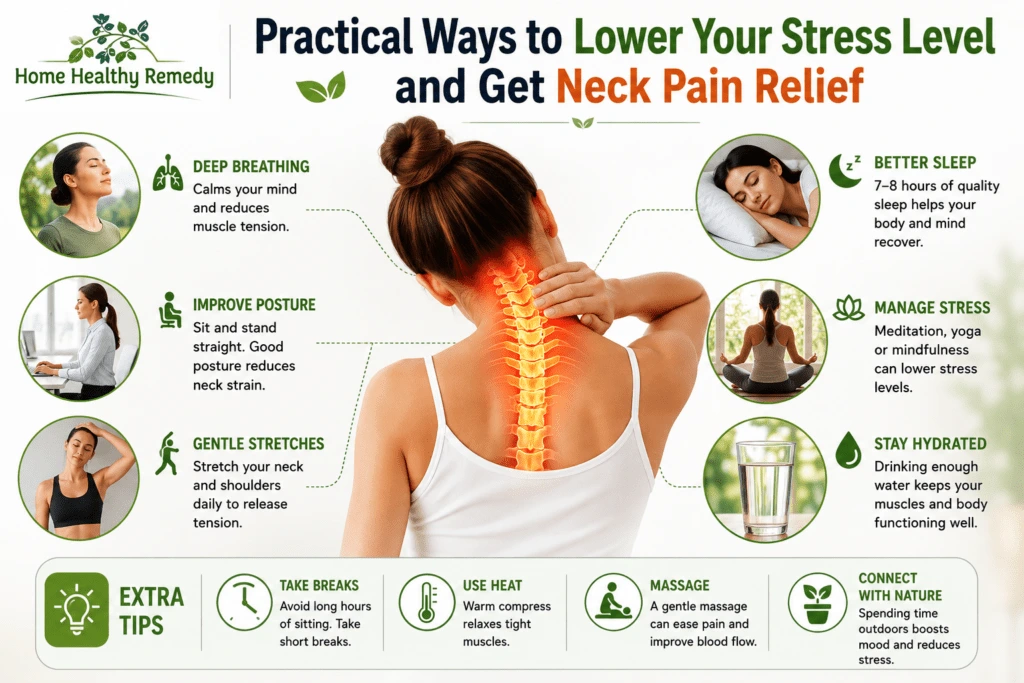
Deep Breathing (Box Breathing): Inhale for 4 counts, hold for 4, exhale for 4, hold for 4. This pattern directly activates the parasympathetic nervous system, lowering your stress level within minutes and triggering muscle relaxation throughout the body — including the neck.
Mindfulness Meditation: Even 10 minutes of daily meditation has been shown to reduce cortisol levels and improve pain perception. Apps like Headspace or Calm make this accessible to beginners.
Progressive Muscle Relaxation (PMR): This technique involves consciously tensing and then releasing each muscle group in the body, starting from the feet and moving upward to the neck and face. It is particularly effective for neck pain because it trains you to recognize and release neck tension you may not even realize you are holding.
Journaling: Writing about your stressors for 15 to 20 minutes before bed can help “offload” mental tension, lowering your overnight stress level and reducing the chance that you wake up with a stiff neck.
Nature Exposure: Research published in environmental psychology journals consistently shows that spending time in natural environments significantly reduces cortisol levels and stress level within 20 minutes — often more effectively than indoor relaxation techniques.
Managing your stress level is not a soft, supplementary strategy — it is a core clinical intervention for long-term neck pain relief.
Nerve Calm: Addressing Cervical Nerve Compression
When neck pain comes with tingling, numbness, or shooting pain down the arm, it is a signal that a nerve root in the cervical spine is being compressed or irritated. Achieving nerve calm in this scenario requires a careful, targeted approach — neither aggressive stretching nor complete rest is appropriate.
Understanding Cervical Radiculopathy
The most common cause of cervical nerve involvement is disc herniation, where the soft inner material of an intervertebral disc pushes outward and presses on a nerve root. Bone spurs from degenerative disc disease can do the same. The affected nerve root determines where the pain, tingling, or numbness travels:
- C5 nerve root: Shoulder and upper arm
- C6 nerve root: Thumb and index finger
- C7 nerve root: Middle finger
- C8 nerve root: Ring and little finger
Techniques for Nerve Calm
1. Neural Mobilization (Nerve Flossing) This is a gentle technique used to relieve nerve tension by moving the nerve through its surrounding tissues. A 2024 systematic review and meta-analysis confirmed the effectiveness of neural mobilization for reducing pain intensity in adults with musculoskeletal pain. To perform basic cervical nerve flossing:
- Sit or stand with good posture.
- Extend your arm to the side with your palm facing upward.
- Gently extend your fingers downward and bend your neck away from your extended arm.
- Hold briefly, then return to neutral.
- Repeat 15 times. Perform slowly and stop if symptoms increase.
2. Cervical Traction Gentle traction — either performed manually by a physical therapist or using an over-the-counter cervical traction device — creates space between the cervical vertebrae, relieving pressure on compressed nerve roots and promoting nerve calm.
3. Ice Before Heat for Nerve Pain When nerve irritation is acute, cold is more effective than heat for reducing inflammation around the nerve root. Apply cold for the first 48 to 72 hours before transitioning to heat therapy.
4. Positional Relief Lying on your back with a small rolled towel under your neck for support can decompress cervical discs and provide nerve calm by restoring the natural cervical lordosis.
5. Anti-inflammatory Supplements Turmeric (curcumin), magnesium, and omega-3 fatty acids have all been studied for their nerve-calming and anti-inflammatory effects. Magnesium, in particular, plays a role in nerve transmission and muscle relaxation — making it especially relevant for promoting nerve calm.
Important: If neurological symptoms (weakness, severe numbness, loss of bladder or bowel control) are present, seek immediate medical evaluation. These can indicate a more serious condition requiring professional intervention beyond home management.
Exercise and Physical Therapy: Building a Pain-Free Neck
Beyond the 60-second trick, a consistent exercise routine is one of the most powerful long-term strategies for neck pain relief. Clinical guidelines consistently rank exercise therapy among the first-line treatments for both acute and chronic neck pain relief.
The Best Exercises for Neck Pain Relief
1. Side Neck Release Targets the sternocleidomastoid and upper trapezius muscles. Sit up straight, slowly tilt your head toward one shoulder, bringing your ear toward your shoulder. Use your hand to apply gentle pressure. Hold 15 to 30 seconds. Repeat on both sides three times.
2. Neck Rotations From a neutral position, slowly turn your head 45 degrees to the left. Hold 5 seconds. Return to center. Repeat to the right. Perform 10 repetitions on each side. This exercise improves range of motion and relieves rotational stiffness.
3. Shoulder Blade Squeezes Sit or stand with your arms at your sides. Squeeze your shoulder blades together as if trying to hold a pencil between them. Hold 5 seconds. Release. Repeat 10 times. This targets the rhomboids and middle trapezius, which are often weak in people with forward head posture.
4. Levator Scapulae Stretch Sit up straight. Place your right hand behind your head. Gently pull your head down and to the right at a 45-degree angle. Hold 30 seconds. This stretches the levator scapulae — a muscle that is almost always involved in neck pain and stiffness.
5. Wall Angels Stand with your back flat against a wall, arms in a “goalpost” position. Slowly slide your arms upward along the wall without allowing your back or head to peel away from it. This exercise restores thoracic mobility and relieves the compensation patterns that lead to cervical pain.
6. Isometric Neck Strengthening This is the foundational movement from the 60-second trick. Regular practice — 2 sets of 10 repetitions, twice daily — has been shown in clinical studies to significantly reduce neck pain and disability over a 6-week period.
Pros and Cons of Common Neck Pain Relief Methods
Understanding the advantages and limitations of each approach helps you make smarter decisions about your care.
| Method | Pros | Cons |
| 60-Second Chin Tuck + Isometric Exercise | Free, fast, no equipment, clinically validated, addresses root cause | Requires consistency; improper form can worsen symptoms |
| Heat Therapy | Immediate muscle relaxation, improves circulation, easy at home | Not suitable for acute injuries; can worsen inflammation if used too early |
| Cold Therapy | Reduces inflammation, numbs sharp pain, ideal post-injury | Temporary relief only; risk of frostbite if ice contacts skin directly |
| Essential Oil Massage | Lowers stress level, promotes nerve calm, natural and soothing | Evidence is largely anecdotal; not a standalone treatment for structural issues |
| Over-the-Counter NSAIDs (Ibuprofen) | Fast-acting, reduces inflammation and pain | Side effects with long-term use; does not address the root cause |
| Physical Therapy | Comprehensive, customized, targets root causes | Requires appointments; cost and time investment |
| Acupuncture | Strong clinical evidence for pain reduction; promotes nerve calm | Needle aversion; cost; variable quality between practitioners |
| Cervical Pillow | Supports spinal alignment during sleep, long-term benefit | Initial adjustment period; finding the right pillow is trial and error |
| Yoga & Meditation | Addresses both physical pain and stress level; holistic approach | Requires learning and consistent practice; not an immediate fix |
| Cervical Traction | Decompresses discs, effective for pinched nerve | Requires correct device and guidance; not suitable for all neck conditions |
| Chiropractic / Manual Therapy | Immediate pain relief from cervical manipulation; evidence-supported | Should be performed only by a licensed professional; rare adverse events |
| Apple Cider Vinegar Compress | Natural, anti-inflammatory home remedy, low cost | Limited clinical evidence; primarily anecdotal support |
When Home Remedies Are Not Enough: Red Flags to Watch For
While the vast majority of neck pain resolves with consistent use of the strategies outlined in this guide, there are situations where professional medical evaluation is not optional — it is essential.
Seek immediate medical attention if you experience:
- Severe, sudden neck pain following an accident or fall
- Pain accompanied by fever, chills, or unexplained weight loss
- Shooting pain, numbness, or weakness down one or both arms that is worsening
- Loss of bladder or bowel control
- Severe headache at the back of the skull
- Neck pain that is progressively worsening despite rest and home treatment
- Pain that prevents you from sleeping or functioning in daily life
These symptoms can indicate conditions such as cervical myelopathy (spinal cord compression), meningitis, or a fracture — none of which should be managed with home remedies alone.
5 Big Resource Sites for Neck Pain Relief Research
For readers who want to go deeper into the science behind neck pain relief, these five authoritative sources are the gold standard:
1. National Center for Biotechnology Information (NCBI) / PubMed
URL:https://www.ncbi.nlm.nih.gov
The world’s largest repository of peer-reviewed biomedical research. PubMed hosts thousands of studies on neck pain relief, cervical spine conditions, manual therapy, exercise interventions, and more. Search “neck pain” and filter by systematic reviews for the highest-quality evidence.
Why it matters: Every major evidence claim about neck pain — from the effectiveness of acupuncture to the role of isometric exercise — can be traced back to studies indexed here. A 2025 systematic review with network meta-analysis on musculoskeletal manipulations for neck pain, published with data from January 2013 to May 2025, is just one example of the cutting-edge research available.
2. Cleveland Clinic Health Library
URL:https://my.clevelandclinic.org
One of the most respected medical centers in the United States, Cleveland Clinic provides patient-friendly breakdowns of neck pain causes, treatment options, when to see a doctor, home care strategies, and more — all written and reviewed by board-certified physicians.
Why it matters: Bridges the gap between clinical research and practical patient education. Ideal for people who want medically accurate information explained in accessible language.
3. Mayo Clinic
URL:https://www.mayoclinic.org
Mayo Clinic’s patient resources on neck pain cover everything from anatomy and causes to diagnosis, home remedies, medications, physical therapy, alternative treatments, and surgical options. Their information is consistently up to date and reviewed by specialists.
Why it matters: Trusted by both patients and healthcare providers globally. Particularly strong on helping patients understand when self-care is sufficient and when professional intervention is needed.
4. Spine-Health (Veritas Health)
URL:https://www.spine-health.com
A specialized resource dedicated entirely to spine and neck conditions, run by physicians and reviewed by a peer board. Covers cervical anatomy, specific conditions (herniated discs, radiculopathy, degenerative disc disease), exercise guides, surgery information, and patient forums.
Why it matters: The level of specificity here is unmatched for patient education. If you need to understand the difference between C5 and C6 radiculopathy, or want to know whether your symptoms suggest a structural problem, this is the resource.
5. WebMD — Neck Pain Center
WebMD’s neck pain section is one of the most visited health resources on the internet. It covers symptoms, causes, home care, physical therapy, medications, and step-by-step exercise guides reviewed by certified physical therapists.
Why it matters: Highly accessible, well-organized, and frequently updated. The exercise guides — including nodding, side-to-side tilts, and chin tucks — are presented with clear, practical instructions that anyone can follow without prior knowledge of anatomy.
Building a Daily Routine for Lasting Neck Pain Relief
Consistency is the most underrated element of any neck pain relief strategy. Here is a simple daily routine that incorporates everything covered in this guide:
Morning (5 minutes):
- Perform the 60-second chin tuck and isometric routine immediately after waking
- Follow with 3 gentle neck rotations on each side
- Apply a warm compress for 10 minutes while you have your morning drink
Midday (2 minutes):
- Perform the 60-second trick again at your desk
- Do 10 shoulder blade squeezes
- Check your posture — ears over shoulders, screen at eye level
Evening (10 minutes):
- Do 10 minutes of gentle yoga — Cat-Cow, Child’s Pose, or a neck-focused YouTube routine
- Practice 5 minutes of box breathing to lower your stress level
- Apply lavender essential oil massage to the neck and shoulders
- If you have nerve irritation, perform gentle cervical nerve flossing
Before Bed:
- Use a cervical pillow to maintain spinal alignment overnight
- Avoid screen time 30 minutes before sleep (reduces stress level and improves sleep quality)
- Practice a 5-minute body scan or progressive muscle relaxation to achieve nerve calm before sleep
The Psychological Side of Neck Pain Relief
There is a phenomenon in pain medicine called pain catastrophizing — the tendency to exaggerate the threat of pain and feel helpless in the face of it. Research consistently shows that people who catastrophize their pain have worse outcomes than those who approach it with confidence and active coping.
Understanding that neck pain relief is achievable — that your body has the capacity to heal, that the 60-second trick works, that home remedies deliver real results, that lowering your stress level directly reduces your pain — is itself therapeutic.
The brain plays a profound role in pain perception. Techniques like mindfulness, cognitive behavioral therapy (CBT), and acceptance-based approaches have all been shown in clinical trials to reduce the experience of chronic neck pain independently of any physical intervention.
This is not to say the pain is “in your head.” It is absolutely real. But the path to lasting neck pain relief runs through both the body and the mind. Managing your stress level, cultivating nerve calm through breathwork, and building a consistent physical routine creates a comprehensive healing environment that pills and single-point treatments simply cannot replicate.
Summary: Your Complete Neck Pain Relief Action Plan
Let us bring everything together. Here is your complete, evidence-based neck pain relief action plan:
Immediately: Perform the 60-second chin tuck and isometric technique. Apply heat or cold as appropriate for your situation.
Daily: Use the morning, midday, and evening routine outlined above. Practice stress level reduction techniques every day — not only when pain peaks.
Weekly: Perform 3 to 5 yoga or dedicated neck exercise sessions. Consider a professional massage or chiropractic adjustment if chronic tension persists.
Ongoing: Address the root causes — improve your ergonomic setup, switch to a cervical pillow, manage your stress level, stay hydrated, and eat an anti-inflammatory diet.
If symptoms worsen: Do not push through severe or worsening pain. Seek professional evaluation, especially if you experience numbness, weakness, or shooting pain down the arm — these are signs that nerve calm cannot be achieved through home care alone.
The journey to lasting neck pain relief is not always a straight line, but with the right tools, the right knowledge, and the right consistency, it is absolutely achievable.
Frequently Asked Questions (FAQ)
Q: Can neck pain relief happen in 60 seconds?
A: Yes — the chin tuck with isometric resistance technique can deliver immediate reduction in neck tension and begin decompressing cervical vertebrae in under 60 seconds. It is not a permanent cure, but it provides genuine, rapid relief.
Q: Are home remedies effective for neck pain?
A: Absolutely. Heat therapy, cold therapy, essential oil massage, anti-inflammatory diet, cervical pillows, and yoga are all home remedies with clinical or strong empirical support for neck pain relief.
Q: How does stress level affect neck pain?
A: Elevated stress level triggers the release of cortisol and activates the sympathetic nervous system, causing muscle tension — especially in the neck and shoulders. Lowering your stress level through breathing, meditation, and exercise is a critical component of neck pain relief.
Q: What does nerve calm mean and how do I achieve it?
A: Nerve calm refers to reducing the irritation and compression of cervical nerve roots. It is achieved through techniques like neural mobilization (nerve flossing), cervical traction, correct sleeping positions, ice therapy for acute flare-ups, and anti-inflammatory supplements like magnesium and omega-3.
Q: When should I see a doctor for neck pain?
A: If you experience weakness, severe or spreading numbness, shooting pain that does not improve, pain after a trauma, or symptoms that are progressively worsening, see a doctor immediately.
Conclusion
Neck pain relief does not have to involve expensive treatments, complicated protocols, or long waits for specialist appointments. The 60-second trick alone — the cervical chin tuck with isometric resistance — is a clinically supported, immediately accessible technique that can begin shifting your pain within moments of starting.
Combined with proven home remedies, a proactive approach to lowering your stress level, targeted strategies for achieving nerve calm, and the consistency of a daily routine, you have everything you need to reclaim a pain-free neck.
Start with the 60-second trick right now. Then build from there.
Your neck pain relief journey begins at this moment.
Disclaimer: This article is for informational purposes only and does not constitute medical advice. Always consult a qualified healthcare professional before beginning any new treatment, especially if you have a diagnosed spinal condition, neurological symptoms, or if your pain is severe or worsening.

Natural home remedies, skincare secrets, dental & eye health tips, and real product reviews to help you stay healthy the natural way.