

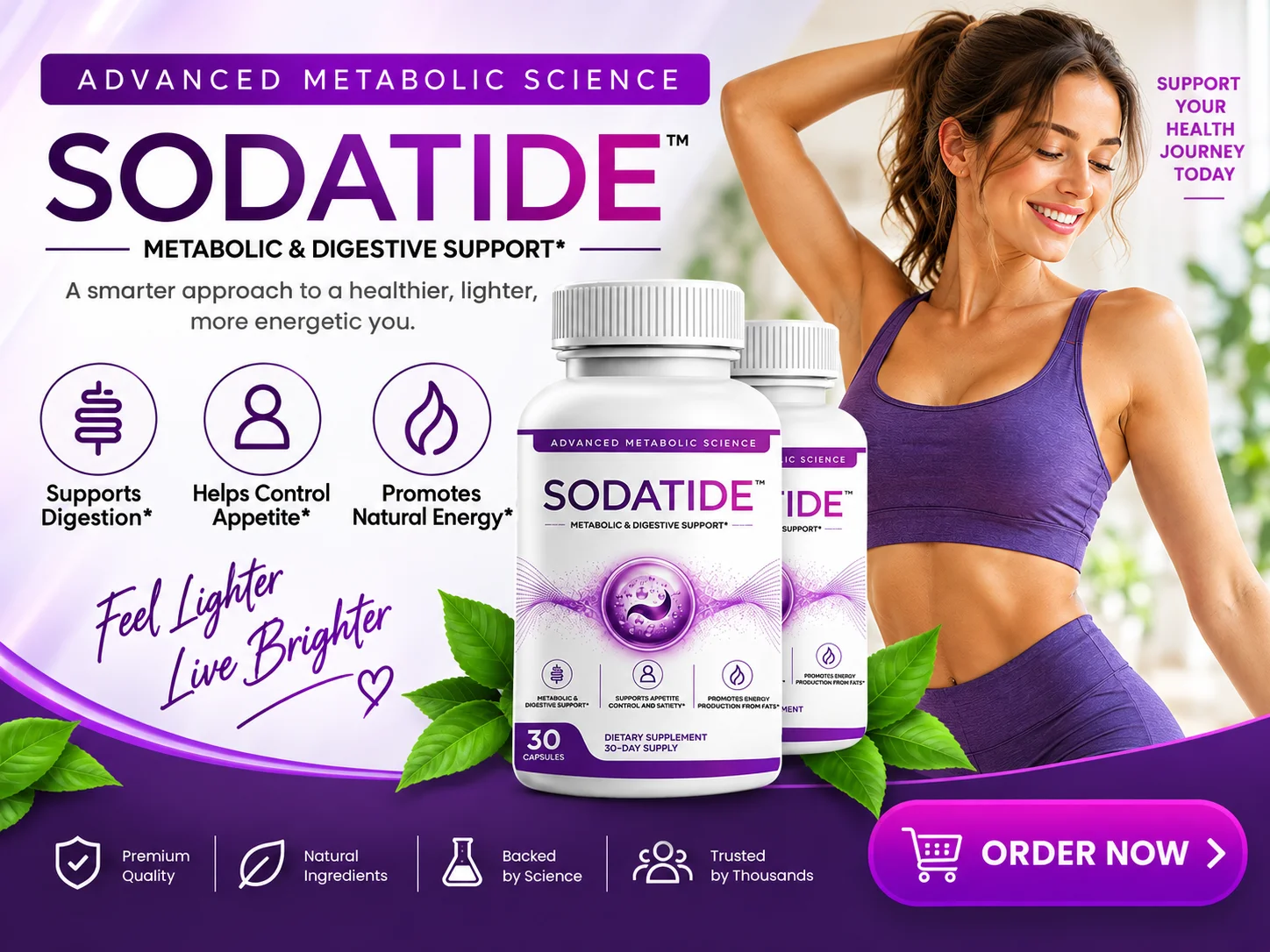
This is a article advertorial containing affiliate links. If you purchase through one of these links, a commission may be earned at no extra cost to you — that relationship does not change the editorial take below, but you deserve to know about it upfront. This piece is promotional consumer-education content about a commercially available product, and disclosure is provided under FTC 16 CFR Part 255.
Before the review starts: claims about SodaTide have not been evaluated by the Food and Drug Administration. SodaTide is a dietary supplement, not a drug, and is not intended to diagnose, treat, cure, or prevent any disease. Individual results vary. If you are pregnant, nursing, on prescription medication, or managing a medical condition, speak with your doctor before starting any new supplement. Pricing, refund terms, shipping, and contact details below reflect what was published as of september 2026 and are subject to change — the official SodaTide website is the authoritative live source.
A quick note on the headline above before diving in: this article is an advertorial analysis of SodaTide’s publicly marketed positioning — its category as a synbiotic formula, its digestive- and satiety-support claims, its pricing structure, its refund policy, and the weight-management language used in its marketing. The phrase “Soda Tide Formula” is the brand’s own naming; “5 pre-purchase checks” describes the buyer-action checklist in this article — specific verifications a buyer can run through the brand’s own public contact channels, not a clinical or laboratory finding by this publication. If you clicked through from a SodaTide ad and want to know whether the marketing lines up with the substance, this is the right place to start.
SodaTide in 90 Seconds: The Short Version Before You Buy
If you’re weighing a $158–$294 SodaTide purchase, there’s a 10-minute pre-purchase check most buyers never bother running. Here’s the condensed version first. SodaTide is a synbiotic dietary supplement — a prebiotic-plus-probiotic combination in a vegetarian capsule — marketed by the brand for digestive support, satiety support, and general weight-management support. Each bottle holds 30 capsules (a stated 30-day supply), and as of september 2026 the published packages range from a 2-bottle starter at $158 plus shipping up to a 6-bottle set at $294 with free shipping, all under a brand-stated 60-day money-back guarantee.
The catch worth flagging up front: the affiliate-checkout page doesn’t print the full Supplement Facts panel, so if strain names and CFU counts matter to you, plan to check the physical bottle label or call customer support first. Everything else about the offer — pricing, the refund window, and how to reach the brand — is straightforward and easy to confirm. The five-point checklist further down walks through exactly how.
SodaTide Quick-Verification Snapshot
| Product type | Dietary supplement — brand-described advanced synbiotic (prebiotic + probiotic) aimed at the gut microbiome |
| Form | Vegetarian capsules |
| Bottle size | 30 capsules per bottle, described as a 30-day supply |
| Brand positioning | Digestive support, satiety support, general metabolic-function support (all brand-asserted) |
| Manufacturing | United States, per brand statement |
| Pricing | 2 bottles: $158 + $9.99 shipping · 3 bottles: $207, free shipping · 6 bottles: $294, free shipping |
| Guarantee | Brand-stated 60-day money-back guarantee |
| Operator | Sodatide Research |
| Support email | contact@customercs.com |
| Support phone | +1 (507) 448-8190 |
| Authoritative source | mysodatide.com |
Buyer Takeaway: Everything above can be confirmed directly from the official SodaTide page and its public contact channels. The one gap label-readers will notice: the full Supplement Facts panel — specific strains, prebiotic fiber, and per-capsule milligrams — isn’t printed on the checkout page itself. That gap is addressed head-on in the ingredients section below.
SodaTide 2026 Fast Facts
- Brand: SodaTide (also styled “Soda Tide”)
- Operator: Sodatide Research
- Category: Synbiotic dietary supplement for digestive and metabolic support
- Format: 30 vegetarian capsules per bottle
- Suggested use: one 30-day supply per bottle, per the brand
- Manufacturing country: United States, per the brand
- Facility claims: GMP-registered and FDA-registered facility, per the brand
- Purity claims: Non-GMO; brand states no listed foreign substances
- Primary benefit claim: digestive support
- Secondary benefit claim: appetite control and satiety support
- Tertiary claim: “energy production from fats” (brand marketing language)
- Starter package: 2 bottles, $158 + $9.99 shipping
- Mid package: 3 bottles, $207, free shipping
- Best-value package: 6 bottles, $294, free shipping
- Refund window: 60 days, brand-stated “no questions asked”
- Support: contact@customercs.com, +1 (507) 448-8190
- Checkout processor: BuyGoods (confirmed at order step)
- FDA status: dietary supplement, not FDA-approved as a drug, not intended to diagnose, treat, cure, or prevent disease
Buyer Takeaway: SodaTide reads as a fairly typical gut-microbiome supplement sitting at mid-tier multi-bottle pricing, backed by a generous refund window. Its three claimed benefit pillars — digestion, satiety, metabolic function — are structure-function claims the FDA disclaimer correctly labels as supplement language rather than drug claims.
Five Things to Verify Before You Order SodaTide
Quick answer: before clicking buy on a $158, $207, or $294 SodaTide order, five short pre-purchase checks — about 10 minutes total — head off the most common buyer complaints: refund confusion, counterfeit risk, and ingredient surprises. Run through these five and you’re covered.
1. Confirm the Supplement Facts panel.
The checkout page reviewed here doesn’t list strain identifiers or CFU counts, even though the printed bottle label is required by FDA rule to carry that information. Call +1 (507) 448-8190 or email contact@customercs.com and ask for the printed panel, image or text. Time: about 2 minutes.
2. Confirm the checkout URL.
At the payment step, the address bar should read buygoods.com. If it shows anything else, stop and contact support before entering payment details — counterfeit and unauthorized-reseller risk is real in this category. Time: about 30 seconds.
3. Get the 60-day refund procedure in writing.
The brand advertises a 60-day guarantee, but the fine print — whether the clock starts at order or delivery, whether opened bottles qualify, who covers return postage, the return address, and any restocking fee — isn’t spelled out on the page. Email support these specific questions and keep the reply. Time: about 3 minutes plus response time.
4. Check in with your own medical context.
If you’re pregnant, nursing, immunocompromised, on prescription medication, or managing a condition — or considering SodaTide as part of weight management — loop in your healthcare provider first. This is general supplement guidance, not a SodaTide-specific flag, but it’s the step buyers skip most often.
5. Confirm your actual checkout total.
The advertised package prices ($158, $207, $294) may not include shipping or tax, which are calculated separately at the BuyGoods order step. Read the final line before you submit payment. Time: about 30 seconds.
Buyer Takeaway: All five checks together run about 10 minutes of hands-on time, plus however long support takes to answer the refund-procedure question. Buyers who work through the list rarely need the refund window — and the ones who do already have the paperwork lined up.
How This Review Was Put Together
Review methodology matters in the supplement space, where affiliate content quality varies enormously. Here’s exactly what went into this piece so you can weigh it against anything else you’ve read on SodaTide.
Sources consulted: the official SodaTide checkout page at mysodatide.com; its linked Terms of Service, Privacy Policy, Returns page, Disclaimer, and Contact page; category-level guidance from the National Center for Complementary and Integrative Health (NCCIH) and Cochrane systematic reviews on probiotics and synbiotics; and current FTC/FDA guidance on supplement marketing.
Timing: sources were reviewed in september 2026, and the pricing, refund, and positioning facts in this article reflect what was live on the brand’s page that month.
What wasn’t done: this publication did not receive a free or compensated product sample, did not interview anyone from the brand, was not given access to internal specifications beyond what’s public, and did not run any lab or field testing on SodaTide. No brand-specific clinical trial was found published on the reviewed lander.
Attribution discipline: any phrase in this article flagged as “according to the brand,” “brand-stated,” or “per the brand” is a brand claim this publication has not independently verified. References to regulatory frameworks (FDA, FTC, EU, California) describe the rules in force as of september 2026.
This article contains affiliate links and may earn a commission on qualifying purchases at no cost to you. The assessment itself was written independently of that relationship — the full disclosure block sits at the bottom of the article.
Update note: SodaTide’s pricing, refund terms, and contact details can change without notice. Treat the live brand site as the final word, and re-verify any price-sensitive detail before you buy.
Buyer Takeaway: Methodology transparency is one of the signals Google’s YMYL guidelines reward, and it’s also a simple way for you to judge whether a review is doing real legwork or just wrapping an affiliate link in filler. Compare this disclosure against other SodaTide write-ups you find — not all of them will be this specific.
About the Marketing Language in This Article’s Headline
The headline above borrows the brand’s own promotional framing. Here’s what each piece actually means — and doesn’t.
“Weight-management support” / weight loss framing
What it means: The brand markets SodaTide within the broader weight-management category, tying the synbiotic mechanism to appetite control, satiety, and metabolic-function support.
What it doesn’t mean: No independently published lab testing verifies weight-loss outcomes for SodaTide users specifically. No clinical endpoint appears on the checkout lander reviewed here, there’s no third-party weight-loss certification, and the FDA hasn’t evaluated any weight-loss claim tied to this product.
“Soda Tide Formula”
What it means: The brand’s own name for its single proprietary formulation, sold in 30-capsule vegetarian bottles.
What it doesn’t mean: The full Supplement Facts panel — specific strains, prebiotic fiber, per-capsule milligrams — isn’t printed on the marketing page. Confirm the printed label before ordering.
“5 pre-purchase checks”
What it means: The editorial framework of this article: sorting brand claims into what’s verifiable, what’s brand-asserted, and what needs a direct buyer confirmation.
What it doesn’t mean: Not a claim of lab analysis, third-party assay testing, or independent strain identification by this publication.
Buyer Takeaway: When a SodaTide ad uses weight-management language, that’s the brand’s own positioning. When this article repeats it, it’s identifying that positioning for readers coming from the ad — neither use guarantees an outcome. The FDA language in the disclosures section below is the regulatory bottom line: supplements aren’t approved to treat, cure, or prevent disease, and results vary by person.
What Is SodaTide, and Who Is It Actually For?
Quick answer: SodaTide is a synbiotic dietary supplement the brand markets for digestive support, satiety support, and weight-management support, aimed at adults looking for gut-microbiome support alongside a broader nutrition and activity routine. It’s not a prescription product, it’s not FDA-approved as a drug, and it doesn’t replace a conversation with your doctor.
In practical terms: the brand calls SodaTide an advanced synbiotic — a blend of prebiotics (fiber that feeds beneficial gut bacteria) and probiotics (bacterial strains, live or shelf-stable). That’s the category label. Within that category, what actually separates one synbiotic from another comes down to three things: which specific strains are used, the type and amount of prebiotic fiber, and whether the label discloses per-strain CFU counts. The page reviewed here doesn’t cover that last point, which is the focus of the ingredients section below.
So who does this fit? Realistically, two kinds of buyer.
If you read supplement labels the way some people read contracts — strain identifiers, per-strain CFU, prebiotic type, per-capsule milligrams, all visible before you click buy — plan to call support and get the printed panel first. A ten-minute phone call handles it.
If you treat the brand’s positioning as a starting point and the refund window as your real safety net, you’ve got 60 days to see how the product performs for you directly. That’s also a reasonable way to approach it.
Buyer Takeaway: SodaTide targets the gut-and-metabolism buyer. Label-focused shoppers should pull the panel before ordering; refund-focused shoppers have two months to find out firsthand. Choose the lane that fits you.
SodaTide Ingredients: Verifiable, Brand-Stated, and Undisclosed
This is the section that matters most in any synbiotic review, and it’s where SodaTide’s public materials leave a real gap. Here’s the straightforward breakdown.
What the brand publicly states:
- SodaTide is positioned as an advanced synbiotic — the brand’s own phrase is “a combination of prebiotics and probiotics”
- Delivered in vegetarian capsules
- 30 capsules per bottle, framed as a 30-day supply
- Three marketed benefit categories: digestive support, appetite-control/satiety support, and “energy production from fats”
- GMP, FDA-registered-facility, non-GMO, and no-foreign-substances badges appear on the checkout lander
What isn’t published on the checkout page reviewed here:
- Specific probiotic strain identifiers (genus, species, and strain designation — e.g., a named strain rather than just “lactobacillus”)
- Per-strain colony-forming-unit (CFU) counts
- Total CFU per capsule or per daily serving
- Specific prebiotic fiber type and milligram amount
- Other inactive ingredients (capsule material, fillers, flow agents)
- A third-party Certificate of Analysis (COA) or potency verification
Worth checking before you buy: synbiotics live or die on strain specificity and viable CFU count at the time you actually take them. A “probiotic blend” without named strains is hard to match against published research, since most of the supporting evidence is strain-specific rather than genus-general. Ask support directly: what are the exact strain identifiers and CFU counts per capsule, and is that CFU count guaranteed through expiration or only at the time of manufacture? Reach them at contact@customercs.com or +1 (507) 448-8190.
Buyer Takeaway: Missing strain and CFU data on a marketing page doesn’t automatically mean a weak product — some brands hold that information for competitive reasons, or reserve it for the printed bottle label rather than the sales page. But it does mean you can’t check the formula against published research without asking. If strain transparency is a priority for you, ask before ordering and treat the 60-day window as your backup verification path.
How SodaTide Is Positioned to Work, According to the Brand
Quick answer: the brand frames SodaTide as working through the gut microbiome — the bacterial population in your digestive tract involved in digestion, some metabolic processes, and appetite signaling. The brand connects supporting that bacterial balance to digestive comfort, satiety cues, and general metabolic function. None of this amounts to an independent treatment claim; it’s category-standard synbiotic positioning.
Some context is useful here. Gut microbiome research has grown considerably over the last decade, and there’s a real body of published work on how specific bacterial strains relate to digestion and certain metabolic pathways. The NCCIH and Cochrane have both published evidence summaries on probiotics noting that trial quality varies, effects tend to be strain-specific, and results from one strain rarely transfer cleanly to another. That’s exactly why strain-level disclosure matters: a strain shown to help digestive comfort in trials doesn’t guarantee the same result from a different strain at a different dose.
The brand’s boldest claim is “energy production from fats.” In supplement-marketing terms, that’s category-general language about metabolic pathways — not a clinically verified fat-burning effect for this specific product. The FDA disclaimer correctly categorizes this as an unevaluated structure-function claim. In plain terms: the brand can use this language within what DSHEA permits, but it shouldn’t be read as a promised weight-loss result.
Buyer Takeaway: The gut-microbiome framing is consistent with the broader synbiotic category and isn’t implausible at that level. Whether SodaTide specifically delivers on its three claimed benefits for any one person is a separate question — one the 60-day refund window exists to let you answer for yourself.
Does SodaTide Actually Work?
Quick answer: SodaTide is a dietary supplement, not an FDA-approved drug, and its claims are structure-function language rather than disease-treatment claims. Results vary by individual. No independently published clinical trial of the SodaTide formula appears on the checkout lander reviewed here. The most honest take: the brand’s positioning is plausible at the category level, no specific outcome can be predicted for any one buyer from public information, and the 60-day refund window is effectively the brand’s built-in way of letting you test it on yourself.
To be blunt about it: synbiotics as a category have research support for certain outcomes at certain strain-and-dose combinations — some bowel-comfort effects, some impact on bloating, some metabolic markers in specific studies. That category-level evidence doesn’t automatically carry over to any particular branded product. Anyone calling their synbiotic “clinically proven” without product-specific trial data is overstating it.
The realistic framing: a synbiotic might help, might not, and the only way to know is to try it within the limits of the refund policy. That’s not a dodge — it’s genuinely how this category works.
Buyer Takeaway: If “does it work” means “is the underlying mechanism scientifically reasonable,” yes, at the broad synbiotic level. If it means “will this specific product do something for me,” nobody — not the brand, not this article — can promise that. The refund policy is the bridge between those two answers.
Is SodaTide a Legitimate Brand? A Quick Verification Framework
Quick answer: based on what’s publicly available as of september 2026, SodaTide shows the standard markers of a real direct-to-consumer supplement business — a working order page, a published refund policy, functioning support contacts, and a recognized checkout processor (BuyGoods). Those markers point to a legitimate commercial operation, not a scam. Whether the product delivers on its marketing is a separate, individual question covered above.
Markers worth checking on any supplement brand, applied here:
- Working support contact: contact@customercs.com and +1 (507) 448-8190, published on the official site
- Recognized payment processor: checkout runs through BuyGoods
- Published refund policy: the 60-day guarantee appears on the checkout page
- Published Terms of Service, linked in the site footer
- Published Privacy Policy, linked in the site footer
- Standard FDA disclaimer present on the official page
Buyer Takeaway: The infrastructure checks out as a genuine commercial operation. “Scam or not” isn’t really the right question here — the better one is whether the formula fits your needs and whether the price feels justified given the available evidence. That’s a personal call, and the 60-day window limits your downside while you make it.
SodaTide Pricing Breakdown (september 2026)
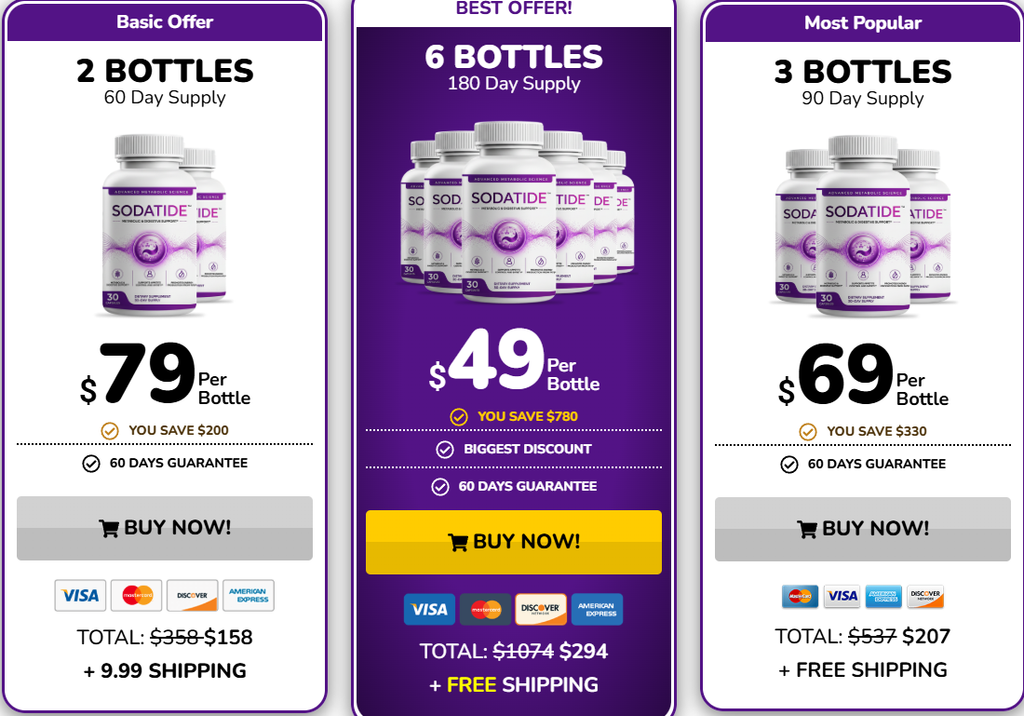
Here’s the brand’s published pricing structure as reviewed for this article. All figures are in US dollars and current as of september 2026; your final total at checkout may include shipping and tax calculated separately at the BuyGoods step, so confirm the total before you submit payment.
| Package | Price | Reference Price |
| 2 bottles (60-day supply) | $158 total ($79/bottle) + $9.99 shipping | Brand reference price: $358 |
| 3 bottles (90-day supply) | $207 total ($69/bottle), free shipping | Brand reference price: $537 |
| 6 bottles (180-day supply) | $294 total ($49/bottle), free shipping | Brand reference price: $1,074 |
On those “before” comparison prices: they’re brand-stated reference points and may not reflect actual prevailing market prices. EU and UK buyers in particular should verify pricing compliance with the EU Omnibus Directive Article 6a, which requires a “before” price to reflect the lowest price charged in the prior 30 days.
Buyer Takeaway: Per-bottle cost drops noticeably at higher tiers — standard for direct-to-consumer supplement pricing. The 6-bottle option saves roughly $30 per bottle over the 2-bottle starter, and shipping turns free once you hit 3 bottles. The 60-day refund window applies across every tier.
The SodaTide 60-Day Refund Policy, in Plain Terms
Quick answer: SodaTide’s lander advertises a 60-day money-back guarantee, described as “100% satisfaction,” “no questions asked.” What it doesn’t spell out: whether bottles need to be unopened, who pays return shipping, whether there’s a restocking fee, or whether the 60 days starts at order date or delivery date. If you’re planning to lean on this window, get the full return procedure from support before you buy — or right after your order arrives.
This is a real point of variation across direct-to-consumer supplement brands. Some accept opened bottles back, some don’t. Some require you to cover return shipping to a specific address; some don’t. A few charge a small restocking fee. The “no questions asked” copy is marketing language — the brand’s Returns page (linked in the site footer) and whatever support tells you at the time of your request are what actually govern the process. A two-minute call before ordering can save real hassle later.
Questions worth asking support before you commit:
- Does the 60-day clock start at order date or delivery date?
- Do bottles need to be unopened to qualify for a refund?
- Who covers return shipping costs?
- What’s the return address?
- Is the full price refunded, or is original shipping deducted?
- Is there a restocking fee?
Buyer Takeaway: A 60-day window is genuinely better than most — many brands cap returns at 30. It’s only useful if you know the exact procedure before you need it, so get the answer in writing (an email reply works fine) and you’ve closed off the most common source of buyer frustration.
SodaTide vs. Prescription GLP-1 Weight-Loss Drugs: Why This Distinction Matters
Quick answer: SodaTide is a dietary supplement — not a prescription medication, not a GLP-1 receptor agonist, and not pharmacologically connected to drugs like semaglutide, tirzepatide, or investigational agents like survodutide. If a name that sounds similar to a prescription drug brought you here, this section should clear things up.
Here’s why the distinction actually matters. Prescription GLP-1 medications (Ozempic, Wegovy, Mounjaro, Zepbound) and investigational dual agonists like survodutide and retatrutide are pharmaceuticals — they require a prescription, clinical evaluation, and ongoing medical oversight. In trials, they’ve produced substantial average weight loss (often in the 15–20%-of-bodyweight range or more) and come with safety and side-effect profiles the FDA reviews before approval.
SodaTide occupies a completely different lane. It’s a synbiotic supplement — prebiotic fiber plus probiotic strains — marketed for digestive support, satiety support, and brand-positioned weight-management support. The mechanism the brand describes (gut-microbiome support) is genuinely different from how GLP-1 drugs function (receptor activation that slows gastric emptying and signals fullness to the brain). Different category, different price point, different safety oversight, different realistic expectations.
So which is right for you? That’s a conversation for your doctor, not an advertorial — but here’s the honest framing for buyers weighing both paths: if you’re a candidate for prescription weight management based on your health history, that conversation starts with a healthcare provider, and no supplement substitutes for a pharmaceutical-grade GLP-1. If you’re after general gut-microbiome support as part of a broader nutrition-and-activity approach, a synbiotic like SodaTide fits the dietary-supplement category — with the expectation that supplement effects tend to be more modest and individual than prescription outcomes. And if you’re hoping for a cheaper substitute that delivers the same result as a prescription drug, that’s the wrong expectation to bring in — supplements aren’t pharmacological stand-ins for prescription medication, whatever any product’s marketing implies.
Buyer Takeaway: SodaTide and prescription GLP-1 drugs sit on different shelves for good reason. If your situation calls for the prescription route, that’s between you and your doctor. If it calls for general gut-microbiome support, SodaTide is one option among many in the synbiotic space, compared against others below.
How SodaTide Stacks Up Against Other Synbiotics
The synbiotic category in 2026 spans everything from sub-$20 drugstore formulas to premium $80–$100-per-bottle products with fully published strain-and-CFU detail. SodaTide lands in the middle on price (roughly $49–$79 per bottle depending on tier) and toward the lower end on public disclosure, since its checkout page doesn’t list strain identifiers or CFU counts.
What to look for when comparing synbiotics:
- Strain identifiers in the standard Genus species strain-designation format
- CFU count per serving — total and per-strain for multi-strain blends
- Whether CFU is guaranteed at expiration (better) or only at manufacture
- Prebiotic fiber type and amount — inulin, FOS, and PHGG have different research profiles
- Storage needs — shelf-stable versus refrigerated affects strain selection and dosing
- Independent third-party testing of label-claim accuracy
- Refund window length — 60 days is above-average, 90 is exceptional, 30 or fewer is buyer-unfriendly
- Manufacturing transparency — country, facility certifications, quality-system disclosures
Buyer Takeaway: Against that framework, SodaTide is comparatively strong on refund window and manufacturing/facility disclosure, and comparatively weak on strain and CFU disclosure on its marketing page. The printed Supplement Facts panel on the physical bottle is required by FDA rule to carry that detail, so this is a marketing-page gap, not necessarily a label gap. If strain transparency is your main filter, you’ll need to contact support or wait for the physical label; if refund terms and basic legitimacy are your filters, SodaTide checks both boxes.
Who SodaTide Fits — and Who It Probably Doesn’t
This isn’t medical advice — it’s a buyer-fit read based on the brand’s positioning and what’s publicly verifiable.
Likely a reasonable fit if you:
- Are an adult looking for general gut-microbiome support alongside a broader nutrition-and-movement routine
- Are comfortable with brand-positioning marketing language and treat the refund window as your real verification tool
- Want a U.S.-manufactured product with brand-stated facility certifications
- Are willing to contact support directly for label details before ordering
- Have the budget flexibility for a 60-to-180-day test period
Probably not the right fit if you:
- Need strain identifiers and CFU counts published on the marketing page before you’ll buy
- Are pregnant, nursing, or managing a medical condition and haven’t yet talked to a healthcare provider
- Are on immunosuppressive medication or have a compromised immune system — a doctor should weigh in on live probiotics for you
- Are looking for a clinically validated weight-loss product — SodaTide is a supplement, not a weight-loss drug, and isn’t marketed as one
- Simply want the lowest per-bottle price available — cheaper drugstore-tier synbiotics exist, with different formulations
- Live somewhere direct-to-consumer supplement shipping is restricted, or where local consumer law changes how refunds work
Buyer Takeaway: Fit matters more than a blanket “good” or “bad” verdict. SodaTide’s public positioning suits one kind of buyer and doesn’t suit another — knowing which one you are before ordering is the difference between a satisfied 60-day trial and an avoidable refund request.
Translating SodaTide’s Marketing Language
SodaTide’s copy uses fairly standard direct-to-consumer supplement phrasing. Here’s a plain-English translation of the phrases that matter most.
“Advanced metabolic science”
Brand positioning language identifying the product category and narrative — not a reference to a specific trial or patent. Read it as framing, not substantiation.
“Supports appetite control and satiety”
A structure-function claim within FDA-permitted supplement language. It doesn’t mean drug-level appetite suppression; it places the product in the satiety-support category.
“Promotes energy production from fats”
A general structure-function reference to metabolic pathways, not a clinical fat-burning claim. The brand’s own FDA disclaimer correctly labels this as unevaluated.
“100% satisfaction” / “no questions asked”
Refund marketing language. The actual governing document is the Returns page and whatever procedure support confirms at the time of your request — get it in writing beforehand.
“Manufactured in the USA”
A brand-stated country-of-manufacture claim. Under FTC 16 CFR Part 323, an unqualified “Made in USA” claim should mean all-or-virtually-all US manufacturing; ask support for specifics if this matters to you.
GMP / FDA-registered facility / non-GMO / no-foreign-substances badges
Brand-displayed positioning icons, common across the category. They’re not the same as USP Verified or NSF Certified third-party programs — different depth of verification.
Buyer Takeaway: The marketing language stays inside FDA-permitted supplement-claim territory and doesn’t cross into drug-claim language, which is the correct regulatory posture. Just don’t mistake structure-function phrasing for a clinical promise.
Safety, Interactions, and Who Should Check With a Doctor First
Synbiotics are generally well tolerated by healthy adults, but “generally” doesn’t answer your specific situation. Here’s the practical safety picture.
Worth discussing with a healthcare provider before starting any synbiotic:
- Immunocompromised status — live probiotics aren’t right for everyone with a weakened immune system
- Active gastrointestinal illness — let your gastroenterologist weigh in
- Pregnancy or nursing — check with your prenatal care provider
- Pediatric use — SodaTide is positioned for adults; children’s synbiotic use is its own separate topic
- Prescription interactions — probiotics don’t typically carry classic drug-interaction risk, but immunosuppressants and certain antibiotics are worth flagging to your prescriber
- Early digestive adjustment — mild bloating or stool changes in the first one to two weeks are common with any new synbiotic, not specific to SodaTide
- Allergies or intolerances — review the full Supplement Facts panel for anything you personally need to avoid
The FDA disclaimer that closes this article exists for a reason: a dietary supplement isn’t a drug, isn’t evaluated for safety or efficacy the way a prescription medication is, and isn’t a stand-in for medical care when you actually need it.
Buyer Takeaway: If any of the considerations above apply to you, talk to your provider before starting, not after. If you’re a healthy adult with nothing flagged, the category’s safety profile is generally favorable, and the 60-day window is your backup if it doesn’t agree with you.
What Independent Research Says About Synbiotics Generally
To be clear, this article isn’t claiming independent clinical testing of SodaTide specifically. What it can offer is the surrounding research context so you can place the brand’s claims appropriately.
The National Center for Complementary and Integrative Health (NCCIH) publishes evidence summaries noting that probiotic effects tend to be strain-specific — a result for one strain doesn’t automatically apply to another — that trial quality across the literature is inconsistent, and that many documented benefits are modest when measured rigorously. Cochrane systematic reviews have found reasonably strong evidence for certain strain-and-dose combinations in specific uses (antibiotic-associated diarrhea, some inflammatory bowel conditions, infant colic); outside those specific indications, the evidence gets considerably more mixed.
For metabolic and satiety outcomes specifically — the territory SodaTide’s marketing leans toward — the published research is more exploratory. Certain strains show modest effects on certain metabolic markers in specific trial designs, but the literature doesn’t support sweeping claims at the category level, and results for one product can’t be assumed from research on a different one.
Reasonable clinicians land in different places on this. Some incorporate synbiotics routinely as general digestive-health support; others rank dietary fiber from food ahead of supplementation outside the specific indications with stronger evidence. Both positions have a legitimate basis.
Buyer Takeaway: Category-level research doesn’t reliably predict outcomes for a specific branded product. That’s exactly why brand-specific clinical data matters when it exists — and why the refund policy carries extra weight when it doesn’t. SodaTide’s checkout lander doesn’t publish brand-specific trial data, which puts the 60-day window at the center of how a buyer actually verifies fit.
Where to Buy SodaTide (and How to Avoid Counterfeits)
Quick answer: the brand directs buyers to mysodatide.com, with checkout handled through BuyGoods. Be cautious of third-party marketplace listings (Amazon, eBay, and similar) for any direct-to-consumer supplement — counterfeit or expired stock is a genuine risk in this space, and the brand’s refund guarantee likely doesn’t extend to product bought outside its official channel.
This isn’t a SodaTide-specific warning; it’s a general buyer-protection principle. When a brand routes sales through a controlled checkout, third-party listings of the “same” product are typically unauthorized resellers outside the brand’s quality control, near-expired inventory sold at a discount, or outright counterfeits. The brand’s refund process usually doesn’t cover any of the three.
How to confirm you’re on the right site:
- URL reads mysodatide.com, not a lookalike domain
- Checkout routes through buygoods.com at the order step
- Support contact matches contact@customercs.com and +1 (507) 448-8190
- Terms of Service, Privacy Policy, and Returns pages are linked in the footer
Why SodaTide Reviews Online Can Look So Similar
This comes up with almost any popular direct-to-consumer supplement, so it’s worth addressing directly. Search for SodaTide reviews and you’ll find a cluster of similarly worded affiliate pages, near-identical social testimonials, and third-party aggregator sites with inconsistent verification standards. Here’s why, and how to read around it.
Affiliate marketing in this category produces a high volume of content because affiliates earn commission on referred sales, and many work from similar brief materials — which naturally produces stylistic overlap across independent sites. That’s a feature of the affiliate economy, not necessarily proof any individual review is fake. It does mean the sheer volume of affiliate content out there shouldn’t be mistaken for independent verification.
Third-party platforms (Trustpilot, Sitejabber, and similar) have their own quirks: positive reviews are sometimes solicited right at the moment of satisfaction, negative ones at the moment of complaint, and review counts aren’t independently audited. FTC 16 CFR Part 465 — the Fake Review Rule effective October 21, 2024 — has tightened the rules around review authenticity industry-wide, but reading critically still matters.
How to read reviews more usefully:
- Weight specific, narrative reviews (use case, timeline, outcome) more than short generic ones
- Look for verified-purchase indicators where they’re available
- Treat clusters of identical phrasing as a sign those reviews share a common origin
- Don’t read the absence of negative reviews on a brand’s own site as proof of universal satisfaction — it’s a curation choice
- Take both glowing and furious reviews with a grain of skepticism; the real picture usually sits somewhere in the middle
The brand’s own disclaimer notes that testimonials aren’t meant to represent or guarantee that any other user will see the same results, and that some names and identifying details on its site have been changed for privacy — standard practice in this category.
Buyer Takeaway: Don’t outsource your purchase decision to review aggregators. Read the brand’s actual claims, verify what you can, ask support what you can’t, and lean on the refund window if the product doesn’t work out. That framework holds up regardless of how the review landscape shifts around it.
Full Verification Checklist Before You Order
Save or screenshot this section before you commit. Working through it takes about ten minutes and resolves most of the friction points buyers report in this category.
- Confirm the URL — mysodatide.com, not a lookalike, with checkout through BuyGoods.
- Confirm pricing — check package price, shipping, and any tax at the BuyGoods step before submitting.
- Confirm the refund procedure — call or email support and ask about window start date, opened/unopened policy, return shipping, return address, and any restocking fee. Save the reply.
- Confirm the Supplement Facts panel — request the printed label image or text if strain transparency matters to you.
- Confirm subscription status — verify it’s a one-time purchase rather than auto-renewal at checkout.
- Confirm your medical context — talk to a provider first if you’re pregnant, nursing, immunocompromised, on medication, or managing a condition.
- Confirm your timeline expectations — synbiotic effects, if they show up, typically build over weeks, not days.
- Confirm your fallback — know the exact refund process before you need it, not after.
Buyer Takeaway: Ten minutes of upfront verification prevents most post-purchase regret. Support is reachable, the refund policy is real, and the verification path is entirely open if you choose to use it.
Package pricing and 60-day guarantee terms below were confirmed directly on the official SodaTide order page.
SodaTide: Frequently Asked Questions
What is SodaTide?
SodaTide is a dietary supplement marketed as an advanced synbiotic — a prebiotic-and-probiotic combination — sold in 30-capsule vegetarian bottles positioned as a 30-day supply. The brand markets it for digestive support, appetite-control and satiety support, and general metabolic-function support. It isn’t FDA-approved, isn’t a weight-loss medication, and doesn’t replace medical evaluation.
Is SodaTide FDA approved?
No. It’s a dietary supplement, regulated under DSHEA rather than approved the way prescription drugs are. The brand states its facility is FDA-registered, which is a facility-level designation, not drug approval. The standard supplement disclaimer applies: claims haven’t been evaluated by the FDA, and the product isn’t intended to diagnose, treat, cure, or prevent disease.
What are the ingredients in SodaTide?
The brand describes it at a category level as an advanced synbiotic targeting the gut microbiome. Specific strain identifiers, per-strain CFU counts, and prebiotic fiber details aren’t published on the checkout page. The printed bottle label is required by FDA rule to carry that full information — request it from support at contact@customercs.com or +1 (507) 448-8190.
How much does SodaTide cost?
As of september 2026: 2 bottles for $158 plus $9.99 shipping, 3 bottles for $207 with free shipping, and 6 bottles for $294 with free shipping — working out to $79, $69, and $49 per bottle. The listed “before” prices are brand-stated reference points. Final totals may include tax and shipping calculated at checkout.
Is there a money-back guarantee?
Yes — a brand-stated 60-day “100% satisfaction” guarantee. The specifics (start date, opened-bottle policy, return shipping, restocking fee) aren’t detailed on the lander, so request the full RMA procedure from support before or right after ordering.
How long before SodaTide starts working?
The brand doesn’t publish a specific timeline, and results vary by individual. As a general rule, synbiotic effects — when they occur — tend to build over weeks rather than days, with a four-to-eight-week window being reasonable to evaluate. The 60-day refund period roughly aligns with that.
Are there side effects?
None are listed specifically for SodaTide on the reviewed page. As a category, synbiotics are generally well tolerated, with mild, temporary digestive adjustment (bloating, stool changes) in the first week or two being the most commonly reported issue. Anyone immunocompromised, pregnant, nursing, or managing a condition should check with a provider first.
Where is SodaTide manufactured?
The brand states the product is made in the United States. Under FTC 16 CFR Part 323, an unqualified “Made in USA” claim should reflect all-or-virtually-all domestic manufacturing. Ask support for specifics on which steps happen where if this matters to you.
Is it a subscription or a one-time purchase?
The packages on the reviewed page present as one-time purchases, not auto-renewing subscriptions. Confirm this at the BuyGoods checkout step, since terms can change; if a subscription option appears later, FTC Click-to-Cancel rules govern its renewal and cancellation disclosures.
Can I buy SodaTide on Amazon or another marketplace?
The brand points buyers to mysodatide.com with BuyGoods checkout. Third-party marketplace listings carry counterfeit and expired-stock risk, and the refund guarantee may not cover purchases made outside the official channel.
How do I contact SodaTide support?
Email contact@customercs.com or call +1 (507) 448-8190. These are the right channels for refunds, returns, label questions, and order status — keep your confirmation email and any support replies on file.
Does the 60-day refund window start at order or delivery?
The lander doesn’t specify. This matters: if it’s order-date-based and shipping takes 7–10 days, you effectively have closer to 50 usable days; if it’s delivery-based, you get the full 60. Email support before ordering and ask directly — save the written answer.
What’s the most common purchase mistake to avoid?
Buying the largest package (6 bottles at $294) before confirming the refund process. Bigger packages have better per-bottle economics, but they also mean more money at risk if the product isn’t a fit. A more cautious approach: start with the smallest package, confirm it works, then reorder larger next time.
What if my order doesn’t arrive on time?
Standard shipping for similar supplements typically runs 5–10 business days, though SodaTide’s specific timeline isn’t published on the reviewed page. If nothing’s arrived by day 14, contact support with your order number. If you added Priority + Insured Shipping, the brand commits to a free reshipment for delivery problems.
Is SodaTide the same thing as survodutide or a prescription GLP-1 drug?
No. SodaTide is a synbiotic dietary supplement, unrelated pharmacologically to prescription GLP-1 medications like semaglutide or tirzepatide, or investigational agents like survodutide. The similar-sounding names are coincidental. SodaTide works through gut-microbiome support; GLP-1 drugs work through receptor activation and require a prescription and clinical oversight.
Will SodaTide cause weight loss?
It isn’t a weight-loss drug and isn’t FDA-approved as one. Its marketing references appetite control, satiety, and metabolic-function support as structure-function claims — not clinical weight-loss promises. No specific outcome is guaranteed, and results vary.
Is it safe with other medications?
Probiotics generally don’t carry classic drug-interaction risk, but immunosuppressants, certain antibiotics, and active treatment for serious conditions are worth flagging to your prescriber, who knows your full medication picture.
How is a synbiotic different from a regular probiotic?
A synbiotic pairs a probiotic (bacterial strains) with a prebiotic (fiber that feeds those bacteria); a standard probiotic delivers strains alone. Whether that combination is meaningfully better depends on the specific strains, fiber, and dose used — details not independently published for SodaTide on the reviewed page.
Morning or night — when should I take it?
The brand implies one capsule daily (30 capsules per 30-day bottle) but doesn’t publish specific timing guidance. For most synbiotics, consistency matters more than the exact time of day. Ask support if timing guidance matters to you.
Does SodaTide publish any customer reviews or testimonials?
The brand references user testimonials on its site but, per its own disclosure, notes these aren’t meant to represent or guarantee results for anyone else, and that some identifying details have been altered for privacy. Treat testimonials as anecdotal rather than as evidence of typical results.
Final Verdict and Buyer Decision Framework
Decision point: if you’ve made it this far, you’ve done more homework than most SodaTide buyers ever will. What’s left is matching the brand’s public positioning against your own needs — and deciding whether the 10-minute verification checklist closes the ingredient-transparency gap well enough for you.
SodaTide presents as a standard direct-to-consumer synbiotic with the usual infrastructure in place: an official site, BuyGoods checkout, a published refund policy, reachable support, FDA-disclaimer compliance, and brand-stated US manufacturing. Pricing sits in the middle of the category — $49 to $79 per bottle depending on tier — with a 60-day refund window that’s above-average for the space. None of that is exaggeration; it’s simply what’s publicly confirmable.
The honest gap is on the marketing page itself. Strain identifiers, per-strain CFU counts, and prebiotic fiber detail aren’t printed there, even though FDA rule requires the full label on the physical bottle, and support can confirm specifics before you order. Whether that gap matters is up to you: strain-focused buyers should close it before purchasing; refund-focused buyers can treat the 60-day window as their verification path instead. Both are reasonable — just be honest with yourself about which one describes you.
The weight-management framing in this article’s headline and the “energy production from fats” language both sit inside FDA-permitted supplement-claim territory and shouldn’t be read as a clinical fat-loss guarantee. The FDA disclaimer below exists for a real reason: supplements aren’t drugs, aren’t evaluated the way pharmaceuticals are, and aren’t a substitute for medical care when you actually need it.
In plain terms: SodaTide is a reasonable option within the synbiotic category if you’re a healthy adult interested in general gut-microbiome support, comfortable with brand-positioning marketing language, want a US-manufactured product with a working refund mechanism, and are willing to spend ten minutes with support closing the label gap. It’s probably not the right fit if you need strain and CFU data printed on the marketing page upfront, have a medical condition that affects supplement choices, or are after a clinically validated weight-loss product.
Buyer Takeaway: The verification path is open — use it before ordering, not after. The 60-day refund window is your safety net either way. Whichever way you go, you’re deciding with the full picture in front of you, which is the entire point of reading a review like this before clicking buy instead of after.
Contact Information
| Company | Sodatide Research |
| contact@customercs.com | |
| Phone support | +1 (507) 448-8190 |
| Checkout platform | BuyGoods |
Scientific Resources
This article’s category-level research context draws on the following authoritative sources for background on probiotics, prebiotics, synbiotics, and gut-microbiome research. None of these sources have evaluated the SodaTide product specifically.
- National Center for Complementary and Integrative Health (NCCIH), NIH — Probiotics: What You Need to Know
- NIH Office of Dietary Supplements (ODS) — Dietary Supplements for Dieting and Weight Loss: Background Information
- Cochrane Library — Systematic Reviews on Probiotic and Synbiotic Use for Gastrointestinal and Metabolic Outcomes
- PubMed / PMC (National Library of Medicine) — Peer-Reviewed Research on Strain-Specific Probiotic and Synbiotic Effects
- U.S. Food and Drug Administration (FDA) — Dietary Supplements: What You Need to Know
- Mayo Clinic — Probiotics and Prebiotics: What You Should Know
- Federal Trade Commission (FTC) — Health Products Compliance Guidance and Dietary Supplement Advertising
Disclaimers
FDA Disclaimer
Statements about SodaTide made in this article and on the brand’s website have not been evaluated by the Food and Drug Administration. SodaTide is a dietary supplement and is not intended to diagnose, treat, cure, or prevent any disease. Individual results vary. Readers experiencing symptoms of a medical condition should consult a qualified healthcare provider rather than rely on a dietary supplement.
FTC Affiliate Disclosure
This article contains affiliate links. A commission may be earned on qualifying purchases made through this content, at no additional cost to the reader. Affiliate relationships do not influence editorial content or product evaluation. Disclosure is provided under FTC 16 CFR Part 255.
FTC 16 CFR Part 255 — Testimonial Variability
Testimonials, case studies, and customer experiences referenced in connection with SodaTide reflect what individual users have reported and are not intended to represent or guarantee that anyone else will achieve similar results. Customer ratings and testimonials referenced are brand-reported and have not been independently audited by this publication. Individual experiences vary. Per the brand’s own disclosure, some names and identifying details on its site have been changed to protect privacy.
FTC 16 CFR Part 465 — Fake Review Rule
All review-volume, satisfaction-score, and customer-feedback data referenced in this article is brand-reported and has not been independently audited by this publication. This publication does not solicit, generate, or post customer reviews of SodaTide. Buyers are encouraged to evaluate feedback across multiple sources critically, look for verified-purchase indicators where available, and weigh reviewer-specific context against their own situation.
FTC 16 CFR Part 323 — Made-in-USA Labeling
The brand states SodaTide is manufactured in the United States. Unqualified “Made in USA” claims under FTC rules require the product be all-or-virtually-all US-made. Buyers wanting detail on which manufacturing steps occur where can request specifics from customer support.
FTC Junk Fees Rule and State Drip-Pricing Laws (CA SB 478, NY GBL)
Final checkout pricing may include shipping and applicable taxes calculated separately at the BuyGoods order step. Confirm your final total before completing purchase. Comparison “before” prices referenced on the brand’s lander are brand-stated reference points and may not reflect prevailing market prices.
EU Omnibus Directive Article 6a
For EU and UK buyers: where the brand displays a price reduction alongside a higher “before” reference price, EU consumer-protection law requires that “before” price reflect the lowest price applied in the prior 30 days. EU and UK buyers are encouraged to verify pricing compliance directly with the brand before purchase.
Magnuson-Moss Warranty Act
Any product warranty referenced or implied in connection with SodaTide is, where applicable, a limited warranty as defined by the Magnuson-Moss Warranty Act (15 U.S.C. §2303). The brand’s 60-day refund offer is a satisfaction-based money-back guarantee, not a manufacturer’s warranty of merchantability.
California Proposition 65 Notice
California residents should review the product label, any brand-published Proposition 65 information, and consult customer support for any product-specific Proposition 65 disclosures applicable to SodaTide before purchase. This is a standing California-specific disclosure applicable to dietary supplements sold in the state.
Geographic and Jurisdictional Disclosure
Pricing, availability, shipping, refund mechanics, and consumer-protection terms vary by geography. Statements in this article reflect the US direct-to-consumer commercial framework as published by the brand. EU, UK, Canadian, Australian, and other non-US buyers are subject to their own jurisdictional consumer-protection laws, which may modify or supplement the brand’s published terms.
Trademark Acknowledgment
SodaTide is a trademark of Sodatide Research as published on the brand’s official website (stylized SODATIDE™). Other product, brand, or category names referenced in this article belong to their respective owners and are used here for nominative identification and editorial comparison purposes only. The ® symbol is not applied to the SodaTide name in this article because the brand’s own lander uses the ™ designation; registered-mark status has not been independently verified by this publication.
YMYL Evidence Balance
Dietary supplement effects, including synbiotic effects, are strain-and-dose specific and vary by individual. NCCIH, Cochrane, and peer-reviewed literature publish evidence summaries noting variable trial quality and modest effect sizes for many supplement claims. Reasonable clinicians can and do disagree on the practical value of synbiotic supplementation outside indications with stronger evidence. This article presents brand positioning alongside category-level research context to support informed buyer decisions; it does not constitute medical advice and does not substitute for individualized clinical evaluation.
Material Limitations of This Review
This review is based exclusively on publicly available materials: the official SodaTide website at mysodatide.com, its published Terms of Service, Privacy Policy, Returns page, Disclaimer, and Contact page, and general industry guidance on synbiotic dietary supplements. This publication did not receive a compensated product sample, did not interview brand personnel, was not given access to internal specifications beyond what’s public, and did not conduct laboratory or field testing of SodaTide. Claims flagged as “according to the brand,” “brand-stated,” or “per the brand” reflect the brand’s own public statements and have not been independently substantiated by this publication. Promotional phrases referenced in this article’s title or body — including weight-management framing and “Soda Tide Formula” — originate with the brand’s own marketing materials and are identified here for reader context, not as independent endorsement or a performance guarantee. Buyers should verify any claim that materially affects their purchase decision directly with the brand through its published support channels.
Third-Party Consumer Feedback Platforms
This article references third-party consumer feedback platforms in general category terms only. This publication does not endorse, audit, or take responsibility for the accuracy, completeness, or fairness of reviews posted on any third-party platform, including general review sites, social media, and online forums. Readers consulting such reviews should evaluate them critically, look for verified-purchase indicators where available, and weigh reviewer-specific context against their own situation.
Forward-Looking Statements and Article Accuracy
This article reflects information available as of september 2026, prepared with reasonable care to be accurate at the time of publication. Product specifications, pricing, promotional offers, shipping policies, warranty and return terms, contact information, and customer-feedback data may change after publication without notice. Statements describing expected buyer outcomes or category trends are educational, forward-looking observations, not guarantees. No representation is made that this information will remain accurate indefinitely, and no warranty of merchantability, fitness for a particular purpose, or non-infringement is provided in connection with this article’s editorial content. Readers should treat the official SodaTide website at mysodatide.com as the authoritative source for current product information before purchasing.
Reasonable Consumer Standard
This article is written for a general adult consumer audience and is intended to be read the way a reasonable consumer would read it in context. Where a statement could otherwise read as an independently substantiated fact, attribution language such as “according to the brand,” “brand-stated,” “brand-reported,” or “per the official Terms” identifies it as a brand claim this publication has not independently verified. Promotional superlatives and marketing phrases from the brand’s own website — including but not limited to weight-management framing, “Soda Tide Formula,” “Advanced Metabolic Science,” and “100% Satisfaction” — are explicitly identified throughout this article as brand-asserted marketing language, addressed directly in the dedicated marketing-language sections above, and are not represented as independent third-party rankings, performance guarantees, or laboratory-verified claims by this publication.
SOURCE: SodaTide

Natural home remedies, skincare secrets, dental & eye health tips, and real product reviews to help you stay healthy the natural way.
1 comment
[…] Post- https://homehealthyremedy.com/sodatide-review-check-before-you-buy/ […]