

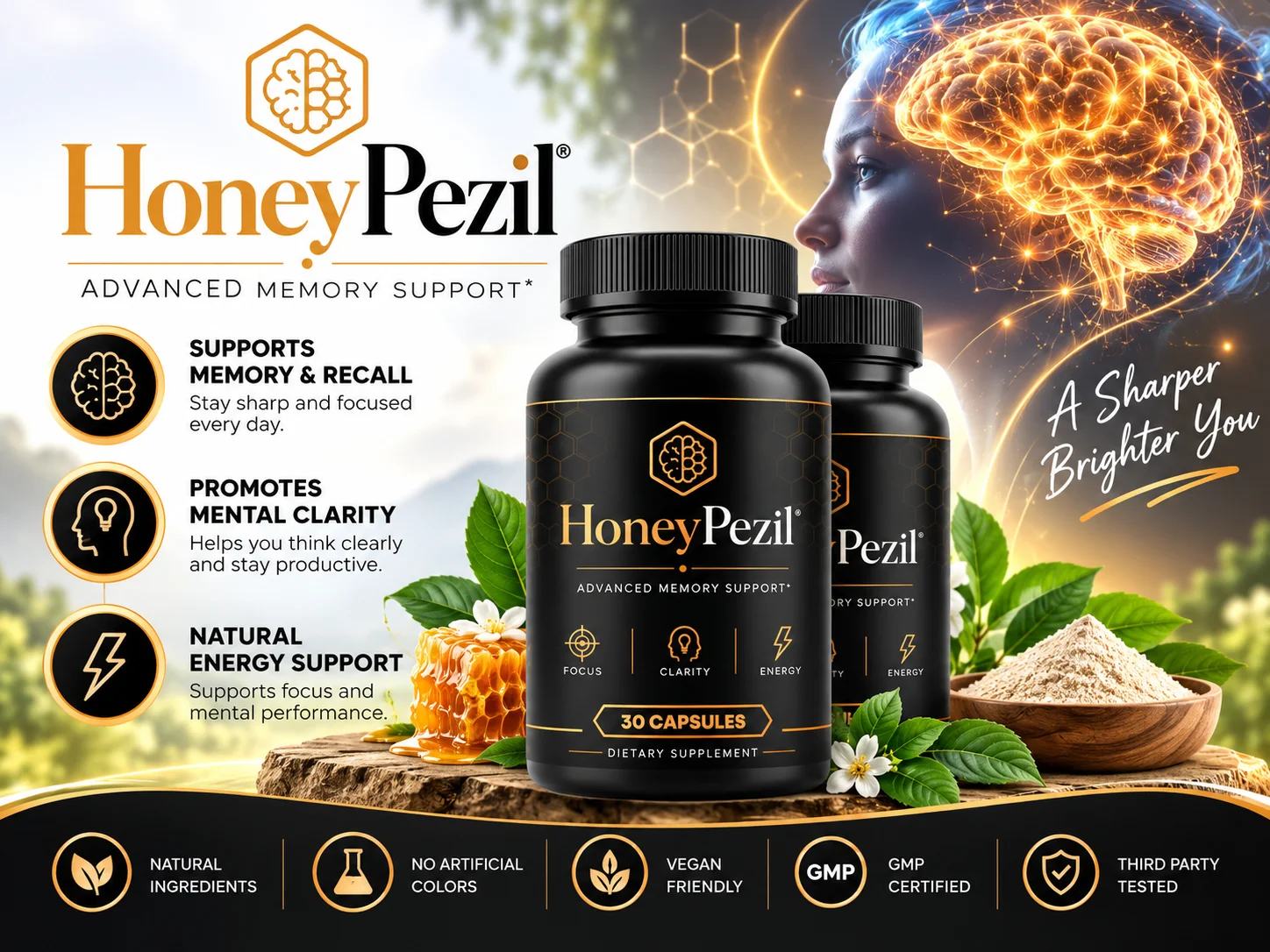
Brain-health supplements are one of the fastest-growing categories in the wellness market, and HoneyPezil has become one of the more talked-about names in that space in 2026. Marketed as a daily capsule for mental clarity, sustained energy, and cognitive well-being, HoneyPezil is sold directly through an online funnel with tiered bottle discounts and a 60-day money-back guarantee, fulfilled through the retailer BuyGoods.
Before recommending any supplement, it’s worth separating the marketing story from what the label and the underlying research actually say. This HoneyPezil review does exactly that — it walks through the full ingredient panel, checks each component against peer-reviewed and government-backed research, and looks honestly at where the science is strong, where it’s thin, and where the marketing may be getting ahead of the label.
See current HoneyPezil pricing and availability
What Is HoneyPezil?
HoneyPezil is a capsule-form dietary supplement, produced in the United States and sold in 30-capsule bottles designed for one-a-day use. It’s positioned as a nootropic-adjacent product — a category of supplements marketed to support memory, focus, and mental sharpness rather than to treat any diagnosed condition.
Unlike many supplements that hide behind proprietary blends, HoneyPezil’s Supplement Facts panel discloses individual ingredients with specific milligram amounts, which several independent review sources have flagged as a genuine point of transparency. That said, transparency about ingredients is different from evidence about outcomes, and that distinction matters throughout this HoneyPezil review.
HoneyPezil Ingredients: What’s Actually on the Label
Reporting on HoneyPezil’s Supplement Facts panel across several independent sources consistently lists the following categories of ingredients.
Vitamins and Minerals
The HoneyPezil formula includes Niacin (Vitamin B3), Vitamin B6, Vitamin B12, Vitamin C, and Vitamin E, each listed in named nutrient forms, along with Calcium, listed as Calcium Carbonate. These are standard micronutrients found in most general multivitamins; B-vitamins in particular play a well-established role in nerve function and energy metabolism, though at the doses typically used in blends like this, they function more as nutritional support than as active cognitive enhancers.
Amino Acids: L-Arginine, L-Citrulline, and Beta-Alanine
The label also includes L-Arginine, L-Arginine AKG 2:1 Extract, L-Citrulline HCl, L-Citrulline Malate, and Beta Alanine, each listed with milligram amounts per serving. This is notable: these three amino acids are the core ingredients of most pre-workout and circulation-support formulas, not memory formulas. That distinction becomes important later in this review.
Botanical Extracts: Ginkgo Biloba and Bacopa Monnieri
HoneyPezil’s plant-based ingredients are Ginkgo Biloba leaf and Bacopa Monnieri, listed by their scientific plant names. These are two of the most widely studied “brain herbs” on the supplement market, with decades of human research behind each — though, as the next section shows, the results are more mixed than marketing copy usually suggests.
DMAE, Phosphatidylserine, and Huperzine-A
Rounding out the formula are DMAE Bitartrate, a Phosphatidylserine Complex, and Huperzine-A. These three ingredients appear in almost every commercial “memory support” stack, and each has a distinct evidence profile worth understanding before you decide whether HoneyPezil is worth trying.
See current HoneyPezil pricing and availability
Does the Science Support HoneyPezil’s Cognitive Claims?
This is the section most HoneyPezil reviews skip. Here’s what the actual research says about each active ingredient.
Ginkgo Biloba: Popular, But the Evidence Is Disappointing
Ginkgo biloba is one of the most heavily researched herbal supplements in existence, and the results are not encouraging for cognitive claims. The National Center for Complementary and Integrative Health notes that ginkgo has not been shown to be effective for any of the conditions for which it has been studied, and there is no conclusive evidence that it is helpful for any health condition. In the large, NIH-funded Ginkgo Evaluation of Memory study, more than 3,000 older adults took ginkgo or a placebo for a median of six years, and there was no difference between groups in rates of developing dementia or Alzheimer’s disease.
A review from the Alzheimer’s Drug Discovery Foundation reaches a similar conclusion: ginkgo may improve memory in people who already have some cognitive impairment, but it does not appear to enhance cognitive function or lower dementia risk in healthy individuals. A separate randomized trial even found ginkgo biloba extract, at 120mg twice daily for 12 weeks, produced no statistically significant improvement in cognitive performance in the population studied. Ginkgo is generally considered safe, but buyers should go in with realistic expectations rather than the “cognitive enhancer” framing common in supplement marketing.
Bacopa Monnieri: The Strongest Ingredient in the Formula
Of everything in HoneyPezil, Bacopa monnieri has the best human evidence behind it. A systematic review of randomized controlled trials found that across six qualifying studies, all using standardized extracts at 300–450mg per day for 12 weeks, Bacopa improved performance on memory free-recall tests, though evidence for other cognitive domains was weaker. A separate placebo-controlled trial in older adults found that Bacopa participants showed enhanced delayed word-recall memory scores relative to placebo, along with improved Stroop test performance, and a trial specifically in people with age-related memory impairment found significant improvement in mental control, logical memory, and paired-associate learning after 12 weeks.
The caveat: these benefits appear at 300mg+ of standardized extract per day, and it’s not publicly confirmed whether HoneyPezil’s Bacopa dose reaches that threshold, since the exact milligram figure for this ingredient hasn’t been independently verified. It’s also worth noting the FDA has previously warned Bacopa supplement makers against making unauthorized therapeutic claims.
Huperzine-A: Real Mechanism, Limited Long-Term Data
Huperzine-A works by inhibiting acetylcholinesterase, the enzyme that breaks down the memory-related neurotransmitter acetylcholine — the same general mechanism used by the prescription Alzheimer’s drug donepezil (Aricept), though huperzine-A is a distinct, unrelated compound available as a supplement rather than a regulated drug. Research summarized by the Alzheimer’s Drug Discovery Foundation indicates huperzine-A showed possible cognitive benefit in short-term trials, mostly under six months, in patients with vascular dementia or Alzheimer’s disease, but data on long-term safety and use in healthy adults is lacking. It appears to have a good short-term safety record with few adverse events across dozens of trials, but there’s little research on huperzine-A in cognitively healthy people looking for an everyday focus boost — which is the population HoneyPezil is actually marketed to.
Phosphatidylserine: One of the Few FDA-Acknowledged Claims
Phosphatidylserine (PS) stands out because it’s one of a small number of supplement ingredients with an FDA “qualified health claim.” The FDA has stated that consumption of phosphatidylserine may reduce the risk of dementia in the elderly and may reduce the risk of cognitive dysfunction in the elderly — though it’s a qualified claim, meaning the FDA also considers the supporting evidence limited rather than conclusive. A 2023 evidence review notes that several small studies suggest a potential cognitive benefit from PS, but larger, more rigorous studies of specific formulations are still needed, and most positive trials used doses around 300mg of PS daily. Again, HoneyPezil’s specific PS dose isn’t independently confirmed.
DMAE: Common Ingredient, Thin Human Evidence
DMAE (dimethylaminoethanol) is a staple of “brain support” stacks, typically paired with phosphatidylserine, as it’s marketed to support neurotransmitter production. Compared to Bacopa or PS, DMAE has considerably less rigorous human clinical trial data behind its cognitive claims, and most of what’s available comes from small or dated studies rather than the kind of large randomized trials seen with ginkgo or Bacopa. It’s generally regarded as low-risk at typical supplement doses, but buyers should treat “supports neurotransmitter production” as a mechanism claim, not a proven outcome.
L-Arginine, L-Citrulline, and Beta-Alanine: Built for Blood Flow and Muscles, Not Memory
This is the most important finding of this HoneyPezil review, and it echoes what independent reviewers have already flagged: several HoneyPezil reviews note a positioning mismatch where the label doesn’t match the memory-support marketing, since ingredients like L-arginine, L-citrulline, and beta-alanine are more associated with circulation and exercise support than cognition.
The science backs that observation up. L-arginine and L-citrulline are nitric-oxide precursors, mechanisms researchers describe in terms of increasing blood flow by dilating blood vessels, with L-citrulline shown in research to raise plasma arginine levels more effectively than arginine supplementation alone — this is standard pre-workout science, aimed at exercise performance and vascular support, not memory. Beta-alanine, meanwhile, is included in supplements because it raises muscle carnosine levels, which buffer acid during high-intensity exercise and may delay fatigue — again, an exercise-performance ingredient, not a cognitive one.
Beta-alanine also produces a well-documented, harmless side effect: a tingling or itching sensation known as paresthesia, which typically starts within 10–20 minutes of ingestion and lasts 30–60 minutes, caused by beta-alanine activating a skin receptor called MrgprD, a histamine-independent pathway. Several HoneyPezil customer reviews specifically mention being caught off guard by this tingling sensation — which makes sense once you know it’s not marketed clearly as an ingredient effect.
See current HoneyPezil pricing and availability
The Marketing vs. the Label: Why This Matters
Taken together, HoneyPezil’s Supplement Facts panel is really two supplements in one bottle: a modest cognitive-support stack (Ginkgo, Bacopa, huperzine-A, PS, DMAE) layered with a circulation/exercise-support stack (arginine, citrulline, beta-alanine) that’s more typical of a pre-workout formula. Neither half is inherently low-quality — Bacopa and phosphatidylserine in particular have real, if modest, science behind them — but the “daily mental clarity without anxiety” marketing framing doesn’t fully reflect what’s actually printed on the bottle. Anyone considering HoneyPezil should read the Supplement Facts panel directly rather than relying on sales-page copy alone.
It’s also worth being direct about something the industry rarely says outright: no clinical trials have been conducted on HoneyPezil as a finished, branded product. The evidence above applies to the individual ingredients in isolation, often at doses that may or may not match what’s in this specific formula. That’s normal for the supplement industry — very few branded blends are ever clinically tested as whole products — but it’s an important distinction between “the ingredients have research” and “this product is clinically proven.”
HoneyPezil Side Effects and Safety Considerations
Based on the ingredient profile, the most likely side effects of HoneyPezil are:
- Tingling or flushing (paresthesia) from beta-alanine — harmless, but can be surprising if you don’t expect it
- Mild gastrointestinal upset, which has been reported with Bacopa, phosphatidylserine, and citrulline in isolation
- Interactions with blood pressure medication or cholinergic/anticholinergic drugs, given the vasodilating amino acids and huperzine-A’s effect on acetylcholine
As with any supplement, people who are pregnant or breastfeeding, taking prescription medication, or managing a diagnosed health condition should talk to a doctor before starting HoneyPezil. Statements about HoneyPezil have not been evaluated by the FDA, and the product is not intended to diagnose, treat, cure, or prevent any disease.
How to Take HoneyPezil
HoneyPezil is designed as a one-capsule daily serving, taken with water, with 30 capsules per bottle representing a one-month supply. As with most nootropic-style ingredients (particularly Bacopa and Ginkgo), any noticeable effects in the research reviewed above typically took 8 to 12 weeks of consistent daily use to show up — a detail worth knowing before judging results after only a few days.
HoneyPezil Pricing and Guarantee
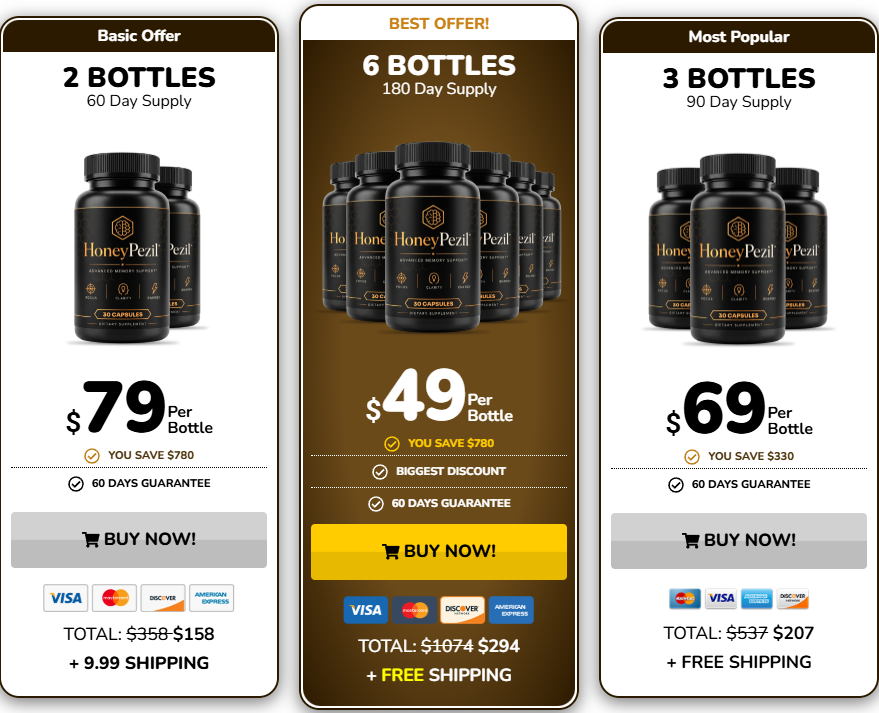
HoneyPezil is sold in three bundle tiers, with per-bottle price dropping as the bundle size increases — a single-bottle-equivalent price ranging from roughly $49 to $79 per bottle depending on quantity purchased, with free shipping on the larger bundles. Every order is backed by a 60-day money-back guarantee, giving buyers a two-month window to request a refund if they’re not satisfied. Given that most of the ingredients in this formula need 8+ weeks to show any measurable effect, a 60-day window is a reasonable — if tight — amount of time to fairly evaluate the product.
Who Might Consider HoneyPezil?
- Adults looking for a general-purpose vitamin, amino acid, and botanical blend rather than a clinically proven nootropic
- People specifically interested in Bacopa monnieri or phosphatidylserine, the two best-evidenced ingredients in the formula
- Buyers who value full label transparency over proprietary blends
- Anyone who wants a product with a refund window to test personal response
Who Should Be Cautious
- Anyone expecting the “memory support” marketing to be reflected one-to-one in a memory-specific formula — the beta-alanine/arginine/citrulline portion is functionally a circulation-support stack
- People on blood pressure medication, given the nitric-oxide-related ingredients
- Anyone sensitive to the beta-alanine tingling sensation who isn’t expecting it
- People looking for a clinically trialed, branded formula rather than a mix of individually studied ingredients
HoneyPezil Pros and Cons
Pros:
- Full ingredient and milligram disclosure rather than a hidden proprietary blend
- Includes Bacopa monnieri and phosphatidylserine, the two ingredients with the most credible human research
- Manufactured in a facility reported to be FDA-registered and GMP-compliant
- 60-day money-back guarantee
Cons:
- No clinical trials on the finished HoneyPezil product itself
- A meaningful portion of the formula (arginine, citrulline, beta-alanine) is targeted at circulation/exercise, not cognition, creating a mismatch with the marketing
- Ginkgo biloba, despite being heavily marketed for cognition, has weak supporting evidence in healthy adults
- Beta-alanine tingling can be an unpleasant surprise if not disclosed clearly upfront
See current HoneyPezil pricing and availability
Frequently Asked Questions
Is HoneyPezil FDA approved?
No dietary supplement is “FDA approved” — the FDA doesn’t approve supplements the way it approves drugs. HoneyPezil is manufactured in a facility reported to follow FDA-registered, GMP-compliant practices, but its health claims have not been evaluated by the FDA.
How long before HoneyPezil works?
Based on the clinical research behind its key ingredients (particularly Bacopa monnieri), most studies measured effects after 8 to 12 weeks of consistent daily use, not days.
Why does HoneyPezil cause a tingling feeling?
That’s almost certainly from beta-alanine, an ingredient on the label associated with a harmless skin sensation called paresthesia, unrelated to allergic reaction.
Is HoneyPezil the same as donepezil (Aricept)?
No. Donepezil is a prescription medication for Alzheimer’s disease. HoneyPezil is an unrelated over-the-counter dietary supplement; the similarity is in the name only, not the ingredients or regulatory status.
Can I take HoneyPezil with medication?
Anyone on blood pressure medication, cholinergic or anticholinergic drugs, or any prescription medication should check with a doctor first, given the vasodilating and acetylcholine-affecting ingredients in the formula.
Final Verdict: Is HoneyPezil Worth It?
HoneyPezil isn’t a scam in the sense of containing fake or undisclosed ingredients — the label is unusually transparent, and it includes at least two ingredients (Bacopa monnieri and phosphatidylserine) with genuine, if modest, human clinical evidence behind them. Where it falls short is the gap between the “mental clarity without anxiety” marketing narrative and a label that’s roughly half circulation-support amino acids more at home in a pre-workout formula. Buyers going in with realistic expectations — a general cognitive-support supplement rather than a clinically proven nootropic — and a willingness to read the actual Supplement Facts panel are the ones most likely to feel the 60-day guarantee and the price were fair value.
See current HoneyPezil pricing and availability
Scientific References
- National Center for Complementary and Integrative Health — Ginkgo
- Alzheimer’s Drug Discovery Foundation — Ginkgo Biloba Evidence Summary
- Pase MP, et al. — The Cognitive-Enhancing Effects of Bacopa Monnieri: A Systematic Review, J Altern Complement Med, 2012
- Calabrese C, et al. — Effects of a Standardized Bacopa Monnieri Extract on Cognitive Performance, J Altern Complement Med, 2008
- Alzheimer’s Drug Discovery Foundation — Huperzine-A Evidence Summary
- U.S. FDA Qualified Health Claim on Phosphatidylserine, cited via USPTO filing records
- Alzheimer’s Drug Discovery Foundation — Phosphatidylserine Evidence Summary
- Frontiers in Nutrition — Beta-Alanine Supplementation and Paresthesia, 2023
- Kyowa Hakko Bio — L-Citrulline and Plasma Arginine Research
Disclaimer
This article was independently researched and written by the team at HomeHealthyRemedy.com. It is intended for informational and educational purposes only and does not constitute medical advice, diagnosis, or treatment.
Affiliate Disclosure: HomeHealthyRemedy.com may earn a commission from qualifying purchases made through links in this article, at no additional cost to you. This does not influence our editorial process — our evaluations are based on publicly available ingredient information and independent clinical research, not on compensation from the manufacturer.
Not Medical Advice: The statements in this article have not been evaluated by the Food and Drug Administration. HoneyPezil and the ingredients discussed are not intended to diagnose, treat, cure, or prevent any disease. Individual results from any supplement can vary significantly, and nothing in this article should be interpreted as a guarantee of specific outcomes.
Consult a Professional: Always consult a licensed physician or qualified healthcare provider before starting any new supplement, especially if you are pregnant, nursing, taking prescription medication, or managing an existing health condition. Some ingredients discussed in this article (including L-arginine, L-citrulline, and huperzine-A) may interact with blood pressure medication or other prescription drugs.
Accuracy: Ingredient and pricing information reflects publicly available data on HoneyPezil at the time of writing and is subject to change without notice by the manufacturer. Readers should verify current pricing, ingredient lists, and label claims directly on the official HoneyPezil website before purchasing.

Natural home remedies, skincare secrets, dental & eye health tips, and real product reviews to help you stay healthy the natural way.