

Affiliate Disclosure: This article contains affiliate links. If you purchase Tinnoril through them, we may earn a commission at no extra cost to you. This does not influence the assessment below, which is based on publicly available ingredient research rather than the manufacturer’s marketing claims.
What Is Tinnoril?
Tinnoril is marketed as a daily capsule supplement aimed at adults who deal with occasional ringing in the ears, general hearing discomfort, or age-related changes in hearing. Like most products in this category, the Tinnoril formula combines a handful of minerals, an antioxidant compound, and a couple of plant extracts, sold under the umbrella claim of supporting “ear health” and “auditory comfort.”
Before going further, it’s worth being upfront about something the Tinnoril marketing page rarely says clearly: tinnitus is a symptom, not a single condition, and its causes range from noise exposure and age-related hearing loss to blood pressure issues, medication side effects, jaw problems, and in some cases nothing identifiable at all. No supplement, including Tinnoril, is a verified cure for tinnitus. What the research does support is more modest — certain nutrients may help support the biological systems involved in hearing, and in a small number of controlled studies, some of those nutrients have shown measurable (if inconsistent) benefits for specific subgroups of tinnitus sufferers.
With that framing in mind, here’s what’s actually in Tinnoril, what independent, peer-reviewed research says about each ingredient, whether the pricing makes sense, and where to go if you want to read the underlying science yourself rather than take a marketing page’s word for it.
How Tinnoril Is Supposed to Work
The theory rests on four overlapping ideas that show up across most ear-health supplements: healthy nerve signaling, healthy blood circulation to the inner ear, cellular energy production, and antioxidant protection against oxidative stress. The ingredient list was clearly chosen to touch each of those four bases — magnesium and L-Carnitine for nerve and cellular energy support, Butcher’s Broom for circulation, and alpha lipoic acid, turmeric, and CoQ10 for antioxidant protection.
That’s a coherent framework on paper, and it isn’t unique to this product — most ear-health formulas on the market are built around the same four pillars. The open question isn’t whether these biological processes matter for hearing (they clearly do), but whether taking it at the labeled doses meaningfully moves the needle on any of them for someone with tinnitus. That’s what the ingredient-by-ingredient research below tries to answer honestly, rather than just repeating the framework as if it were proof.
The Ingredients in Tinnoril, and What Research Actually Says About Them
Magnesium (as Magnesium Glycinate) — 80 mg
Magnesium plays a well-established role in nerve signaling and vascular tone, and magnesium glycinate — the form used here — is a commonly chosen option because it tends to be gentler on the stomach and reasonably well absorbed compared to cheaper forms like magnesium oxide.
On tinnitus specifically, the evidence is more interesting than most supplement listings let on. A small open-label study published in the International Tinnitus Journal followed 26 patients taking roughly 532 mg of magnesium daily for three months and reported reductions in tinnitus severity. Separate population research published in the American Journal of Clinical Nutrition found an association between higher magnesium and antioxidant vitamin intake and lower rates of hearing loss in U.S. adults.
Two caveats matter here. First, the tinnitus study had no control group, so some of the improvement could reflect natural fluctuation or a placebo effect rather than the magnesium itself. Second, the dose studied (532 mg) is well above the 80 mg included in this formula — so even if magnesium has a real effect at that higher dose, it doesn’t automatically follow that a much smaller amount will do the same. The recommended dietary allowance for adult men and women is 310–420 mg per day from all sources, so 80 mg is best thought of as a partial contribution toward that total rather than a therapeutic dose on its own.
Alpha Lipoic Acid (ALA)
ALA is a genuinely well-studied antioxidant, and there is more tinnitus-specific research on it than on most other included ingredients. A study using the Tinnitus Handicap Inventory found improvements in audiometric measures and handicap scores among tinnitus patients linked to cochlear dysfunction and metabolic syndrome, but the same research noted no benefit for patients whose tinnitus stemmed from acoustic nerve lesions — and it lacked a comparison group, which limits how much weight the findings can carry.
A separate randomized, double-blind, placebo-controlled trial combining a multivitamin with high-dose ALA (300 mg twice daily) over 12 weeks did find significant reductions in tinnitus loudness and handicap scores compared to placebo. That’s a meaningfully stronger study design than most of what exists in this space, though it tested ALA as part of a combination regimen, at a dose far higher than a typical single-capsule formula would include.
The honest takeaway: ALA has some of the more credible tinnitus research behind it of any commonly used supplement ingredient, which is a genuine point in its favor as a formulation choice. But the benefit in the literature appears to be condition-specific (metabolic or cochlear-related tinnitus, not all types) and dose-dependent, and it’s not a settled, broadly applicable finding — something the marketing copy doesn’t really convey.
Butcher’s Broom (Ruscus aculeatus) Root Extract
Butcher’s Broom is traditionally used in Europe to support venous circulation, primarily for conditions like chronic venous insufficiency and varicose veins. Its established use case is peripheral circulation, not inner-ear blood flow specifically — there isn’t meaningful direct research connecting it to tinnitus or hearing outcomes. Its inclusion here rests on a general “better circulation may support the ear” logic rather than on studies of the ear itself, so it’s the weakest-evidenced ingredient in the formula from a hearing-specific standpoint.
L-Carnitine
L-Carnitine’s core role is shuttling fatty acids into cells for energy production, and it’s been studied in various contexts related to cellular energy and nerve health, including some research on noise-induced hearing damage in animal models. Direct evidence linking oral L-Carnitine supplementation to improved tinnitus or hearing outcomes in humans is limited; most of what supports its inclusion here is mechanistic reasoning — cells need energy, so supporting energy metabolism could theoretically help — rather than dedicated human hearing-outcome trials.
Turmeric (Curcuma longa) Extract, 95% Curcuminoids
Curcumin is one of the more broadly researched anti-inflammatory and antioxidant compounds on the market, with a large body of general health literature behind it, and the National Center for Complementary and Integrative Health has published an overview of that evidence base. However, curcumin also has a well-documented bioavailability problem — it’s poorly absorbed on its own — and the label doesn’t specify whether it’s paired with piperine (black pepper extract) or another bioavailability-enhancing agent, which matters for whether the stated amount does much at all once swallowed. Tinnitus-specific research on curcumin remains sparse, so its presence here is best understood as general antioxidant support rather than an ear-targeted ingredient.
Coenzyme Q10 (Ubiquinone)
CoQ10 supports mitochondrial energy production and has antioxidant properties, and it’s one of the nutrients that shows up repeatedly in general discussions of noise-induced hearing loss prevention. The evidence here is again more preliminary than definitive — promising mechanistic rationale and some supporting animal or small-scale human research, but not the kind of large, replicated trial data that would let anyone call it proven for tinnitus. As with the other antioxidants in the formula, CoQ10 is a reasonable inclusion on biological grounds without being a demonstrated tinnitus treatment on its own.
So Does the Research Support Tinnoril’s Marketing Claims?
Partially, and it’s worth being precise about where the line sits. Several ingredients in Tinnoril — magnesium, alpha lipoic acid, and CoQ10 in particular — do appear in real, published tinnitus and hearing-related research, which puts Tinnoril on more solid ground than products that rely purely on generic “ear health” branding with no ingredient rationale at all.
At the same time, three things are worth keeping in mind before treating this as anything close to a clinical treatment:
- Most of the supportive studies behind these key ingredients are small, short-term, or lack a placebo control group, which limits how confidently their results can be generalized.
- Several ingredients are dosed well below the amounts used in the studies that showed benefit, so the formula may not deliver an equivalent effect.
- Tinnitus has many different underlying causes, and the studies that did show benefit were often specific to certain subtypes (like metabolic-syndrome-linked tinnitus), not tinnitus in general.
None of this means Tinnoril is a scam or that its ingredients are useless — it means the marketing language on the official Tinnoril page (“reduces tinnitus symptoms,” “promotes healthy hearing”) is a broader and more confident claim than the underlying science supports for this specific formula at these specific doses.
Safety Considerations Before Taking Tinnoril
The individual ingredients here are generally recognized as safe at typical supplement doses for most healthy adults, but a few practical points apply before adding this to a daily routine:
- ALA, one of the core ingredients, can interact with diabetes medications by lowering blood sugar further, and has been associated with headache, heartburn, nausea, or a tingling sensation in some users.
- Magnesium can cause digestive upset (loose stools) at higher doses, and people with kidney disease should not supplement without medical guidance.
- Curcumin/turmeric extracts, also present in the formula, can interact with blood thinners and are best avoided before surgery.
- Anyone who is pregnant, nursing, managing a chronic condition, or taking prescription medication should check with a doctor or pharmacist before starting Tinnoril or any new supplement.
If tinnitus is new, sudden, one-sided, or accompanied by hearing loss, dizziness, or ear pain, that’s a reason to see a doctor or audiologist rather than start with any supplement — those symptom patterns can sometimes point to something that needs direct medical evaluation, and no capsule should delay that.
Tinnoril Pricing
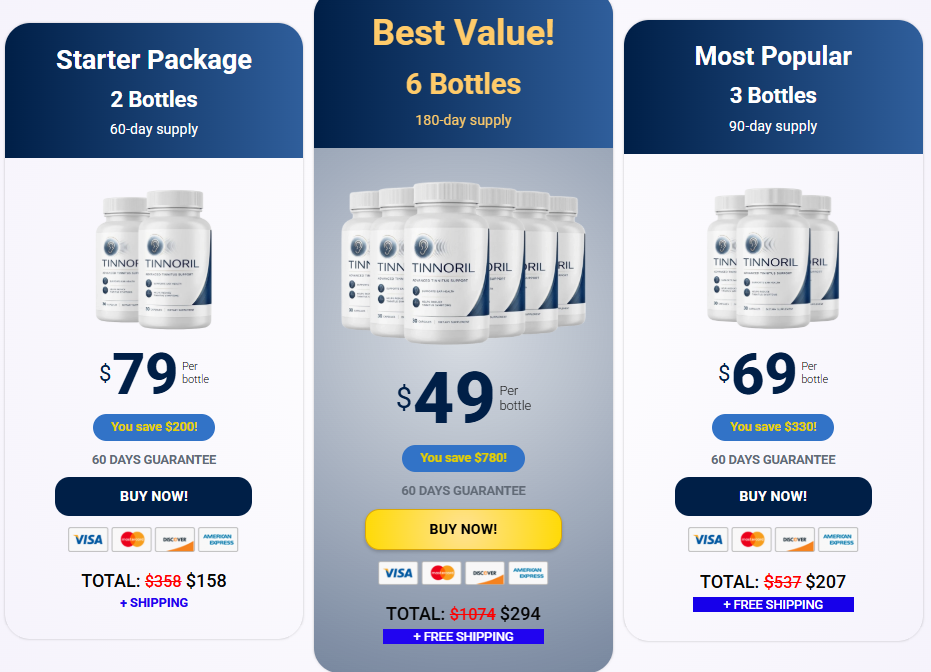
Tinnoril is sold in three bundle sizes on the official website:
- 2 bottles (60-day supply): $158 total, $79 per bottle — shipping charges apply
- 3 bottles (90-day supply): $207 total, $69 per bottle — free shipping
- 6 bottles (180-day supply): $294 total, $49 per bottle — free shipping
Every order is backed by a 60-day money-back guarantee, which is a reasonable window to judge whether it’s doing anything for you, and it’s sold exclusively through the official website rather than in retail stores or third-party marketplaces.
At roughly $49–$79 a bottle depending on quantity, it sits in the mid-to-upper range for this supplement category — not the cheapest option, but not the most expensive either. Given that some of the key ingredients (magnesium, ALA) are also available individually at a fraction of the cost, part of what you’re paying for is convenience — one capsule instead of managing three or four separate supplements — rather than a formula unavailable elsewhere.
Who Might Reasonably Consider Tinnoril
It’s most sensible for someone who already wants to try a general antioxidant and circulation-support supplement, understands it is not a guaranteed tinnitus treatment, has ruled out serious underlying causes with a doctor or audiologist, and wants the convenience of a single daily capsule over sourcing ingredients separately. It’s a weaker fit for anyone expecting a fast or dramatic reduction in ringing, since the research behind its ingredients points to modest, inconsistent, and often subgroup-specific effects at best.
It’s also worth setting expectations honestly: even in the more encouraging studies above, meaningful improvement generally took several weeks to three months of consistent use to show up, if it showed up at all. Anyone trying it should plan to use it consistently through most of the 60-day refund window before judging whether it’s doing anything noticeable, rather than expecting results in the first few days.
Scientific Resources and Further Reading
Rather than asking you to take a marketing page’s word for it, here are the actual research sources and consumer-education resources referenced in this review. These come from government health agencies and peer-reviewed journals, not from Tinnoril’s own website, so you can read the underlying data yourself and draw your own conclusions:
- NIH Office of Dietary Supplements — Magnesium Fact Sheet for Health Professionals — https://ods.od.nih.gov/factsheets/Magnesium-HealthProfessional/
- International Tinnitus Journal — Phase 2 study on magnesium and tinnitus severity — https://tinnitusjournal.com/abstract/phase-2-study-examining-magnesiumdependent-tinnitus-5917.html
- PubMed — Antioxidant vitamins, magnesium, and risk of hearing loss (Choi et al., Am J Clin Nutr, 2014) — https://pubmed.ncbi.nlm.nih.gov/24196403/
- Audiology Research (MDPI) — Alpha-lipoic acid and chronic subjective tinnitus, Tinnitus Handicap Inventory study — https://doi.org/10.3390/audiolres13040043
- National Center for Complementary and Integrative Health — Turmeric overview — https://www.nccih.nih.gov/health/turmeric
- National Center for Complementary and Integrative Health — Coenzyme Q10 overview — https://www.nccih.nih.gov/health/coenzyme-q10
If you want to go deeper, searching PubMed directly for “alpha lipoic acid tinnitus,” “magnesium tinnitus,” or “CoQ10 hearing loss” will surface the full, current body of research rather than the small selection any single review (including this one) can cover.
Bottom Line on Tinnoril
Tinnoril isn’t built on fabricated science — its core ingredients, particularly magnesium, alpha lipoic acid, and CoQ10, do show up in genuine, published tinnitus and hearing research. But Tinnoril’s marketing framing overstates how settled that research is. The honest summary is: some of the nutrients in Tinnoril have shown modest, sometimes condition-specific benefits in small studies, often at higher doses than what’s included in this particular formula, and none of them amount to a proven tinnitus cure.
Anyone considering Tinnoril should treat it as a low-risk, low-certainty addition to a broader hearing-health approach — not a replacement for a proper hearing evaluation if symptoms are new, worsening, or paired with other warning signs. Used with realistic expectations, alongside the 60-day guarantee as a safety net, Tinnoril is a reasonable low-risk option to test rather than a guaranteed fix.
Frequently Asked Questions About Tinnoril
Does Tinnoril cure tinnitus?
No. No dietary supplement, including Tinnoril, has been shown to cure tinnitus. Some of Tinnoril’s ingredients have shown modest symptom improvements in small studies for specific tinnitus subtypes, which is different from a proven, general treatment.
Is Tinnoril safe to take long-term?
The individual ingredients in Tinnoril are generally considered safe for most healthy adults at typical doses, but long-term use should still be discussed with a doctor, especially for anyone on medication for diabetes, blood pressure, or blood clotting.
How long before Tinnoril starts working?
Based on the timelines used in the underlying research on its key ingredients, several weeks to three months of consistent daily use is the realistic window to evaluate whether Tinnoril is having any noticeable effect, rather than days.
Can Tinnoril be taken with other medications?
It depends on the medication. Because Tinnoril contains alpha lipoic acid and turmeric extract, it can interact with diabetes medications and blood thinners in particular. Anyone on prescription medication should check with a pharmacist or doctor before starting Tinnoril.
Is Tinnoril worth trying?
If expectations are realistic — a possible modest supportive effect rather than a cure — and there are no contraindications with existing medications or conditions, Tinnoril is a low-risk option to try within its refund window. It should not replace a medical evaluation for new or worsening tinnitus.
Previous post- https://homehealthyremedy.com/sodaburn-review-benefits-price/

Natural home remedies, skincare secrets, dental & eye health tips, and real product reviews to help you stay healthy the natural way.