

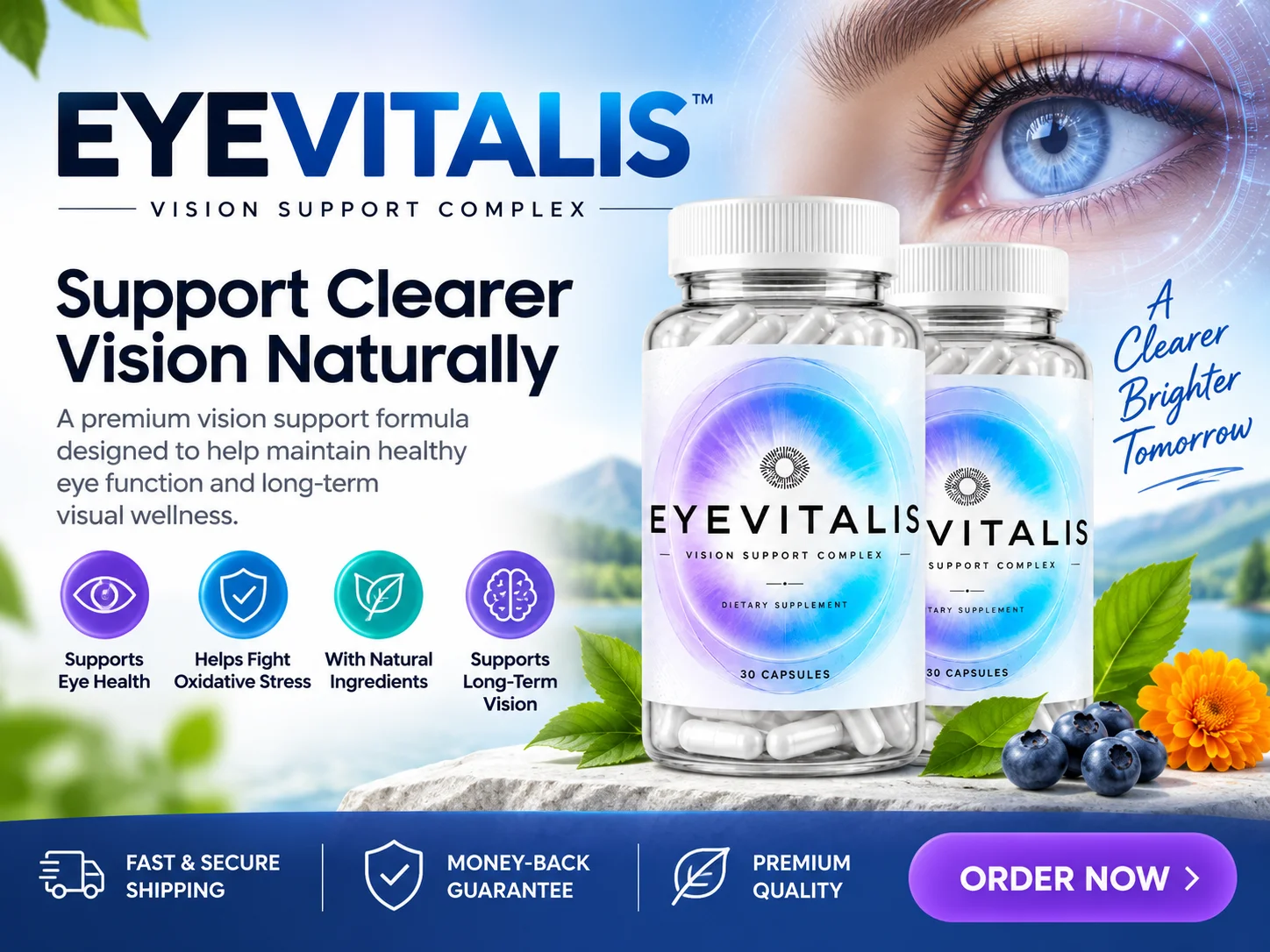
If you spend most of your day on screens, or you’re past 50 and thinking about long-term vision health, you’ve probably seen ads for EyeVitalis. It’s marketed as a daily vision-support capsule, and the sales page promises a lot. This review looks at what EyeVitalis contains, what it costs, what the science says about its ingredients, and where the marketing goes further than the evidence.
A short summary first. EyeVitalis is a multi-ingredient eye supplement built around nutrients that are genuinely studied in eye research, especially the carotenoids lutein and zeaxanthin. But the research was done on those ingredients, not on the EyeVitalis formula. One review found no independent clinical trial of EyeVitalis, and noted that the research behind several ingredients was conducted on the ingredients themselves rather than on the finished product. That distinction matters, and we’ll come back to it.
What Is EyeVitalis?
EyeVitalis is a dietary supplement sold in capsule form through its official website. It is marketed as a vision-support formula with 20 nutrients, aimed at eye health, macular wellness, clarity and daily visual comfort. The target audience is adults concerned about digital eye strain, tired eyes, and age-related changes in vision.
Like all dietary supplements in the United States, EyeVitalis is not approved by the FDA the way a prescription drug is. It cannot legally claim to diagnose, treat, cure or prevent any disease. Anything you read about it “restoring” vision or “reversing” eye disease should be treated with strong skepticism.
Each bottle is labeled as containing 30 capsules, as shown in the product images on the pricing page. The product is sold mainly online, in 2-, 3- and 6-bottle bundles, backed by a 60-day money-back guarantee (details below).
EyeVitalis at a Glance
- Type: Eye-health dietary supplement (capsules)
- Main ingredients: Lutein, zeaxanthin, astaxanthin, bilberry, saffron, ginkgo biloba, plus vitamins and zinc
- Bottle size: 30 capsules
- Packages: 2, 3 or 6 bottles
- Guarantee: 60 days
- Best for: Adults looking for general nutritional support for eyes
- Not a replacement for: Eye exams, prescribed treatment, or an AMD or glaucoma care plan
EyeVitalis Ingredients: What’s Actually Inside?
This is the part of any supplement review that matters most. EyeVitalis names 15 active ingredients across its site: lutein, zeaxanthin, astaxanthin, bilberry extract, ginkgo biloba, saffron extract, eyebright, grape seed extract, rutin, quercetin, alpha lipoic acid, vitamins A, C and E, and zinc. The marketing talks about “20 or more” nutrients, but only these 15 are individually named, and per-ingredient milligram amounts were not available on the pages reviewed.
Below is what each major ingredient is known for, and how strong the research really is.
Lutein and Zeaxanthin
These two carotenoids are the backbone of most eye supplements. They are found in leafy greens, and when consumed they accumulate in the retina. They form the macular pigment, which filters high-energy blue light and provides antioxidant protection to the central retina.
They also have the strongest evidence in the EyeVitalis formula. In the large NIH-funded AREDS2 trial, participants compared a formula with 10 mg lutein and 2 mg zeaxanthin against one containing beta-carotene. The catch is that AREDS2 studied people who already had intermediate AMD, not healthy adults looking to prevent problems. The National Eye Institute states that AREDS and AREDS2 supplements do not prevent AMD onset and have no effect on cataract.
Because EyeVitalis doesn’t publish its per-capsule amounts, you can’t tell whether it reaches the doses used in those trials. ConsumerLab suggests that a supplement with at least 6 to 10 mg of lutein plus zeaxanthin could help people who don’t get enough greens in their diet. The same source adds that if you already eat more than half a cup of leafy greens a day, you can probably skip a supplement.
Astaxanthin
Astaxanthin is a red carotenoid found in microalgae, salmon and shrimp. Research interest centers on eye fatigue from screen use. A review of clinical applications reports that astaxanthin has been studied in retinal disease, ocular surface disorders, cataract and asthenopia (eye fatigue). One double-blind trial of visual display terminal workers measured eye-muscle endurance after astaxanthin or placebo.
The results are encouraging but early, and most trials are small. Astaxanthin is best described as a promising ingredient for eye strain, not a proven treatment for anything.
Bilberry Extract
Bilberry is a European relative of the blueberry, rich in anthocyanins. It has a long reputation for night vision, and modern trials focus on eye fatigue. One 12-week randomized, placebo-controlled trial looked at bilberry extract’s effect on ciliary muscle tension caused by screen tasks. A 2025 systematic review of randomized trials concluded that anthocyanin supplements may improve contrast sensitivity and reported symptoms of eye fatigue, but noted variability in formulations, doses and methods.
Saffron Extract
Saffron is one of the more interesting ingredients in the formula. A randomized, double-blind crossover trial of 100 adults with mild to moderate AMD gave 20 mg/day of saffron for 3 months and concluded it modestly improved visual function, including in people already using AREDS supplements. Another trial in 60 AMD patients used 30 mg/day for 6 months.
The trials are small and short, and they involved people with AMD. They don’t show that saffron protects healthy eyes, and we don’t know how much saffron is in EyeVitalis.
Ginkgo Biloba
Ginkgo is popular for circulation, and it’s included here presumably to support blood flow. The evidence for eye benefits is thin. NCCIH states there is no conclusive evidence that ginkgo is helpful for any health condition. Ginkgo also carries the most significant interaction warning in this formula, covered in the safety section below.
Eyebright, Grape Seed Extract, Rutin, Quercetin and Alpha Lipoic Acid
This group is a blend of plant antioxidants and flavonoids. Eyebright has a long folk-medicine history, but high-quality human trials are scarce. Grape seed extract, rutin and quercetin are antioxidant flavonoids studied for vascular and inflammatory effects generally. Alpha lipoic acid is an antioxidant studied mostly in diabetes-related nerve and eye contexts.
None of these has strong, direct evidence for improving vision in healthy adults. They’re best viewed as supportive extras, not the reason to buy.
Vitamins A, C, E and Zinc
These are classic eye-health nutrients, echoing the original AREDS formula. Vitamin A is essential for the retina’s light-sensing pigments, vitamins C and E are antioxidants, and zinc is concentrated in the retina.
Zinc dose is worth checking. The US FDA allows up to 40 mg of zinc per day as the tolerable upper level, while the European Food Safety Authority sets it at 25 mg. Since EyeVitalis doesn’t disclose amounts, you can’t verify where it falls.
How Does EyeVitalis Work?
The theory behind EyeVitalis is straightforward and fairly typical for the category:
- Macular pigment support. Lutein and zeaxanthin help maintain the pigment layer in the macula, the part of the retina responsible for sharp central vision.
- Antioxidant protection. The retina uses a lot of oxygen and is exposed to light, which creates oxidative stress. Astaxanthin, vitamins C and E, flavonoids and alpha lipoic acid are included to help neutralize free radicals.
- Visual comfort. Bilberry and astaxanthin are studied for eye fatigue during screen tasks.
- Circulation and botanical support. Ginkgo, saffron and grape seed are included with the aim of supporting blood flow and retinal function.
This is a reasonable rationale on paper. The gap is between a plausible mechanism and a proven result from this specific formula.
What Does the Science Say About EyeVitalis?
Let’s separate what’s established from what’s marketing.
What’s well supported: A specific combination of vitamins C and E, zinc, copper and lutein/zeaxanthin (the AREDS2 formula) can slow progression from intermediate to advanced AMD in people who already have it. The NEI says AREDS and AREDS2 supplements reduce the risk of progression from intermediate to advanced AMD by about 25 percent. A ten-year follow-up strengthened this. It concluded that lutein/zeaxanthin was an appropriate replacement for beta carotene, which nearly doubled lung cancer risk in that analysis.
What’s partly supported: Astaxanthin, bilberry and lutein may ease symptoms of screen-related eye fatigue. These trials are generally small and short, and they use specific doses of standardized extracts.
What isn’t supported: Claims that EyeVitalis will “sharpen” vision, reverse damage, or replace glasses or medical treatment. There is no published clinical trial of the EyeVitalis formula. Testimonials aren’t clinical evidence.
An important caution: an ingredient list that overlaps with AREDS2 does not make a product equivalent to it. ConsumerLab reports a class-action lawsuit against CVS over an eye supplement promoted as comparable to the AREDS2 formula despite not containing the same ingredients. If your doctor has diagnosed intermediate AMD, ask specifically about the exact AREDS2 formulation rather than assuming a similar-looking product will do.
EyeVitalis Price: How Much Does It Cost?
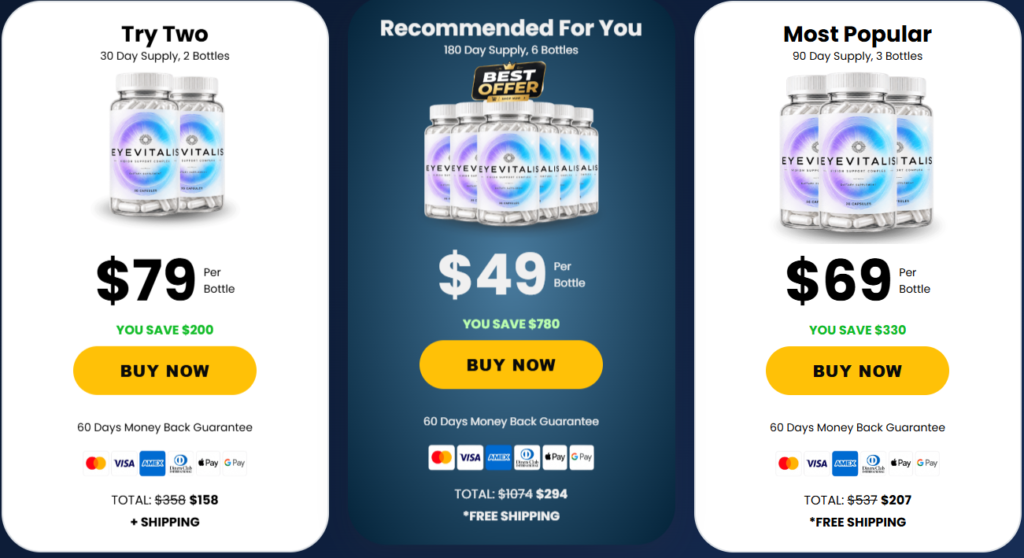
The pricing shown on the EyeVitalis order page (see screenshot) offers three bundles. All prices below are in US dollars and are taken directly from the pricing screenshot.
| Package | Supply label | Price per bottle | Regular total | Sale total | “You save” | Shipping |
|---|---|---|---|---|---|---|
| Try Two (2 bottles) | 30 days | $79 | $358 | $158 | $200 | + Shipping |
| Most Popular (3 bottles) | 90 days | $69 | $537 | $207 | $330 | Free |
| Recommended For You / Best Offer (6 bottles) | 180 days | $49 | $1,074 | $294 | $780 | Free |
A few honest observations on the pricing:
- The math checks out. 2 × $79 = $158, 3 × $69 = $207 and 6 × $49 = $294. The “regular” price implied by the crossed-out totals is about $179 per bottle, and that anchor price is what produces the large “you save” numbers. Treat “save $780” as marketing framing rather than a real market price.
- The 6-bottle pack has the lowest cost per bottle, at $49, versus $79 for the 2-bottle pack. But it’s a $294 commitment, so it only makes sense after you know the capsules agree with you.
- Free shipping applies to the 3- and 6-bottle packs. The 2-bottle pack adds shipping.
- Prices can change. One third-party review listed the 2-bottle option at $178 ($89 per bottle). Always confirm the current price on the official website before ordering.
- Check the supply-length labels. The pack labeling looks inconsistent with the bottle size. The brand’s own math of 30 servings per bottle at one capsule daily would make a 2-bottle package closer to 60 days than the 30 days it is labeled as. Confirm the recommended daily dose before assuming how long each bundle lasts, because it changes the real cost per month.
The 60-Day Money-Back Guarantee
The pricing page advertises a 60-day money-back guarantee, and this is a genuine plus for a product with no published trial. But read the terms carefully. One review found the sales page advertises a guarantee with no return required, while the brand’s separate shipping policy requires returning every bottle, including bonus bottles, within 60 days of purchase. It also found conflicting details on when the 60-day clock starts, how quickly refunds are processed, and which contact number to use.
Those are inconsistencies in the company’s own published materials, not proof of bad faith. Still, before buying, screenshot the refund terms, keep your order confirmation, and note the return address. Paying by credit card also gives you a dispute option if a refund stalls.
EyeVitalis Pros and Cons
Pros
- Contains several ingredients with real research behind them, especially lutein, zeaxanthin, astaxanthin and saffron
- Combines many eye-related nutrients in one capsule
- Multi-bottle discounts lower the per-bottle cost significantly
- 60-day money-back guarantee
- Common payment methods are accepted (Visa, Mastercard, Amex, Diners Club, Apple Pay, Google Pay)
Cons
- No published clinical trial on the EyeVitalis formula
- Per-ingredient doses aren’t publicly available, so you can’t compare against studied doses
- “20+ nutrients” is advertised, but only 15 are named
- Contains ginkgo, which can interact with blood thinners
- Conflicting policy details on refunds and supply length
- Sold mainly through one website, so you can’t compare shelf prices in stores
- Premium pricing compared with basic lutein and zeaxanthin supplements
EyeVitalis Side Effects and Safety
For most healthy adults, the individual ingredients in EyeVitalis are generally well tolerated at typical supplement doses. Still, several deserve attention.
Ginkgo and blood thinners. This is the main one. NCCIH notes that ginkgo may increase bleeding risk in people taking anticoagulants such as warfarin. A Veterans Affairs records review of more than 807,000 patients found about a 38% higher bleeding-event risk in people taking ginkgo with warfarin than warfarin alone, and the same caution applies to drugs like clopidogrel and apixaban. If you take any blood thinner, or have surgery planned, talk to your doctor before using EyeVitalis.
Zinc. Long-term intake above the upper limit can interfere with copper absorption. Excess zinc may cause symptoms such as anemia, neutropenia and zinc-induced copper deficiency.
Mild digestive effects. As with many multi-ingredient capsules, some people report stomach upset. Taking capsules with food usually helps.
Pregnancy and breastfeeding. Botanical supplements like ginkgo are generally not recommended without medical advice during pregnancy or nursing.
Allergies. Check the full label for plant allergens and fillers.
Stop taking any supplement and contact a doctor if you notice unusual bruising or bleeding, rash, swelling, or any sudden change in vision. A sudden vision change is a medical emergency, not a supplement problem.
Who Might Consider EyeVitalis?
EyeVitalis may suit you if you:
- Want general nutritional support for eye health and prefer one capsule over several separate products
- Have a diet low in leafy greens, colorful vegetables and fish
- Spend long hours on screens and want to try a formula built around commonly studied nutrients
- Are comfortable with the risk that no formula-specific trial exists
You should probably skip it or talk to your doctor first if you:
- Take blood thinners or antiplatelet drugs
- Have been diagnosed with AMD, glaucoma, diabetic eye disease or another condition (ask about the specific AREDS2 formula instead)
- Are pregnant or breastfeeding
- Already take a multivitamin with zinc, vitamin A or other overlapping nutrients
Habits That Matter More Than Any Supplement
No capsule can outperform the basics of eye care. Consider these first:
- Get a dilated eye exam. Many serious eye diseases have no early symptoms.
- Follow the 20-20-20 rule. Every 20 minutes, look at something 20 feet away for 20 seconds.
- Eat for your eyes. Spinach, kale, eggs, oily fish, citrus and colorful vegetables supply lutein, zeaxanthin, omega-3s and antioxidants.
- Don’t smoke. Smoking is a major risk factor for AMD and cataract.
- Wear UV-blocking sunglasses outdoors.
- Manage blood pressure and blood sugar. Both directly affect retinal health.
- Blink and hydrate. Screens reduce blink rate, which dries the eyes.
Where to Buy EyeVitalis
The safest option is the official website, since third-party marketplaces may sell counterfeit, expired or mishandled products, and they’re outside the manufacturer’s guarantee. Check that the URL matches the brand’s official page, look for the order confirmation email, and keep records of your purchase in case you need a refund.
EyeVitalis FAQs
Is EyeVitalis FDA approved?
No. Dietary supplements aren’t FDA-approved before sale, and the FDA does not verify their effectiveness.
How many capsules should I take daily?
Follow the directions on the bottle. Reported information suggests one capsule per day with 30 servings per bottle, but confirm this on your label.
How long until I notice results?
There is no clinical data on the timeline for this formula. Studies of individual ingredients typically run 6 to 12 weeks or longer, and many people notice nothing, so set realistic expectations.
Can EyeVitalis cure or reverse eye disease?
No. No supplement has been shown to reverse macular degeneration, cataracts or glaucoma.
Is EyeVitalis the same as the AREDS2 formula?
Not necessarily. It shares some ingredients (lutein, zeaxanthin, vitamins C and E, zinc), but doses aren’t disclosed and it adds other botanicals. It hasn’t been tested as a whole.
Does EyeVitalis have a money-back guarantee?
Yes, 60 days, but read the return terms carefully first.
Which package is the best value?
The 6-bottle pack costs the least per bottle at $49, but it’s the biggest upfront spend. Many people start with a smaller pack.
Final Verdict: Is EyeVitalis Worth It?
EyeVitalis is a reasonably designed multi-ingredient eye supplement with some well-studied components, particularly lutein, zeaxanthin, astaxanthin and saffron. If you want broad nutritional support and are aware of the limits, it’s a defensible option.
The concerns are also clear. There’s no clinical trial of the formula itself, no public per-ingredient dosing, a “20+ nutrients” claim that doesn’t match the named list, and inconsistent policy details around supply length and refunds. The ginkgo content means anyone on blood thinners needs medical guidance first.
Our take: Treat EyeVitalis as a supplement, not a treatment. If you decide to try it, start with a smaller pack, confirm the label doses and refund terms, and keep your regular eye exams. If you have an eye condition, talk to an eye doctor about evidence-based options before spending money on any formula.
Scientific References and Resources
- National Eye Institute (NIH). AREDS/AREDS2 Clinical Trials. https://www.nei.nih.gov/eye-health-information/clinical-trials/age-related-eye-disease-studies-aredsareds2/about-areds-and-areds2
- National Eye Institute. NIH study confirms benefit of supplements for slowing AMD. https://www.nei.nih.gov/research-and-training/research-news/nih-study-confirms-benefit-supplements-slowing-age-related-macular-degeneration
- AREDS2 Research Group. Secondary analyses of lutein/zeaxanthin on AMD progression: AREDS2 Report No. 3. JAMA Ophthalmology. https://pubmed.ncbi.nlm.nih.gov/24310343/
- Chew EY et al. Long-term outcomes of adding lutein/zeaxanthin and ω-3 fatty acids to the AREDS supplements: AREDS2 Report 28. JAMA Ophthalmology, 2022. https://pubmed.ncbi.nlm.nih.gov/35653117/
- Broadhead GK et al. Saffron therapy for mild/moderate AMD: a randomised clinical trial. Graefes Arch Clin Exp Ophthalmol, 2019. https://pubmed.ncbi.nlm.nih.gov/30343354/
Medical disclaimer: This article is for information only and is not medical advice. Statements about supplements have not been evaluated by the FDA, and EyeVitalis is not intended to diagnose, treat, cure or prevent any disease. Consult a qualified healthcare provider before starting any supplement, especially if you take medication or have an eye condition.

Natural home remedies, skincare secrets, dental & eye health tips, and real product reviews to help you stay healthy the natural way.