

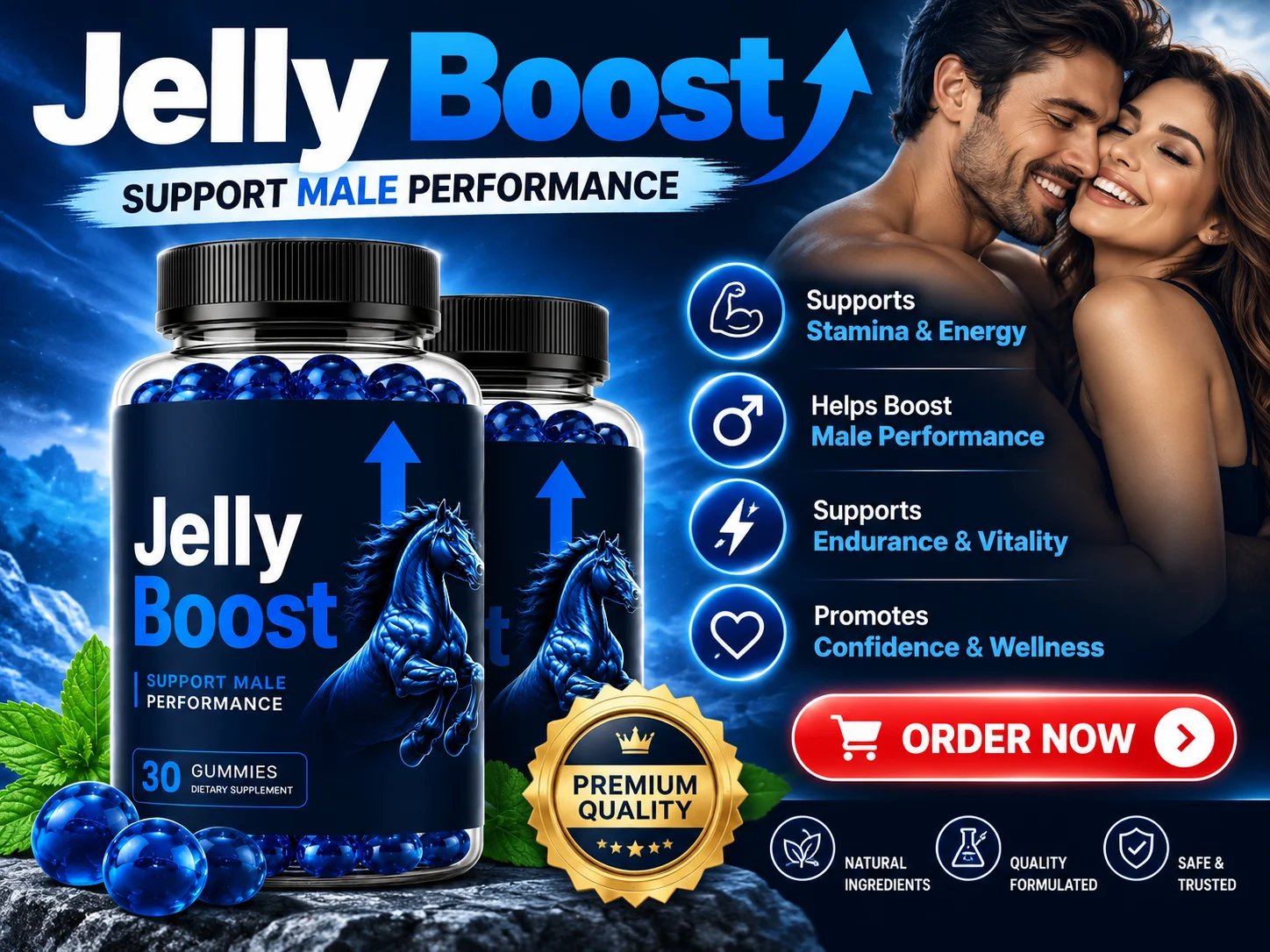
Jelly Boost is a chewable daily supplement marketed to men as “premium formula support for male performance,” promising sustained energy, libido enhancement, and overall testosterone support. It’s sold in 2, 3, and 6-bottle bundles through a BuyGoods checkout, backed by a 60-day money-back guarantee.
This Jelly Boost review looks at what’s actually on the official sales page, what independent sources say about the ingredients (and why those sources don’t agree with each other), how the pricing and guarantee stack up, and the questions men are already asking about gummy-format testosterone supplements like this one. As always, the goal here isn’t to push you toward buying or avoiding it — it’s to give you the information to make that call yourself.
What Is Jelly Boost ?
According to its own marketing copy, Jelly Boost is “a dietary supplement in gummy form, developed for oral administration,” manufactured in the USA with globally sourced ingredients, and marketed to provide “premium formula support for male performance, targeting sustained energy, libido enhancement, and overall testosterone support.”
That’s the entirety of the product description on the sales page reviewed here — there is no ingredient list, no Supplement Facts panel, and no scientific references section on this particular page, which is worth flagging immediately. This puts Jelly Boost in a different position from some other products in this category (like Stallion Power or Jelly Force, which do publish ingredient blends and cite outside research on their own sales pages): here, there’s simply nothing on the page itself to verify against.
Jelly Boost is sold through BuyGoods, a third-party retailer commonly used by direct-to-consumer supplement brands, with the standard disclosure that BuyGoods’ role as retailer “does not constitute an endorsement, approval or review of this product or any claim, statement or opinion used in promotion of this product.” The page also carries the required FDA disclaimer: statements about the product have not been evaluated by the FDA, and it is not intended to diagnose, treat, cure, or prevent any disease.
A Familiar Template: Same Pricing, Same Guarantee, Different Name
Before getting into ingredients, it’s worth naming something that becomes obvious once you’ve looked at more than one product in this category: Jelly Boost’s exact bundle pricing — $79 per bottle for 2 bottles ($158 total), $69 per bottle for 3 bottles ($207 total), and $49 per bottle for 6 bottles ($294 total), each with the smallest bundle charging separate shipping and larger bundles offering free shipping — is identical, dollar for dollar, to the pricing structure used by other male-vitality gummies sold through the same BuyGoods infrastructure.
This doesn’t necessarily mean anything sinister is happening — it’s common for the same manufacturing and marketing operations, or affiliate networks built on the same checkout templates, to reuse a proven pricing structure across multiple branded products aimed at the same audience. But it is useful context: Jelly Boost’s discount tiers, “you save $X” framing, and guarantee language are close to a shared industry template rather than something unique to this specific formula, and it’s a reasonable reason to treat the marketing copy itself with a bit more skepticism than a completely one-of-a-kind product might warrant.
How Does Jelly Boost Claim to Work?
The official description points to three general areas: sustained energy, libido enhancement, and testosterone support. No specific mechanism (blood flow, hormone pathway, adaptogen/stress response, etc.) is spelled out on the page reviewed here, which is itself a gap compared to competitor sales pages that at least name their theory of action.
Jelly Boost Ingredients: What Third-Party Sources Actually Say (And Why They Disagree)
Because the official sales page doesn’t list ingredients, this review looked at multiple independent, third-party pages describing Jelly Boost’s formula. The results were inconsistent enough to be worth reporting as a finding in itself:
- One source describes a “seven-component botanical” formula centered on Tongkat Ali, Horny Goat Weed, Saw Palmetto, Nettle Leaf, Wild Yam, Sarsaparilla, and Boron Chelate.
- A different source describes a six-ingredient formula of Tongkat Ali, Fadogia Agrestis, Ashwagandha, Maca Root, Zinc, and Vitamin D3.
- A third source describes a nitric-oxide-focused formula involving Ginkgo, Horny Goat Weed, D-Aspartic Acid, and Niacin.
- A fourth describes a formula “leaning on” Tongkat Ali, Maca root, and Ashwagandha blended into a gummy base of cane sugar and glucose syrup, without giving a complete list.
These aren’t small differences in wording — they’re substantively different ingredient lists, several of which share almost no overlap beyond Tongkat Ali showing up repeatedly. That pattern is a meaningful red flag in its own right: it strongly suggests that much of the “review” content circulating about Jelly Boost online is templated or AI-generated filler built around a product name, rather than independently verified reporting sourced from an actual product label. If you’re researching this product yourself, treat any ingredient list you find in a third-party “review” with real skepticism unless it’s a direct photo or scan of the actual Supplement Facts panel on a bottle you or someone else has purchased.
What Can Be Said With More Confidence: The Category Ingredients
Setting aside which specific list (if any) is accurate for Jelly Boost, the ingredients that repeatedly show up across these sources are the same handful of botanicals found throughout the men’s vitality gummy category generally. Here’s what the actual clinical research shows for the ones most consistently mentioned:
Tongkat Ali (Eurycoma longifolia). This is the ingredient with the strongest human clinical evidence in this category. Several randomized controlled trials — including a one-month study using 200 mg/day of a standardized extract in men with low testosterone — found significant increases in testosterone, with one trial normalizing testosterone into the reference range in the large majority of previously low-testosterone participants. A systematic review and meta-analysis has also found evidence for improved erectile function. Importantly, these results come from standardized, verified extracts (commercial names like LJ100 or Physta) at specific doses (100–600 mg/day) — not from “Tongkat Ali” as a generic label on an unverified proprietary blend, where actual extract concentration is unknown.
Maca Root. As covered in other reviews on this site, small randomized trials support modest improvements in self-reported sexual desire at gram-level doses (1.5–3 g/day), with no measurable effect on testosterone itself.
Ashwagandha. Has a reasonably strong evidence base for stress and cortisol reduction, with a smaller number of studies suggesting benefits for testosterone and sexual satisfaction in specific populations (particularly men with high stress or existing low testosterone).
Horny Goat Weed (Epimedium). Its active compound, icariin, shows PDE5-inhibiting activity in animal and lab studies, but controlled human clinical trials are lacking, and estimated potency is far below prescription PDE5 inhibitors.
Fadogia Agrestis. A West African botanical that has become popular in recent men’s health marketing largely off the back of animal studies showing testosterone increases in rodents. Human clinical trial data is essentially absent, and at least one small human trial and case reports have raised questions about liver enzyme changes at high doses — making it one of the less-established and more caution-worthy ingredients when it does appear in this product category.
Zinc and Vitamin D3. Both are legitimate nutrients with a real, well-established role in testosterone production — but specifically in men who are deficient. Supplementing zinc or vitamin D in someone who already has adequate levels has not been shown to raise testosterone further, so their inclusion mainly helps people who are short on these nutrients to begin with, not a blanket testosterone boost for every user.
How Jelly Boost Compares to Other Jelly-Format Gummies
Jelly Boost enters a crowded field of near-identically named and near-identically priced men’s vitality gummies — JellyBlue, Jelly Force, and others share the same gummy format, the same general claims (energy, libido, testosterone/vitality), and often the same BuyGoods checkout infrastructure. A few of these competitors do publish their ingredient blend and total blend weight on the sales page itself (for example, one competitor discloses an 82 mg proprietary blend across eight named botanicals, with a full Supplement Facts panel showing calories, sugar content, and serving size). Jelly Boost’s page, by contrast, provides none of that — not even a total blend weight or a serving-size breakdown.
This matters practically: even a proprietary blend with undisclosed individual amounts (a real transparency limitation on its own, as covered in reviews of comparable products) still tells a buyer the total milligram weight of active ingredients and the full sugar/calorie content per gummy. Jelly Boost’s page doesn’t offer even that minimum level of disclosure, which makes it harder to evaluate than some of its direct competitors, not easier.
How to Verify Jelly Boost Before You Buy
Given the gaps identified above, here’s a practical checklist for anyone still considering ordering:
- Request the Supplement Facts panel from customer support in writing before ordering, and keep the response for your records.
- Cross-check any ingredient list you’re given against the third-party sources above — if what support tells you doesn’t match what’s printed on a photo of an actual bottle from a verified buyer, treat that as a serious red flag.
- Search for recent, dated verified-purchase reviews (rather than “review” blog posts, which — as shown above — are often unreliable for this specific product) on independent retailer or forum platforms.
- Start with the smallest bundle rather than the 6-bottle “best offer,” even though the per-bottle price is worse, until you’ve confirmed the product matches what you were told.
- Photograph the Supplement Facts panel yourself once you receive it, both for your own reference and in case you need to raise a safety question with a doctor or pharmacist later.
Pricing and Packages
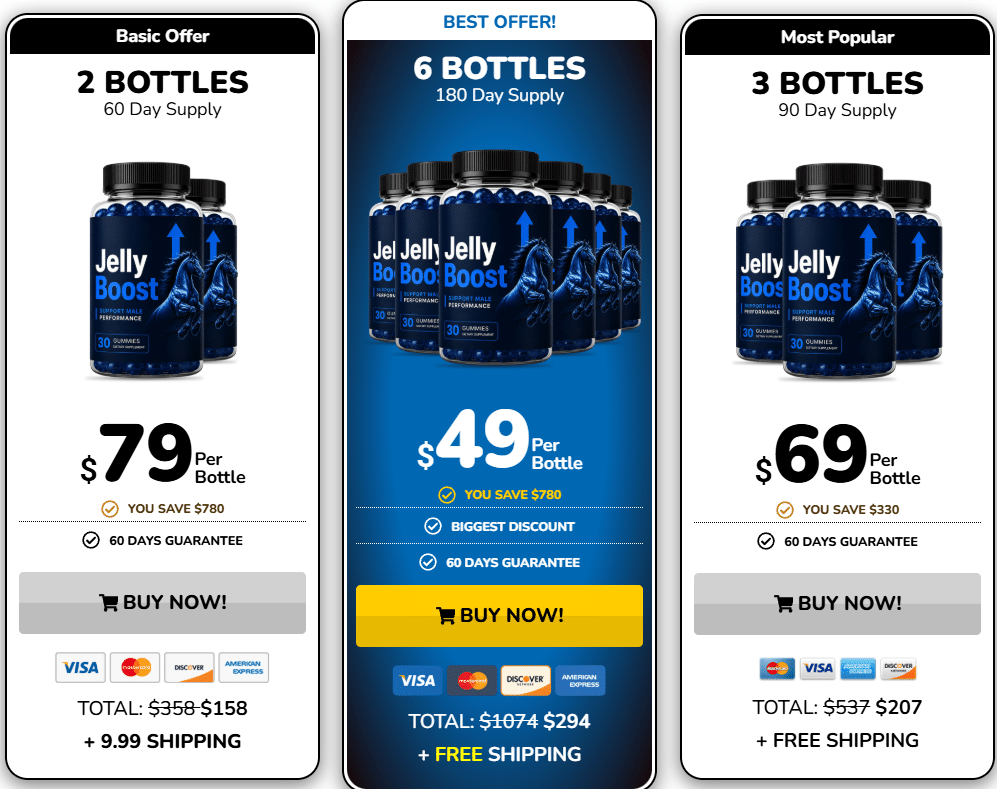
Jelly Boost is sold in three bundle sizes, each covered by the same 60-day guarantee:
| Package | Price/Bottle | Total Price | Supply | Shipping |
|---|---|---|---|---|
| 2 Bottles (Basic Offer) | $79 | $158 (listed from $358) | 60 days | $9.99 |
| 3 Bottles (Most Popular) | $69 | $207 (listed from $537) | 90 days | Free |
| 6 Bottles (Best Offer) | $49 | $294 (listed from $1,074) | 180 days | Free |
A few things worth noting about this pricing:
- The “you save $780” framing on both the 2-bottle and 6-bottle tiers is worth reading carefully — the discount claim appears identical across two very differently priced bundles, which suggests it’s a template value rather than a bundle-specific calculated saving.
- As with most products sold this way, there’s no true single-bottle trial option — the smallest available commitment is already a 60-day supply.
- The struck-through “original” prices ($358, $537, $1,074) are the anchor prices used to make the discount feel larger; there’s no independent way to verify that Jelly Boost was ever actually sold at those prices.
The 60-Day Money-Back Guarantee
Jelly Boost advertises a “100% Satisfaction or Your Money Back” guarantee, described as valid for 60 days from purchase, with the company stating it will refund “every penny, no questions asked” if you’re not completely happy for any reason.
Practical steps that apply to any guarantee structured this way:
- Keep your order confirmation and payment receipt — refund requests will need proof of purchase.
- Get the specific refund process in writing (email) before you need it, including whether bottles need to be returned and to what address.
- Track your 60-day window from the purchase or ship date, not from when you actually start taking it, since shipping delays can eat into the window.
- Read the separate Returns policy page linked on the site (a “Returns” link is provided separately from the general Terms of Service), since return-specific terms sometimes add conditions not mentioned in the main guarantee copy.
Who Sells Jelly Boost ? Understanding BuyGoods
Jelly Boost is processed at checkout through BuyGoods rather than a merchant account under the Jelly Boost brand name directly. This is a standard, legal arrangement used across thousands of direct-to-consumer supplement offers — it isn’t, by itself, a marker of fraud. It does mean that your billing statement, payment dispute process, and often customer service will run through BuyGoods’ systems, and that BuyGoods itself has explicitly disclaimed any review or endorsement of the product’s claims. It’s worth searching “Jelly Boost BuyGoods reviews” for recent, dated customer experiences before ordering a larger bundle.
Is Jelly Boost Legit or a Scam? A Red-Flags Checklist
- Is a full ingredient/dose panel disclosed on the official sales page? No — this is the biggest transparency gap found in this review.
- Do independent sources agree on what’s actually in it? No — multiple third-party pages list substantially different ingredient sets, suggesting a lot of the “research” available online about this specific product is unreliable, templated content rather than verified reporting.
- Are there scientific references cited on the official page? None are provided in the material reviewed here, unlike some competitor products in this category that at least link out to studies (even if those citations don’t always test the finished product either).
- Is the pricing/discount framing internally consistent? Partially — the identical “$780 savings” figure appearing on two differently priced bundles suggests templated marketing copy rather than bundle-specific math.
- Is the guarantee clearly stated? Reasonably — 60 days, “no questions asked” language, though the details are split across separate Terms and Returns pages rather than fully spelled out on the main sales page.
- Are required FDA disclaimers present? Yes.
Taken together, Jelly Boost reads as a legally-operating supplement sold through standard affiliate infrastructure, but with meaningfully less on-page transparency than several comparable products in the same category — no ingredient list, no dosing information, and no citations to check. Combined with third-party sources that can’t agree on the formula, the honest position is that a buyer currently has no reliable way to know exactly what they’d be taking before ordering.
Common Questions About Gummies Like Jelly Boost
“If I can’t find the real ingredient list anywhere, should I just not buy it?” That’s a reasonable position to take. At minimum, contact the company’s customer support (via the Contact page) before ordering and ask them to send you the actual Supplement Facts panel. A legitimate company should be able to provide this without difficulty; hesitation or a non-answer is itself useful information.
“Why do so many of these men’s gummies use the exact same bottle tiers and pricing?” This is common in affiliate-marketed supplement categories where multiple brands are produced by the same manufacturing partners or sold through the same performance-marketing networks. It doesn’t automatically mean the product is fake, but it does mean the marketing itself is often interchangeable across brand names, which is worth remembering when reading any single page’s claims.
“Does ‘testosterone support‘ mean it will actually raise my testosterone?” Not necessarily, and definitely not for everyone. Ingredients like zinc and vitamin D only meaningfully raise testosterone in men who are deficient in them to begin with. Tongkat Ali has real trial support at specific standardized doses, but “testosterone support” as a phrase on a label doesn’t guarantee any particular ingredient, dose, or effect size.
“Is it safe to take if I’m on blood pressure medication?” This depends entirely on the actual ingredients, which — as covered above — can’t be confirmed from the official sales page. Ingredients commonly found in this product category (horny goat weed, certain amino acids) can interact with blood pressure medication, so this is a question to bring to a pharmacist once you have the real ingredient list in hand, not before.
“Should I be worried about Fadogia Agrestis if it’s in the formula?” If it is included, yes, it’s worth extra caution — it’s one of the least human-tested ingredients in this entire product category, with some case reports raising questions about liver effects at higher doses. This is exactly the kind of detail an undisclosed ingredient panel makes impossible to evaluate in advance.
Possible Side Effects and Who Should Be Cautious
Because the specific formula can’t be confirmed, the following reflects general cautions relevant to the ingredient categories most commonly associated with this type of product:
- Digestive upset, commonly reported with concentrated herbal extracts generally
- Changes in blood pressure, particularly with ingredients that affect circulation (horny goat weed, certain amino acids)
- Possible liver enzyme changes at high doses of less-studied botanicals like Fadogia Agrestis, if present
- Interactions with blood pressure medication, blood thinners, or hormone-related medications
People who should talk to a doctor before trying Jelly Boost or any similar unverified-formula supplement include those who:
- Take blood pressure medication, nitrates, or blood thinners
- Have any liver or kidney condition
- Take hormone-related medication or have a hormone-sensitive medical condition
- Are unable to obtain a full ingredient and dosage list from the company before ordering
Pros and Cons
Potential Pros
- Generous multi-tier bundle pricing with a genuine 60-day refund window
- Gummy format may be easier to take consistently than capsules for some users
- Standard FDA disclaimer is present
- Manufactured claim of USA production, common (though unverifiable from this page alone) across this category
Potential Cons
- No ingredient list, dosing information, or Supplement Facts panel on the official sales page
- No scientific references or citations provided
- Independent third-party sources give conflicting, mutually exclusive ingredient lists
- Identical pricing/discount structure to other products in the category, suggesting templated marketing rather than a distinctly formulated product
- No way to evaluate medication interactions or safety without first obtaining the real label
Final Verdict
Jelly Boost isn’t provably a scam — it has a real checkout process, a stated guarantee, and standard regulatory disclaimers — but it’s also one of the least transparent products reviewed on this site in terms of on-page information. With no ingredient list, no dosing, and no cited research on the official sales page, and third-party sources that can’t agree on what’s actually inside the gummy, there’s currently no responsible way to evaluate whether Jelly Boost contains clinically meaningful amounts of anything, or how it might interact with any medication you’re taking.
If you’re generally healthy and want to try it anyway, the most responsible step is to contact customer support before ordering and request the actual Supplement Facts panel in writing — and to hold off on a larger bundle until you’ve confirmed exactly what you’d be committing to. If you’re on any regular medication, get that ingredient list to a pharmacist before you start, not after.
Disclaimer
This article was published by HomeHealthyRemedy.com for general educational and informational purposes only. It is not medical advice and is not a substitute for consultation with a licensed physician or pharmacist. Always talk to a qualified healthcare provider before starting any new dietary supplement, especially if you take prescription medication or have an existing health condition.
Statements about Jelly Boost or any other product mentioned in this article have not been evaluated by the U.S. Food and Drug Administration. These products are not intended to diagnose, treat, cure, or prevent any disease.
HomeHealthyRemedy.com may earn a commission from qualifying purchases made through links in this article, at no additional cost to you. This affiliate relationship does not influence the factual accuracy of the information presented above, which reflects the product’s own sales page and publicly available research as of the date of publication. Because Jelly Boost’s official sales page does not disclose a verified ingredient list, several sections of this review rely on general research for commonly-associated ingredient categories rather than a confirmed formula; individual results from any supplement will vary from person to person.

Natural home remedies, skincare secrets, dental & eye health tips, and real product reviews to help you stay healthy the natural way.