

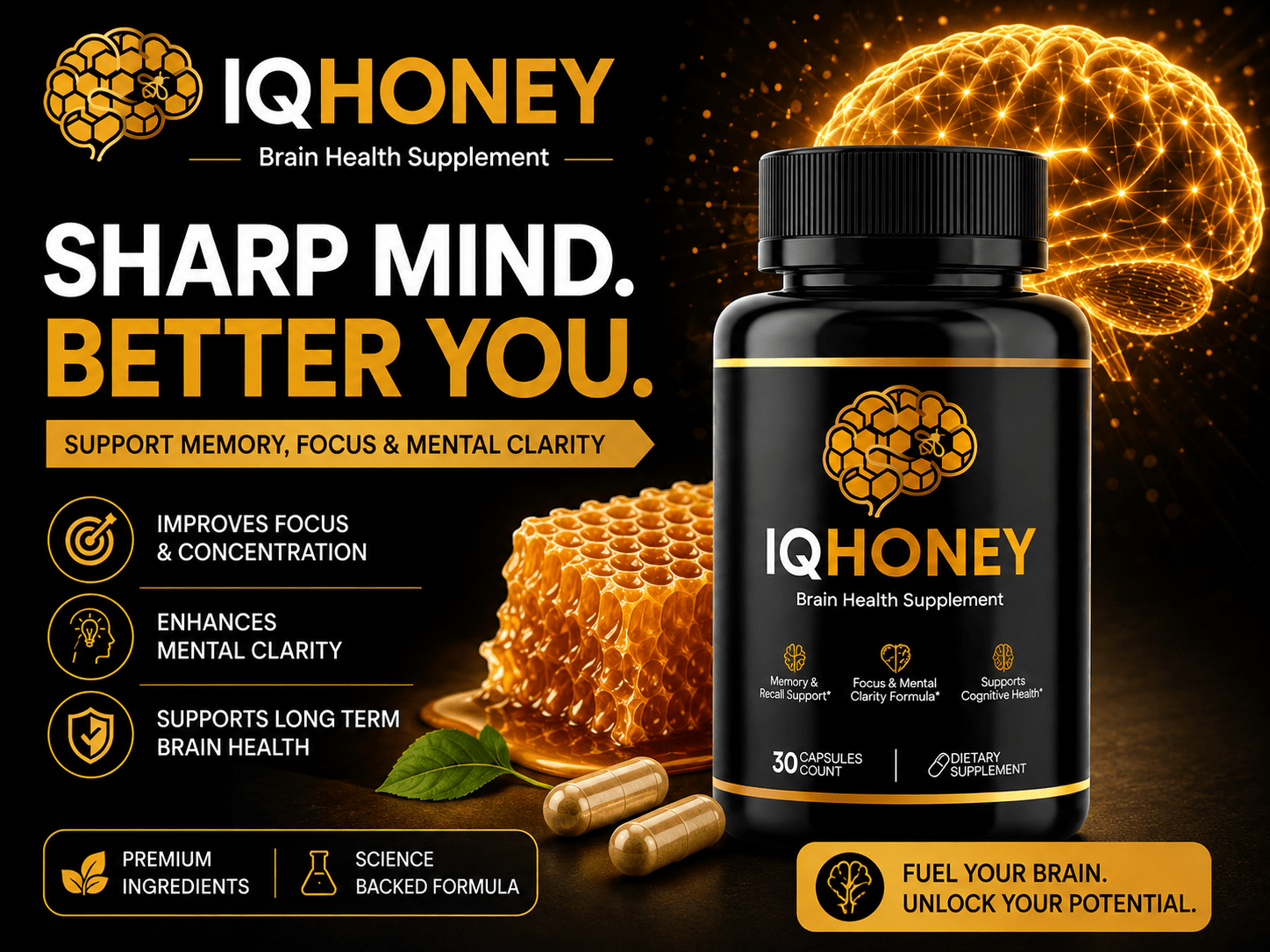
You saw an ad for IQHoney. Maybe it showed up as a video on Facebook, or maybe it followed you around for a week before you finally clicked. Something in it caught your attention — probably the mention of a famous Microsoft co-founder, or the claim that thousands of people have reversed cognitive decline — and now you’re doing exactly what a careful buyer should do before spending money: checking the details first.
A video sales page for IQHoney is drawing scrutiny for the scale of its claims. The advertisement tells visitors that more than 4,000 Americans over age 55 have “reversed cognitive decline” using what it calls a “2-minute morning ritual” — some versions market it as an “ancient honey ritual” rather than a conventional capsule regimen — asks whether the approach is “better than Lecanemab,” and attributes the product’s origin to a Microsoft co-founder widely known for his global health philanthropy.
This article separates what the advertisement says from what can be independently confirmed, so readers searching for answers before they buy have something more reliable than the sales page itself to work from.
Quick Answer
IQHoney-branded products are currently marketed for sale online. The most consequential claims in the reviewed advertisement — Alzheimer’s reversal, a Microsoft co-founder origin story, and a 2,000-patient clinical trial — remain unverified. That origin story closely resembles a broader celebrity-endorsement advertising pattern that Snopes and Forbes have reported as fraudulent, and a dated BBB Scam Tracker consumer report names IQHoney directly in connection with a fake video of the same tech figure.
Quick Verification Snapshot
Confirmed: The reviewed IQHoney advertisement presents a capsule-form supplement for sale and states a dosage of two capsules daily.
Not independently verified: The Microsoft co-founder origin story, the 2,000-patient clinical trial, and the Alzheimer’s-reversal claims — though a dated BBB Scam Tracker report names IQHoney directly alongside a fake video of the same tech figure.
Conflicting: Ingredient sources disagree (see the Ingredients section below), and the refund policy contains an internal inconsistency.
What the Advertisement Is Selling
The IQHoney landing page targets adults roughly 55 and older who are experiencing forgetfulness, brain fog, word-finding difficulty, or concern about progressive cognitive decline — including people already diagnosed with, or worried about, Alzheimer’s disease.
- Format: Capsules, two per day, taken with water at any time.
- Core proposition: Allegedly addresses the “root cause” of cognitive decline, not just symptoms.
- Results timeline: Improved focus and reduced brain fog within days, memory changes within one to two weeks, larger improvements within a month, and “permanent results” positioned as requiring a six-month course.
None of those timelines or outcomes are independently verified. They are the seller’s own claims, presented on its own sales page.
The Alzheimer’s and Cognitive Reversal Claims
The advertisement’s language goes well beyond typical dietary-supplement positioning. Terms like “brain rejuvenation,” “restoring memory pathways,” and protection “against future cognitive decline” appear alongside a headline asserting that thousands of people have reversed cognitive decline entirely. The page also features testimonials describing dramatic, disease-specific outcomes, including:
- A Mini-Mental/MoCA cognitive score allegedly rising from 17 to 28, alongside a reported reduction in amyloid plaque on a PET scan.
- A physician allegedly discontinuing a prescription Alzheimer’s medication.
- “Early onset Alzheimer’s” allegedly removed from a patient’s medical chart.
These are testimonials and comments displayed on the advertisement — not clinical outcome data — and readers should treat them accordingly. The FDA has specifically warned supplement marketers that products cannot lawfully be advertised as treating, reversing, preventing, or curing Alzheimer’s disease without going through the drug approval process that applies to that kind of claim. A dietary supplement making treatment or cure claims for a diagnosed neurological disease sits outside what a structure/function supplement claim is permitted to say under DSHEA (the Dietary Supplement Health and Education Act).
This article is not asserting that IQHoney does or does not work — only that the specific disease-reversal and diagnostic-outcome claims made on the sales page have not been independently substantiated by any source outside the advertisement itself.
Buyer takeaway: “Reverses cognitive decline” and “restores memory pathways” are marketing phrases, not clinical findings. No independent source confirms these outcomes for IQHoney specifically, and FDA rules restrict disease-reversal language for dietary supplements.
Is the Microsoft Co-Founder Actually Connected to IQHoney?
This is likely the single most-searched question tied to this advertisement, so it deserves a direct answer.
The sales page names a specific, real public figure — a Microsoft co-founder widely recognized for his philanthropic work in global health — stating that after his father’s death from Alzheimer’s disease in 2020, he invested more than $100 million into Alzheimer’s research and subsequently developed IQHoney after testing it on 2,000 patients in a double-blind clinical trial.
Part of that narrative has a real basis: this public figure has spoken openly about his father’s Alzheimer’s diagnosis and death, and about his personal financial involvement in Alzheimer’s research funding. That much is a matter of public record.
Here’s what turned up nothing during this review: any confirmation from his personal blog, his foundation, Microsoft, the FDA, a clinical-trial registry, or a peer-reviewed source that he created, developed, tested, or endorses IQHoney — or that he ran or funded the double-blind, 2,000-patient trial the ad describes. No trial matching that description shows up in any public registry, and neither he nor anyone speaking on his behalf appears to have made a public statement referencing this product.
Nothing found during this review indicates that he authorized the use of his name in connection with IQHoney. Accordingly, this article does not treat the attribution as authentic unless corroborating evidence becomes available. That caution is reinforced by a wider pattern independent fact-checkers have already documented.
The Broader Fake-Endorsement Pattern
Snopes and Forbes have reported on a recurring advertising pattern involving supposed endorsements from this same Microsoft co-founder for “Brain Honey” and similarly named Alzheimer’s remedies, using AI-generated video and voice-cloning technology to make it appear that he — along with figures like CNN’s Dr. Sanjay Gupta, Anderson Cooper, and Bruce Willis — are endorsing a honey-based Alzheimer’s remedy.
That coverage does not name IQHoney specifically. But a separate BBB Scam Tracker consumer report, dated June 30, 2026, names IQHoney directly. The consumer describes an Instagram ad using what they later recognized as a fake video of this same public figure, and being pressured into completing the purchase over a follow-up phone call. That’s one consumer’s account, not a BBB factual determination — but it is a specific, dated, publicly viewable complaint naming this exact product.
His foundation has separately warned that his name and likeness are frequently misused in fraudulent marketing.
Bottom line on this claim: IQHoney’s advertisement — a Microsoft co-founder origin story tied to his father’s 2020 Alzheimer’s death, a stated nine-figure research investment, and a honey-based formula said to reverse cognitive decline — closely resembles the broader pattern Snopes and Forbes describe, and a dated consumer complaint now names the product directly.
The Alleged 2,000-Patient Clinical Trial
The advertisement states that IQHoney was tested on 2,000 patients in a double-blind clinical trial. A trial of that size, if real and properly conducted, would be significant evidence. A verifiable trial claim of this kind would typically include:
- A trial registry number.
- A named institution or principal investigator.
- A stated dosage and placebo protocol.
- Reported statistical results and a peer-reviewed publication.
None of this is present on the sales page, and no independent, authoritative source substantiating a trial of this description could be located during this review. Until a verifiable trial record surfaces, this claim should be treated strictly as advertising copy, not evidence of demonstrated efficacy.
IQHoney vs. Lecanemab (Leqembi): What’s Actually Different
The advertisement’s headline directly invokes lecanemab, the FDA-approved anti-amyloid antibody marketed as Leqembi, asking whether IQHoney’s approach is “better.” That comparison deserves a factual anchor point.
Lecanemab holds full FDA approval for early-stage Alzheimer’s disease — specifically for patients with mild cognitive impairment or mild dementia who have confirmed amyloid pathology — and that approval is backed by randomized, placebo-controlled trial data rather than marketing claims. Its pivotal study, Clarity AD (NCT03887455 in the federal trial registry), tracked 1,795 participants over 18 months. Eisai, the company behind the drug, reports the trial hit its primary and key secondary endpoints with statistically significant results. Administration options have expanded further since approval, with subcutaneous formulations cleared in 2025 and again in mid-2026. The drug isn’t risk-free either — amyloid-related imaging abnormalities (ARIA) are a recognized risk that requires ongoing patient monitoring during treatment.
Side-by-Side Comparison
| Lecanemab (Leqembi) | IQHoney | |
|---|---|---|
| Regulatory status | FDA-approved | Not FDA-approved (marketed as a supplement) |
| Trial evidence | Randomized controlled trial, 1,795 participants (Clarity AD, NCT03887455) | Advertised 2,000-patient trial not independently located |
| Published results | Statistically significant primary and secondary endpoints | No published controlled data |
| Known risks | ARIA, requires monitoring | Not established |
No comparable published, controlled evidence exists for IQHoney. The two products should not be described as clinically equivalent, and IQHoney should not be characterized as superior to an FDA-approved medication based on anything currently available.
Ingredients: What the Available Pages Actually Show
The exact IQHoney sales funnel reviewed for this article does not display a complete Supplement Facts panel, so this article is not publishing an ingredient list as confirmed fact. This review found at least three distinct ingredient lists circulating under the same product name:
- Formula A: Baobab fiber, L-arabinose, spermidine, and konjac glucomannan — no per-serving amounts disclosed.
- Formula B: A separate powder-format product containing apple cider vinegar, apple pectin, and beetroot.
- Formula C: A third variant referencing Alpha GPC, Bacopa, Gotu Kola, and Collagen Type II, found on other IQHoney-branded pages.
Product names in this category are frequently reused across different formulations and sales funnels, so this article is not guessing which list, if any, matches the specific product a given buyer would receive.
Before ordering, buyers can request the actual Supplement Facts panel directly from the seller’s support contact, or check the physical label on arrival before opening the product. Confirming the label matters here specifically because supplement side effects and medication interactions depend on knowing the actual ingredients and doses — not a third-party guess.
Safety Claims on the Sales Page
The advertisement bundles several safety claims together — worth separating rather than accepting as one blanket statement:
- “Absolutely safe” — an unqualified claim not independently established by anything reviewed for this article.
- “100% natural ingredients” — “natural” doesn’t by itself establish that a finished supplement is free of adverse effects or interactions.
- “Clinically precise doses” — no confirmed Supplement Facts panel exists to verify dosing precision.
- “GMP-certified, U.S.-based facilities” — a production-quality designation, not FDA approval.
Notably, the same advertisement separately advises anyone with a medical condition or taking medication to consult a physician before use — advice worth following regardless of how confidently the rest of the page is worded.
Pricing, Guarantee, and Availability
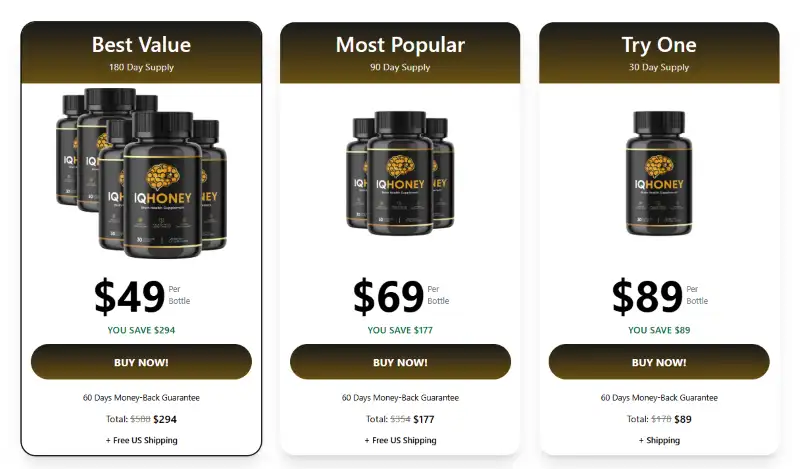
- Two-bottle, 60-day supply: $79 per bottle.
- Three-bottle, 90-day supply: $69 per bottle, free shipping.
- Six-bottle, 180-day supply: $49 per bottle, free shipping.
A 60-day money-back guarantee is advertised. Two things are worth flagging before you order:
- Refund mechanics conflict. The page contains an internal inconsistency about whether a refund requires returning unused bottles or allows the customer to keep them — confirm directly with the seller before purchase.
- The “not on Amazon” claim doesn’t fully hold up. The page states the product is sold only through its official site; this review separately found active Amazon listings under the same product name.
Pricing, stock claims, and promotional terms on direct-to-consumer sales pages change frequently and should be confirmed at the time of purchase.
IQHoney Complaints and Customer Reviews
The testimonials on the sales page are seller-hosted content, not independently collected reviews. One specific finding is worth flagging: on a separate site presenting itself as an official IQHoney source, this review found a customer testimonial that referenced a different product name entirely, rather than IQHoney — a known signature of templated marketing copy reused across multiple, differently-branded supplement funnels. That doesn’t confirm anything about whether the product works, but it’s a concrete reason to treat on-site testimonials as marketing copy, not verified customer accounts.
Common Questions Buyers Are Searching
Is IQHoney legitimate or a scam? IQHoney is being actively marketed through an online sales funnel with a stated refund policy; this review did not independently verify order-fulfillment performance. “Legitimate business” and “substantiated marketing claims” are two different questions — the disease-reversal and clinical-trial claims used to sell it are not independently substantiated, the Microsoft co-founder story closely resembles a broader ad pattern Snopes and Forbes have reported as fraudulent, and a dated BBB Scam Tracker report names IQHoney directly.
Did the Microsoft co-founder named in the ad create IQHoney? No authoritative source connected to him confirms this. Snopes and Forbes have reported on a closely resembling ad pattern as fraudulent without naming IQHoney specifically; a BBB Scam Tracker report dated June 30, 2026 does name it directly. Treat the attribution as unverified.
Can IQHoney reverse Alzheimer’s or dementia? No independent clinical evidence supports that claim. FDA guidance specifically cautions against supplement products marketed as Alzheimer’s treatments or cures.
Is IQHoney better than Leqembi/lecanemab? There is no published comparative data supporting that claim. Lecanemab has FDA-approved, trial-backed status that IQHoney does not currently have.
What’s actually in IQHoney memory supplement formulas? Sources conflict — at least three different ingredient lists circulate under the same name. Confirm the Supplement Facts panel on the specific product before purchase.
The search “IQHoney scam” is ultimately asking whether a real product exists, whether the seller can be identified, whether terms are disclosed, and whether the advertising claims are substantiated — separate questions this article does not collapse into an unsupported fraud accusation against the seller.
Bottom Line
IQHoney is a real, purchasable supplement whose most attention-grabbing claims — the Microsoft co-founder attribution, the 2,000-patient trial, Alzheimer’s reversal — aren’t independently verified. That doesn’t mean don’t consider it; it means verify the seller, the label, and the refund terms before you do.
The advertisement built to sell IQHoney makes claims — disease reversal, a named-celebrity origin story, and a large unverified clinical trial — that go well past what’s typically defensible in dietary supplement marketing, and well past what any source outside the advertisement itself could confirm. The absence of substantiation for those advertised outcomes does not establish what effects, if any, an individual consumer may experience; it means those specific claims should not be treated as proven. Anyone considering IQHoney, particularly for themselves or a family member dealing with diagnosed cognitive decline or Alzheimer’s disease, should treat this as a conversation to have with a physician first, not a replacement for one.
Research & Clinical Data
PubMed (pubmed.ncbi.nlm.nih.gov) — peer-reviewed studies citation ke liye
ClinicalTrials.gov — koi bhi “clinical trial” claim verify karne ke liye
FDA.gov (Dietary Supplements section) — disease-claim rules aur warnings ke liye
NIH Office of Dietary Supplements (ods.od.nih.gov) — individual ingredients ke fact sheets, dosage, evidence level
Cochrane Library (cochranelibrary.com) — “does it actually work” type systematic reviews
FTC.gov — deceptive supplement advertising ke enforcement cases
Snopes.com — fake celebrity endorsement / AI-scam pattern verify karne ke liye
IQHoney Contact Information
Email: support@iqhoneyy.com
Editorial Methodology
This article is based on a direct review of the IQHoney sales page as published, cross-referenced against publicly available statements from the Microsoft co-founder named in the ad regarding his Alzheimer’s research involvement, independent fact-checking coverage from Snopes and Forbes, a dated BBB Scam Tracker consumer report naming IQHoney directly, FDA guidance on dietary supplement disease claims, and published information about lecanemab/Leqembi’s clinical trial history and FDA approval status. Where a claim could not be independently confirmed through a source outside the advertisement itself, it is identified here as a seller claim rather than an established fact. Pricing and promotional terms reflect what was displayed at the time of review and are subject to change without notice.
Advertorial and Affiliate Disclosure: This article is sponsored content and contains affiliate links. A commission is earned on purchases made through links in this article.
Medical Disclaimer: Statements regarding dietary supplements have not been evaluated by the Food and Drug Administration. This product is not intended to diagnose, treat, cure, or prevent any disease. Individual results vary. Consult your physician before beginning any new supplement regimen, particularly if you are pregnant, nursing, have a medical condition, or take prescription medication.
Results/Testimonial Disclaimer: Testimonials and anecdotal reports reflect individual claims or experiences and do not establish typical results or constitute clinical evidence.
Commercial-Terms, Retailer, and Publisher Independence Disclosure: Pricing, availability, shipping, ingredient disclosures, and refund terms can change; verify the current product label and checkout terms before purchasing. This publisher is not the manufacturer, seller, or retailer of IQHoney and does not process orders, handle fulfillment, or control the product label.
Geographic, Jurisdiction, and Forward-Looking Statements Disclosure: Product availability and regulatory requirements vary by state and country and are not addressed comprehensively in this article. Statements about advertised timelines or future availability reflect the seller’s own representations as reviewed and are not independently verified projections or guarantees.
California Consumer Disclosure (Proposition 65): California residents should review the product label and the manufacturer’s official website for any warnings required under California’s Safe Drinking Water and Toxic Enforcement Act of 1986, commonly known as Proposition 65, before purchase. This article is not the seller of the product and does not control the product label; any Prop 65 warning obligation rests with the manufacturer and seller of the product. Information about Proposition 65 is publicly available through the California Office of Environmental Health Hazard Assessment (OEHHA).
Trademark Acknowledgment: Leqembi® is a registered trademark of Eisai Co., Ltd. IQHoney is used throughout this article to refer to the product as marketed by its seller; no trademark registration for this mark was confirmed as of this review. Trademarks referenced in this article are the property of their respective owners; mention does not imply affiliation, endorsement, or sponsorship beyond what is expressly disclosed in the affiliate disclosure above.
previous Post- https://homehealthyremedy.com/flowstrong-review-supplement-really-work/
previous Post-https://homehealthyremedy.com/retraburn-review-metabolism-drop-work/
previous Post- https://homehealthyremedy.com/horse-fil-review-ingredients-is-it-legit/

Natural home remedies, skincare secrets, dental & eye health tips, and real product reviews to help you stay healthy the natural way.