

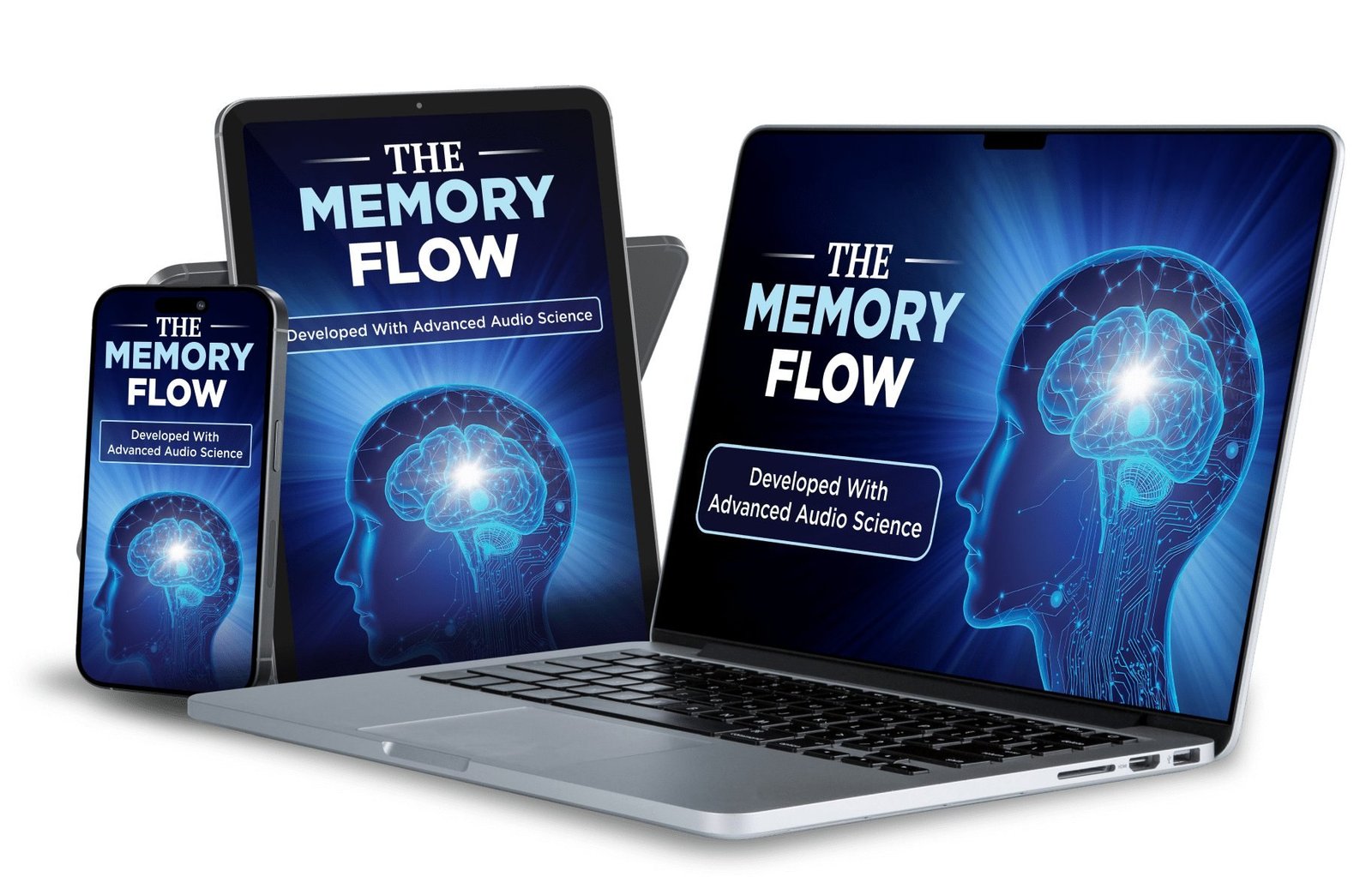
If you’ve come across MemoryFlow, you’ve probably seen the pitch: no pills, no supplements, no complicated routine — just a 12-minute audio track you press play on, and your brain supposedly does the rest. It’s a compelling idea, especially if you’ve already tried memory supplements without much luck. But “press play and your memory improves” is a big claim for a short audio file, so this review goes through exactly what MemoryFlow’s official site says, what’s independently checkable about the science behind it, and where the marketing gets ahead of what’s actually been demonstrated.
This isn’t a paid or sponsored write-up. It’s based on a direct read of thememoryflow.com and its linked policy pages — refund policy, shipping policy, disclaimer, terms of use, contact/FAQ, and references — as they existed at the time of writing, cross-referenced against outside sources where possible.
What Is MemoryFlow?
According to its official site, MemoryFlow is described as “a breakthrough sound-based program designed to support a sharp, clear memory well into old age.” Rather than being a supplement, it’s positioned as a brain optimization program: a professionally engineered 12-minute audio track that the company says is built to stimulate and synchronize gamma brain waves through specific sound patterns — a process generally called brainwave entrainment.
The pitch is built around three points on the landing page: healthy memory function, clear and focused thinking, and long-term mental agility. The core promise is convenience — the site emphasizes there’s “no effort required,” and that you simply listen and let the audio “do the work.” It’s marketed as usable from home, requiring no special equipment (a phone, tablet, or computer is enough), with headphones described as optional rather than required.
Delivery is entirely digital. The shipping policy page explicitly states that MemoryFlow “is delivered instantly as a digital download” and that after purchase you get immediate access through a secure online portal.
The Core Mechanism: Gamma Waves and Memory
MemoryFlow’s central claim rests on gamma brain waves, a genuinely real and actively studied area of neuroscience. According to the company’s own FAQ, memory problems are described as occurring when gamma activity weakens, which the company says reduces the brain’s ability to “clear normal protein byproducts” — a description that closely echoes real research into how gamma-frequency stimulation may relate to amyloid clearance in the brain, a topic tied to Alzheimer’s research. The company states that its audio is designed to encourage brainwave entrainment — getting the brain’s own electrical rhythms to synchronize with an external stimulus — specifically to “strengthen gamma activity and improve memory.”
This is where it’s worth separating two very different things: the underlying science, and the specific product built on top of it.
What’s real: Gamma-frequency brain activity is a legitimate subject of memory and cognition research. There is published work on gamma oscillations and memory processing (including hippocampal studies on memory load), on brainwave synchronization to external acoustic stimuli, and — notably — on animal research from MIT into whether sensory gamma stimulation might help clear amyloid buildup associated with Alzheimer’s disease in mice. MemoryFlow’s own references page cites several credible sources touching on these topics, including peer-reviewed neuroscience journals and MIT News coverage of that gamma-stimulation research.
What’s not established: None of the cited research demonstrates that a 12-minute downloadable audio track produces the same effects seen in laboratory gamma-stimulation studies, which typically use calibrated light and sound devices under controlled conditions — not an MP3 played through a phone speaker or headphones. The MIT research on gamma stimulation and amyloid clearance was conducted in mice, using specific engineered light-and-sound protocols, not consumer headphone audio, and hasn’t been established as producing equivalent effects in humans from a short daily listening session. Citing real science establishes that the general concept isn’t invented from nothing — but it doesn’t establish that this specific product, in this specific format, delivers the claimed outcome. That’s a distinction the marketing copy doesn’t draw for you, and it’s one worth holding onto throughout the rest of this review.
A Closer Look at the References Page
To MemoryFlow’s credit, it publishes a references page — something plenty of products in this space skip entirely. It’s a substantial list: peer-reviewed neuroscience papers on gamma oscillations and memory (Kucewicz et al., van Vugt et al.), research on brainwave entrainment to acoustic stimuli (Will & Berg), MIT News coverage of gamma-stimulation research in Alzheimer’s models, and even Matthew Walker’s well-known book on sleep science.
That said, a few things about this reference list are worth flagging for a careful reader. First, several citations aren’t actually about gamma-wave audio or memory at all — they cover Alzheimer’s drug approvals (lecanemab/Leqembi), the cost of long-term nursing care, the Alzheimer’s therapeutics market size, and even an unrelated pharmacology paper on antifungal immunity. These read like general background citations pulled from a broader “brain health” or “memory decline” content template rather than sources specifically supporting MemoryFlow’s own audio mechanism. Second, and more tellingly, the references page itself displays an image labeled “ProMind Complex Label” at the bottom — ProMind Complex being a different, unrelated supplement product. That’s a strong indication this page (and quite possibly other site infrastructure) was adapted from a template originally built for a different product, rather than written specifically for MemoryFlow. Neither of these observations proves anything is fraudulent, but they’re the kind of detail that should lower your confidence that every citation on the page was chosen because it specifically validates this exact audio program.
Testimonials: A Disclosure Worth Reading Twice
This is arguably the single most important thing on the entire site, and it’s tucked into the disclaimer page rather than the main sales page: “Some names have been changed and some testimonials have been recorded with paid actors to protect the anonymity of those involved. No identification with actual persons (living or deceased), places, buildings, and products is intended or should be inferred.”
In plain terms, the company is disclosing upfront that at least some of its customer testimonials may not be from real customers at all — they may be scripted and performed by paid actors. This is a common legal disclosure in direct-response marketing (it protects the company from claims of fabricating endorsements while still allowing dramatized or composite testimonials), but it means that any glowing customer story you see on the sales page should be treated as illustrative marketing content, not verified proof of what buyers experience. This review did not see the specific testimonials referenced on the visible sales page, since much of that content is rendered as images rather than text, but the disclosure itself applies regardless of which testimonials appear.
What You Get: Program Contents and Bonuses
Per the official site, purchasing MemoryFlow gets you:
- The core audio program — a 12-minute track engineered to target gamma brainwave synchronization, accessed digitally with lifetime membership access.
- Bonus #1 — Total Brain Reboot: described as “little-known tactics” covering a homemade drink for learning and recall, nutrients aimed at preventing afternoon energy crashes, and sleep-related tips for mental sharpness. Listed reference price: $135, included free with purchase.
- Bonus #2 — Memory Made Easy: a “3-step system” described as covering a mnemonic “jingle technique” for recall, memory-trigger methods, and a daily ritual framed as supporting long-term mental sharpness. Listed reference price: $155, included free with purchase.
As with most direct-response offers, those $135 and $155 “retail price” figures for the bonuses are the company’s own stated reference values rather than independently verified prices from any other marketplace — a very standard practice in this kind of sales funnel, but worth treating as a marketing anchor rather than a confirmed market price.
Pricing: What We Could and Couldn’t Confirm
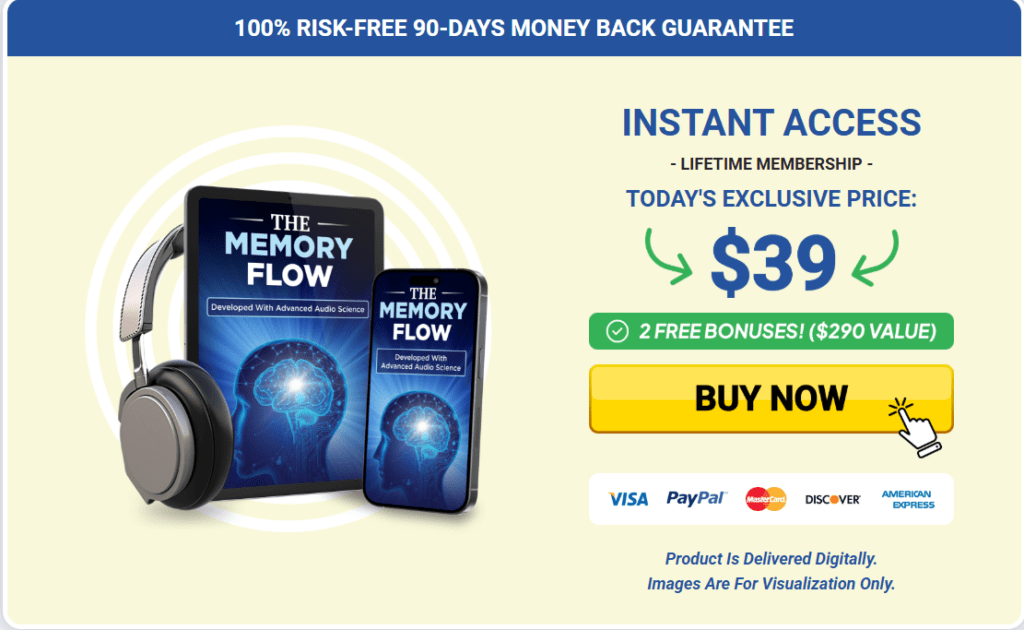
Here’s an important limitation of this review: the MemoryFlow sales page displays its actual price as an image file rather than as page text, so the specific current dollar amount couldn’t be directly extracted or confirmed at the time of writing. The page does reference “today’s exclusive price” alongside marketing suggesting a discount from a higher original price, consistent with typical direct-response pricing structures — but the precise number should be confirmed directly at checkout.
For context, it’s worth knowing that MemoryFlow sits within a broader category of near-identical “gamma wave audio for memory” products, most notably one called The Memory Wave, which uses an almost identical pitch: a 12-minute gamma-frequency audio track, sold as a one-time digital purchase around $39, distributed through the same class of affiliate retail platforms, with a 90-day money-back guarantee and bonus PDF guides. The similarity in structure, length, guarantee period, and format across these products suggests a shared marketing template or production approach circulating in this niche, rather than each product being an entirely independent innovation. That’s not necessarily evidence of anything improper on its own, but if you’re comparison-shopping, it’s worth knowing you may be choosing between several very similarly-constructed offers rather than one truly unique product.
Checkout and Retailer: BuyGoods
MemoryFlow’s checkout is processed by BuyGoods, which the site explicitly identifies as “the retailer of this product.” BuyGoods is described in the site’s own footer as a registered trademark of a Delaware corporation headquartered in Wilmington, Delaware. This is a real, established digital-product payment processor used across a wide range of direct-response offers — comparable in function to ClickBank, which many similar products in this space use instead.
Importantly, the site’s own disclosure states plainly that “BuyGoods’ role as retailer does not constitute an endorsement, approval, or review of this product or any claim, statement, or opinion used in promotion of this product.” In other words, the fact that a real, identifiable payment processor is handling the transaction tells you the checkout mechanism itself is legitimate — it tells you nothing about whether the product’s specific claims hold up. For order-related issues (billing, transaction lookups), the site directs customers to BuyGoods’ own order-lookup tool rather than to MemoryFlow directly.
The Refund Policy: A Notable Inconsistency
This is worth walking through carefully, because it’s the clearest sign that parts of this site weren’t built entirely from scratch for this specific product.
The site states a 90-day money-back guarantee, and recommends using the product for “at least 3 months” before requesting a refund to judge its effects. That much is consistent with the shipping policy’s separate, shorter description of the guarantee.
But the actual refund procedure, as published on the refund policy page, describes returning physical bottles by mail: “Send all the bottles back to us (no matter if they are empty or not)… It doesn’t matter if the bottles are opened or not,” to a physical address in Aurora, Colorado, and explicitly states that return shipping costs are not covered by the company. This directly contradicts the product itself, which is a digital audio download with no physical bottles, packaging, or shipment involved at all — a fact confirmed elsewhere on the very same site.
The shipping policy page has a similar issue: it opens by correctly describing MemoryFlow as an instant digital download requiring no shipping, and then immediately continues into boilerplate language about physical order fulfillment (“your order will be automatically shipped,” a shipping-tracking email “in no more than 60 hours,” and a shipping fee table listing rates to Canada, the UK, Ireland, Australia, and New Zealand).
The most reasonable explanation is that these policy pages were copied from a template originally written for a physical supplement product and not fully edited for a digital-only offering — a common shortcut in this style of direct-response website, but one that leaves genuinely confusing, contradictory instructions for anyone who actually needs a refund. If you buy MemoryFlow and later want your money back, this is worth flagging directly with support before assuming you need to mail anything anywhere, since there’s clearly nothing physical to return.
Claimed Benefits and Timeline
Per the site’s own FAQ, MemoryFlow lays out a specific expected timeline: small improvements within 1–2 weeks, improved memory clarity and focus by 3–4 weeks, and what the company describes as “significant cognitive gains and sharper recall” by 6–12 weeks of consistent daily use. As with the rest of the site’s claims, this timeline is presented as the company’s own expectation rather than data from an independent, controlled study of the product itself.
The FAQ also states that MemoryFlow is intended to work for people with “most health conditions,” while still recommending that users consult a doctor — fairly standard, cautious language for a product in this category. It emphasizes non-invasiveness (no chemicals, pills, or drugs) and states there are no known side effects, which is a reasonable claim given the product’s simple nature as an audio file rather than an ingested substance. That said, “safe for most people” is a different claim than “clinically proven to enhance memory,” and this review found no evidence of an independent clinical trial specifically testing MemoryFlow’s audio track.
One caution worth noting on brainwave entrainment audio generally, independent of MemoryFlow specifically: entrainment products, including flickering lights or rhythmic audio, have occasionally been flagged as a photosensitive-seizure risk for people with certain neurological conditions, including epilepsy. MemoryFlow’s own site doesn’t specifically address seizure risk in its FAQ, so anyone with a seizure disorder or a family history of one should check with a doctor before trying any brainwave-entrainment audio product, MemoryFlow included.
Is MemoryFlow a Scam?
Based on what’s publicly available, MemoryFlow doesn’t show the classic signs of an outright scam: it has an identifiable product, a working checkout through a real third-party retailer (BuyGoods), a published refund policy (however poorly edited), a functioning support contact, and a references page attempting to ground its claims in real science. Those are all things a genuinely fraudulent, disappearing-overnight operation typically doesn’t bother with.
At the same time, several details should temper how much weight you put on the marketing itself: the explicit disclosure that some testimonials may be paid actors rather than real customers; a references list padded with citations unrelated to the product’s actual mechanism; a leftover reference to an entirely different product (“ProMind Complex”) on the citations page; and refund/shipping policies that describe physical bottle returns for a purely digital product. Individually, each of these might be explainable as a copy-paste oversight. Together, they paint a picture of a site built quickly from a shared marketing template rather than one custom-built and carefully proofed for this specific product — which is worth knowing before you rely heavily on anything the sales page tells you about expected results.
Who Might Consider MemoryFlow, and Who Should Think Twice
MemoryFlow could reasonably appeal to someone who wants a low-cost, no-pills way to experiment with brainwave entrainment audio, is comfortable with a short daily listening habit, and is going in with modest expectations rather than assuming a dramatic cognitive transformation. Because it’s non-ingested and inexpensive relative to many supplements, the physical risk profile is low for most healthy adults.
It’s a poorer fit for anyone expecting results equivalent to the animal studies referenced on the site — those used controlled laboratory light-and-sound protocols, not a consumer MP3 — or for anyone dealing with a diagnosed cognitive condition like dementia or Alzheimer’s disease, which requires actual medical evaluation and care rather than a self-directed audio program. It’s also worth extra caution for anyone with epilepsy or a seizure disorder, given the general (not MemoryFlow-specific) caution around rhythmic sensory stimulation products.
Things Worth Confirming Before You Buy
- The exact current price, since the sales page displays it as an image rather than page text — confirm it on the final checkout screen through BuyGoods before submitting payment.
- How refunds are actually processed for a digital product, given that the published refund policy describes mailing back physical bottles — email support first to get written clarification on the real digital-refund process before assuming you need to send anything by post.
- Whether the testimonials you see reflect real customers or paid performers, per the site’s own disclaimer — treat specific before-and-after stories as illustrative rather than verified.
- Whether your own health situation (particularly any seizure history) calls for a doctor’s input before trying a brainwave-entrainment audio product, since MemoryFlow’s own materials don’t address this directly.
The Bottom Line
MemoryFlow is a digital, non-stimulant brain-support product built around a real and actively researched neuroscience concept — gamma brainwave activity and its relationship to memory — delivered through a short daily audio session with a stated 90-day guarantee. The underlying science it references is genuine, but the leap from “gamma waves are linked to memory in laboratory research” to “this specific 12-minute consumer audio track meaningfully improves your memory” is not something this review found independently demonstrated. Several site details — templated policy pages that don’t match a digital product, a references page with an unrelated product’s label still attached, and an upfront admission that some testimonials may be paid actors — suggest a marketing operation built for speed and volume rather than one custom-tailored and carefully checked for this specific offer. That doesn’t make MemoryFlow a scam, but it does mean the burden of proof for “does this actually work for me” rests almost entirely on your own 90-day trial, not on the claims made on the sales page.
Frequently Asked Questions
What is MemoryFlow, exactly? It’s a digital audio program consisting of a 12-minute track the company says is engineered to stimulate gamma brainwave activity, sold with two bonus PDF-style guides, delivered instantly online with no physical shipment involved.
Does gamma-wave stimulation for memory have real scientific backing? The general concept — that gamma-frequency brain activity relates to memory processing, and that external stimulation can influence brainwave activity — is a real, published area of neuroscience research, including some notable animal studies on sensory gamma stimulation and Alzheimer’s pathology. Whether a short consumer audio file reproduces those laboratory effects in humans is a separate question that isn’t established by the available evidence.
Is MemoryFlow safe to use? As a non-ingested audio program, it carries a low physical risk profile for most healthy adults. People with epilepsy or a seizure disorder should check with a doctor before using any brainwave-entrainment audio product, since rhythmic sensory stimulation has occasionally been associated with seizure risk in sensitive individuals.
Are the testimonials on the site real? The company’s own disclaimer states that some names have been changed and some testimonials were recorded using paid actors “to protect the anonymity of those involved.” Treat testimonial content as illustrative marketing rather than independently verified customer results.
How much does MemoryFlow cost? The current price is displayed as an image on the sales page rather than in page text, so this review could not directly confirm the exact figure. Confirm the price shown at the final BuyGoods checkout screen before completing your purchase.
Is there a money-back guarantee? Yes — the site states a 90-day, 100% money-back guarantee, with the company suggesting at least three months of use before deciding whether to request a refund.
How do refunds actually work for a digital product? This is a genuine point of confusion on the official site. The published refund policy describes mailing back physical bottles to a Colorado address, which conflicts with MemoryFlow being a purely digital download. Anyone requesting a refund should contact support directly for clarification rather than assuming the written mail-back instructions apply.
Who processes payment for MemoryFlow? BuyGoods, a Delaware-registered company, is listed as the official retailer and handles checkout and order support. BuyGoods explicitly states that its role as retailer doesn’t constitute an endorsement of the product’s specific claims.
Is MemoryFlow a scam? Nothing found during this review points to it being an outright scam — there’s a real product, a legitimate third-party payment processor, and a stated refund policy. However, several inconsistencies (templated policy pages, an unrelated product’s label appearing on the references page, and the paid-actor testimonial disclosure) suggest the marketing materials weren’t built with the same care as, say, an independently audited clinical product, and buyers should weigh the sales copy accordingly.
How is MemoryFlow different from similar products like The Memory Wave? Both are 12-minute gamma-frequency audio programs sold as one-time digital purchases with roughly 90-day guarantees through similar affiliate retail platforms. The strong structural similarity across several products in this niche suggests a shared marketing and production template circulating among sellers rather than one clearly unique innovation — worth knowing if you’re comparing several similarly pitched options.
Should I expect the same results as the MIT research cited on the site? No. The MIT-affiliated research referenced concerns controlled laboratory light-and-sound gamma stimulation in mice, studying amyloid clearance specifically. That is a materially different intervention, species, and measured outcome than a consumer audio file played through headphones or a speaker, and the available evidence doesn’t establish that MemoryFlow reproduces those specific effects in humans.
Disclosure and limitations: This review is published on homehealthyremedy.com and is based on a direct reading of thememoryflow.com and its linked policy pages (refund policy, shipping policy, disclaimer, terms of use, contact/FAQ, and references) as they appeared at the time of writing, along with independent web searches for pricing context and comparison products. It does not reflect a completed purchase, product testing, or independent clinical evaluation of MemoryFlow’s audio program. The exact current price could not be confirmed since it’s displayed as an image rather than text on the sales page. This article is not medical advice; anyone with a neurological condition, a seizure disorder, or other diagnosed health concern should consult a qualified healthcare provider before using any brainwave-entrainment product. Pricing, guarantee terms, and site content may change after publication — confirm current details directly on the official site and at checkout before purchasing.

Natural home remedies, skincare secrets, dental & eye health tips, and real product reviews to help you stay healthy the natural way.