

Home Health Remedy • Advertorial • Updated September 18, 2026
Disclosure: This article is paid promotional content and contains affiliate links. If you click through and purchase, Home Health Remedy may earn a commission at no extra cost to you. This is not independent medical or journalistic reporting, and it is not medical advice. Neuro Salt is a dietary supplement, not a drug, and has not been evaluated by the FDA to diagnose, treat, cure, or prevent any disease. Consult a qualified healthcare provider before starting any new supplement, especially if you are pregnant, nursing, taking medication, or managing a medical condition.
Why People Search for “the Pink Salt Trick”
If a Facebook or YouTube ad about a “pink salt trick” or a “morning nerve repair ritual” is what brought you here, you’re not alone — these phrases show up constantly in Neuro Salt’s advertising, and they’re designed to do exactly what they did: make you curious enough to look further. It’s worth being direct about what that phrase actually means, and what it doesn’t. The pink salt trick is not a clinical term. It doesn’t appear in peer-reviewed research.
It’s a marketing hook attached to Neuro Salt’s ad campaigns, built around the idea of a simple, previously unknown combination of minerals and botanicals for nerve health. The “salt” framing is creative packaging, not a literal description of the product. What’s actually inside Neuro Salt is a five-ingredient botanical formula — passionflower, marshmallow root, corydalis, prickly pear extract, and California poppy seed — built around supporting how the nervous system manages stress signals and transitions toward rest.
The “morning nerve repair ritual” language works the same way: it’s a memorable frame wrapped around the genuinely accurate advice that consistency is how botanical supplements work — taking it daily as part of a routine gives these ingredients the best chance to accumulate in the system over time. Understanding that context matters because it puts the marketing hook in its proper place: it got your attention, but the ingredient research is what should actually shape your decision. That’s what the rest of this review covers.
Check current Neuro Salt pricing and availability via our official link
What Is Neuro Salt?
Neuro Salt is a dietary supplement produced by Neuro Salt Research, sold through an affiliate product page with checkout processed by BuyGoods. According to the brand’s published materials, it’s manufactured in the United States in an FDA-registered, GMP-compliant facility and marketed as free of artificial stimulants and synthetic additives.
The formula contains five botanical ingredients: passionflower (Passiflora incarnata), marshmallow root (Althaea officinalis), corydalis (Corydalis yanhusuo), a 20:1 concentrated prickly pear extract (Opuntia phaeacantha), and California poppy seed (Eschscholzia californica). The suggested use, per the official site, is two capsules daily with an 8-ounce glass of water. The brand positions Neuro Salt around nerve comfort, nervous system relaxation, and sleep quality, using a multi-pathway approach rather than a single mechanism. This is a dietary supplement — it is not a medication, and it is not intended to diagnose, treat, cure, or prevent any disease.
Who Tends to Look Into a Supplement Like This
Three groups typically research Neuro Salt. The first is people dealing with ongoing nerve discomfort in the hands or feet — tingling that disrupts sleep, a burning sensation in the soles of the feet, or numbness that comes and goes. This is a common experience among adults over 50, people managing blood sugar, and people whose work involves repetitive motion or sustained compression.
Many in this group have already talked with a doctor and are exploring whether a botanical option is worth trying alongside — or before — a prescription-level approach. The second group is people whose nervous system doesn’t easily wind down: stress that builds through the day without releasing at night, tension that doesn’t respond to normal rest, and sleep that feels lighter than it should.
This is common among working adults in their 40s and 50s managing an accumulation of ordinary daily stress rather than a diagnosed condition. The third group is people researching this as a gift for a parent or family member who has mentioned struggling with nerve discomfort or restless sleep. All three groups will find the ingredient breakdown below directly relevant.
Why Nerve Discomfort, Stress, and Sleep Are Connected
This context matters for understanding why Neuro Salt uses five ingredients instead of one. When peripheral nerves are persistently irritated — from inflammation, blood sugar fluctuations, or mechanical pressure — the nervous system reads that constant signaling as a threat, which activates the same sympathetic “stress response” system responsible for anxiety and tension elsewhere in the body. That, in turn, makes deep, restorative sleep harder to reach — and deep sleep is when the nervous system carries out much of its own maintenance and pain-threshold regulation.
Reduced sleep quality feeds back into more sensitized nerve signaling and more stress-system activation, tightening the cycle. This is the rationale behind formulating a nerve-comfort supplement with ingredients addressing more than one part of that cycle: nervous system calming, pain-signal modulation, and systemic anti-inflammatory support, rather than a single ingredient targeting just one piece. This is not medical advice. If you’re experiencing significant or worsening nerve discomfort, tingling, numbness, or pain, talk to your doctor, and don’t change or stop a prescribed medication without your physician’s guidance.
Neuro Salt’s Ingredients: What the Research Actually Shows
Every ingredient below is examined on its own, using its proposed mechanism, the research behind it, and any relevant safety notes. This is ingredient-level research — Neuro Salt as a combined, finished formula has not been studied in a clinical trial, and ingredient-level findings don’t guarantee the same result from the finished product. The milligram amounts below come from the brand’s published Supplement Facts panel and have not been independently verified against a physical label or third-party lab report.
Passionflower (Passiflora incarnata) — 145 mg per serving
Passionflower is present at the highest dose in the formula and has one of the longer human-research histories of the five ingredients. Its proposed mechanism runs through the GABA pathway — gamma-aminobutyric acid is the brain’s primary inhibitory neurotransmitter, and supporting healthy GABA activity is thought to help the nervous system shift from an activated state toward rest.
The NIH’s National Center for Complementary and Integrative Health notes that passionflower’s effects on anxiety haven’t been studied extensively, but that a small amount of research suggests oral passionflower may help reduce anxiety symptoms — including anxiety before a surgical or dental procedure — and may modestly improve total sleep time in adults with insomnia, though effects on falling and staying asleep are mixed; NCCIH is clear that conclusions here are not definitive (NCCIH: Passionflower). A small controlled trial published in Phytotherapy Research found a short course of passionflower tea improved self-reported sleep quality in healthy adults over about a week, and other small human trials have looked at passionflower for pre-procedure anxiety with generally favorable but modest results.
In the context of a nerve-comfort formula, passionflower’s role is indirect: a less activated, better-rested nervous system tends to also be less reactive to discomfort signals, which is the logic connecting its anxiety and sleep research to its inclusion here. Safety considerations: Generally well tolerated. Possible side effects include drowsiness, dizziness, or mild digestive upset. Because it may enhance the effect of sedatives, benzodiazepines, or other CNS depressants — and because NCCIH specifically flags a possible interaction with anesthesia — anyone taking those medications, or with upcoming surgery, should talk to a doctor first. Not recommended during pregnancy or nursing.
Marshmallow Root (Althaea officinalis) — 110 mg per serving
Marshmallow root is one of the older continuously used medicinal plants, traditionally known for producing a soothing mucilage that coats mucous membranes — the basis of its historical use for digestive and throat-related complaints. Within a nerve-support formula, its more relevant contribution is its studied anti-inflammatory and antioxidant activity, an area with a growing but still developing research base. The link between marshmallow root and nerve comfort specifically runs through an area of active research interest rather than settled science: whether chronic low-grade systemic inflammation contributes to increased nerve sensitivity over time, and whether reducing that inflammatory load has a meaningful effect on how nerve discomfort is experienced.
That connection is plausible and worth stating as a rationale for inclusion — it is not the same as proof that marshmallow root itself measurably improves nerve comfort in humans. Safety considerations: Generally considered safe at typical supplement doses, and recognized by the FDA as safe for food use. Its mucilage content may slow absorption of other medications taken at the same time — spacing it one to two hours from other medications is a common practical recommendation. Pregnant women should check with a provider before use.
Corydalis (Corydalis yanhusuo) — 100 mg per serving
Corydalis is the most pharmacologically distinctive ingredient in this formula, and the most directly relevant to a nerve-discomfort audience — but it also carries the most important safety caveat, so it’s worth reading this section in full. Used in traditional Chinese medicine for thousands of years, corydalis contains alkaloids including tetrahydropalmatine (THP) and dehydrocorybulbine (DHCB), which are studied for interacting with dopamine and GABA receptor systems involved in pain processing and mood regulation.
The most notable research here is a 2016 study by UC Irvine pharmacology researchers, published in the peer-reviewed journal PLOS ONE, which tested corydalis extract across standardized rodent pain models — acute, inflammatory, and neuropathic — and found activity across all three, without the tolerance buildup seen with repeated morphine dosing in the same study (PLOS ONE: The Antinociceptive Properties of the Corydalis yanhusuo Extract). This is animal research, not a human clinical trial, and the researchers themselves described it as pointing toward a possible non-addictive analgesic direction worth further study — not as an established treatment.
Important safety note: published medical case reports have linked THP, corydalis’s key alkaloid, to rare instances of liver injury, including acute hepatitis. These cases are uncommon in the literature, but they’re a real, documented safety signal. Anyone with liver disease, elevated liver enzymes, or a history of liver problems should talk to a doctor before taking a corydalis-containing supplement, and it’s sensible to avoid combining it with medications that affect liver function or with regular alcohol use. Some people also report vertigo, fatigue, or nausea. Not recommended during pregnancy or nursing. This is preclinical, ingredient-level research — it does not mean Neuro Salt replaces prescribed pain management or neuropathy treatment.
Prickly Pear (Opuntia phaeacantha) 20:1 Extract — 50 mg per serving
Prickly pear (Opuntia species) has a long history of traditional use across Mexican, Native American, and Mediterranean medicine. In this formula it’s used as a 20:1 concentrated extract, meaning each 50 mg represents roughly the bioactive equivalent of 1,000 mg of raw material. Its notable compounds include betalains, flavonoids, and vitamin E, giving it a fairly antioxidant-dense profile. Small human studies on Opuntia (cactus pear) supplementation have looked at effects on inflammatory markers, generally finding modest favorable shifts in markers like CRP and TNF-alpha over short supplementation periods in healthy adults.
Broader reviews describe cactus-derived compounds as having anti-inflammatory, antioxidant, and — at a much earlier, exploratory stage — potential neuroprotective properties worth further study. Within this formula, prickly pear’s role is as general systemic antioxidant and anti-inflammatory support, rather than a nerve-specific mechanism. Safety considerations: Generally considered safe and widely eaten as a food. People taking blood glucose-lowering medications should be aware Opuntia extracts have shown blood-sugar-lowering activity in research, which raises the possibility of an additive effect — worth discussing with a doctor if you’re on diabetes medication.
California Poppy (Eschscholzia californica) Seed — 45 mg per serving
California poppy is often confused with opium poppy because they share a plant family (Papaveraceae), but California poppy contains none of the opioid alkaloids — morphine, codeine, thebaine — found in Papaver somniferum. It is not a controlled substance and does not carry opioid-related dependency risk. Its own alkaloids (including eschscholtzine and californidine) are studied, mostly at the preclinical level, for possible GABA-A receptor interactions that may contribute to mild calming and sedative effects — through a pathway that overlaps with, but is chemically distinct from, passionflower’s.
It has a long history of traditional use for sleep and calm, and is included in several European pharmacopoeias as a mild sedative herb, though controlled human trial data specific to isolated California poppy supplementation remains limited. Present at the lowest dose in this formula, it appears to play a complementary role alongside passionflower. Safety considerations: Generally considered safe at typical supplement doses. Like other GABA-pathway ingredients here, it may have additive effects with sedatives, benzodiazepines, or alcohol. Not recommended during pregnancy or nursing.
How the Five Ingredients Work as a System
Looking at the formula as a whole rather than ingredient by ingredient: passionflower, California poppy, and corydalis all interact with or near the GABA pathway, supporting the nervous system’s ability to shift from activation toward rest, with corydalis additionally bringing dopamine-related pain-signal activity from its own distinct chemistry. Marshmallow root and prickly pear work at a more systemic level, contributing anti-inflammatory and antioxidant support to the broader physiological environment the nervous system operates in.
That’s a coherent design — three converging angles rather than one — but whether the specific doses in this formula are individually sufficient to produce a noticeable effect in a given person, and whether the ingredients work additively or synergistically together, are questions that would require a finished-product clinical trial to answer. That trial doesn’t currently exist for Neuro Salt. Individual responses vary, and results are not guaranteed.
View current Neuro Salt pricing and bundle options via our official link
What Honest Expectations Look Like
If months of tingling or years of burning discomfort have brought you here, you deserve a straight answer about what a botanical supplement can and can’t do. It won’t replicate the immediate, targeted effect of a prescription medication like gabapentin, and it isn’t meant to. Botanical mechanisms tend to be gentler, slower, and more variable between individuals. If you’re under active medical care for a significant nerve condition and it isn’t working well enough, that conversation belongs with your physician, not with a supplement purchase.
What a thoughtfully formulated botanical supplement can offer is a supportive role alongside — not instead of — the basics that matter most: blood sugar management, consistent sleep, appropriate physical activity, and a diet that doesn’t add to systemic inflammation. Some people notice a difference within a few weeks of consistent use; others need longer; some notice nothing. That variability is real, and it’s part of being upfront about this category rather than overselling it.
What Neuro Salt Is Not
It’s not a medication, and dietary supplements cannot legally be marketed to diagnose, treat, cure, or prevent disease. It’s not a replacement for a treatment plan your doctor has already put you on — don’t reduce or stop a prescription based on starting a supplement without your physician’s guidance. And it’s not an immediate-relief product; the mechanisms here are gradual and cumulative, and results aren’t guaranteed for any individual.
Who This Might Suit — and Who Should Think Twice
May be worth considering for people who: want a multi-ingredient botanical approach to everyday nerve discomfort, tension, or sleep disruption; have their foundational health habits (sleep, diet, activity) reasonably in order already and are looking for a complementary layer; or are exploring non-pharmaceutical options as part of an ongoing conversation with their doctor.
Other approaches may be preferable for people who: have a diagnosed nerve condition under active medical management (this product doesn’t replace that treatment plan); have liver disease, elevated liver enzymes, or regular significant alcohol use (due to the corydalis safety signal above); take prescription sedatives, benzodiazepines, or other CNS depressants (three ingredients here have GABA-related activity); are pregnant or nursing; or specifically require finished-product clinical trial data before purchasing, since none currently exists for Neuro Salt.
Neuro Salt Pricing, Packages, and Bonuses
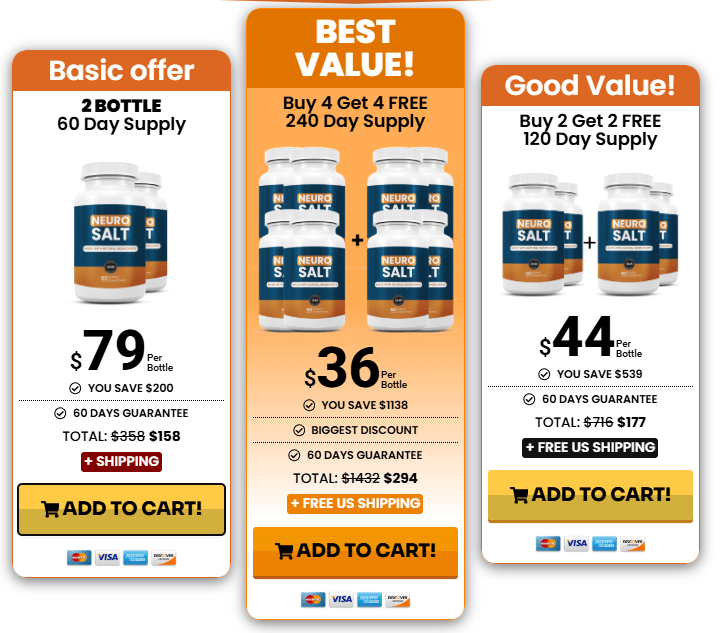
| Package | Price/Bottle | Total | Shipping | Supply |
|---|---|---|---|---|
| 2 Bottles | $79 | $158 | Paid | 60 days |
| 3 Bottles (Most Popular) | $69 | $207 | Free | 90 days |
| 6 Bottles (Best Value) | $49 | $294 | Free | 180 days |
Per the brand’s FAQ, the six-month package is positioned as their recommended option, framed around giving the ingredients time to work consistently in the system. According to the official site, the three- and six-bottle packages include five digital bonus guides as instant downloads; the two-bottle package does not appear to include them. Confirm current bonuses and pricing at checkout, since offers can change.
The 60-Day Guarantee
- Window runs 60 days from the delivery date.
- Email the company with a refund request within that window.
- Return all bottles, including empty ones, to the address on file.
- Return shipping is the buyer’s responsibility per the published policy.
- Refunds are processed within 5–10 business days of the return being received.
Always verify current guarantee terms on the official page before ordering, since policies can change.
Manufacturing and Third-Party Testing
The brand states the product is made in a GMP-compliant, FDA-registered U.S. facility and is non-GMO. GMP compliance is a regulatory floor — it means the manufacturer is subject to oversight for production quality and identity verification — but it isn’t the same as an independent, batch-specific Certificate of Analysis (COA) confirming potency. As of this review, a public COA wasn’t available on the product page; anyone who wants that level of verification should contact the company directly and ask for current testing documentation.
How Neuro Salt Compares to Other Approaches
Single-ingredient passionflower products isolate the ingredient with the most established (if still limited, per NCCIH) human research here, without the additional pathways the combination formula covers. Alpha-lipoic acid and B-vitamin combinations (benfotiamine, methylcobalamin) are a commonly recommended, mechanistically different approach to nerve-specific micronutrient support — not a competing option so much as a complementary one many people use alongside a botanical formula.
Ashwagandha-based products have solid human trial data for cortisol and stress-response support specifically, which may suit someone whose primary concern is generalized burnout-stress rather than nerve-specific discomfort. Prescription options like gabapentin or pregabalin work through an entirely different mechanism with their own clinical evidence and their own documented risks (sedation, dizziness, dependency potential with long-term use) — that decision belongs with a physician, and nothing here is a substitute for it.
Frequently Asked Questions
Is Neuro Salt FDA-approved?
No. Dietary supplements aren’t reviewed or approved by the FDA before marketing. The brand states its manufacturing facility is FDA-registered and GMP-compliant, which is a separate thing from product approval.
What is the pink salt trick, and does it work?
It’s a marketing phrase from Neuro Salt’s ad campaigns, not a clinical term. The actual product is a five-ingredient botanical supplement; its potential effects depend on the ingredient research covered above, not on any literal salt-based mechanism.
Does Neuro Salt contain opioids?
No. California poppy shares a plant family with opium poppy but contains none of its opioid alkaloids and is not a controlled substance.
Is corydalis safe for the liver?
Rare case reports have linked corydalis’s THP alkaloid to liver injury. Anyone with liver disease, elevated liver enzymes, or regular significant alcohol use should talk to a doctor before starting.
How should Neuro Salt be taken?
Per the official site, two capsules daily with an 8-ounce glass of water, with the brand recommending consistent use over roughly six months to properly evaluate results.
How long before someone might notice a difference?
The brand doesn’t publish a guaranteed week-by-week timeline. Based on how botanical formulas of this kind are generally discussed, some people report changes within the first few weeks; others need longer; some notice nothing. Individual results vary.
Is Neuro Salt appropriate for people managing blood sugar?
Talk to your doctor first. Prickly pear extract has shown blood-sugar-lowering activity in research, which could have an additive effect with diabetes medication, and corydalis carries its own liver-related caution that’s worth reviewing with your provider regardless of blood sugar status.
What if it doesn’t work for me?
Per the brand’s published policy, contact them within 60 days of delivery for a refund, return all bottles (including empty ones), and expect processing within 5–10 business days of the return being received. Return shipping is on the buyer.
Questions Worth Asking Yourself First
Have you discussed the ingredients — corydalis in particular — with your doctor, especially against your current medications and health history? Do you understand this is a supplement, not a treatment for any diagnosed condition? Are you prepared for the real possibility that it does nothing for you personally? And are you treating this as a complement to your existing sleep, diet, and activity habits rather than a replacement for them? Honest answers to these are the most useful filter for whether this is worth trying.
The Bottom Line
Neuro Salt is a five-ingredient botanical formula built around a genuinely coherent multi-pathway idea: calm the nervous system, support pain-signal regulation, and reduce systemic inflammatory load, rather than leaning on a single mechanism. Passionflower has some — though NCCIH is clear it’s limited — human research behind it. Corydalis brings an unusual and interesting preclinical profile, including a real, peer-reviewed rodent study out of UC Irvine, alongside a documented (if rare) liver safety signal that deserves a real conversation with your doctor before you start. Prickly pear has modest human evidence for anti-inflammatory effects.
Marshmallow root and California poppy round things out with plausible but thinner direct evidence for this specific use. None of this amounts to proof that the finished Neuro Salt formula works as marketed — that trial hasn’t been run. It amounts to a reasonably thoughtful ingredient selection with real (if uneven) research behind the individual pieces, sold with a 60-day window to find out whether it does anything for you personally. Whether that’s worth the cost and the corydalis conversation with your physician is a decision only you and your doctor can make together.
Scientific References Used in This Review
- NCCIH (NIH): Passionflower
- PLOS ONE (2016): The Antinociceptive Properties of the Corydalis yanhusuo Extract (UC Irvine, rodent study)
- NCCIH (NIH): General NCCIH botanical supplement evidence framework
- PubMed: Opuntia (prickly pear) anti-inflammatory research
- PubMed: Corydalis / tetrahydropalmatine hepatotoxicity case reports
Disclaimers
FDA Disclaimer: These statements have not been evaluated by the Food and Drug Administration. This product is not intended to diagnose, treat, cure, or prevent any disease.
This article is educational and does not constitute medical advice. Neuro Salt is a dietary supplement, not a medication. If you take medications, have existing health conditions, are pregnant or nursing, or are considering changes to your health regimen, consult your physician before starting Neuro Salt or any new supplement. Do not change or discontinue prescribed medications without your physician’s guidance.
Results May Vary: individual results depend on age, baseline health, liver health history, lifestyle, consistency of use, current medications, and other factors. Results are not guaranteed.
Ingredient Interaction Warning: passionflower, corydalis, California poppy, and prickly pear may interact with certain medications or health conditions, including sedatives, benzodiazepines, anticoagulants, and blood-glucose medications. Corydalis carries rare but documented case reports of liver injury. Always consult your healthcare provider before starting, especially if you take blood thinners, blood pressure medication, blood sugar medication, sedatives, or have chronic health conditions.
Home Health Remedy earns a commission on qualifying purchases made through links in this article. This does not affect the price you pay. Always verify current pricing, ingredients, and policies directly on the official brand site before ordering.

Natural home remedies, skincare secrets, dental & eye health tips, and real product reviews to help you stay healthy the natural way.