

Editorial disclosure: This article contains no affiliate links and no tracked partner links. Home Health Remedy earns nothing if you buy SteadyFlow or any product named here. This piece is consumer-protection reporting, not an advertorial. SteadyFlow is marketed as a dietary supplement, not an FDA-approved drug — the FDA does not approve dietary supplements for safety and effectiveness before they are sold — and nothing here claims the product diagnoses, treats, cures, mitigates, or prevents diabetes or any other disease. Details reflect brand materials reviewed in September 2026.
Phrases including “Sugar Drop” reflect marketing language used on SteadyFlow’s promotional video landing page. This publication does not independently substantiate them and reproduces them only to identify the campaign being described.
Why This Article Exists
You saw an ad for SteadyFlow. Maybe it looked like a local news segment. Maybe it was a link a friend sent. Maybe it was a scroll-stopping post with a countdown clock and a comment section full of people saying their blood sugar dropped in a week.
Something in it made you pause before handing over a card number. That instinct is the right one, and this article exists to back it up rather than talk you out of it.
Most articles you’ll find by searching this product’s name are affiliate pages. They earn a commission when you click through and buy, which means the writer’s income depends on your purchase. That isn’t automatically dishonest, but it is a conflict of interest, and you deserve at least one page about this product written by someone who gets paid the same whether you buy or not. This is that page.
At a Glance
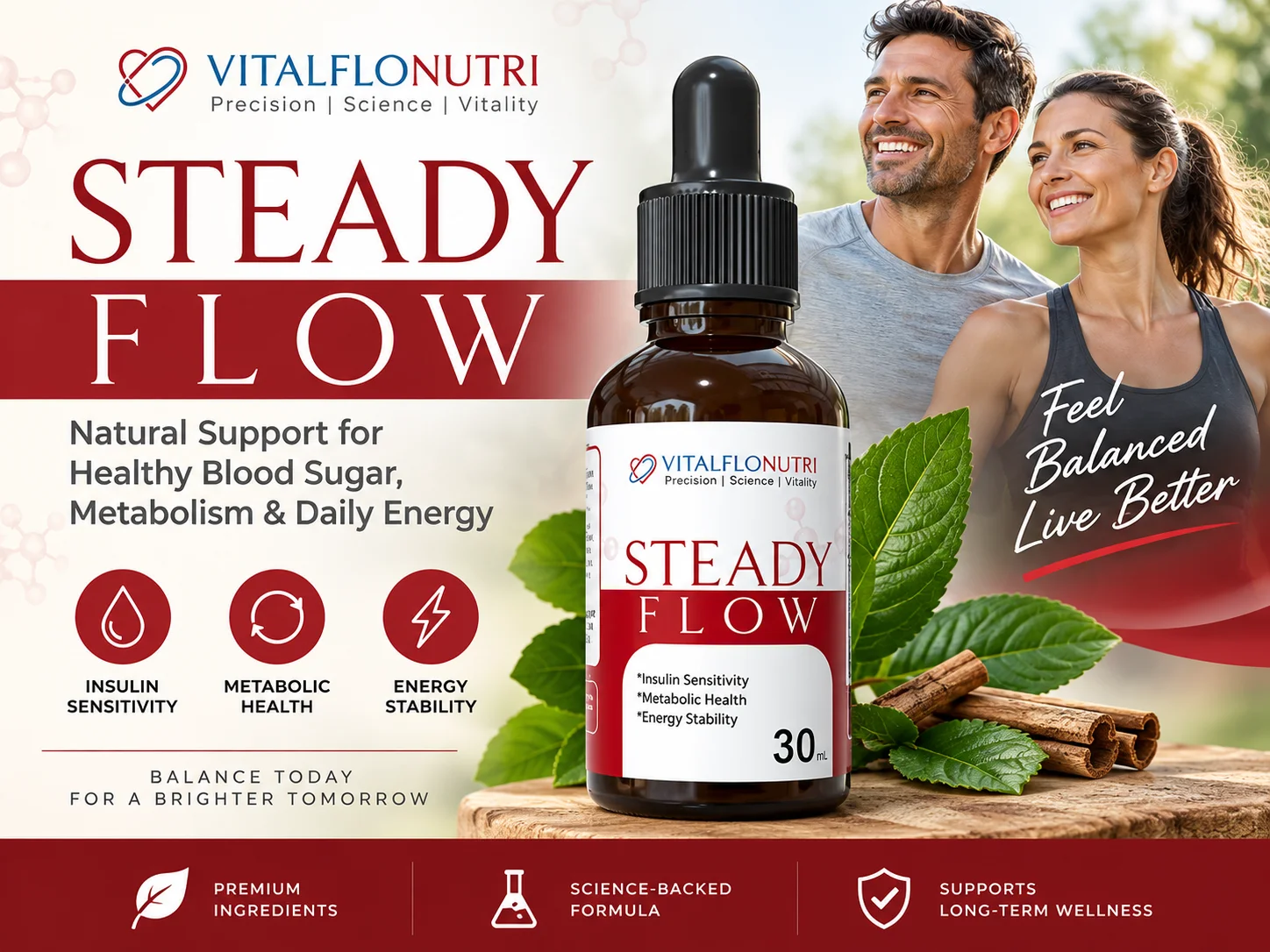
- Blood sugar support dietary supplement, sold in 2 / 3 / 6-bottle packages at $79 / $69 / $49 per bottle
- Promoted through a separate “Sugar Drop” video page carrying disease-related claims that appear nowhere on the order pages
- No ingredient list, Supplement Facts panel, serving size, or dosage published anywhere reviewed
- Two different company names and two different guarantee descriptions appear across the brand’s own pages
- A 60-day guarantee window is consistent; the mechanics inside that window are not
- The federal position on this product category is unambiguous, and it is covered in full below
What SteadyFlow Is, According to the Brand
Based on the seller’s own order page:
- Category: dietary supplement (brand-stated)
- Stated purpose: support already-healthy blood sugar levels and steadier daily energy
- Language style: structure/function wellness language — not a claim of treating or reversing a diagnosed condition
- Not established anywhere reviewed: that the product should replace insulin, prescription medication, or any physician-directed treatment plan
That last point carries the most weight in this article, because the video funnel feeding this same checkout uses far stronger language than the checkout itself does. Any decision about insulin, prescription medication, or a treatment plan belongs with a qualified healthcare provider — not with a supplement, not with a marketing video, and not with this article.
Where the Product Is Sold
This product runs across multiple domains, which is itself worth noting:
- Order/checkout page: secure.getvitalflonutri.com/DTC/ — where packages, pricing, and guarantee language are displayed.
- “Sugar Drop” promotional video page: turninghealthusa.com/sugar_drop/ — a separate landing page hosting the video presentation discussed below, treated here as promotional material rather than a brand or news source.
- This article: links to neither. Domains are named in plain text so you can evaluate them, not so you can be routed into a checkout.
A split between a heavily claim-laden promotional page and a plainer checkout page on a different domain is a structural feature of this kind of campaign, not an accident. The strong claims live where they can be walked back. The transaction lives somewhere quieter.
Reading the Marketing Language: A Phrase Glossary
- “Sugar Drop” — the name of the video presentation used to promote SteadyFlow on a separate domain. A campaign title, not a clinical term. No published research uses this phrase to describe anything.
- “100% Satisfaction or Your Money Back” — guarantee language on the order and video pages. The checkout footer describes the same window differently (see below). The FTC specifically flags results-or-refund promises as a common feature of deceptive health marketing.
- “You Save $780 / $330 / $200” — calculated against a brand-set reference total ($1,074 / $537 / $358), not a price independently verified as ever having been charged.
- “Biggest Discount” / “Best Value!” — the brand’s own labels for its highest-volume package, not a third-party price comparison.
Buyer takeaway: these are standard direct-response constructions. Recognizing them doesn’t prove anything about the product, but it does mean you’re reading the sales page the way a careful shopper would.
What the Order Page Claims
In the brand’s own words, the order page says the formula:
- “has helped countless people maintain healthy blood sugar levels”
- helps “support stable glucose response”
- helps “promote overall blood health”
- may lead users to “notice more stable energy levels, reduced sugar cravings, and a steadier feeling” within days
- could lead to “healthier blood sugar readings” and “improved glucose response” over a longer window
The qualifiers matter. “May notice” and “could start to see” are legally cautious phrasings, and they make the order page materially more restrained than the promotional video that drives traffic to it. That gap between the two surfaces is the single most important thing on this page.
Health notice: SteadyFlow is marketed as a dietary supplement, not a treatment for diabetes. Nothing here is medical advice or a recommendation to stop, reduce, replace, or modify prescribed diabetes treatment. Anyone managing diabetes, prediabetes, or another medical condition should speak with a qualified healthcare professional before starting any new supplement. No mechanism is explained anywhere on the order pages — and, as covered next, no ingredient list at all.
The Video Versus the Checkout: The Core Problem
This is the section that matters most.
SteadyFlow is marketed through at least two surfaces: a plain checkout flow, and a separate video landing page styled as a breaking-news segment. That page uses broadcast-style graphics and references recognizable media brands and programming. Nothing found during this review confirms that any of those broadcasters, programs, platforms, or public figures are connected to SteadyFlow in any way.
The same page displays a comment section — labeled as showing 16 of 552 comments — with reader-submitted-style testimonials describing outcomes well beyond anything on the brand’s own order pages, including:
- A rapid blood-sugar change described within about a week
- A described diabetes “reversal” within days
- A family member’s long-term insulin use continuing alongside an unspecified regimen with a doctor’s apparent approval
- A comment referencing a name closely resembling a well-known media personality’s, spelled differently than that person’s name is normally spelled
Nothing found here connects that person, or any of the media brands referenced, to SteadyFlow. None of these claims appear anywhere on the brand’s actual checkout or order pages. This article describes only what the marketing displays — not what is true — and does not repeat these claims as evidence of anything.
This pattern has a regulatory history. The FTC has brought enforcement action against supplement campaigns built on exactly this architecture: online ad campaigns using “news” websites that were not news sites, featuring testimonials attributed to public figures who had nothing to do with the products, with commenters who were invented outright, and money-back guarantees that consumers were then blocked from collecting on. The agency’s published guidance names fake patient endorsements, results-or-refund promises, cure claims, and manufactured urgency as recurring markers of deceptive health advertising.
Buyer takeaway: if the video’s news framing or comment section is any part of why you’re considering ordering, understand that the checkout pages this brand actually processes orders through repeat none of those claims. A seller that believed those claims were defensible would put them where the transaction happens. That gap is the tell.
The Ingredient Problem
None of the pages reviewed — order page, checkout page, or video landing page — publish:
- A Supplement Facts panel
- An ingredient list
- A serving size
- Dosage information
For any supplement this is a disclosure failure. For one marketed around blood sugar to an audience that disproportionately takes prescription medication, it is a safety problem.
Here is the concrete risk, and it is not hypothetical. FDA laboratory analysis has found products marketed as “all-natural” diabetes remedies that contained undeclared active pharmaceutical ingredients — the same compounds found in approved prescription diabetes drugs. When a consumer and their physician don’t know what is actually in a product, those hidden ingredients can stack on top of prescribed medication. The agency’s stated concern is that patients may end up taking a larger combined dose than intended, which can drive blood sugar down to a dangerous degree — hypoglycemia. The FDA has repeatedly issued warning letters to companies marketing diabetes products in violation of federal law, and in September 2021 the FDA and FTC jointly issued warning letters to ten companies selling dietary supplements that claimed to cure, treat, mitigate, or prevent diabetes.
None of that is a finding about SteadyFlow specifically. It is the reason an undisclosed formula in this category cannot be treated as a minor documentation gap. You cannot check a product against your prescriptions when the product won’t tell you what it contains, and no article — including this one — can fill that blank by guessing from similar products.
What the Science Actually Says About Blood Sugar Supplements
Since the formula isn’t published, the honest thing to report is the state of the evidence for the category as a whole.
The National Center for Complementary and Integrative Health, part of NIH, states the position plainly: there is not enough scientific evidence to show that any dietary supplement can help manage or prevent type 2 diabetes. Some may offer benefit for certain associated conditions, but the overall picture does not support supplements as a management tool.
NCCIH also flags a specific hazard that gets almost no airtime in supplement marketing: there are multiple case reports linking dietary supplement use to kidney disease. Diabetes is already the leading cause of chronic kidney disease and kidney failure in the United States, which makes supplement use in this population something to monitor closely rather than casually add.
On individual ingredients commonly found in this category, the picture is mixed rather than promising. Alpha-lipoic acid may improve symptoms of diabetic nephropathy, but the evidence isn’t sufficient to draw conclusions about its effect on other symptoms of diabetes. Chromium may offer some benefit for glycemic control, but the research is conflicting. Evidence for resveratrol’s effect on glycemic control has been characterized as low certainty. Data on omega-3 supplementation and glucose levels in people with diabetes are conflicting.
That is the realistic ceiling for this category: modest, inconsistent, ingredient-specific, and nowhere near what a video promising a reversal in days is selling.
NCCIH also states the risk in the bluntest available terms: fraudulent diabetes products can be especially dangerous if used in place of proven treatments, because without proper disease management people with diabetes face greater risk of serious complications.
Pricing, as Displayed
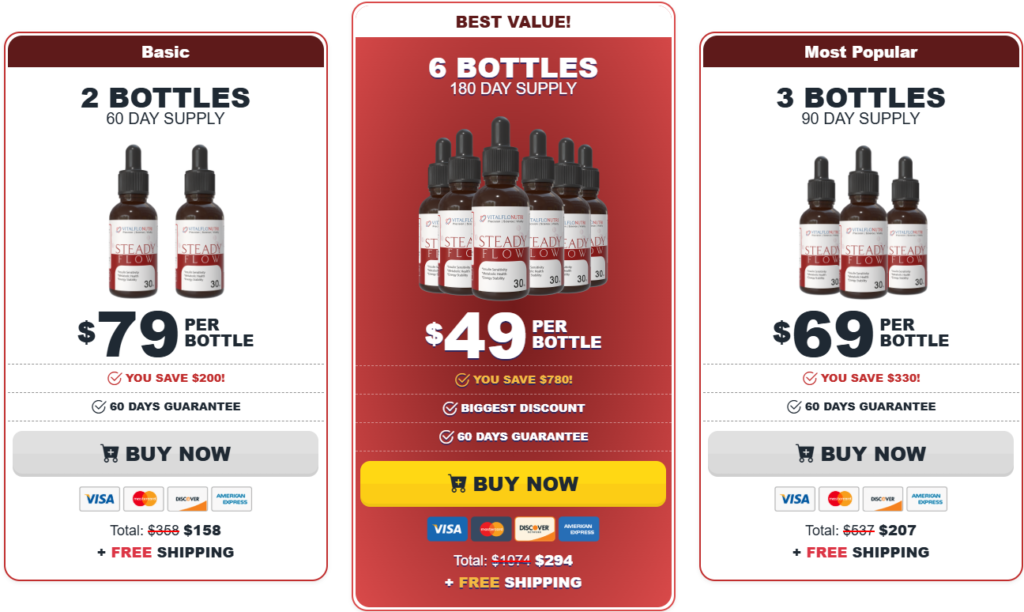
As shown on SteadyFlow’s checkout page when reviewed in September 2026:
- 2 bottles (Basic): $79 per bottle, $158 total, described as a 60-day supply. Brand reference total: $358.
- 3 bottles (Most Popular): $69 per bottle, $207 total, described as a 90-day supply. Brand reference total: $537.
- 6 bottles (Best Value): $49 per bottle, $294 total, described as a 180-day supply. Brand reference total: $1,074. The video page also references an unspecified bonus item with this package, undescribed anywhere reviewed.
Cost per day, using the brand’s own totals and stated supply lengths:
- 2-bottle package: about $2.63/day ($158 ÷ 60 days)
- 3-bottle package: about $2.30/day ($207 ÷ 90 days)
- 6-bottle package: about $1.63/day ($294 ÷ 180 days)
All three packages include free shipping per the brand’s pages. No separate shipping, handling, or additional fees beyond the listed total appeared at checkout as reviewed. The checkout described the transaction as a one-time purchase, with no subscription or autoship enrollment displayed.
Worth naming the structure: the per-bottle price falls as volume rises, which pushes buyers toward a $294 commitment on a product whose contents they have not been shown. Under a 60-day guarantee, a 180-day supply means most of what you bought falls outside the return window before you could plausibly evaluate it.
The Rating Figures Don’t Reconcile
SteadyFlow’s own pages display two different ratings:
- Order page: “Average Customer Rating” of 4.9
- Checkout page: “9.7 — Excellent!” alongside “36,015 reviews”
These don’t line up, and neither page identifies a platform either figure came from. Treat both as brand-displayed graphics rather than independently confirmed ratings.
For context, the FTC’s Rule on the Use of Consumer Reviews and Testimonials exists specifically because fake and manipulated reviews are a persistent problem, including businesses paying supposedly independent websites for favorable coverage. An unattributed rating with no named source and no methodology is not evidence. It’s a design element.
The Guarantee Is Described Two Different Ways
- Order and video pages: a “100% Satisfaction or Your Money Back” guarantee lasting 60 days from purchase. The video page adds that a dissatisfied customer should wait until after at least 30 days of use before contacting the company — which consumes half the window.
- Checkout page footer: a different policy. The seller “will allow for the return or replacement of any product within 60 days from the date of purchase” — return-or-replacement framing, not an explicit cash-refund framing.
Neither page specifies who covers return shipping or what condition a returned bottle must be in.
Buyer takeaway: get exact refund terms in writing before ordering — specifically whether you’re entitled to money back or only a replacement, and what the process requires. The 60-day window is consistent. The mechanics inside it are not, and refund friction is a documented feature of enforcement cases in this category.
Is SteadyFlow a Scam?
This article does not make that call, and it is not positioned to. Fraud is a legal determination that requires evidence this review does not have.
What is confirmable from the reviewed pages:
- Product name and package structure
- Displayed pricing
- The 60-day guarantee window
- Checkout availability
What remains unverified:
- The full ingredient list and dosages
- The legal operating entity
- The methodology behind either displayed rating figure
- The exact refund mechanics
- Any connection between the media brands or public figures referenced in the video and this product
What this article will say is narrower and firmer: the promotional funnel exhibits several patterns that federal consumer-protection agencies have publicly identified as markers of deceptive health marketing. That is a statement about the marketing, which is observable, rather than about the company’s intent, which is not.
Verification Gaps Found
These are not complaints pulled from a review site. They are gaps this review found on the brand’s own pages:
- No ingredient disclosure anywhere
- A company-name discrepancy: “VitalFloNutri Steadyflow” (checkout footer) versus “SteadyFlow Research” (order and video pages)
- Guarantee wording that changes depending on which page you read
- No disclosed source for either rating figure
- A support email (support@vitalflownutri.com) that differs from the checkout domain (getvitalflonutri.com)
- A 6-bottle bonus item referenced but never described
- GMP, Non-GMO, and “100% Natural” badges displayed as graphics with no certifying-body statement confirmed
If You Are Managing Diabetes With Medication
This is the part that isn’t about shopping.
Talk to your prescribing physician before starting any supplement, and do not change insulin or any other prescribed medication on the strength of a marketing video, a comment section, or an article. The federal warning is specifically that products like these carry additional risk when they cause people to delay or discontinue effective treatment. Without proper disease management, the risk of serious complications rises.
If you already bought something in this category and are taking it, that is worth mentioning at your next appointment — not as a confession, just as information your doctor should have. If you experience a bad reaction to any supplement, you can report it to the FDA at 800-FDA-1088 or through the agency’s online reporting form, and to the manufacturer using the contact information on the label.
Before You Buy Anything in This Category
- Require a full Supplement Facts panel with per-serving amounts, in writing, before you pay. No panel, no purchase.
- Confirm which legal entity you’re actually buying from.
- Get refund terms in writing: cash refund or replacement only, who pays return shipping, what condition the bottle must be in.
- Ask which platform any displayed rating came from, and check whether the reviews exist there.
- Search the product name alongside “FDA warning letter” and check the FDA’s health fraud listings.
- Treat news-styled video pages as advertising until proven otherwise. Look for a named author, a real publication masthead, and a working contact route.
- Show the ingredient panel to your doctor or pharmacist if you take any prescription medication.
Scientific and Regulatory Resources
These are the sources behind this article, and they are more useful than any supplement review:
- NCCIH — Diabetes and Dietary Supplements: What You Need To Know: https://www.nccih.nih.gov/health/diabetes-and-dietary-supplements-what-you-need-to-know
- NCCIH — Type 2 Diabetes and Dietary Supplements: What the Science Says: https://www.nccih.nih.gov/health/providers/digest/type-2-diabetes-and-dietary-supplements-science
- NCCIH — Using Dietary Supplements Wisely: https://www.nccih.nih.gov/health/using-dietary-supplements-wisely
- NIH Office of Dietary Supplements — Dietary Supplements: What You Need to Know: https://ods.od.nih.gov/factsheets/WYNTK-Consumer/
- FDA — Information for Consumers on Using Dietary Supplements: https://www.fda.gov/food/dietary-supplements/information-consumers-using-dietary-supplements
- FDA — Beware of Illegally Marketed Diabetes Treatments, Fraudulent Pharmacies: https://www.fda.gov/consumers/consumer-updates/beware-illegally-marketed-diabetes-treatments-fraudulent-pharmacies
- FDA — Illegally Sold Diabetes Treatments (warning letter listings): https://www.fda.gov/consumers/health-fraud/illegally-sold-diabetes-treatments
- FDA and FTC — Warning letters to 10 companies selling supplements claiming to treat diabetes (Sept. 2021): https://www.fda.gov/food/cfsan-constituent-updates/fda-and-ftc-send-warning-letters-10-companies-illegally-selling-dietary-supplements-claiming-treat
- FTC Consumer Advice — Common Health Scams: https://consumer.ftc.gov/articles/common-health-scams
- FTC — Bogus celebrity testimonials and phony formats: DON’Ts for advertisers and affiliates: https://www.ftc.gov/business-guidance/blog/2019/04/bogus-celebrity-testimonials-phony-formats-donts-advertisers-affiliates
- FTC — Endorsements, Influencers, and Reviews: https://www.ftc.gov/business-guidance/advertising-marketing/endorsements-influencers-reviews
To report a deceptive health product or ad, use https://reportfraud.ftc.gov.
Frequently Asked Questions
What is SteadyFlow? A product marketed by its seller as a dietary supplement for already-healthy blood sugar levels, stable glucose response, and general blood health. It’s sold through a checkout page in 2-, 3-, and 6-bottle packages and separately promoted through a video presentation called “Sugar Drop.” The order-page language is hedged; the video’s language is not. This review reflects the pages as they appeared in September 2026.
Does SteadyFlow treat or reverse diabetes? No claim on the brand’s own order or checkout pages says so. That idea comes from reader-style comments on a separate video landing page, none of which this review could verify. SteadyFlow is marketed as a dietary supplement, not an FDA-approved treatment. NCCIH’s position is that there is not enough evidence that any dietary supplement can manage or prevent type 2 diabetes. Nothing here supports reducing, stopping, or replacing insulin or any prescribed treatment.
What’s in SteadyFlow? Not published anywhere reviewed. No Supplement Facts panel, ingredient list, serving size, or dosage appears on the order page, checkout page, or video landing page. This article does not invent, estimate, or infer an ingredient list from similar products and treats the absence as disqualifying rather than incidental.
Is SteadyFlow a scam? This article makes no such determination. What is documented: two company names, two guarantee descriptions, two irreconcilable rating figures, no ingredient disclosure, and a promotional video using news styling and unverifiable disease-outcome testimonials. Those are verification gaps and marketing-pattern observations, not a fraud finding.
How much does it cost? $79, $69, and $49 per bottle for the 2-, 3-, and 6-bottle packages, totaling $158, $207, and $294 as displayed in September 2026 — roughly $2.63, $2.30, and $1.63 per day against the brand’s stated supply lengths. “You save” figures are calculated against reference prices the brand sets itself.
What is the refund policy? It depends which page you read. The order page and video describe a 60-day money-back guarantee; the checkout footer describes 60-day return-or-replacement. Neither specifies who pays return shipping or what condition a returned bottle must be in. Get it in writing before ordering.
Are the media and public-figure references verified? No. No independent confirmation was found that any broadcaster, program, platform, or public figure referenced in the presentation produced, aired, sponsored, endorsed, or is affiliated with SteadyFlow. Treat the styling as promotional packaging.
Does it require a subscription? The checkout reviewed in September 2026 displayed a one-time purchase with no autoship enrollment visible. Read the final order summary carefully before paying, since checkout flows change.
The Bottom Line
Stripped of the video, SteadyFlow is a conventional direct-to-consumer supplement offer: tiered multi-bottle pricing, free shipping, and a brand-stated 60-day guarantee. What it does not have is the one thing that would let you or your doctor evaluate it — a published formula.
Add the “Sugar Drop” video, and the picture gets harder to defend. News-style branding, references to media brands with no confirmed connection, a comment section describing diabetes reversal in days, and a near-miss celebrity name — none of it appearing on the pages that actually take your money.
The federal guidance here is not ambiguous. There is not enough evidence that any supplement manages or prevents type 2 diabetes. Undisclosed “all-natural” diabetes products have been found to contain hidden prescription drugs. The real danger is not the $158 — it’s a delayed or discontinued treatment plan.
If you’re managing blood sugar with medication, the highest-value thing you can do this week costs nothing: bring this ad to your next appointment and ask your doctor what they think. That is a better use of the conversation than any bottle.
Editorial Disclosures
Independence: No affiliate links, tracked links, or commission arrangements appear in this article. Home Health Remedy received no compensation from SteadyFlow, VitalFloNutri, SteadyFlow Research, or any affiliate network in connection with this piece.
Material limitations: Based on SteadyFlow’s order page, checkout page, and “Sugar Drop” video landing page as they appeared in September 2026. No product testing was performed and no product was purchased. Brand claims — pricing, guarantee, and wellness statements — are attributed to the brand and are not independently verified. The following could not be confirmed and are flagged rather than assumed: the full ingredient list and dosages, the correct legal operating entity, the platform behind either rating figure, the contents of the referenced bonus item, and any connection between the media or public-figure references and the product.
Not medical advice: This article is general consumer information. It is not a diagnosis, a treatment recommendation, or a substitute for care from a qualified healthcare professional. Decisions about insulin, diabetes medication, or any treatment plan belong with your prescribing clinician.
Forward-looking: Pricing, packaging, guarantee terms, and company details are subject to change without notice. Details reflect September 2026.
Trademarks: SteadyFlow is referenced as a product name as displayed on the brand’s own pages; no registered trademark symbol was confirmed on any page reviewed. Media brands and programming referenced in the promotional video are trademarks of their respective owners; their mention here refers solely to branding displayed on third-party marketing material and does not imply any affiliation, endorsement, or sponsorship.
Corrections: If the brand publishes a Supplement Facts panel, clarifies its operating entity, or reconciles its guarantee language, this article will be updated. Contact the editorial desk with documentation.

Natural home remedies, skincare secrets, dental & eye health tips, and real product reviews to help you stay healthy the natural way.