

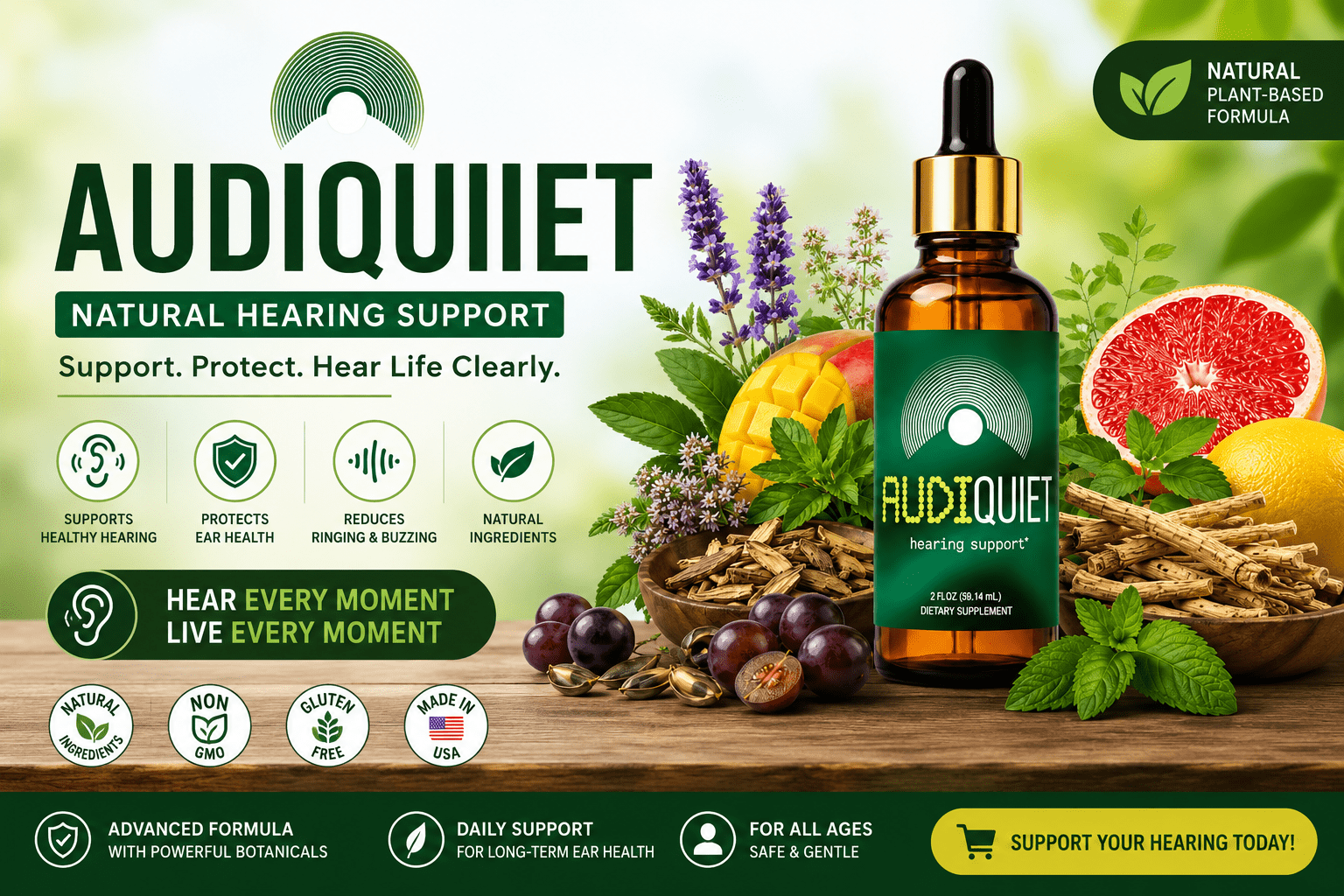
AudiQuiet is a liquid “auditory wellness” dietary supplement that has become one of the most-searched hearing-support drops of 2026, frequently mentioned alongside similar formulas such as Audifort. This guide breaks down what AudiQuiet is, what its listed ingredients are actually backed by in independent research, current 2026 pricing straight from the official checkout tiers, safety considerations, and a side-by-side comparison with Audifort — so you can make an informed decision before you buy.
Important upfront: Tinnitus and hearing loss are medical conditions with many possible causes. No dietary supplement — including AudiQuiet or Audifort — is FDA-approved to treat, cure, reverse, or prevent hearing loss or tinnitus. This article is educational and does not replace a hearing evaluation by a licensed audiologist or ENT physician.
What Is AudiQuiet?
AudiQuiet is marketed as a daily liquid supplement designed to support “auditory wellness” — a broad term used to describe inner-ear comfort, balanced auditory nerve activity, antioxidant protection for delicate ear structures, and general hearing-related quality of life. It is taken as drops, typically placed under the tongue or mixed into water or a beverage once per day, according to product listings.
The formula is promoted around a small number of botanical and antioxidant ingredients, with grape seed extract highlighted as a headline component. Like most direct-to-consumer wellness supplements in this category, AudiQuiet is sold primarily through an online checkout page rather than in pharmacies, and manufacturer claims about GMP certification or manufacturing standards are not independently verified in the sources reviewed for this article.
AudiQuiet does not claim to be a medical device or drug, and it is not positioned as a treatment for diagnosed hearing loss, tinnitus, or any inner-ear disease — a distinction worth keeping in mind while reading marketing claims.
How AudiQuiet Claims to Work
Marketing materials for AudiQuiet and comparable products in this category generally describe four claimed mechanisms:
● Supporting blood circulation to the inner ear, which delivers oxygen and nutrients to sensitive structures.
● Providing antioxidant compounds intended to help offset oxidative stress, a process implicated in cellular aging.
● Supporting balanced auditory nerve signaling and a calmer stress response.
● General nutritional support for long-term ear wellness alongside healthy lifestyle habits.
These are plausible-sounding physiological targets — oxidative stress and reduced cochlear blood flow are genuine areas of hearing research — but that is different from saying AudiQuiet’s specific finished formula has been tested in a published clinical trial. No such trial was found for this article. The evidence below applies to individual ingredients studied largely in isolation, not to the branded product as a whole.
AudiQuiet Ingredients: What the Science Actually Shows
Grape Seed Extract (Proanthocyanidins / OPCs)
Grape seed extract is rich in proanthocyanidins, a class of polyphenol antioxidants. Laboratory and animal research shows meaningful antioxidant activity and some anti-inflammatory effects. However, the National Institutes of Health’s LiverTox database, published through the NCBI Bookshelf, notes plainly that despite decades of purported benefits for circulation and other conditions, none of these claims has been verified in properly designed, adequately powered human trials, and grape seed extract has not been approved by the FDA for any medical condition.
GABA (Gamma-Aminobutyric Acid)
GABA is the brain’s primary inhibitory neurotransmitter and is involved in calming neural activity. Oral GABA supplements are commonly marketed for relaxation and stress support. Whether meaningful amounts of orally supplemented GABA cross the blood-brain barrier to directly influence auditory nerve signaling is not well established in human research, and it should be viewed as a general relaxation-support ingredient rather than an ear-specific one.
Green Tea Catechins
Green tea is a well-studied source of catechin antioxidants, most notably EGCG. General antioxidant and anti-inflammatory properties are well documented, but there is no strong body of human clinical evidence specifically linking green tea catechin supplementation to reversing hearing loss or tinnitus symptoms.
Capsicum Annuum (Cayenne)
Capsicum is traditionally used for circulatory support and contains capsaicin, which has documented effects on blood flow and metabolism in some studies. As with the other ingredients here, ear-specific human trials are lacking.
Vitamins and Minerals (Vitamin C, Vitamin E, Zinc, Copper, Selenium)
These micronutrients play established roles in general antioxidant defense and immune function, and deficiencies in some of them have been loosely associated with age-related hearing changes in observational research. That is different from proving that supplementing them reverses existing hearing loss in people who are not deficient.
Gymnema Sylvestre
Gymnema Sylvestre is most widely researched for blood sugar support rather than hearing, which is why anyone on diabetes medication should review this ingredient with a physician or pharmacist before use (see Safety section below).
What Science Actually Says About Tinnitus and Hearing Loss
Before evaluating any hearing supplement, it helps to understand what leading medical authorities actually say about these conditions:
● The National Institute on Deafness and Other Communication Disorders (NIDCD), part of the NIH, reports that tinnitus affects roughly 10–25% of adults, and that it is a symptom — not a disease — usually linked to some degree of underlying hearing loss.
● NIDCD identifies noise exposure as a leading, largely preventable cause of hearing damage and tinnitus, alongside aging, certain medications, and inner-ear disorders.
● Mayo Clinic notes there is no single FDA-approved cure for most tinnitus; management instead focuses on treating any underlying condition, hearing aids, sound therapy/masking, and counseling approaches such as cognitive behavioral therapy.
None of these authoritative sources list oral botanical supplements as a recommended primary treatment for tinnitus or hearing loss. That does not necessarily mean ingredients like antioxidants are useless for general wellness — it means the specific claim “this supplement restores hearing or eliminates tinnitus” goes beyond what current independent research supports for this product category.
AudiQuiet Pricing 2026 (Updated From Official Checkout)

Pricing below reflects the current three-tier checkout structure shown on the official order page at the time of writing. Promotional pricing on direct-to-consumer supplement sites changes frequently, so always confirm the live total at checkout before completing a purchase.
| Package | Price / Bottle | Total Price | You Save | Shipping |
| Try Two — 30-Day Supply (2 Bottles) | $89 | $178 (was $358) | $180 | + Shipping |
| Most Popular — 90-Day Supply (3 Bottles) | $72 | $216 (was $537) | $321 | Free Shipping |
| Best Offer — 180-Day Supply (6 Bottles) | $49 | $294 (was $1,074) | $780 | Free Shipping |
● All three packages are backed by a 60-day money-back guarantee, per the checkout page.
● The 3-bottle and 6-bottle packages ship free; the 2-bottle package adds shipping.
● Accepted payment methods shown at checkout include Mastercard, Visa, American Express, Diners Club, Apple Pay, and Google Pay.
● The 6-bottle “Best Offer” tier has the lowest per-bottle cost ($49/bottle), which is standard practice across this supplement category — larger bundles are priced to encourage bigger upfront purchases, so weigh that against the refund window before committing to six months of product.
AudiQuiet vs Audifort: Full Comparison
AudiQuiet and Audifort are both liquid “auditory wellness” drops sold direct-to-consumer, and they share some overlapping ingredients — grape seed extract being the most notable. Here’s how the two compare based on publicly available product information:
| Feature | AudiQuiet | Audifort |
| Format | Liquid dropper, taken daily | Liquid dropper, taken daily |
| Positioning | Auditory comfort, inner-ear circulation, nerve balance | Inner-ear circulation, inflammation, cognitive clarity |
| Headline ingredient | Grape Seed Extract (OPCs) | Grape Seed Extract, Maca Root, GABA, Green Tea, Capsicum, Gymnema Sylvestre |
| Ingredient count (per brand claims) | Not fully disclosed on packaging shown | 20+ ingredients across 4 formula “blends” |
| Money-back guarantee | 60 days (per current packaging) | 60–90 days depending on seller/listing |
| Where sold | Official site / online retailers | Official site and third-party marketplaces (e.g., Walmart listing) |
| Clinical trials on the finished product | None published/independently verified | None published/independently verified |
| Best-value package (as shown) | 6 bottles at $49/bottle ($294 total) | Varies by current promotion — check official listing |
The practical difference for most shoppers comes down to formula breadth (Audifort markets a larger, multi-blend ingredient list) versus simplicity and price (AudiQuiet’s checkout tiers shown above are competitively priced at the 6-bottle level). Neither product’s finished formula has published, peer-reviewed human clinical trial data behind it, so the comparison is really one of ingredient philosophy, guarantee terms, and price — not proven clinical outcomes.
Potential Side Effects and Who Should Be Cautious
Botanical supplements are generally well tolerated by most healthy adults, but “natural” does not mean risk-free for everyone. Based on the known properties of the ingredients discussed above, consider the following before starting AudiQuiet, Audifort, or any similar product:
● Grape seed extract and capsicum may have mild effects on blood pressure and circulation — use caution if you take blood pressure medication or blood thinners.
● GABA supplements can cause drowsiness in some people, particularly when combined with sedatives or alcohol.
● Gymnema Sylvestre can lower blood sugar; people on insulin or diabetes medication should talk to their doctor first to avoid hypoglycemia.
● Anyone who is pregnant, nursing, under 18, or managing a chronic condition should consult a physician before starting any new supplement.
● Bring the full supplement facts label to your doctor or pharmacist so they can check for interactions with your current medications.
● Stop use and seek medical attention if you notice signs of an allergic reaction, unusual dizziness, or new ringing/hearing changes.
Pros and Cons
Potential Pros
● Simple liquid-drop format that’s easy to add to a daily routine.
● Contains grape seed extract, an antioxidant with real (if general, non-ear-specific) research support.
● 60-day money-back guarantee reduces financial risk on the trial-size packages.
● Bundle pricing brings the per-bottle cost down significantly for longer commitments.
Potential Cons
● No published, independently verified clinical trial on the finished AudiQuiet formula.
● Full ingredient list and exact dosing were not clearly disclosed in the materials reviewed.
● Marketing language (“auditory wellness,” “nerve balance”) is vague compared to medically defined outcomes.
● Not a substitute for a professional hearing evaluation if you have persistent tinnitus or hearing changes.
Beyond the Bottle: Evidence-Based Habits for Ear Health
Whether or not you decide to try a supplement, the habits with the strongest research backing for protecting hearing over the long term are lifestyle-based rather than pill-based. NIDCD and hearing-health researchers consistently point to a handful of practical steps:
● Limit exposure to loud noise, and wear earplugs or earmuffs around power tools, concerts, or machinery — noise-induced damage is cumulative and largely preventable.
● Give your ears recovery time after loud events; consecutive days of loud exposure without rest compound the risk.
● Keep headphone/earbud volume moderate and take listening breaks during long sessions.
● Manage cardiovascular risk factors — blood flow to the inner ear depends on healthy circulation, so blood pressure, cholesterol, and blood sugar control all matter.
● Review medications with your doctor or pharmacist, since a number of drugs are known to be ototoxic (potentially damaging to hearing) at certain doses.
● Get a baseline hearing test, especially after age 50 or with any occupational noise exposure, so changes can be tracked early.
● Manage stress and sleep, since both can make existing tinnitus more noticeable even when they don’t cause it outright.
These steps don’t carry the promise of a quick fix, but unlike a proprietary supplement blend, each one is backed by consistent, published guidance from hearing-health authorities — making them a reasonable foundation to build on regardless of which supplement, if any, you choose to add on top.
How to Evaluate Any Hearing Supplement Before Buying
AudiQuiet and Audifort are two names in a crowded field of similarly marketed liquid ear-health drops. Before buying any product in this category — including these two — it’s worth running through a short checklist:
● Is the full ingredient list and exact dosage per serving disclosed, or only a partial list of “highlight” ingredients?
● Are there any published, peer-reviewed human trials on the finished product itself, not just on individual ingredients in unrelated formulations?
● Does the sales page make specific medical claims (“reverses hearing loss,” “cures tinnitus”) that go beyond what a dietary supplement is legally allowed to claim?
● What exactly does the money-back guarantee cover, and what is the actual deadline and return process?
● Would the ingredients interact with any medications or conditions you already have?
Running any hearing supplement through these questions — rather than relying on testimonials or before/after claims alone — gives you a more realistic picture of what you’re actually paying for.
Frequently Asked Questions
Is AudiQuiet FDA approved?
No. AudiQuiet is a dietary supplement, and dietary supplements are not FDA-approved for treating, curing, or preventing any disease, including hearing loss or tinnitus. Supplement manufacturers are responsible for ensuring safety, but the FDA does not evaluate these products for effectiveness before they go on sale.
Does AudiQuiet cure tinnitus or reverse hearing loss?
There is no independent clinical evidence that AudiQuiet cures tinnitus or reverses hearing loss. Leading authorities like the NIDCD and Mayo Clinic do not list supplements of this type as an established tinnitus treatment. If you have persistent ringing or hearing changes, see an audiologist or ENT for a proper evaluation.
How long does it take to notice results?
Marketing materials for products in this category typically suggest consistent daily use over several weeks to months, but timelines are anecdotal rather than clinically established. Individual results will vary, and some users may notice no change.
What is the difference between AudiQuiet and Audifort?
Both are liquid hearing-wellness drops with overlapping ingredients, most notably grape seed extract. Audifort markets a larger, multi-blend ingredient list (20+ components across four formula groups), while AudiQuiet’s checkout page shown here emphasizes a simpler, lower-cost bundle structure. Neither has published clinical trial data on the finished product.
Is AudiQuiet safe to take with blood pressure or diabetes medication?
Possibly not without medical guidance. Ingredients like grape seed extract and capsicum can interact with blood pressure medication, and Gymnema Sylvestre can affect blood sugar. Anyone on these medications should consult a doctor or pharmacist before use.
What is AudiQuiet’s refund policy?
Per the current checkout page, all three package tiers (2, 3, and 6 bottles) are covered by a 60-day money-back guarantee. Always review the exact refund terms and conditions on the official order page before purchasing, as policies can change.
Where can I buy AudiQuiet at the price shown here?
Pricing in this article reflects the official three-tier checkout page at the time of writing: $89/bottle (2-bottle package), $72/bottle (3-bottle package), and $49/bottle (6-bottle package). Prices on direct-to-consumer supplement sites can change without notice, so confirm the live total before checking out.
Final Verdict
AudiQuiet fits squarely into the fast-growing category of liquid “auditory wellness” supplements that includes Audifort and several similarly positioned products. Its headline ingredient, grape seed extract, does have real (though general, not ear-specific) antioxidant research behind it, and the 60-day guarantee offers some purchase protection. That said, the product’s marketing claims about hearing clarity and tinnitus relief outrun what independent, peer-reviewed research currently supports for this specific formula. Treat AudiQuiet as a general wellness supplement to discuss with your doctor — not a replacement for a professional hearing evaluation, hearing aids, or established tinnitus management strategies if you’re dealing with persistent symptoms.
Medical Disclaimer
This article is provided for general educational purposes by homehealthyremedy.com and does not constitute medical advice, diagnosis, or treatment. AudiQuiet, Audifort, and similar products discussed here are dietary supplements that have not been evaluated by the FDA and are not intended to diagnose, treat, cure, or prevent any disease, including hearing loss or tinnitus. Statements about ingredients reflect general research on those ingredients in isolation, not clinical trials of the finished branded products. Always consult a licensed physician, audiologist, or pharmacist before starting any new supplement, especially if you are pregnant, nursing, taking medication, or managing a chronic health condition. If you experience sudden hearing loss, severe dizziness, ear pain, or rapidly worsening tinnitus, seek medical care promptly.
Scientific Resources & References
NIDCD — What Is Tinnitus? Causes and Treatment — https://www.nidcd.nih.gov/health/tinnitus
NIDCD — Noise-Induced Hearing Loss —https://www.nidcd.nih.gov/health/noise-induced-hearing-loss
Mayo Clinic — Tinnitus: Symptoms and Causes —https://www.mayoclinic.org/diseases-conditions/tinnitus/symptoms-causes/syc-20350156
Mayo Clinic — Tinnitus: Diagnosis and Treatment —https://www.mayoclinic.org/diseases-conditions/tinnitus/diagnosis-treatment/drc-20350162
NIH / NCBI Bookshelf (LiverTox) — Grape Seed —https://www.ncbi.nlm.nih.gov/books/NBK590485/
PMC — Proanthocyanidin-Rich Grape Seed Extract: Antioxidant & Anti-Inflammatory Effects —https://pubmed.ncbi.nlm.nih.gov/32492806/
PMC — Tinnitus — Current Developments: 2024 Overview of Pathophysiology and Treatment —https://www.ncbi.nlm.nih.gov/pmc/articles/PMC12634720/
PMC — In Vitro Study on Grape Seed Extract for Mood and Cognitive Support (GABA-Related Activity) —https://www.ncbi.nlm.nih.gov/pmc/articles/PMC11510545/

Natural home remedies, skincare secrets, dental & eye health tips, and real product reviews to help you stay healthy the natural way.