

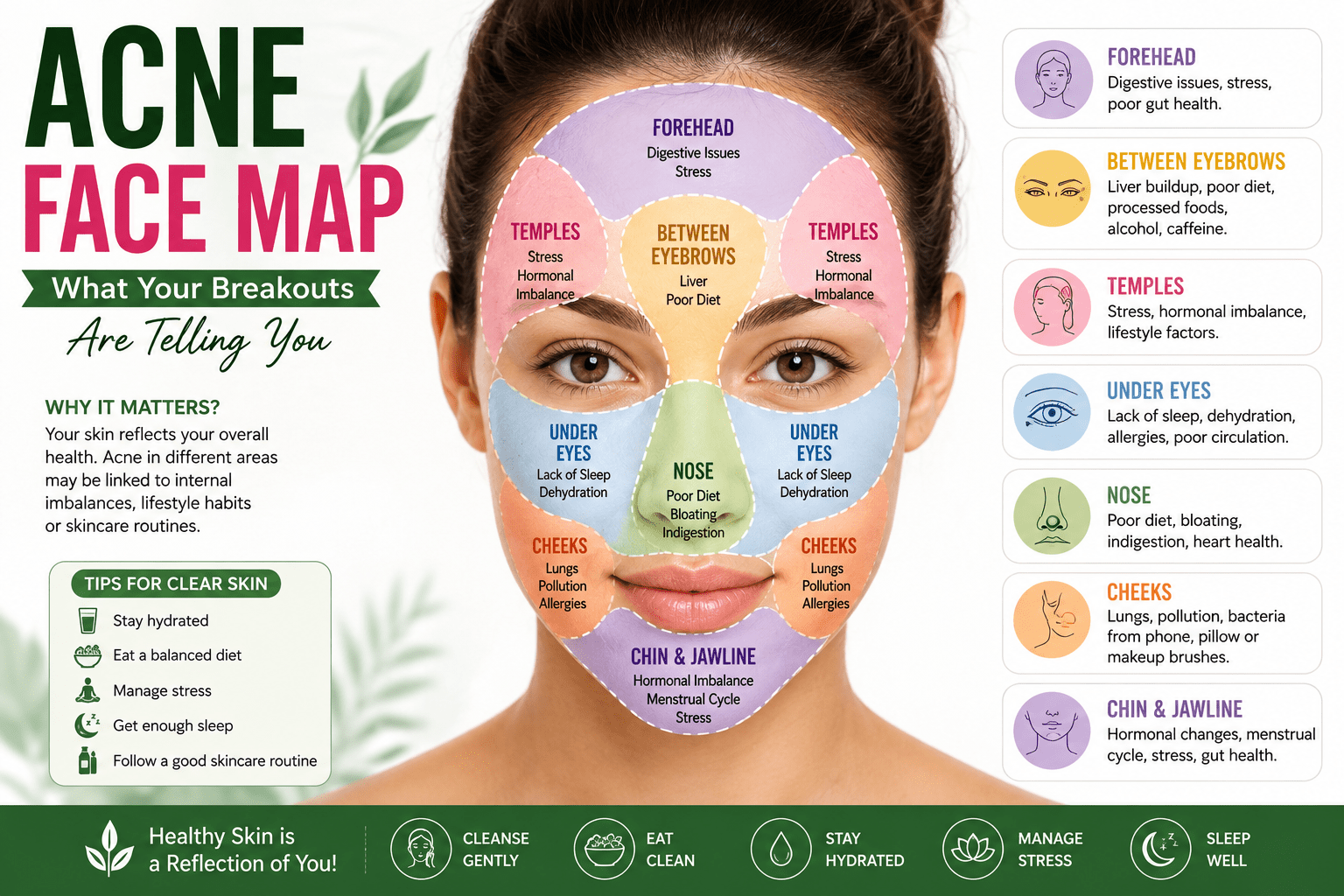
If you’ve ever searched “why do I keep getting pimples in the same spot,” you’ve probably come across an acne map — one of those colorful charts that divides the face into zones and links each one to a different organ, from your liver to your lungs to your hormones. These diagrams, often called an acne face map, acne pimple face map, or acne map face chart, are everywhere on skincare blogs and social media. But how much of this is real dermatology, and how much is centuries-old folklore repackaged for the internet age?
The short answer: face mapping acne has one foot in ancient tradition and one foot in modern skin science. Some of it holds up. Most of it doesn’t. This article breaks down where the acne map came from, what a typical chart claims, what dermatologists and researchers actually say about it, and how to use the useful parts of face mapping without falling for the myths.
What Is an Acne Map?
An acne map (sometimes called a face map for acne) is a diagram of the face broken into regions — forehead, nose, eyebrow area, cheeks, hairline, ears, jawline, and chin — with each zone assigned a supposed internal cause. A typical chart looks something like this:
- Forehead & Nose — linked to digestion and gut health
- Hairline — linked to hair-care product buildup
- Eyebrow Area — linked to the liver
- Ears — linked to the kidneys
- Cheeks — linked to lungs, allergies, or diet
- Jawline & Chin — linked to hormones and reproductive health
This zone-by-zone breakdown is the version most people mean when they talk about an acne pimple face map. It’s visually appealing, easy to screenshot, and feels intuitive — which is a big part of why it keeps circulating online.
Where Face Mapping Acne Actually Comes From
The concept of face mapping acne isn’t a modern dermatological invention. It has roots in Traditional Chinese Medicine (TCM) and Ayurvedic practice, both of which view the face as a mirror of internal organ health. In TCM specifically, the idea is that qi (energy) flows through meridians connected to specific organs, and skin problems in a given facial zone reflect an imbalance in the corresponding organ system. Face mapping has roots in ancient Chinese and Ayurvedic medicine, with historical proponents believing that acne in specific face areas indicated dysfunction in other parts of the body, such as the digestive system and kidneys.
These traditions weren’t built on clinical trials or controlled studies — they were observational systems developed over centuries of practice. That doesn’t make them worthless, but it does mean they’re a different kind of knowledge than what modern dermatology relies on.
Does the Acne Map Have Scientific Backing?
This is the part most articles gloss over, so let’s be direct: the specific organ-to-zone claims in a traditional acne map are not supported by clinical evidence.
Dermatologist and researcher Dr. Leslie Baumann has stated plainly that face mapping is not backed up by any kind of scientific data, and that in her clinical experience there is no link between the location of acne and issues within the body. She’s not alone in this assessment. Other dermatologists note that acne mapping isn’t a common technique used in clinical practice, that the underlying research isn’t robust, and that there’s a lack of controlled studies demonstrating its accuracy.
Part of the problem is that the acne map itself isn’t standardized. Different face-mapping practitioners divide the face into anywhere from three or four zones to nine or ten — which is a strong signal that this is a folk framework, not a measured, reproducible clinical model.
Colorful face maps linking your forehead to your liver or your nose to your heart are largely considered pseudoscience, rooted in traditional Chinese medicine observations rather than clinical evidence. Even sources that present a “modern” acne map are careful to add a disclaimer. Scientific studies suggest that acne on certain areas of the face is more plausibly explained by bacteria, excess oil production, hormonal changes, or external factors like waxy hair products, rather than by internal organ dysfunction.
So if the acne map isn’t a real diagnostic tool, why does it feel so intuitive? Because there’s a genuine — if narrower — pattern hiding underneath the pseudoscience.
The One Zone Where Face Mapping Gets It Right: The Jawline
Almost every dermatologist who dismisses face mapping still makes one exception: the lower face.
According to Dr. Baumann, the one real exception to the “no link” rule is acne along the jawline, which is often associated with a hormonal issue known as hormonal acne. This isn’t a fringe opinion. The American Academy of Dermatology notes that hormonal acne has a few telltale signs, and one of them is location — it often clusters along the jawline, chin, neck, and lower cheeks, in contrast to “regular” acne, which tends to favor the forehead and nose.
There’s a biological reason for this. A 2014 review found that adult acne — particularly in people who menstruate — tends to concentrate along the chin, jawline, and lower cheeks, and that this distribution is closely tied to androgen excess, because the sebaceous glands in this zone are anatomically more sensitive to androgens than glands elsewhere on the face. In other words, when a face-mapping chart tells you “chin acne equals hormones,” it’s not entirely making that up — it’s stretching a real, localized biological pattern into a much bigger claim than the evidence supports.
Women who develop acne along the jawline and lower face also tend to respond particularly well to hormonal therapy, unlike forehead acne, which is more often related to hair products, or cheek acne, which has different triggers altogether.
What Each Zone of the Acne Map Actually Means (Evidence-Based Version)
Using the image-style chart layout — forehead, hairline, eyebrow area, ears, cheeks, and jawline/chin — here’s what’s actually driving breakouts in each region, according to dermatologic and clinical sources rather than organ-mapping folklore.
Forehead and Nose (T-Zone)
This area has the highest concentration of sebaceous (oil-producing) glands on the face, which is why it’s often the first place breakouts show up during puberty or oily-skin flare-ups. Forehead acne is frequently linked to sweat, buildup from hair products, or friction from hats and headbands — a pattern sometimes called “pomade acne,” which happens when styling products migrate down onto the skin and clog pores.
Hairline
Closely related to the forehead pattern above — this zone reacts strongly to whatever touches it. Oily hair products and makeup can build up along the hairline, causing acne breakouts specifically in that band of skin.
Eyebrow Area and Ears
Traditional charts assign these zones to the liver and kidneys respectively, but there’s no clinical literature connecting breakouts here to those organs. In practice, breakouts near the eyebrows and ears are most often tied to product residue (makeup, brow gel, hair oils) sitting on the skin, or to touching these areas with unwashed hands — the same mechanical and hygiene-driven causes seen elsewhere on the face.
Cheeks
This is one of the clearer “environmental exposure” zones. The most common and scientifically supported causes of cheek acne are friction and bacteria — including pressure from holding a phone against the face, sleeping on a dirty pillowcase, wearing masks, or frequently touching the face with unwashed hands. Some researchers have also looked at dietary connections. A study in Clinical, Cosmetic and Investigational Dermatology examining dietary patterns and acne found that high consumption of saturated and trans fats correlated with increased sebum production and inflammatory markers, which can worsen breakouts — cheeks and jaw included.
Jawline and Chin
As covered above, this is the zone with the strongest evidence-based link to hormones. Androgens stimulate growth in the hair follicles and sebaceous glands, and when androgen concentration or receptor sensitivity increases, it drives follicle and oil gland overgrowth — which shows up disproportionately along the jaw and chin. A 2017 study in Clinical, Cosmetic and Investigational Dermatology also confirmed that psychological stress significantly worsens acne severity, likely working through this same hormonal pathway, which helps explain why jawline breakouts often flare around exam periods, big life events, or a stressful week at work.
Should You Actually Use an Acne Map?
Here’s a balanced way to think about it: an acne map is not a diagnostic tool, but it can be a useful prompt for self-reflection.
While there’s no robust scientific evidence supporting the specific organ-to-face-zone connections in traditional face mapping, the general habits it encourages you to examine — diet, stress levels, sleep, and hygiene — are broadly supported by modern medicine as genuine factors that influence skin health. In that sense, the acne map works best as a memory aid, not a medical chart. Looking at a breakout and asking “have I been stressed, sleeping poorly, or using a new hair product?” is a reasonable habit. Assuming a pimple on your cheek means your lungs are failing is not.
Modern dermatology does not support acne face mapping as a diagnostic tool — research shows that acne is driven by a combination of excess oil production, clogged pores, bacteria, inflammation, and hormones, rather than a map of internal organs. If you’re dealing with persistent or painful breakouts, especially cystic acne along the jaw, chin, or lower cheeks, that combination of factors — not a face chart — is what a dermatologist will actually investigate.
When to See a Dermatologist Instead of Relying on a Chart
An acne face map should never be used to self-diagnose an internal health condition — it’s a traditional concept, not a medical diagnostic tool, and any concerns about internal health should be directed to a qualified medical doctor. A dermatologist can go far beyond what any chart offers: rather than applying a blanket technique like face mapping, they’ll examine your skin directly and discuss your medical history to pinpoint the actual cause of your breakouts, which may include hormone testing for female patients.
Treatment from there is tailored to the real cause, not the zone. Depending on what’s driving the acne, treatment often includes a combination of topical and oral options — antibiotics, anti-androgenic medications, retinoids, and exfoliants. For more stubborn or cystic acne, a dermatologist can also offer prescription-strength topical medications, oral antibiotics, hormonal therapies, or isotretinoin, depending on the specific case, and early treatment matters for reducing the risk of scarring.
Frequently Asked Questions About the Acne Map
Is the acne map scientifically accurate? No — not in the traditional organ-linked sense. The one partial exception is the jawline and chin, where a genuine hormonal connection is supported by clinical research.
What’s the difference between an acne map and acne face mapping? None — they’re the same concept described two ways. “Acne map,” “acne face map,” and “face mapping acne” all refer to the same zone-based chart.
Can I diagnose a health condition using an acne pimple face map? No. It should never replace a conversation with a doctor or dermatologist, especially if you’re concerned about an underlying hormonal or internal issue.
Why does my acne always show up in the same spot? Recurring breakouts in one zone are usually explained by a consistent local trigger — a phone pressed to the cheek, a hat brim on the forehead, or androgen-sensitive glands along the jaw — rather than a specific organ.
Does diet affect where acne shows up on an acne map face chart? There’s some evidence that high-sugar, high-fat, and high-glycemic diets are associated with worse acne overall, though the effect isn’t neatly confined to one facial zone the way traditional charts suggest.
The Bottom Line
The acne map is a compelling visual, and it’s not going away anytime soon — it’s colorful, shareable, and taps into a very human desire to find a tidy explanation for something as frustrating as a breakout. But treat it as a conversation starter, not a diagnosis. The jawline-hormone connection is real. The liver-eyebrow or kidney-ear connections are not. If your skin isn’t responding to basic changes in hygiene, product use, or stress management, the most reliable next step isn’t a new chart — it’s a board-certified dermatologist who can look at your actual skin, not a diagram of it.
Disclaimer: This article is intended for general informational purposes and does not constitute medical advice. The acne map is a popular concept, not a clinically validated diagnostic method. Home remedies mentioned above are commonly used supportive measures, not proven treatments, and results vary by individual. If you have persistent, painful, cystic, or worsening acne, or symptoms like irregular periods or unusual hair growth alongside jawline breakouts, consult a board-certified dermatologist or physician rather than relying on this article or any home remedy alone.
Sources
- Medical News Today — Acne face map: Causes of breakouts
- The Healthy — What Is Acne Face Mapping, and Is It Accurate?
- Next Steps in Dermatology — Patient Buzz: Is There Any Truth to Acne Face Mapping?
- Fortis Healthcare — Face Mapping: What Your Acne Reveals About Your Health
- Biology Insights — What Your Acne Means: Face Mapping Facts vs. Myths
- Honeydew — What Does Chin Acne Mean? Face Mapping, Hormones, and What Your Breakouts Are Telling You
- Houston Methodist — Adult Acne in Women: What’s Triggering Your Breakouts?

Natural home remedies, skincare secrets, dental & eye health tips, and real product reviews to help you stay healthy the natural way.