


You’ve probably seen the ad more than once. It shows up between Reels, sneaks into your Facebook feed, or follows you around after you searched “apple cider vinegar gummies” one late night. A soft jelly-textured gummy, a promise of daily wellness support, and apple cider vinegar without the mouth-puckering taste — and now you’ve landed here, doing the one smart thing most people skip: actually checking the details before buying.
That’s exactly what this review is for.
JellyTide is a daily chewable supplement built around apple cider vinegar (ACV) and BHB ketone salts. It’s sold by Jellytide Research and processed through BuyGoods, a long-running direct-to-consumer supplement retailer. The pitch is simple: get your ACV habit without the vinegar burn, without another capsule to choke down, and without rearranging your whole routine right as summer heats up.
What follows is a full, unglamorized breakdown — the ingredients, what current research says about them, what the pricing and refund terms actually mean in practice, and who this product genuinely fits. Nothing here is dressed up to sell you, and nothing is dressed down to scare you off either. You’ll have what you need to make your own call by the end.
This review draws on public product labeling, brand materials, and peer-reviewed research on the ingredients involved. Beyond the affiliate relationship disclosed below, there’s no other tie between this article and Jellytide Research.
Always double-check current pricing, ingredients, and policies on the official page before you buy.
[View the current JellyTide offer]
Disclosure: purchases made through links in this article may earn a commission, at no extra cost to you.
What Exactly Is JellyTide, and Why Does It Keep Showing Up in Your Feed?
JellyTide sits right at the crossing point of two trends that have defined 2026’s supplement market: the gummy format taking over from capsules, and apple cider vinegar’s comeback as a mainstream daily wellness habit. Add BHB ketone salts into that mix, and you get a product aimed at people who want a bit of appetite awareness, some digestive comfort, and a habit they can actually stick to — all packed into something that takes about three seconds each morning.
Here’s something worth clearing up first, because the naming has caused real confusion this year: several “jelly” branded gummies are running near-identical ad campaigns right now, including Jelly Lean and Jelly Burn. JellyTide is not either of those. Different company, different formula sheet, different checkout page. If you searched for one of the others and ended up here, hang tight — there’s a full comparison section further down.
Why does this category keep growing? Gummy supplements are consistently reported as one of the fastest-growing delivery formats in the industry, and the reason isn’t complicated: people actually take gummies. They don’t build lasting habits around something they dread taking, and liquid ACV is a habit most people abandon within a couple of weeks because of the taste and the burn. That behavioral reality is a real part of why this whole category exists.
And the timing matters too. Late April through July is consistently the busiest stretch of the year for searches in this exact category — swimsuit season, vacation prep, more time outdoors. If you’re reading this right now trying to decide whether JellyTide is worth ordering, you’re one of a lot of people asking the same question at the same time of year.
Who’s Actually Behind JellyTide?
JellyTide is a Jellytide Research brand, ordered through BuyGoods, a well-established fulfillment processor used by a large number of supplement companies. The main storefront is thejellytide.com, while the legal pages — terms of service, returns, contact info — live on a separate customer-service domain, yourorderwasconfirmed.com.
There’s no named founder or leadership team listed on the sales page. The Terms of Service refer to the business only as “COMPANY,” without naming a specific legal entity beyond the brand itself, and disputes are governed under Barbados law. It’s worth reading those terms yourself before ordering.
According to the brand’s published contact page, you can reach support by phone at +1 (507) 448-8190, or through the site’s contact form. Physical returns go to 11870 62nd St N, Largo, FL 33773 — a real, domestic U.S. address used for processing.
Manufacturing is described as happening in a U.S. facility that follows Good Manufacturing Practices (GMP), and the sales page carries GMP and non-GMO badges. There’s no independent, third-party audit of those claims publicly available, which is fairly typical for this category rather than unusual.
Put plainly: the basic legitimacy markers are there. A working U.S. return address, a phone number that connects to someone, a functioning checkout, and a stated refund window. That’s what an operating business looks like, even without a named CEO on the page.
What’s Actually in the Bottle
This is the part where most reviews either oversell the science or dismiss it entirely, and neither approach actually helps you. So here’s the label, followed by an honest read on the research behind each ingredient.
One thing to flag before diving in: everything discussed below is ingredient-level research — meaning ACV and BHB have been studied on their own, in various forms and doses, but JellyTide itself, as a finished gummy, hasn’t been through a clinical trial. That’s standard across the supplement industry; the FDA doesn’t require finished-product trials before something reaches shelves. The research context below helps you judge the ingredients fairly — it isn’t a promise about what JellyTide specifically will do for you.
These statements haven’t been evaluated by the FDA. JellyTide isn’t intended to diagnose, treat, cure, or prevent any disease.
Per one gummy (2.5g serving):
Calories: 8 · Total Carbohydrates: 2g · Total Sugars: 2g (1g added) · Sodium: 2.5mg · Calcium: 1mg · Magnesium: 0.75mg
Proprietary Blend (525mg): Apple Cider Vinegar, BHB as Calcium BHB, Magnesium BHB, and Sodium BHB
Other Ingredients: Corn Syrup, Purified Water, Pure Cane Sugar, Apple Pectin, Citric Acid, Sodium Citrate, Tapioca Starch, Natural Flavors, Beet Root Powder
Apple Cider Vinegar: What the Evidence Actually Supports Right Now
ACV has been used as a folk wellness remedy for centuries, and its active compound is acetic acid, which makes up roughly 5–6% of raw vinegar. Most of the modern research interest centers on acetic acid’s role in appetite and metabolic markers.
It’s important to be upfront about where the science currently stands, because it shifted significantly in the past year. The most widely cited recent trial on ACV and weight loss — published in BMJ Nutrition, Prevention & Health in March 2024, involving young Lebanese adults — was formally retracted by BMJ Group on September 23, 2025. The retraction notice cited concerns over statistical analysis, implausible data values, unreliable raw data, and the fact the trial had never been prospectively registered. BMJ’s editor-in-chief later said publishing it in the first place was “the wrong decision.” That study should no longer be cited as evidence for ACV’s weight-loss effects, and it isn’t relied on here.
What does hold up: a genuine, still-standing 2009 double-blind, placebo-controlled trial published in Bioscience, Biotechnology, and Biochemistry, which followed 175 obese Japanese adults over 12 weeks. Groups drinking either 750mg or 1,500mg of acetic acid daily (via 15ml or 30ml of liquid vinegar) showed statistically significant, if modest, reductions in body weight, visceral fat area, waist circumference, and triglycerides compared to placebo. The higher-dose group lost roughly 1.7kg over the study period — a real but small effect, and one that used liquid vinegar at doses well above what any gummy could reasonably deliver, and that didn’t persist once participants stopped drinking it.
Beyond that one trial, the broader picture is mixed. Meta-analyses and reviews published through 2025 generally describe the evidence on ACV and body composition as inconsistent — some studies show a modest directional effect, especially at higher doses over longer periods, while others show nothing meaningful. Nobody credible is currently pointing to strong, reliable outcome data for ACV supplementation at consumer doses.
Where the science is more consistent is on mechanism, not outcome. Acetic acid appears to slow gastric emptying — how quickly food leaves your stomach — which plausibly contributes to feeling full longer after a meal. There’s also research into acetic acid activating AMPK pathways in the liver, tied to cellular energy regulation in lab settings. These are believable mechanisms. They are not, on their own, proof that a gummy with an unspecified ACV dose delivers a noticeable real-world effect.
And that dose question matters a lot here. The studies showing any positive signal used 750–1,500mg of acetic acid daily from liquid vinegar. JellyTide’s entire proprietary blend — ACV and BHB salts combined — totals 525mg. The actual ACV content inside that 525mg isn’t broken out on the label, so it’s almost certainly a fraction of the doses used in the research above.
What that means practically: ACV is a real ingredient with a real, if modest, research base, and a gummy format solves a genuine problem — nobody keeps up a daily habit of drinking harsh liquid vinegar for long. That behavioral upside is legitimate even before you get into dosing questions.
BHB Salts: What the Ketone Half of the Formula Adds
Beta-hydroxybutyrate (BHB) is one of three ketone bodies your body naturally produces during fasting or carb restriction. As an exogenous ketone supplement, BHB salts deliver ketones from an outside source rather than requiring your body to make its own through diet.
JellyTide binds its BHB to three minerals — calcium, magnesium, and sodium — which is a standard delivery method in this category, and also explains the trace electrolytes on the label.
Research on BHB and appetite hormones does exist, but the details matter. One notable study, published in the journal Obesity, used a ketone ester drink (a different, more concentrated form than BHB salts) in fifteen normal-weight adults and found reduced ghrelin — the hunger hormone. That’s a meaningfully different formulation and dose than what’s in a gummy, so it doesn’t transfer directly to JellyTide’s claims. Research on BHB salts specifically, at supplement-level doses, is thinner and more mixed.
One framing point worth being direct about: JellyTide is not a keto-diet product. The gummy base itself contains corn syrup and cane sugar, both of which work against maintaining ketosis. So the BHB here isn’t functioning as a ketosis tool — it’s part of the formula design, not a low-carb aid, and shouldn’t be evaluated as one.
Again, this is ingredient-level research on BHB generally, not a study of the finished product. It doesn’t guarantee any specific result.
Apple Pectin and Beet Root Powder: The Supporting Ingredients
Apple pectin sits in the “Other Ingredients” section rather than the proprietary blend, which tells you its main job here is texture — it’s the gelling agent that gives the gummy its chew. Pectin does have some research behind it as a soluble fiber tied to satiety, but its placement outside the active blend suggests it’s a functional base ingredient, not a featured active compound.
Beet root powder is in the same boat. Beets contain dietary nitrates, which research links to healthy blood flow and exercise endurance — but only at functional doses, and beet root’s placement outside the proprietary blend means it’s present in a trace amount here. The sales page frames it as an energy-support ingredient, which should be read as general marketing context about beets, not a claim about a verified dose inside JellyTide.
Neither ingredient is dosed here at a level that calls for deep research citations — they round out the formula rather than driving it.
What JellyTide Actually Costs
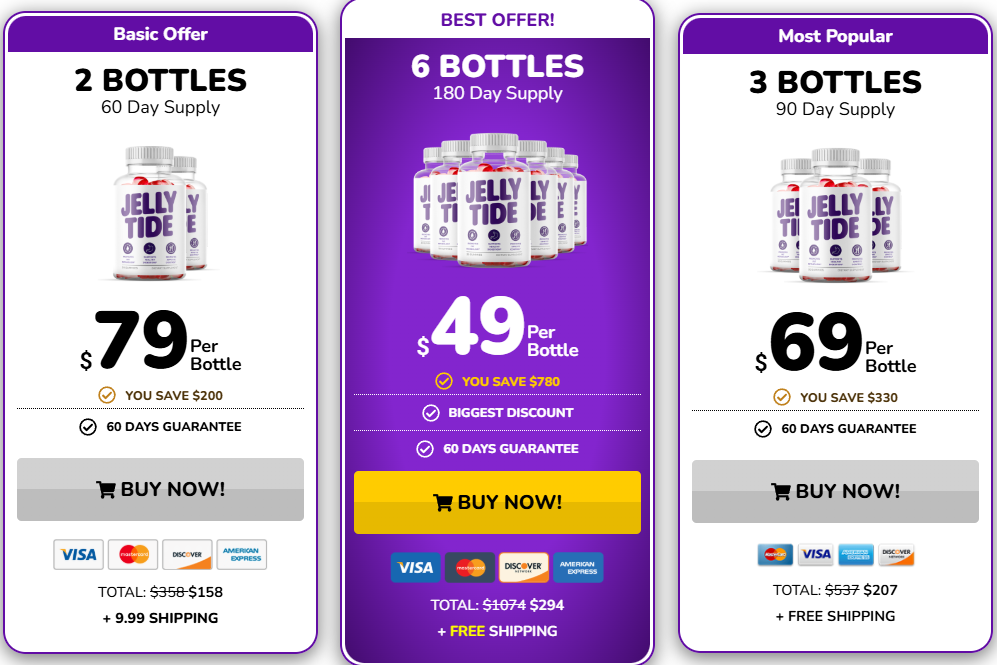
Based on the official site at the time of publication (April 2026), here’s the current pricing structure. Prices change, so verify before ordering.
- Two bottles (60-day supply): $79/bottle → $158 total, plus $9.99 shipping
- Three bottles (90-day supply) — most popular: $69/bottle → $207 total, free shipping
- Six bottles (180-day supply) — best value: $49/bottle → $294 total, free shipping
That’s a pretty standard volume-discount curve for this category — bigger bundles drop the per-bottle price sharply, and free shipping kicks in at three bottles. If you’re just testing whether JellyTide fits your routine, the two-bottle option keeps your initial spend lower while still covering the full 60-day refund window.
[View the current JellyTide offer]
For context, ACV gummies as a category range widely in price — some cost less with a bare-bones ingredient list, others charge more for a similar proprietary-blend structure. JellyTide lands in the middle of that range, which tracks with its positioning as a convenience-focused daily supplement rather than a budget or premium outlier.
The Guarantee: What It Says vs. What It Actually Requires
This part deserves more attention than most reviews give it.
The sales page advertises a “100% satisfaction, 60-day money-back guarantee” with “no questions asked” language front and center. That phrasing is real and it’s on the page.
The actual returns policy tells a fuller story. To get a refund, you need to email support within 60 days of delivery — not purchase — with “Refund Request” in the subject line, and then physically ship all bottles back to the Largo, FL address at your own cost. Once they receive the return, processing takes five to ten business days, plus however long your bank takes to post it.
So “no questions asked” means you don’t need to justify why you didn’t like it — it doesn’t mean a no-hassle, keep-your-money-without-returning-anything refund. That’s a meaningful difference, and it’s disclosed here as a transparency issue, not an accusation. A lot of supplement brands run sales-page language that’s more aspirational than their formal terms. The real question is whether you’re willing to pack up and ship bottles back if it’s not for you — because that’s what actually gets your money returned.
Read the current return terms directly on the official returns page before ordering.
JellyTide vs. Jelly Lean vs. Jelly Burn: Sorting Out the Confusion
A handful of “jelly” gummies are running similar ad campaigns simultaneously this year, and the mix-up between them is a documented, real problem — not just a coincidence of naming.
JellyTide — the product covered here — is sold by Jellytide Research, processed through BuyGoods, built around a 525mg ACV + BHB salts blend, and hosted at thejellytide.com with support at yourorderwasconfirmed.com.
Jelly Lean is a separate product from a different company, using a nearly identical 525mg ACV/BHB blend structure. Publicly available labels for both suggest the formulas are structurally very similar, but they’re sold by different businesses with different pricing, return policies, and checkout systems. Reporting from April 2026 noted Jelly Lean’s label lists an Aurora, Colorado distribution address and claims U.S. manufacturing.
Jelly Burn is a third product circulating in the same ad space. Consumer discussion around it generally notes less ingredient transparency compared to either JellyTide or Jelly Lean.
The practical takeaway: if you got here from a “jelly” gummy ad, double-check which checkout page you’re actually on before you enter payment details. This ad ecosystem is active and the name overlap is real. This article is specifically about JellyTide.
Who JellyTide Is Actually a Good Fit For
Rather than leaning on customer testimonials — which are self-selected and impossible to verify — here’s a more honest framework for figuring out whether this product matches your situation.
JellyTide is probably a reasonable fit if you:
- Have tried and failed to keep up a liquid ACV habit. If the taste or acidity has made you quit before, a gummy solves that specific problem — the compliance issue, not the dosing question.
- Prefer not to swallow capsules. Around a third of U.S. supplement users say they prefer gummies over pills. That’s a legitimate preference, not just a marketing hook.
- Want one simple daily addition, not a whole routine overhaul. People stick with single, low-effort changes far more reliably than multi-step protocols.
- Are treating this as one piece of a broader wellness approach — alongside food quality, movement, and sleep, not instead of them.
- Want to start a summer habit now, since habits generally need a few weeks to stick, and starting in late April gives you a running start through the busiest months.
Other options are probably better if you:
- Are looking for a medical or clinical weight-loss intervention. JellyTide is a dietary supplement, not a drug, and it isn’t evaluated or approved for weight loss.
- Are already on GLP-1 medications or another supervised program. Talk to your provider before adding anything new.
- Expect fast or dramatic results. No supplement, JellyTide included, should be approached with that expectation.
- Already tolerate liquid ACV well. You’d be paying for convenience, not additional benefit.
- Manage carbohydrate intake, sodium, or blood sugar under medical guidance. The formula has added sugar, trace sodium, and mineral-bound BHB — worth a conversation with your doctor first.
- Are strictly keto. The corn syrup and cane sugar base makes this incompatible with maintaining ketosis, despite the BHB content.
Before ordering, it’s worth asking yourself honestly: Have you genuinely struggled with a liquid ACV habit before? Are you willing to commit to at least 60 days of consistent use to give it a fair shot? Do you have any conditions or medications that could interact with acetic acid or BHB mineral salts? And are you treating this as daily support, or expecting it to be a primary fix?
Where the Research on This Category Stands Heading Into 2026
The ACV-plus-BHB gummy category has grown fast, and scrutiny has grown with it. The fair summary: both ingredients have plausible mechanisms and a limited, ingredient-level research base; no finished product in this space has been independently studied as formulated; and there’s a real, unresolved gap between the doses used in research and what a typical gummy serving delivers.
The BMJ retraction in September 2025 is a significant part of that picture — it removed the single most-cited piece of “strong” evidence for ACV weight-loss claims from circulation, and nutrition researchers have been clear that what’s left is, in their words, limited and inconsistent.
The honest bottom line: ACV and BHB are real, biologically active ingredients that researchers are still actively studying. The current evidence doesn’t support bold outcome claims. What it does support is that the mechanisms are worth further study, that a gummy format solves a genuine adherence problem, and that treating a product like this as routine support — rather than a primary intervention — matches what the evidence can actually back up.
Fitting JellyTide Into a Summer Routine
Heading into summer, the behavioral backdrop is specific: more activity, more outdoor social eating, more awareness of how you feel in your body. That combination genuinely does push people toward forming new daily habits, JellyTide or otherwise.
A daily gummy is one piece of that, not the whole plan. Used consistently alongside reasonable food choices and regular movement, it fits the role of a small daily anchor point rather than a centerpiece. One bottle covers about a month; the three-bottle bundle covers a full 90-day stretch, which is enough to carry you through the busiest part of the season without a mid-summer reorder.
The appetite-awareness angle is most relevant here — afternoon cravings and heat-driven snacking changes are common complaints in summer, and ACV’s researched effect on gastric emptying is at least mechanistically relevant to that pattern. Again: that’s ingredient research, not a guarantee about what JellyTide specifically will do for you.
Results vary by baseline health, consistency, medications, and other individual factors. These aren’t outcome guarantees. Talk to a healthcare professional before starting.
Interaction Considerations Worth Knowing
ACV and BHB salts are generally well tolerated, but a few things are worth flagging before you start:
- Blood sugar medications: Acetic acid can affect glucose dynamics. If you’re on insulin, metformin, or another diabetes medication, talk to your doctor first.
- Digestive sensitivity: Some people get mild GI discomfort starting ACV. The gummy format likely reduces acid irritation versus liquid vinegar, but sensitivity varies.
- Electrolyte balance: The BHB salts add trace calcium, magnesium, and sodium. At 2.5mg of sodium per gummy it’s minimal, but worth mentioning if you’re managing sodium for cardiovascular or kidney reasons.
- Tooth enamel: The gummy format cuts down direct acid contact compared to drinking vinegar, but if your enamel is already sensitive, rinsing with water afterward isn’t a bad habit.
Don’t adjust or stop any prescribed medication based on anything in this article. That decision belongs to your physician.
How Ordering Actually Works
Checkout runs through thejellytide.com and hands off to a BuyGoods-powered payment page — a processor used by a wide range of D2C supplement brands. Shipping timelines aren’t spelled out on the public sales page, so it’s worth confirming at checkout if timing matters for your trip or your routine.
The two-bottle tier is the lowest-commitment way to try it. The three-bottle tier is the most popular because it drops per-bottle shipping and gives you a full 90-day runway — enough time to fairly judge daily use.
Before you order, read the actual return terms. As covered above, refunds require a physical return at your expense, and the 60-day clock starts at delivery, not purchase. Knowing that upfront means you’re ordering with the full picture.
Final Verdict: Is JellyTide Worth Ordering in 2026?
Here’s the plain-language summary.
JellyTide is a real, operating product with a verified label, a working checkout, and two ingredients — ACV and BHB salts — that have plausible mechanisms and a modest, mixed research base at the ingredient level. It’s not a miracle in a jar. There’s no finished-product clinical trial behind it. Its proprietary blend doses sit below what most of the relevant research actually used. The one major trial that used to anchor stronger ACV weight-loss claims was retracted in September 2025. And the refund guarantee, while genuine, requires you to ship product back on your own dime.
The case in its favor: if a taste or compliance barrier has always killed your ACV habit before, the gummy format genuinely solves that. If you want a low-effort daily wellness add-on for the summer stretch — one that slots into an existing routine instead of replacing it — that’s exactly the role this is built for. Pricing sits in the middle of the category, BuyGoods is an established processor, and the 60-day window, properly understood, is a reasonable amount of consumer protection.
Things to weigh against it: the proprietary blend doesn’t break out how much ACV versus BHB you’re actually getting. The guarantee costs you return shipping if it doesn’t work out. The legal entity behind it is offshore. And this only really works as one piece of a broader routine — not a standalone fix for anything.
If the format solves a real problem for you, the price fits your budget, and you’re approaching it as daily support rather than expecting a dramatic transformation, JellyTide is a reasonable option in a category where the ingredients are legitimately still being studied.
JellyTide is not positioned as a weight-loss treatment. It’s a dietary supplement meant to support a daily wellness routine — nothing more, nothing less.
Verify current pricing, ingredients, and return terms directly on the official page before purchasing.
[View the current JellyTide offer]
Contact Information
Company: JellyTide
Phone: +1 (507) 448-8190
Returns Address: 11870 62nd St N, Largo, FL 33773
Email support: available via the contact form at the brand’s customer service site
Include “Refund Request” in your subject line for faster processing on refund inquiries.
References
- Kondo, T. et al. (2009). Vinegar Intake Reduces Body Weight, Body Fat Mass, and Serum Triglyceride Levels in Obese Japanese Subjects. Bioscience, Biotechnology, and Biochemistry, 73(8), 1837–1843. — jstage.jst.go.jp
- NPR (Oct 2025). How apple cider vinegar cured everything — until it didn’t. — npr.org
- NutraIngredients (Oct 2025). Apple cider vinegar and weight loss study retracted: “Wrong decision” to publish. — nutraingredients.com
- Science Media Centre Spain (2024/2025 update). [Retracted] Small clinical trial concludes that consuming apple cider vinegar helps control obesity. — sciencemediacentre.es

Natural home remedies, skincare secrets, dental & eye health tips, and real product reviews to help you stay healthy the natural way.