

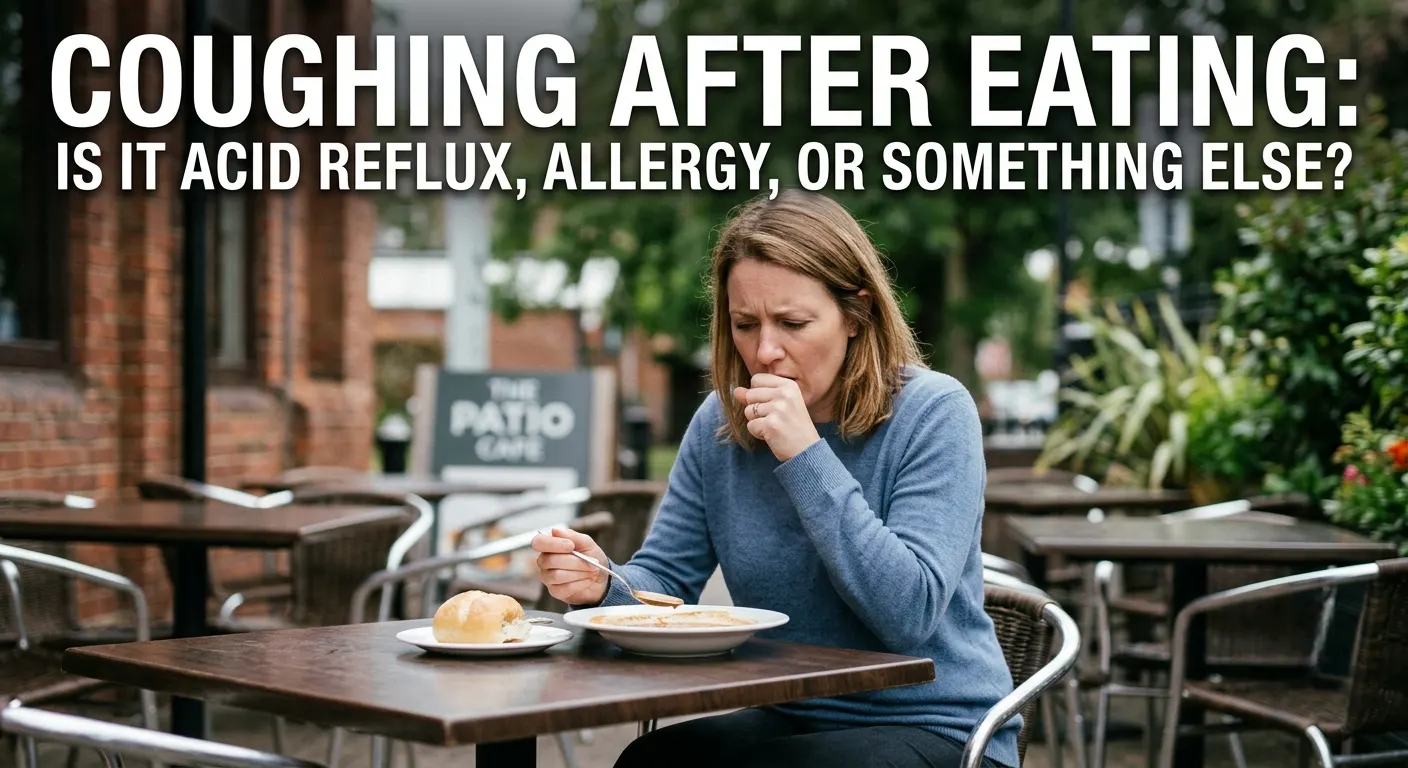
You take a bite of dinner, swallow, and out of nowhere — you’re coughing so hard your eyes water. If this happens often, you’ve probably typed some version of “why do I cough after I eat” into your phone at 2 a.m. You’re not alone, and you’re not imagining it. Coughing after eating is a real, well-documented symptom, and it can mean several very different things depending on what’s actually going on in your throat, lungs, and digestive tract. Whether it’s an occasional tickle or a nightly battle, coughing after eating deserves a real explanation, not a guess.
This guide breaks down the most common reasons behind coughing after eating, how to tell acid reflux apart from a food allergy, when phlegm after eating is a red flag, why some people end up coughing till they throw up, and what actually helps you get rid of a bad cough for good.
Why Do I Cough After I Eat? The Short Answer
Coughing after eating usually comes down to one of four things: acid reflux (GERD), a food allergy or sensitivity, a swallowing problem (dysphagia), or an irritation/inflammation issue like postnasal drip or asthma triggered by food. Figuring out which one applies to you is the fastest way to actually stop coughing after eating for good. Each of these has its own pattern, timing, and warning signs, which is why coughing after eating shouldn’t be treated as “just one thing.” A cough that starts the second you swallow is very different from one that shows up twenty minutes after a meal.
According to the American College of Gastroenterology, chronic cough is one of the “atypical” or extra-esophageal symptoms of gastroesophageal reflux disease, alongside hoarseness and throat clearing. That means your food pipe can be the actual root cause even when your main complaint is your throat or lungs, not your stomach.
Acid Reflux: The Most Common Cause of Coughing After Eating
For most adults, coughing after eating is tied to acid reflux, and it’s the single most common explanation doctors hear in clinic. When the lower esophageal sphincter — the little valve between your esophagus and stomach — doesn’t close properly, stomach acid can travel back up. That acid can irritate the esophagus directly, or tiny droplets can be inhaled into the airway, triggering a cough reflex almost instantly.
Signs that your coughing after eating is specifically reflux-related:
- A burning sensation in the chest or throat after meals
- A sour or bitter taste in the mouth
- Coughing that gets worse when you lie down after eating
- A chronic, dry cough that has lasted more than eight weeks
- Coughing after eating spicy, fatty, or acidic foods specifically
The Mayo Clinic notes that GERD-related cough is often worse at night because lying flat makes it easier for acid to travel upward. If your coughing after eating tends to strike after dinner, right before bed, this pattern alone is a strong clue that reflux, not allergy, is driving your coughing after eating.
Allergies: When Your Immune System Is the Trigger
Food allergies work completely differently from reflux, but they’re another well-known cause of coughing after eating. Instead of acid irritating your throat, your immune system is reacting to a specific protein in the food — treating it like an invader. This can cause the airway to narrow or the throat to swell slightly, both of which trigger coughing.
Allergy-related coughing after eating rarely shows up alone — it usually comes with company:
- Itching in the mouth, lips, or throat
- Hives or a skin rash
- Swelling of the lips, tongue, or face
- Nasal congestion or sneezing
- In severe cases, difficulty breathing (this is a medical emergency)
The American Academy of Allergy, Asthma & Immunology explains that oral allergy syndrome — common with certain fruits, vegetables, and nuts — can cause itching and mild coughing right after eating, especially in people who also have seasonal pollen allergies. Unlike reflux, allergic coughing after eating tends to happen almost immediately, within minutes of the first bite. This near-instant timing is the biggest clue that separates allergy-driven coughing after eating from reflux-driven coughing after eating.
Phlegm After Eating: What It Usually Means
Phlegm after eating is one of the most common companion symptoms people report alongside coughing after eating, and it can point in a few directions. If you’re noticing thick mucus in your throat right after meals, consider these possibilities:
- Postnasal drip — Certain foods (dairy, spicy dishes) can thicken mucus production, and that extra phlegm after eating drips down the back of the throat, triggering a cough.
- Silent reflux (LPR) — Laryngopharyngeal reflux irritates the throat and voice box without the classic heartburn, and phlegm after eating is often the main clue people notice.
- Mild food sensitivity — Some people produce more mucus in response to specific proteins, even without a true allergy.
If phlegm after eating is thick, colored, or blood-tinged, that’s a signal to see a doctor rather than wait it out.
Coughing Till You Throw Up: When It’s More Than Irritation
Coughing till you throw up sounds dramatic, but it happens more often than people admit, especially in kids and in adults whose coughing after eating has been left untreated for a long time. A forceful, prolonged coughing fit can trigger the gag reflex, and in reflux-heavy cases, the same irritated esophagus that caused the cough in the first place makes vomiting easier to trigger.
Common causes of coughing till you throw up after meals:
- Severe GERD with esophageal irritation
- Whooping cough (pertussis) — still circulating in parts of the U.S. despite vaccination
- Post-nasal drip combined with a sensitive gag reflex
- Asthma flare-ups triggered by food particles or reflux
- Aspiration, where small amounts of food or liquid slip into the airway instead of the esophagus
The CDC notes that pertussis classically causes coughing fits severe enough to end in vomiting, particularly in children, and it’s a good reminder that not every case of coughing after eating is reflux or allergy — infections belong on the list too. If coughing till you throw up is a regular occurrence, this isn’t something to manage with home remedies alone; it needs a medical evaluation.
Other Causes: What Causes a Cough Besides Reflux and Allergy
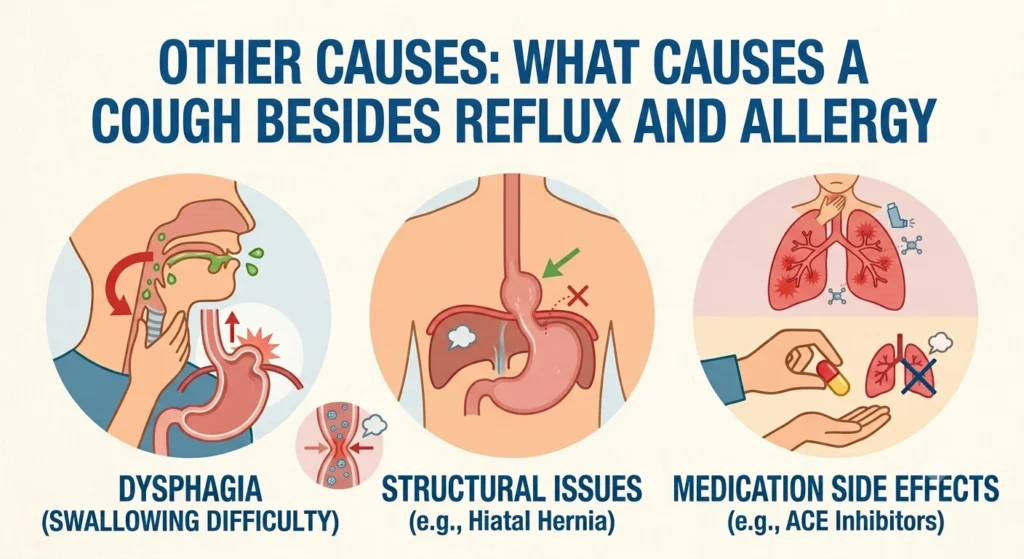
It’s worth zooming out, because coughing after eating and what causes a cough in general aren’t always digestive or immune-related. Other possibilities include:
- Dysphagia (swallowing difficulty) — Common in older adults or after a stroke, where food or liquid doesn’t travel smoothly down the throat, and small amounts enter the airway.
- Asthma — Eating can trigger bronchospasm in some asthmatics, especially with cold foods or drinks.
- Eosinophilic esophagitis (EoE) — A chronic immune condition where white blood cells build up in the esophagus, often linked to food triggers.
- Structural issues — Hiatal hernia or esophageal strictures can change how food moves and how often reflux occurs.
- Medication side effects — Certain blood pressure medications (ACE inhibitors) are known to cause a chronic dry cough that can feel worse after meals.
Understanding what causes a cough in your specific case is really about pattern-matching your symptoms against timing, texture of food, and what else is going on in your body.
Case Study: A Real Patient Experience From the United States
Consider “Mark,” a 42-year-old office worker from Ohio (details adapted from a de-identified patient account shared in a U.S. gastroenterology clinic newsletter). Mark had been dealing with a nagging cough after eating for nearly a year. It started small — a tickle in the throat after lunch — but progressed to full coughing fits after dinner, especially with pizza, coffee, or anything spicy.
Mark assumed it was seasonal allergies and tried over-the-counter antihistamines for weeks with no real improvement. He also noticed phlegm after eating, especially in the mornings, and occasional hoarseness. After the cough started interrupting his sleep, he saw a primary care doctor, who referred him to a gastroenterologist.
An endoscopy revealed mild esophagitis consistent with GERD, along with early signs of laryngopharyngeal reflux. Mark had none of the classic heartburn most people associate with acid reflux — his main symptoms were coughing after eating, occasional phlegm, and throat clearing. Once he started a proton pump inhibitor, cut back on late-night eating, and elevated the head of his bed, his coughing after eating dropped by more than 80% within six weeks.
Mark’s case is a useful reminder: coughing after eating doesn’t have to come with textbook heartburn to be reflux-related, and U.S. clinicians increasingly recognize “silent reflux” as an underdiagnosed cause of chronic coughing after eating.
Acid Reflux vs. Allergy vs. Other Causes: A Quick Comparison
| Feature | Acid Reflux (GERD/LPR) | Food Allergy | Other Causes (Dysphagia, Asthma, Infection) |
|---|---|---|---|
| Timing of cough | Minutes to hours after eating, worse lying down | Almost immediately after eating | Varies; often during swallowing or with specific triggers |
| Common triggers | Spicy, fatty, acidic foods, caffeine, and alcohol | Nuts, shellfish, dairy, eggs, and certain fruits | Cold foods, liquids, thin/thick textures |
| Associated symptoms | Heartburn, sour taste, hoarseness, phlegm after eating | Itching, hives, swelling, and nasal congestion | Wheezing, choking sensation, gagging |
| Severity range | Mild to chronic, rarely life-threatening | Mild to severe (anaphylaxis possible) | Mild irritation to serious aspiration risk |
| Typical fix | Diet changes, antacids, PPIs, lifestyle changes | Avoidance, antihistamines, epinephrine if severe | Speech therapy, inhalers, and medical evaluation |
How to Get Rid of a Bad Cough Caused by Eating
If your coughing after eating is mild and occasional, there’s a lot you can do at home before coughing after eating becomes a chronic problem. Here’s how to get rid of a bad cough tied to meals:
- Eat smaller portions. A full stomach puts more pressure on the esophageal sphincter, making reflux and coughing after eating more likely.
- Slow down. Eating too fast increases the chance of swallowing air and food unevenly, which can trigger coughing.
- Avoid trigger foods. Spicy, fried, and acidic foods are the usual suspects behind coughing after eating and phlegm after eating.
- Stay upright for 2–3 hours after meals. Gravity keeps stomach acid where it belongs.
- Elevate the head of your bed. This helps if your coughing after eating tends to flare at night.
- Sip warm water or herbal tea. Warmth can soothe an irritated throat and loosen phlegm after eating.
- Try honey. A small amount of honey after meals is a traditional, evidence-supported way to calm a throat-based cough in adults and children over one year old.
- Identify allergy triggers. If a specific food consistently causes symptoms, get tested rather than guessing.
- Track your symptoms. A simple food-and-symptom journal helps you and your doctor figure out what causes a cough in your particular case.
Pros and Cons: Home Remedies vs. Medical Treatment
| Approach | Pros | Cons |
|---|---|---|
| Home remedies (diet changes, honey, upright posture) | Low cost, low risk, easy to start immediately, helps with mild coughing after eating | May not resolve moderate-to-severe reflux, allergies, or structural issues |
| Over-the-counter antacids | Fast relief for occasional acid-related cough, widely available | Doesn’t treat root cause, not effective for allergy-driven cough |
| Prescription medication (PPIs, antihistamines, inhalers) | Targets the actual mechanism, better for chronic coughing after eating | Requires diagnosis, possible side effects with long-term use |
| Allergy testing and avoidance | Identifies the exact trigger, prevents future reactions | Time and cost of testing, lifestyle adjustment needed |
| Medical evaluation (endoscopy, swallow study) | Confirms diagnosis, rules out serious causes like EoE or aspiration | More invasive, higher cost, may require specialist referral |
When Coughing After Eating Needs a Doctor’s Visit
Most cases of coughing after eating are manageable at home, but certain signs mean coughing after eating needs professional attention rather than self-treating:
- Coughing till you throw up regularly
- Difficulty breathing, wheezing, or throat tightness after meals
- Unexplained weight loss alongside a chronic cough
- Blood in phlegm after eating
- Choking or a sensation that food “goes down the wrong pipe” frequently
- A cough lasting longer than eight weeks despite home care
The American Lung Association recommends seeing a physician for any cough lasting more than three weeks, especially when it’s tied to a specific pattern like eating.
FAQ: Coughing After Eating
These are the questions people searching for coughing after eating ask most often.
Why do I cough after I eat almost every meal?
If coughing after eating happens consistently, acid reflux or LPR (silent reflux) is the most likely explanation, especially if it’s worse at night or after certain foods. A pattern this regular is worth mentioning to a doctor.
What causes a cough that only happens with certain foods?
These point more toward a food allergy or sensitivity than reflux. Reflux tends to be triggered by categories of food (spicy, fatty, acidic), while allergies are usually tied to one specific ingredient.
Is phlegm after eating always a sign of reflux?
Not always. Phlegm after eating can come from postnasal drip, mild food sensitivities, or silent reflux. If it’s persistent, colored, or accompanied by a sore throat, it’s worth checking with a doctor.
Why am I coughing till I throw up after dinner?
Coughing till you throw up after meals is usually a sign that the cough itself has become severe, often from advanced reflux, asthma, or in rarer cases, an infection like pertussis. This level of symptom deserves medical attention rather than home treatment alone.
How to get rid of a bad cough naturally?
Smaller meals, staying upright after eating, warm fluids, honey, and avoiding trigger foods are effective first steps for how to get rid of a bad cough linked to eating. If symptoms persist beyond a few weeks, medical evaluation is the next step.
Can coughing after eating be a sign of something serious? In most people, coughing after eating is reflux or a mild allergy. But it can occasionally signal aspiration, eosinophilic esophagitis, or a swallowing disorder, especially in older adults or those with a history of stroke.
Does coughing after eating go away on its own? Mild, occasional coughing after eating often improves with simple diet and posture changes. Chronic coughing after eating that lasts weeks or months usually needs a proper diagnosis to resolve.
The Bottom Line
Coughing after eating isn’t a single condition — it’s a symptom with several possible explanations, from acid reflux and food allergies to swallowing issues and infections, and coughing after eating almost always has an identifiable trigger once you know what to look for. Paying attention to timing, trigger foods, phlegm after eating, and whether you’re ever coughing till you throw up can help you and your doctor figure out what causes a cough in your specific situation. For most people, small lifestyle changes are enough to calm things down. For others, coughing after eating is the first clue to a bigger issue that’s worth getting checked out properly. Either way, this is a symptom worth listening to, not ignoring.
Sources and Scientific References
- American College of Gastroenterology – Clinical guidelines on GERD and extra-esophageal symptoms: https://gi.org
- Mayo Clinic – GERD symptoms and causes: https://www.mayoclinic.org/diseases-conditions/gerd
- American Academy of Allergy, Asthma & Immunology – Oral allergy syndrome and food allergy: https://www.aaaai.org
- Centers for Disease Control and Prevention (CDC) – Pertussis (whooping cough) information: https://www.cdc.gov/pertussis
- American Lung Association – Chronic cough evaluation guidelines: https://www.lung.org
- National Institute of Diabetes and Digestive and Kidney Diseases (NIDDK) – GER & GERD overview: https://www.niddk.nih.gov
- American College of Allergy, Asthma and Immunology (ACAAI) – Eosinophilic esophagitis overview: https://acaai.org
This article is for informational purposes only and does not replace professional medical advice. If you’re experiencing persistent coughing after eating, please consult a licensed healthcare provider.

Natural home remedies, skincare secrets, dental & eye health tips, and real product reviews to help you stay healthy the natural way.