

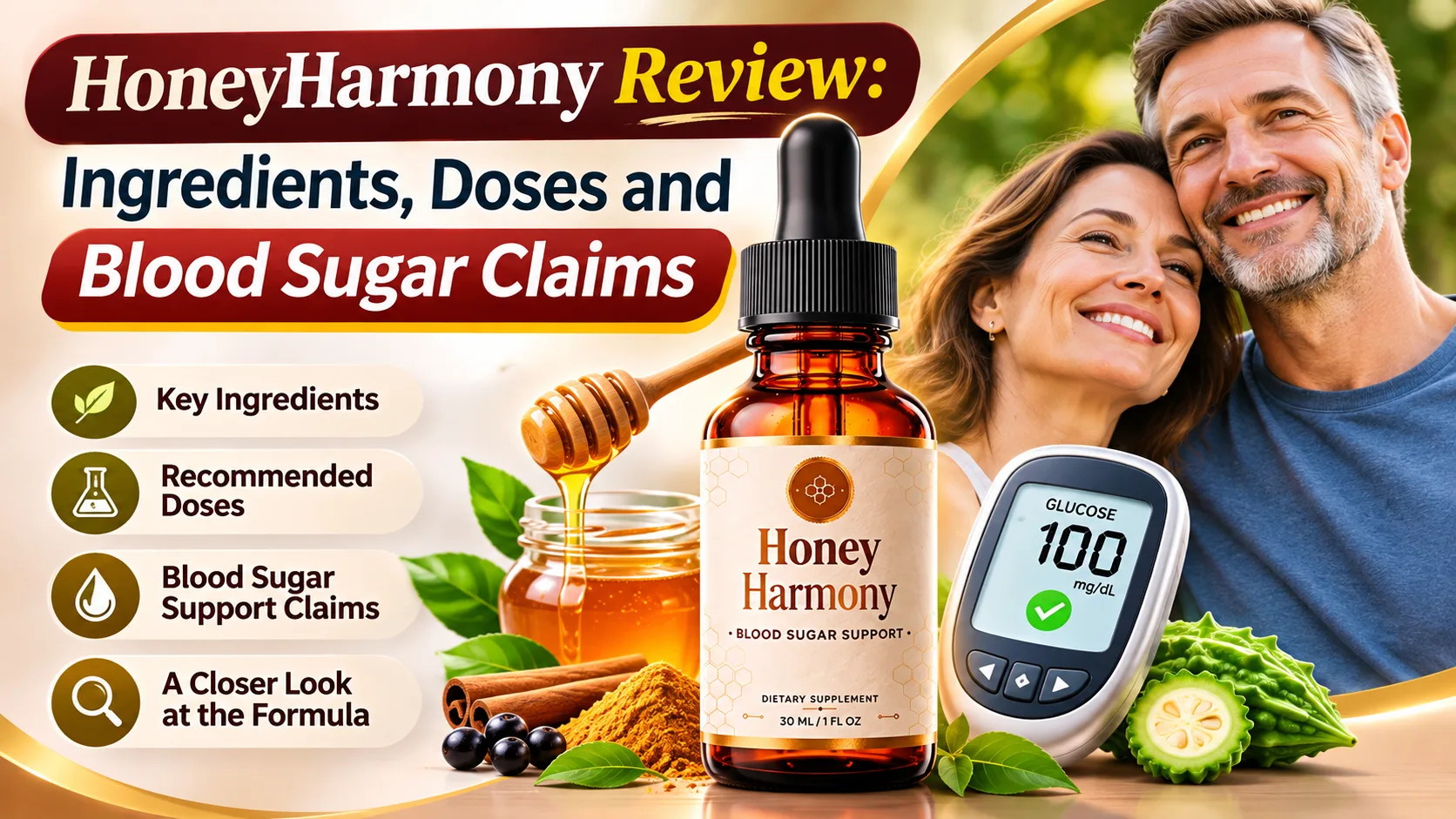
When a liquid supplement is marketed around blood sugar support, the most important questions are not simply whether the ingredient list looks impressive. Buyers also need to know how much of each ingredient is actually provided, what research exists, whether the finished product has been studied, how it should be used, and what the purchase terms look like.
This HoneyHarmony review examines those points in detail. HoneyHarmony is presented as a liquid dietary supplement designed to support healthy blood sugar and metabolic wellness. The product uses a dropper format and combines chromium with a proprietary blend containing botanical extracts, amino acids, and other nutritional ingredients.
The label information supplied for this review lists 1 mL as the serving size, 30 servings per 30 mL bottle, 7 mcg of chromium, and a 15.47 mg proprietary blend containing 21 additional ingredients. Importantly, the individual amounts of those 21 blend ingredients are not disclosed on the label.
HoneyHarmony Review: At a Glance
| Feature | HoneyHarmony Details |
|---|---|
| Product Name | HoneyHarmony |
| Product Type | Liquid dietary supplement |
| Primary Positioning | Blood sugar and metabolic wellness support |
| Serving Size | 1 mL / 1 dropperful |
| Bottle Size | 30 mL / 1 fl oz |
| Servings Per Bottle | 30 |
| Listed Chromium | 7 mcg as chromium picolinate |
| Proprietary Blend | 15.47 mg |
| Ingredients in Blend | 21 ingredients |
| Total Listed Actives | 22 |
| Individual Blend Doses | Not disclosed |
| Suggested Use | Shake well and take 1 dropperful daily |
| Listed Package Prices | $79, $69 or $49 per bottle depending on package |
| 2-Bottle Package | $158 + listed U.S. shipping |
| 3-Bottle Package | $207 with listed free U.S. shipping |
| 6-Bottle Package | $294 with listed free U.S. shipping |
| Guarantee | 60-day money-back window, with conditions depending on the published policy |
| Product Format | Liquid drops |
| Target Audience | Adults seeking nutritional blood sugar support |
| Product Link | HoneyHarmony Product Page |
What Is HoneyHarmony?
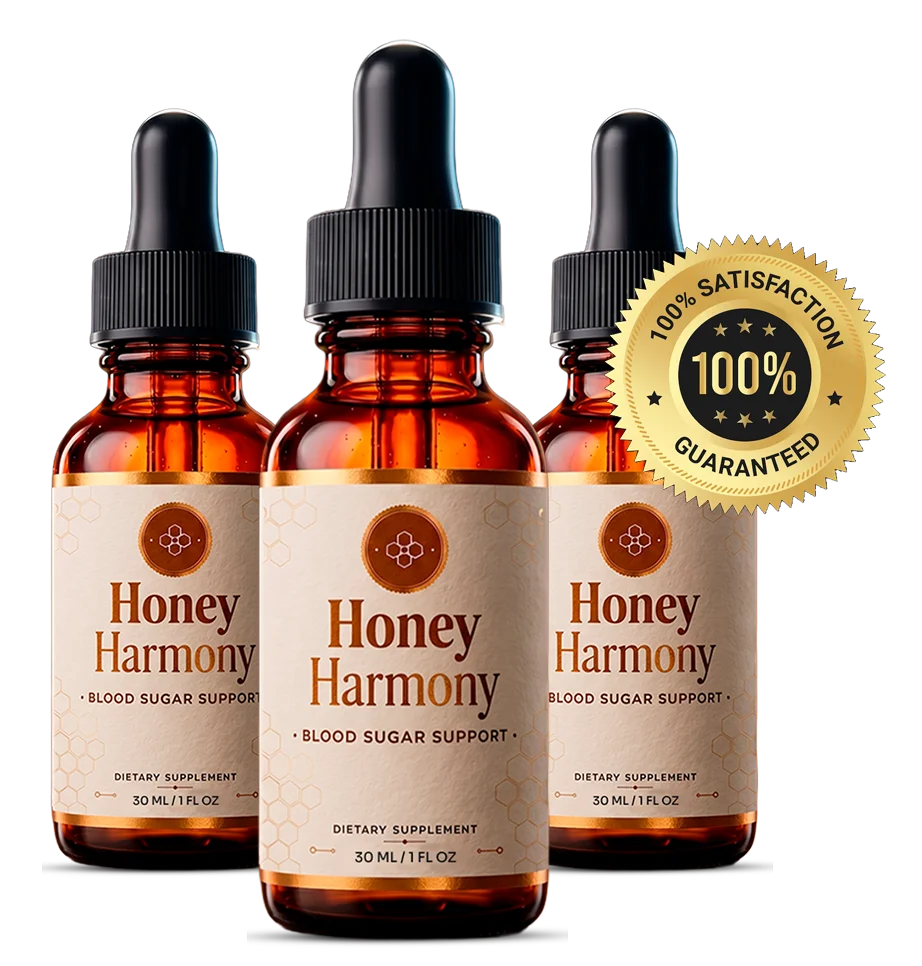
HoneyHarmony is marketed as a liquid dietary supplement intended to provide nutritional support for healthy blood sugar and metabolic wellness.
Unlike conventional capsules, the product comes in a 30 mL dropper bottle. The supplied label information identifies 1 mL, or one dropperful, as the daily serving, providing 30 servings per bottle.
The formula contains one clearly quantified active ingredient—chromium at 7 mcg—and a proprietary blend containing 21 other ingredients. The blend includes botanicals such as gymnema, green tea, African mango, maca, Panax ginseng, grape seed, astragalus, guarana, and other compounds.
The product therefore has two different transparency levels: chromium is individually quantified, while the other 21 ingredients are grouped into one total proprietary-blend weight.
That is one of the most important points to understand before buying HoneyHarmony.
Check Current HoneyHarmony Price & Offer
What Does HoneyHarmony Claim to Support?
HoneyHarmony is positioned around healthy blood sugar support rather than as a diabetes medication.
The formula includes ingredients that are commonly discussed in relation to glucose metabolism, insulin function, antioxidant activity, metabolic wellness, or general nutritional support.
However, there is an important difference between saying that an ingredient has been researched and saying that HoneyHarmony itself has been clinically proven to lower blood sugar.
The supplied product information does not provide evidence of a clinical trial conducted on the finished HoneyHarmony formula. Therefore, ingredient research should be interpreted as ingredient-level evidence rather than proof of HoneyHarmony’s effectiveness as a finished product.
This distinction is especially important for blood sugar products because glucose management can involve medications, diet, exercise, sleep, weight, genetics, and other health factors.
HoneyHarmony Ingredients
The label lists 22 active lines in total: chromium plus 21 ingredients contained within the proprietary blend.
Chromium Picolinate
HoneyHarmony provides 7 mcg of chromium per serving, listed as chromium picolinate and representing 20% of the Daily Value on the supplied label.
Chromium is an essential trace mineral involved in normal insulin-related processes. However, research on chromium supplementation and glucose control has produced mixed results.
The NIH Office of Dietary Supplements notes that chromium supplementation has been studied in relation to diabetes and glucose metabolism, but the evidence does not establish a consistent major benefit for everyone.
HoneyHarmony’s 7 mcg amount is also substantially lower than the doses commonly investigated in chromium supplementation trials.
Therefore, it is more appropriate to describe the chromium as a nutritional component of the formula rather than assuming that 7 mcg will reproduce results seen in higher-dose clinical studies.
Gymnema Leaf Extract
Gymnema sylvestre is one of the most notable ingredients in the formula because it has been studied specifically in relation to glucose control.
A systematic review and meta-analysis identified clinical studies examining Gymnema supplementation in people with type 2 diabetes and reported reductions in fasting glucose, post-meal glucose, and HbA1c across the analyzed studies. However, the studies were heterogeneous, and the evidence should not be interpreted as proof that every Gymnema product produces the same outcome.
The major issue with HoneyHarmony is dosage transparency.
The label identifies Gymnema as part of the 15.47 mg proprietary blend but does not disclose how much Gymnema is actually present.
Consequently, research conducted using substantially larger amounts cannot automatically be applied to the amount contained in HoneyHarmony.
Green Tea Leaf Extract
Green tea extract is another ingredient included in the proprietary blend.
A meta-analysis of 17 randomized controlled trials involving more than 1,100 participants found that green tea consumption or supplementation was associated with modest reductions in fasting glucose and HbA1c.
Again, however, the studies used defined amounts of green tea or catechins. HoneyHarmony does not disclose the individual amount of its green tea extract.
This makes it impossible to determine from the label alone whether the product provides an amount comparable to the doses studied in clinical research.
Panax Ginseng
Panax ginseng is included as ginseng root extract.
Ginseng has been investigated for potential effects on glycemic control. Research reviews have reported some modest effects on fasting glucose, but results have not consistently demonstrated meaningful improvements in all markers.
The HoneyHarmony label does not disclose the amount of ginseng in the proprietary blend, so the clinical research cannot be directly translated into a HoneyHarmony-specific dose.
African Mango
African mango, or Irvingia gabonensis, is another botanical included in the formula.
Research on African mango has focused more heavily on weight and metabolic outcomes than on established blood sugar treatment. A systematic review found that the available randomized trials had methodological and reporting limitations and concluded that the evidence was insufficient to recommend Irvingia as a weight-loss aid.
HoneyHarmony uses African mango seed extract in the proprietary blend, but its exact quantity is not disclosed.
Maca Root Extract
Maca is traditionally associated with areas such as energy, mood, sexual health, and general wellness.
The supplied product information does not identify a well-established human clinical dose of maca specifically for blood sugar support. Therefore, it would be inappropriate to present maca as a proven blood sugar ingredient based solely on its inclusion in HoneyHarmony.
Grape Seed Extract
Grape seed extract is included in the formula and is generally associated with antioxidant and cardiovascular wellness research.
However, the product label does not disclose its individual dose, and the evidence does not establish HoneyHarmony as a treatment for blood sugar disorders.
Guarana Seed Extract
Guarana is a natural source of caffeine.
This is worth noting because caffeine can affect glucose responses differently depending on the individual and circumstances. The exact guarana amount in HoneyHarmony is not disclosed, so the amount of caffeine supplied by the product cannot be calculated from the label.
Eleuthero Root Extract
Eleuthero, also known as Siberian ginseng, is generally used in supplement formulations associated with energy and adaptogenic wellness.
Its presence in HoneyHarmony contributes to the broad ingredient profile, but the supplied information does not establish a specific blood sugar benefit at the product’s undisclosed dose.
Astragalus Root Extract
Astragalus is traditionally used in various herbal formulations and has been investigated in relation to metabolic and other health outcomes.
However, strong clinical evidence for a specific blood sugar benefit from the amount contained in HoneyHarmony is not established by the product information.
Forskohlii Root Extract
Forskohlii, or Coleus forskohlii, has primarily been studied in areas such as body composition and metabolic outcomes.
The label does not provide its amount in HoneyHarmony, making a direct dose comparison with published studies impossible.
Cayenne Pepper Fruit Extract
Cayenne pepper extract provides capsaicinoid compounds and is commonly used in nutritional products for metabolism and thermogenesis-related positioning.
HoneyHarmony does not provide a separate dose for this ingredient.
Grapefruit Seed
Grapefruit seed extract is included in the proprietary blend. Its presence does not establish a clinically demonstrated blood sugar effect for HoneyHarmony.
Because grapefruit-related compounds can have interactions with certain medications, individuals taking prescription medications should discuss supplement use with a healthcare professional.
Raspberry Ketones
Raspberry ketones are frequently associated with weight-management products.
However, the presence of raspberry ketones in HoneyHarmony should not be interpreted as proof of a blood sugar effect, particularly because the exact dose is not disclosed.
L-Glutamine
L-glutamine is an amino acid found naturally in the body and in protein-containing foods.
HoneyHarmony does not disclose the amount included in its proprietary blend.
L-Tyrosine
L-tyrosine is an amino acid used in the body to produce several important compounds.
The supplied product information does not establish a specific blood sugar benefit from the amount present in HoneyHarmony.
L-Arginine
L-arginine is involved in nitric oxide production and vascular physiology.
Clinical studies of arginine often use gram-level quantities, while HoneyHarmony’s entire proprietary blend weighs only 15.47 mg. That means the individual amount of L-arginine cannot be assumed to resemble clinical research doses.
Beta-Alanine
Beta-alanine is commonly used in sports nutrition and is generally associated with muscle carnosine and exercise performance.
Its presence in HoneyHarmony does not by itself establish a blood sugar benefit.
Monoammonium Glycyrrhizinate
This licorice-derived ingredient is included in the proprietary blend.
Licorice compounds can have important effects at sufficiently high exposures, including effects on blood pressure and potassium. Anyone with cardiovascular or blood pressure concerns should therefore discuss supplement ingredients with a healthcare professional.
GABA
GABA, or gamma-aminobutyric acid, is a naturally occurring neurotransmitter.
It is frequently marketed in supplements related to relaxation and calm, but the product information does not establish a specific glucose-lowering effect for the amount contained in HoneyHarmony.
L-Tryptophan
L-tryptophan is an amino acid used by the body in pathways associated with serotonin and melatonin.
It is not established as a primary blood sugar ingredient in HoneyHarmony.
L-Carnitine HCl
L-carnitine is involved in fatty-acid metabolism and has been studied in various metabolic contexts.
However, the exact amount in HoneyHarmony is not disclosed, making it impossible to determine whether it corresponds to doses used in clinical studies.
The Biggest Question: What Are the Actual Doses?
This is arguably the most important issue in the HoneyHarmony formula.
The label gives an exact amount for chromium: 7 mcg.
However, the other 21 ingredients are combined into a proprietary blend weighing 15.47 mg in total. Their individual quantities are not listed.
That means a buyer cannot determine exactly how much Gymnema, green tea, ginseng, African mango, maca, or any other blend ingredient is present.
This matters because human studies usually use defined quantities.
For example, research on Gymnema has used hundreds of milligrams, while the entire HoneyHarmony proprietary blend contains only 15.47 mg across 21 ingredients.
Therefore, it would be misleading to assume that because Gymnema or another ingredient has been studied, HoneyHarmony automatically provides a clinically equivalent dose.
Check Current HoneyHarmony Price & Offer
Does HoneyHarmony Have Clinical Research Behind It?
Based on the supplied material, HoneyHarmony itself has not been clinically studied as a finished formula.
The evidence available for several ingredients is separate from evidence for the product.
This is an important distinction:
Ingredient research: A study investigates one ingredient at a defined dose.
Finished-product research: A study investigates the exact supplement formula in humans.
HoneyHarmony’s marketing positioning relies on a combination of ingredients, but that does not mean clinical trials have demonstrated that the complete combination lowers blood sugar.
For this reason, buyers should avoid interpreting ingredient research as a guarantee of personal results.
How Does HoneyHarmony Work?
The formula is positioned around several potential mechanisms associated with metabolic wellness.
Chromium is included because of its role in normal insulin-related physiology.
Gymnema has been investigated for glucose control and may also influence sweet taste perception.
Green tea has been studied for possible effects on glucose and insulin sensitivity.
Ginseng has been investigated in relation to fasting glucose.
African mango has primarily been studied around body weight and metabolic parameters.
These mechanisms are interesting from a nutritional research perspective, but they do not prove that HoneyHarmony will lower glucose or replace established diabetes treatment.
How to Take HoneyHarmony
The supplied label instructions say to shake the bottle well and take one dropperful daily, placing it in the mouth and swallowing.
The seller’s current FAQ also describes one dropperful daily.
Because product instructions can change, buyers should always follow the current label supplied with the product.
HoneyHarmony should not be used as a reason to stop prescribed medication, change diabetes treatment, or skip glucose monitoring.
HoneyHarmony Price
The supplied November 2026 pricing information lists three main package options.
2-Bottle Package
The 2-bottle package is listed at $79 per bottle, for a product total of $158. The supplied information lists an additional $9.99 U.S. shipping charge, bringing the stated checkout total to $167.99.
3-Bottle Package
The 3-bottle option is listed at $69 per bottle, making the product total $207. U.S. shipping is listed as free for this package.
6-Bottle Package
The 6-bottle package is listed at $49 per bottle, for a product total of $294, with free U.S. shipping according to the supplied information.
Pricing and promotional terms can change, so buyers should verify the current total before completing checkout.
Check Current HoneyHarmony Price & Offer
HoneyHarmony Money-Back Guarantee
HoneyHarmony is marketed with a 60-day money-back window, but the supplied information shows that buyers should read the actual refund terms carefully.
Different pages associated with the seller reportedly describe somewhat different return conditions, including requirements related to the minimum trial period, bottle condition, restocking fees, shipping, and return postage.
Because these conditions can affect how much money a customer actually receives back, it is sensible to save the order confirmation and review the applicable refund policy before ordering.
Do not assume that the phrase “60-day money-back guarantee” automatically means every shipping charge or every bottle condition is covered.
Is HoneyHarmony FDA Approved?
No dietary supplement should be described as FDA-approved simply because it is manufactured in an FDA-registered facility.
The FDA explains that it does not approve dietary supplements for safety and effectiveness before they are marketed. Manufacturers and distributors are responsible for meeting applicable safety and labeling requirements, while FDA oversight is primarily post-market.
Therefore, if you see an “FDA-approved” claim associated with a dietary supplement, it is important to distinguish FDA registration of a facility from FDA approval of the product.
HoneyHarmony should be considered a dietary supplement, not an FDA-approved diabetes treatment.
HoneyHarmony Safety and Possible Concerns
Blood sugar supplements require more caution than ordinary wellness products because ingredients may interact with medications or influence glucose levels.
Anyone using insulin or other glucose-lowering medication should consult their healthcare professional before adding a supplement intended for blood sugar support.
Pregnant or nursing individuals and people with existing medical conditions should also seek professional advice before use.
The product information specifically flags considerations involving diabetes medication, liver disease, pregnancy, nursing, and children.
The formula also contains xylitol. The FDA warns that xylitol is dangerous to dogs, so households with pets should keep HoneyHarmony securely away from dogs.
HoneyHarmony Pros and Cons
Pros
- Convenient liquid dropper format
- One-dropperful daily serving
- Chromium amount is clearly listed
- Includes Gymnema, green tea, ginseng and African mango
- 30 servings per 30 mL bottle
- Multiple package options
- 60-day refund window is advertised
- U.S. shipping is listed as free on the 3- and 6-bottle packages
Cons
- Individual amounts for 21 blend ingredients are not disclosed
- The complete HoneyHarmony formula has not been shown to be clinically studied
- The total proprietary blend is only 15.47 mg
- Research doses for several ingredients are substantially higher than what can reasonably be inferred from the blend
- Different published refund terms require careful review
- It should not replace prescribed diabetes medication or medical monitoring
- Pricing and promotions may change
Who May Consider HoneyHarmony?
HoneyHarmony may be of interest to adults looking for a convenient liquid dietary supplement to complement an existing healthy lifestyle.
It may particularly appeal to people who prefer liquid supplements over capsules and who want a formula containing multiple botanical and nutritional ingredients.
However, people with diagnosed diabetes should approach the product differently.
A supplement should not be considered a substitute for medication, A1C testing, dietary planning, physical activity, or professional diabetes management.
The NIDDK explains that an A1C test reflects average blood glucose over approximately the previous three months and is an important tool for diagnosing and managing diabetes.
HoneyHarmony and Blood Sugar Claims: What Should Buyers Expect?
The most reasonable conclusion is that HoneyHarmony contains several ingredients with some human research behind them, but the evidence does not establish that the finished product will produce the same results.
Gymnema has human research supporting potential glucose-related effects. Green tea has evidence from randomized trials showing modest changes in fasting glucose and HbA1c. Ginseng has also been studied for glycemic control. African mango has some metabolic research, although its evidence base has limitations.
The problem is dose transparency.
Because the individual amounts of 21 ingredients are not disclosed, buyers cannot compare the HoneyHarmony formula directly with the amounts used in those studies.
That does not automatically mean the product is ineffective. It means that the available evidence is not strong enough to promise a specific blood sugar result from HoneyHarmony itself.
HoneyHarmony Customer Reviews
Customer testimonials can be useful for understanding how a product is marketed, but they should not be confused with clinical evidence.
The supplied product material contains testimonials describing improved readings, reduced cravings, and better energy. However, these are individual experiences rather than controlled clinical outcomes.
A responsible review therefore should not present those testimonials as proof that HoneyHarmony lowers blood sugar.
For people monitoring glucose, objective measurements and appropriate medical testing are much more meaningful than isolated testimonials.
What Should You Check Before Buying HoneyHarmony?
Before ordering, buyers should consider several practical points.
First, look at the Supplement Facts panel, not only the marketing description.
Second, recognize that the proprietary blend does not provide individual amounts for 21 ingredients.
Third, compare the current price with the package size and shipping charges.
Fourth, read the current refund policy rather than relying only on the headline “60-day guarantee.”
Finally, if you take medication for diabetes, blood pressure, or another condition, discuss the full ingredient list with a qualified healthcare professional.
HoneyHarmony Review: Ingredients, Doses and Blood Sugar Claims
Explore HoneyHarmony’s ingredients, dosing information, and blood sugar support claims before buying.
Final Verdict: Is HoneyHarmony Worth Considering?
HoneyHarmony is an interesting blood sugar-support supplement because it combines chromium with a broad proprietary blend of botanical extracts and amino acids in a convenient liquid format.
Its strongest selling point is the variety of ingredients. Gymnema, chromium, green tea, Panax ginseng, and African mango have all appeared in human research related to glucose, metabolic health, or related outcomes.
However, the biggest limitation is dose transparency.
Only chromium is individually quantified at 7 mcg. The remaining 21 ingredients are combined into a total 15.47 mg proprietary blend, with no individual quantities disclosed.
That makes it difficult to compare HoneyHarmony directly with clinical research.
Therefore, HoneyHarmony should be viewed as a dietary supplement intended to complement healthy lifestyle habits, not as a proven treatment for diabetes or a replacement for prescribed medication.
If you are interested in trying it, review the label, confirm the current price and refund terms, and speak with a healthcare professional if you have diabetes, take glucose-lowering medication, are pregnant or nursing, or have another medical condition.
Most importantly, do not stop or change prescribed diabetes medication based on supplement testimonials or marketing claims.
Frequently Asked Questions About HoneyHarmony
What is HoneyHarmony?
HoneyHarmony is a liquid dietary supplement marketed for blood sugar and metabolic wellness support. Its supplied label lists chromium plus a proprietary blend of 21 additional ingredients.
What are the main HoneyHarmony ingredients?
The formula includes chromium picolinate, Gymnema sylvestre, African mango, grape seed, guarana, eleuthero, astragalus, green tea, forskohlii, cayenne, grapefruit seed, Panax ginseng, raspberry ketones, L-glutamine, L-tyrosine, L-arginine, beta-alanine, monoammonium glycyrrhizinate, GABA, L-tryptophan, and L-carnitine HCl.
How much chromium is in HoneyHarmony?
The supplied label lists 7 mcg of chromium as chromium picolinate per 1 mL serving.
Are the individual doses of all HoneyHarmony ingredients disclosed?
No. The label provides the total 15.47 mg weight for the 21-ingredient proprietary blend but does not disclose the individual amount of each ingredient.
How do you take HoneyHarmony?
The supplied label instructs users to shake the bottle well and take one dropperful daily.
Is HoneyHarmony FDA approved?
No dietary supplement should be described as FDA-approved simply because it is sold in the United States or produced in an FDA-registered facility. The FDA does not pre-approve dietary supplements for safety and effectiveness before marketing.
Can HoneyHarmony replace diabetes medication?
No. HoneyHarmony should not be used as a substitute for prescribed diabetes medication, glucose monitoring, A1C testing, or professional medical care.
Does HoneyHarmony have a money-back guarantee?
The product is advertised with a 60-day refund window, but the supplied information indicates that different published policy versions contain different conditions. Buyers should review the applicable return policy before ordering.
How much does HoneyHarmony cost?
The supplied November 2026 pricing lists $79 per bottle for the two-bottle package, $69 per bottle for the three-bottle package, and $49 per bottle for the six-bottle package.
Is HoneyHarmony clinically proven?
The available material does not establish a clinical trial of the complete HoneyHarmony formula. Some individual ingredients have human research, but that research should not be treated as proof of the finished product’s effectiveness.
References
The following references were selected to support the regulatory, ingredient, glucose-control, safety, and evidence-related points discussed in this review.
U.S. Food and Drug Administration — Questions and Answers on Dietary Supplements. This FDA resource explains what dietary supplements are, what manufacturers must disclose on labels, and why dietary supplements are not pre-approved by the FDA for safety and effectiveness before marketing.
FDA — Questions and Answers on Dietary Supplements
U.S. Food and Drug Administration — Information for Consumers on Using Dietary Supplements. This consumer guidance discusses the FDA’s role in dietary supplement oversight and recommends that consumers consult healthcare professionals when considering supplement use.
FDA — Information for Consumers on Using Dietary Supplements
NIH Office of Dietary Supplements — Chromium Fact Sheet for Health Professionals. This resource provides background on chromium, its biological role, recommended intake information, and the evidence surrounding chromium supplementation and glucose-related outcomes.
NIH ODS — Chromium Fact Sheet for Health Professionals
Devangan et al., 2021 — Gymnema sylvestre and glycemic control. This systematic review and meta-analysis evaluated clinical studies of Gymnema supplementation in people with type 2 diabetes and provides context for the evidence surrounding this ingredient.
PubMed — Gymnema sylvestre Systematic Review and Meta-Analysis
Liu et al., 2013 — Green Tea and Glucose Control. This meta-analysis examined 17 randomized controlled trials and reported modest changes in fasting glucose and HbA1c associated with green tea consumption or supplementation.
PubMed — Effect of Green Tea on Glucose Control and Insulin Sensitivity
Shishtar et al., 2014 — Ginseng and Glycemic Control. This systematic review and meta-analysis examined randomized clinical trials evaluating Panax ginseng and glycemic outcomes.
PubMed — Ginseng and Glycemic Control Meta-Analysis
Onakpoya et al., 2013 — Irvingia gabonensis Systematic Review. This review evaluated randomized controlled trials of African mango supplementation and concluded that the available evidence was limited by the small number and quality of studies.
PubMed — Irvingia gabonensis Systematic Review
National Institute of Diabetes and Digestive and Kidney Diseases — The A1C Test & Diabetes. This resource explains that A1C reflects average blood glucose over approximately the previous three months and is used for diabetes diagnosis and management.
NIDDK — The A1C Test & Diabetes
Medical Disclaimer
This article is for general educational and informational purposes only. HoneyHarmony is a dietary supplement and should not be considered a treatment, cure, or prevention for diabetes or any other disease. Individual results may vary. Do not stop, reduce, or change prescribed medication based on supplement claims or customer testimonials. If you have diabetes, take glucose-lowering medication, are pregnant or nursing, or have a medical condition, consult a qualified healthcare professional before using a dietary supplement.
Affiliate Disclosure
The HoneyHarmony product link in this article is provided for purchasing information. The publisher may receive a commission if a purchase is completed through the link, at no additional cost to the buyer.


Natural home remedies, skincare secrets, dental & eye health tips, and real product reviews to help you stay healthy the natural way.