

You sit down for breakfast, take a bite of toast, and feel it: a dull, throbbing ache beside your ear, an uncomfortable tenderness along your cheek, or a sharp twinge whenever your back teeth meet. When jaw pain appears out of nowhere on just one side of your face, it is completely natural to feel a spike of anxiety. Your mind might jump to worst-case scenarios, leaving you wondering if a major medical emergency is unfolding.
Fortunately, the reality is usually much more manageable. Jaw pain on one side is an incredibly common symptom, and more often than not, it stems from highly treatable issues like an irritated jaw joint, nighttime teeth grinding, or a localized dental problem.
However, because the anatomy of the face is so densely packed, figuring out exactly why your jaw hurts can feel like a game of diagnostic telephone. Your jaw joints, chewing muscles, teeth, nerves, sinuses, and salivary glands live in close quarters. When one structure becomes inflamed, the pain can easily radiate, making a problem in an upper molar feel like an earache or a strained muscle feel like a deep bone ache.
This comprehensive guide is designed to help you decode what your body is trying to tell you. We will break down why jaw pain frequently strikes only one side, explore the most common culprits, look at how to tell different types of pain apart, and clarify exactly when you can manage it at home versus when it is time to seek professional care.
Why Does Jaw Pain Choose a Side?
To understand why pain favors one side of the face, it helps to look at how your lower jaw functions. The jawbone, or mandible, connects to your skull through two temporomandibular joints (TMJs), which sit directly in front of your ears. Think of them as a pair of highly sophisticated hinges that slide and rotate to let you talk, chew, yawn, and swallow.
These joints do not always share the workload equally. If you have a habit of chewing your food primarily on the right side, clenching your jaw unevenly when you are stressed, or sleeping in a position that puts prolonged pressure on one cheek, you can easily strain the muscles and ligaments on just one side.
Furthermore, if you have a missing tooth or a poorly aligned bite, your jaw muscles may overcompensate on one side to keep your teeth meeting properly, leading to localized fatigue and inflammation.
Beyond joint mechanics, many anatomical issues are naturally isolated to one specific location:
- Dental issues: A cavity, cracked root, or erupting wisdom tooth typically affects one specific tooth at a time.
- Infections: A blocked salivary gland, ear infection, or localized sinus infection will usually flare up on either the left or right side, sending referred pain directly into that side of the jaw.
Because your facial nerves share interconnected pathways, your brain cannot always pinpoint the exact origin of the distress. That is why tracking your specific triggers, the timing of the pain, and any accompanying symptoms is the most effective way to narrow down the cause.
Comparing the Roots of One-Sided Jaw Pain
Before diving into the detailed explanations, it can be incredibly helpful to see how these potential causes stack up against one another. The table below outlines how different issues tend to present themselves, giving you a quick reference point for your symptoms.
| Possible cause | Typical pain pattern | Other useful clues | Sensible next step |
|---|---|---|---|
| TMD or muscle strain | Dull ache near the ear; worsens when chewing, yawning, or speaking | Jaw clicking or popping, stiffness, limited movement, tension headaches | Schedule a visit with a dentist or primary-care doctor if it persists |
| Teeth grinding (bruxism) | Widespread soreness or tightness across the jaw, usually worst after waking | Flattened or chipped teeth, morning headaches, tight temple muscles | Mention it to your dentist and ask whether a custom nightguard is appropriate |
| Cavities or dental abscess | Localized, sharp, or throbbing pain that often flares when biting | Sensitivity to hot or cold, localized gum swelling, bad taste, fever | Contact your dentist promptly for an evaluation |
| Impacted wisdom tooth | Deep, radiating ache at the back of the jawbone | Swollen or bleeding gums behind the last molars, difficulty opening wide | Schedule a dental exam to assess the tooth’s position |
| Sinus or ear condition | Full, heavy pressure or ache, often affecting the upper jaw and cheekbone | Nasal congestion, ear fullness, recent cold, respiratory infection, fever | Consult a primary-care doctor or ENT specialist |
| Salivary gland blockage | Sharp pain or sudden swelling under the jaw or near the ear during meals | Swelling that visibly increases while eating, dry mouth, localized tenderness | See a doctor or dentist to check for salivary stones |
| Trigeminal neuralgia | Sudden, severe, electric-shock-like jolts lasting a few seconds | Triggered by light touch, washing the face, shaving, or brushing the teeth | Seek a medical evaluation from a doctor or neurologist |
| Facial injury or dislocation | Sharp, immediate pain following an impact or unusually wide yawn | Bruising, rapid swelling, crooked bite, inability to close the mouth | Visit an urgent-care clinic or emergency department |
| Heart-related referred pain | Sudden discomfort, pressure, or tightness radiating into the jaw or neck | Chest pain, shortness of breath, sweating, nausea, lightheadedness | Call emergency services immediately |
The Nine Common Causes of One-Sided Jaw Pain
1. Temporomandibular Disorders
Temporomandibular disorders are an umbrella term for problems affecting the jaw joints and the complex web of muscles that control them. You will often hear people refer to this simply as “TMJ,” although technically, TMJ is the name of the joint itself, while TMD refers to the actual condition.
When TMD causes jaw pain on one side, the discomfort usually settles directly in front of the ear. It tends to behave like a sports injury: the more you use the joint, the more it hurts. Chewing a tough piece of meat, talking during a long phone call, or opening wide to yawn can cause the ache to flare up.
Many people with TMD notice that their jaw clicks, pops, or makes a grating sound when they move it. It is important to know that a painless click is generally nothing to worry about because many joints make noise without indicating a functional problem.
However, if the clicking is accompanied by pain, a feeling that the jaw is catching, or a restriction in how wide you can open your mouth, the joint requires professional attention. TMD can be triggered by several factors, including physical trauma, arthritis within the joint, stress-induced muscle tension, or chronic habits such as biting your nails and chewing gum.
2. Chronic Teeth Grinding and Clenching
If you wake up in the morning and notice that the side of your face feels incredibly sore, tight, or exhausted—as if you spent the entire night chewing bubble gum—you might be dealing with sleep bruxism. Bruxism is the involuntary grinding, gnashing, or clenching of your teeth, and it frequently happens while you are asleep.
Even though you grind with both sides of your mouth, the structural alignment of your bite might mean that one side takes the brunt of the physical force. Over time, this immense, repetitive pressure strains the masseter muscle, the primary chewing muscle running along the side of your jaw, resulting in one-sided soreness.
Aside from morning jaw fatigue, clues that point to bruxism include frequent tension headaches that start in the temples, increased tooth sensitivity, and physical signs your dentist can spot, such as flattened tooth surfaces, micro-cracks in your enamel, or indentations along the sides of your tongue.
Daytime clenching is also common, often happening as an unconscious physical reaction to intense concentration, driving, or emotional stress.
If you notice an actual sore, lump, or raised area rather than simple tooth indentations, this guide explains how to evaluate a bump inside the tongue according to its location, appearance, symptoms, and duration.
3. Cavities, Cracked Teeth and Abscesses
Not all dental issues present themselves as a straightforward, easily identifiable toothache. Sometimes, a problem deep within a tooth can manifest as a vague, radiating ache across the entire lower or upper quadrant of your jaw.
A deep cavity, a hidden fracture running down the root of a molar, or an infection at the very tip of a tooth root can cause severe, one-sided jaw pain. This type of pain is often distinct from muscular soreness; it is usually described as deep, throbbing, and persistent.
It will often intensify significantly when you bite down, consume hot or cold foods, or lie flat in bed at night due to the increased blood pressure in your head.
If an infected tooth is left untreated, a dental abscess can form, creating a pocket of pus that builds pressure inside the jawbone. If you notice a small, pimple-like bump on your gums, a foul taste in your mouth, facial swelling, or a fever alongside your jaw pain, it is a clear sign that you need prompt dental intervention.
Furthermore, neglecting oral hygiene can lead to significant plaque and tartar accumulation. When tartar hardens along the gumline over a long period, it can form what is known as a calculus bridge on teeth—a dense, continuous crust that connects multiple teeth.
While a calculus bridge does not directly cause sudden jaw-joint pain, it traps harmful bacteria against your gums, potentially contributing to periodontal disease, gum recession, bone loss, and localized gum abscesses that can make the surrounding area ache.
If you notice heavy, chalky, or brown deposits along your teeth that cause your gums to bleed, arrange professional dental scaling instead of trying to scrape the deposits away yourself. Makeshift tools can permanently damage your enamel and delicate gum tissues.
4. Impacted Wisdom Teeth and Localized Gum Inflammation
Your wisdom teeth, or third molars, are the last teeth to emerge, typically arriving in your late teens or early twenties. Because modern human jaws are often too small to comfortably accommodate these extra molars, they frequently become “impacted,” meaning they become stuck beneath the gumline or emerge at an awkward angle.
When a wisdom tooth tries to break through the gums but runs out of room, it can create a partial opening. This creates a pocket where food particles, plaque, and bacteria can become trapped. Because the area is at the very back of the mouth, it can be difficult to clean properly with a standard toothbrush or dental floss.
The resulting inflammation, known as pericoronitis, causes localized swelling, tenderness, and an unpleasant taste or odor from the back of the mouth.
Because wisdom teeth rarely erupt at exactly the same rate, this issue often starts on one side first. It can cause a deep, radiating ache at the corner of the jaw that makes opening the mouth or swallowing uncomfortable.
5. Sinus Infections and Ear Conditions
Sometimes, the source of jaw pain does not originate in the jaw or mouth. Due to the proximity of facial cavities and nerve pathways, problems in the respiratory tract or ears can easily masquerade as jaw pain.
Your maxillary sinuses are large, hollow spaces located directly above your upper teeth. When you develop a sinus infection or experience severe seasonal allergies, these cavities can become inflamed and filled with fluid.
Because the roots of your upper molars sit directly beneath—and may sometimes extend close to—the floor of the maxillary sinus, pressure buildup can cause the upper jaw and several teeth on that side to ache intensely.
This type of pain usually feels like heavy, dull pressure that worsens when you bend forward or tilt your head down. It is commonly accompanied by nasal congestion, a reduced sense of smell, facial pressure, or recent recovery from a cold.
Similarly, because your jaw joint sits directly beside your ear canal, a middle-ear infection or other ear problem can be felt as sharp or dull pain in the jaw.
If your jaw pain is accompanied by an earache, fluid draining from the ear, a feeling of fullness in the ear canal, marked dizziness, fever, or changes in your hearing, a medical examination focusing on the ear is the best path forward.
6. Blocked or Inflamed Salivary Glands
You have three major pairs of salivary glands located beneath your jaw and in front of your ears. These glands produce saliva, which travels through small tubes called ducts into your mouth.
Just as your kidneys can develop stones, your salivary glands can develop small, calcium-rich deposits known as salivary stones, or sialolithiasis.
If a stone grows large enough to block a salivary duct, fluid backs up inside the gland, causing swelling and localized pain. The defining characteristic of a salivary gland blockage is its timing: pain and swelling commonly flare around mealtimes.
When you see, smell, or taste food, your brain signals the glands to release saliva. If a duct is blocked, this sudden surge of fluid creates intense pressure and swelling under the corner of the jaw or near the ear.
The pain may settle an hour or two after you finish eating, only to return at the next meal. If the stagnant saliva becomes infected, you may experience persistent swelling, redness, fever, and a foul-tasting discharge in your mouth. These symptoms require prompt treatment from a doctor, dentist, or ear, nose, and throat specialist.
7. Physical Injuries, Arthritis and Acute Muscle Strain
Your jaw joint is susceptible to many of the same musculoskeletal problems as other joints in your body, such as your knees or shoulders.
A direct blow to the face from a sports injury, accidental fall, or vehicle accident can bruise the delicate tissues within the joint, strain the surrounding ligaments, or cause a fracture or dislocation of the mandible.
If you experience sudden, severe jaw pain immediately following an impact and notice that your teeth no longer line up properly when you close your mouth, seek emergency medical care.
Strain can also happen more subtly. If you undergo a lengthy dental procedure that requires keeping your mouth open for an hour or more, the muscles on one side can become overstretched and go into painful spasms afterward.
Chronic inflammatory conditions such as osteoarthritis or rheumatoid arthritis can also affect the temporomandibular joint. Over time, they may contribute to a persistent grinding ache, morning stiffness, reduced movement, or a crunchy sound known as crepitus when moving the jaw.
8. Neurological Conditions
While structural, muscular, and dental issues account for many cases of jaw pain, there are situations in which the problem originates from a malfunctioning nerve. The most notable condition in this category is trigeminal neuralgia.
The trigeminal nerve is the primary sensory nerve for your face. It divides into three main branches that cover the forehead, cheek, and lower jaw. If this nerve becomes compressed by a nearby blood vessel or affected by an underlying condition, it can begin sending abnormal pain signals.
Trigeminal neuralgia feels distinctly different from the dull, heavy, or throbbing ache of a muscle strain or cavity. It is characterized by sudden, unpredictable attacks of severe, sharp, electric-shock-like pain that typically last from a few seconds to a couple of minutes.
These jolts usually affect one side of the face and can be triggered by surprisingly light contact, such as a cool breeze hitting your cheek, washing your face, applying makeup, talking, smiling, or gently brushing your teeth.
Because nerve pain can closely imitate a severe toothache, anyone experiencing recurring electric-shock sensations needs a thorough medical evaluation.
9. Heart-Related Referred Pain
It surprises many people to learn that jaw pain can be a warning sign of a cardiovascular emergency, such as angina or a heart attack. When the heart muscle does not receive enough oxygen-rich blood, discomfort can spread into the neck, shoulders, back, arms, or jaw.
Popular media often portrays a heart attack as sudden chest pain on the left side. In reality, heart-related referred pain may spread into either side of the jaw and may present differently between individuals.
It is therefore essential to consider the complete pattern of symptoms. Isolated jaw pain that clearly changes when you chew, press on the joint, or move your mouth is less suggestive of a heart problem.
However, if jaw pain begins suddenly and is accompanied by heavy pressure, squeezing, or fullness in the chest, shortness of breath, unexplained sweating, nausea, dizziness, or sudden extreme weakness, it is a medical emergency. Call emergency services immediately and do not attempt to drive yourself to the hospital.
When to Worry: Recognizing the Warning Signs
Most cases of one-sided jaw pain can be safely evaluated during a routine appointment with a dentist or doctor. However, certain warning signs may indicate a serious condition that requires immediate attention.
Seek Emergency Care Immediately If:
- Your jaw pain is accompanied by chest discomfort, crushing pain, pressure, or a squeezing sensation.
- You experience unexplained shortness of breath or difficulty catching your breath.
- You experience sudden sweating, nausea, dizziness, lightheadedness, or profound weakness.
- You notice rapidly spreading swelling around your face, beneath your jaw, or down your neck.
- You have difficulty swallowing your saliva or feel as though your throat is closing.
- The pain started after significant physical trauma or a blow to the face.
- Your jaw is stuck in an open or closed position and cannot move.
Schedule a Prompt Professional Appointment If:
- The pain is severe, steadily worsening, or keeps returning after brief periods of relief.
- You have a fever, visible pus around the gums, or a foul taste that does not go away.
- The discomfort makes it difficult to chew food, drink liquids, or open your mouth for oral hygiene.
- Your jaw joint repeatedly catches, clicks painfully, or feels increasingly locked and stiff.
- You experience persistent numbness or tingling in your face, lips, or tongue.
- You notice a new, firm, unexplained lump forming beneath your jaw or along your cheek.
- Mild jaw pain on one side shows no signs of improvement after several days of gentle care.
Who Is the Best Specialist to See First?
If your jaw pain does not fall into an emergency category, you might wonder whether you should contact your dentist or primary-care doctor. The most appropriate starting point depends on the nature of your symptoms.
When to Call Your Dentist First
Dentists are experts not only in teeth but also in the functional relationship between the mouth, bite, chewing muscles, and jaw joints. Start with a dental evaluation if:
- The pain feels localized to a specific tooth or quadrant of your mouth.
- Your jaw throbs or aches specifically when you bite or chew.
- Your teeth are highly sensitive to hot drinks, cold water, or sweet foods.
- You notice swollen, bleeding, or tender gums around a particular tooth.
- You frequently wake with a tight, sore jaw or temple headache.
- Your jaw joint makes clicking or popping noises that have become uncomfortable.
Your dentist can examine your bite alignment, check the chewing muscles for tenderness, and take dental X-rays to look for hidden decay, fractures, bone loss, or impacted teeth.
When to Call Your Doctor First
Contact a primary-care doctor when your symptoms suggest a systemic condition or a problem outside the teeth and gums:
- Your jaw ache is accompanied by facial pressure, nasal congestion, postnasal drip, or pain that worsens when you bend forward.
- The pain is paired with an earache, fluid in the ear, hearing changes, or ringing.
- You experience severe electric-shock-like bursts triggered by light touch.
- You notice a tender lump beneath your jaw that becomes larger during meals.
- Your jaw pain is part of a broader ache affecting multiple joints.
If the cause remains unclear after the initial evaluation, doctors and dentists can collaborate. A dentist may refer you to an oral surgeon or ENT specialist, while a doctor may refer you to a neurologist, orofacial pain specialist, or physical therapist.
Safe, Gentle Home Care for Mild Jaw Pain
If your jaw pain is relatively mild, has only been present for a few days, was not caused by an injury, and is free of warning signs, conservative self-care may help.
What to Do
Switch to Soft Foods
Give your jaw muscles a break. For a few days, build meals around easy-to-chew foods such as scrambled eggs, yogurt, oatmeal, mashed potatoes, soups, smoothies, and well-cooked pasta. Take smaller bites to avoid opening your mouth excessively wide.
Apply Temperature Therapy
If your jaw feels tight, stiff, and muscularly sore, apply a warm compress wrapped in a thin towel to the side of your face for about 15 minutes.
If you are dealing with recent swelling or an acute ache, use an ice pack wrapped in cloth for 10–15 minutes. Do not place ice directly against your skin.
Follow the “Lips Together, Teeth Apart” Rule
Under normal circumstances, your upper and lower teeth should not remain firmly pressed together throughout the day unless you are chewing.
Check in with yourself periodically. If you notice that you are clenching while typing, driving, exercising, or feeling stressed, consciously relax your jaw and allow the teeth to separate.
Use Nonprescription Relief Carefully
If nonprescription pain medicine is normally safe for you, it may help reduce short-term discomfort. Follow the product label and consider speaking with a healthcare professional if you have existing medical conditions, take other medications, or are unsure which option is appropriate.
What to Avoid
Avoid Hard and Chewy Foods
Temporarily avoid tough meats, crunchy vegetables, whole apples, hard bread crusts, nuts, sticky candy, and chewing gum. Continuous chewing places additional stress on an irritated joint.
Do Not Force or Test the Joint
It can be tempting to repeatedly open your mouth in front of a mirror to see whether the jaw still clicks. Constantly testing an irritated joint may keep it inflamed, much like repeatedly placing weight on a sprained ankle.
Avoid DIY Dental Treatment
Never place an aspirin tablet directly against an aching gum because it can damage the delicate oral tissue. Do not attempt to drain gum swelling, use sharp tools to scrape tartar, or depend on whitening products while dealing with unexplained pain.
While some people use home methods for cosmetic stains, it is important to understand their limits. For example, anyone using sodium bicarbonate should review the benefits and risks of brushing teeth with baking soda.
Baking soda may help remove certain surface stains, but it cannot cure a dental infection, soothe an injured jaw joint, or treat an inflamed nerve. Depending on cosmetic home methods for a structural or biological problem may delay the professional treatment you need.
Practical Ways to Protect Your Jaw
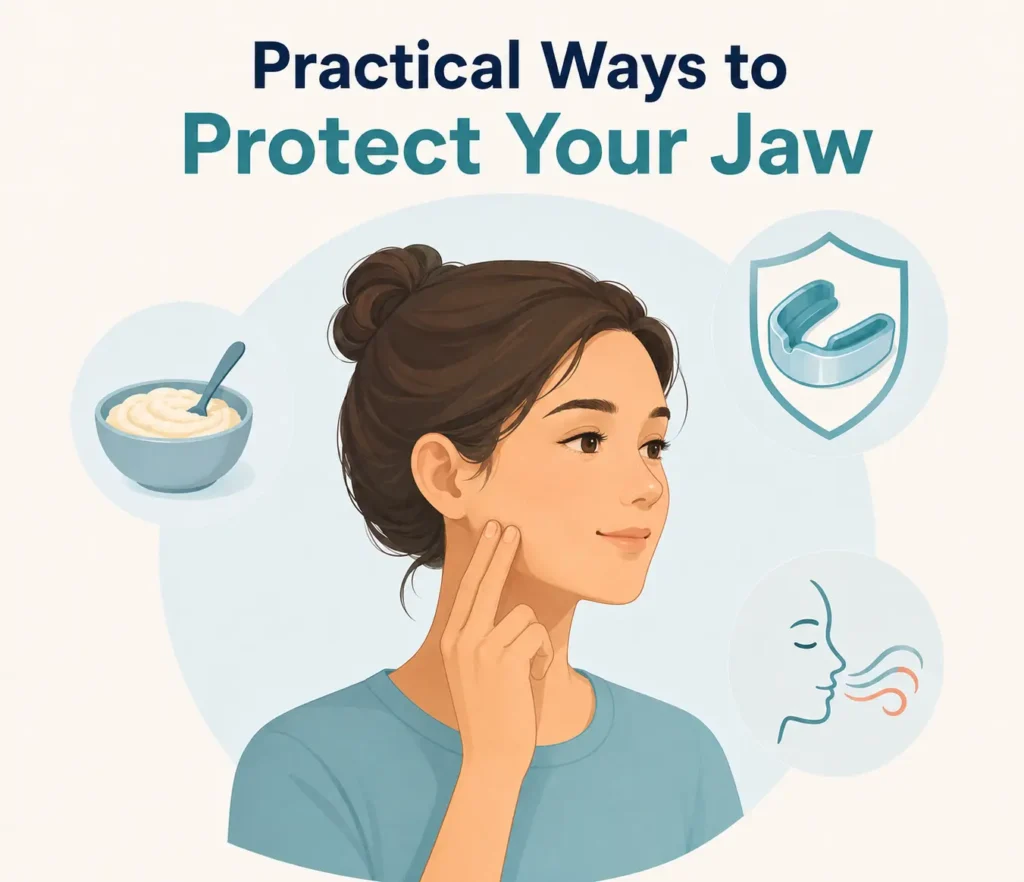
Although you cannot prevent every possible cause of jaw pain, several everyday habits can reduce the likelihood of painful flare-ups.
Maintain Consistent Oral Hygiene
Brush your teeth twice daily with fluoride toothpaste, clean between your teeth with floss or an interdental brush, and attend regular dental examinations and professional cleanings.
Finding a small cavity or early gum disease during a routine visit can prevent it from developing into a deeper infection that causes severe tooth and jaw pain.
Protect Your Mouth During Activities
If you participate in contact sports such as basketball, soccer, martial arts, or hockey, wear a properly fitted athletic mouthguard. It can cushion the teeth and absorb some of the force from an impact.
Address Stress Physically
Emotional stress causes many people to clench their jaws or grind their teeth without realizing it. Finding a healthy outlet for anxiety may help protect the facial muscles.
Consider progressive muscle relaxation before bed, regular physical activity, gentle stretching, breathing exercises, or brief breaks during the workday to release tension building in your shoulders, neck, and jaw.
Frequently Asked Questions
Is Jaw Pain on One Side Always Related to TMJ?
No. While temporomandibular disorders are a common cause of one-sided jaw pain, they are far from the only explanation.
A deep cavity, cracked molar, impacted wisdom tooth, sinus infection, ear problem, blocked salivary gland, arthritis, or nerve condition can create a similar ache. A proper examination considers all the surrounding structures to find the source.
Why Does My Jaw Hurt on One Side When I Open My Mouth Wide?
When pain flares specifically during wide movements, such as yawning or taking a large bite, it may point toward a mechanical issue within the jaw joint or a strain in the surrounding chewing muscles.
This is especially likely when you also experience painful clicking, stiffness, or a feeling that the jaw is tracking sideways. However, a severe dental infection or impacted wisdom tooth can also make opening the mouth uncomfortable because of localized swelling.
How Long Is It Safe to Wait Before Seeking Professional Help?
If you experience warning signs such as chest pressure, shortness of breath, rapidly increasing facial swelling, fever, or difficulty swallowing, do not wait. Seek urgent medical care.
If your jaw pain is mild, dull, and free of warning signs, it may be reasonable to use gentle home care and monitor it for a few days. If it shows no clear improvement after five to seven days, steadily worsens, or repeatedly returns, arrange an appointment with your dentist or doctor.
Can a Hidden Tooth Problem Cause Jaw Pain Without a Classic Toothache?
Yes. The nerves supplying your teeth are closely connected with the nerves running through the jaw.
When a tooth has deep decay, a cracked root beneath the gumline, or a low-grade infection around the root, the discomfort can spread outward. Instead of feeling like one sore tooth, it may present as a vague or throbbing ache across part of the upper or lower jaw.
Dental X-rays and a clinical examination may be needed to identify the source.
Perspective for Long-Term Relief
At the end of the day, jaw pain on one side is a symptom, not a final diagnosis. Because your face is a complex intersection of joints, muscles, teeth, and nerves, the most valuable clues lie in the behavior of your pain: what triggers it, when it feels worst, and which other symptoms accompany it.
An ache that flares in front of your ear after chewing a tough meal tells a different story from sudden swelling under your jaw during dinner or deep throbbing that keeps you awake at night.
Most conditions responsible for one-sided jaw pain are treatable and manageable once they are correctly identified. Give a mild, new ache a few days of gentle rest, soft foods, and mindful care.
However, if the discomfort refuses to improve, disrupts your ability to eat or sleep, or presents any warning signs, listen to your body and arrange a professional evaluation. Getting a clear answer from a dentist or doctor is the safest way to address the pain and protect your health.
More Oral-Health Articles
- Explore additional dental-health and wellness information at Home Healthy Remedy.
- Learn what causes a calculus bridge on teeth and why professional removal is recommended.
- Check the location, appearance, symptoms, and duration of a bump inside the tongue.
- Review the benefits and potential risks of brushing teeth with baking soda.
References
- National Institute of Dental and Craniofacial Research — TMD (Temporomandibular Disorders)
- Cleveland Clinic — Jaw Pain: Common Causes and How to Treat It
- Mayo Clinic — TMJ Disorders: Symptoms and Causes
- MedlinePlus — Jaw Injuries and Disorders
- NHS — Dental Abscess
- NHS — Trigeminal Neuralgia
- American Heart Association — Warning Signs of a Heart Attack

Home Healthy Remedy — trusted natural remedies, honest product reviews, and simple wellness tips for skin, eyes, teeth, and overall health.