

This is a researched article , and a commission may be earned if you buy through the links here. Product and mechanism claims below — including “microglia regulation,” “inflammatory nerve poisoning,” and specific ingredient benefits — come from the brand’s own marketing materials and are not independently verified in this article unless a specific study is cited. Nerve Alive is a dietary supplement, not a drug: it is not FDA-approved and, per the brand’s own disclaimer, is not intended to diagnose, treat, cure, or prevent any disease.
What the Brand Says Nerve Alive Is
Nerve Alive is marketed as a functional-nutrition supplement built around bioavailable nutrients, antioxidants, and botanical compounds, positioned by the brand as support for nerve comfort and function. The marketing frames it as a “comprehensive” alternative to single-ingredient supplements, with a stated focus on so-called microglia regulation, therapeutic nutrition, anti-inflammatory support, and cellular regeneration.
The brand attributes much of modern nerve discomfort to lifestyle and dietary factors — sedentary behavior, processed food, chronic stress, and environmental toxin exposure — and cites diabetic neuropathy as one of the most common forms, describing it as affecting a majority of people living with diabetes. It’s worth being precise here: prevalence estimates for diabetic peripheral neuropathy in the medical literature vary by study population and diagnostic criteria and are generally cited in a wide range (commonly somewhere between roughly one-third and over half of people with long-standing diabetes, depending on the source), rather than a single fixed figure. Readers who want a number for their own situation should ask a physician rather than relying on marketing copy.
The brand also describes an underlying process it calls “inflammatory nerve poisoning,” in which overactive microglia (the brain and nervous system’s resident immune cells) are said to drive nerve damage. Microglial involvement in neuroinflammation is a real and active area of neuroscience research, but “inflammatory nerve poisoning” is the brand’s own descriptive term, not standard clinical terminology, and no citation to a specific study on Nerve Alive’s own formulation modulating microglial activity was found on the brand’s accessible pages.
The Brand’s Positioning on Functional Nutrition
The brand frames its approach as “functional nutrition” — providing nutrients in supposedly more absorbable forms to support cellular repair, inflammation reduction, and nerve regeneration, rather than only managing symptoms. This is presented as brand philosophy and marketing framing rather than a claim backed by a specific citation for the finished product. Bioavailability does genuinely vary between different forms of the same nutrient (for example, chelated magnesium is generally better absorbed than magnesium oxide), so that part of the framing has a basis in general nutrition science — but that’s a statement about nutrient chemistry in general, not evidence that this specific formulation outperforms others for nerve symptoms.
What Nerve Alive Claims to Do
Per the brand’s marketing, Nerve Alive is positioned around four mechanisms:
- Microglia regulation — described as normalizing activity of the nervous system’s immune cells
- Therapeutic nutrition — bioavailable vitamins, minerals, and amino acids for nerve cell metabolism
- Anti-inflammatory support — botanical compounds said to reduce systemic inflammation
- Cellular regeneration — nutrients framed as supporting repair of damaged nerve fibers
These are the brand’s own categories and claims. As the brand’s own disclaimer states elsewhere in its materials, none of this has been evaluated by the FDA, and the product is not intended to diagnose, treat, cure, or prevent any disease — a disclaimer that sits in some tension with language elsewhere describing the product as addressing conditions “at the source.”
What’s Actually In Nerve Alive, and What the Ingredient Research Shows
Nerve Alive’s labeled ingredients, per the brand, include:
- Alpha-lipoic acid (ALA)
- Acetyl-L-carnitine (ALC)
- Curcumin and Boswellia serrata extract
- B-vitamins — thiamine (B1), pyridoxine (B6), cobalamin (B12)
- Magnesium glycinate
- N-acetylcysteine (NAC)
- Ginkgo biloba extract
This section covers what’s been studied about these ingredients individually — not about Nerve Alive as a finished, combined product. No clinical trial on the Nerve Alive formulation itself was found on the brand’s accessible pages, and none is cited by the brand.
Alpha-lipoic acid. This is the best-studied ingredient in the formula for nerve-related use, and it’s worth reporting the current evidence accurately rather than only the flattering part. Alpha-lipoic acid has real antioxidant properties and a long history of trials in diabetic peripheral neuropathy, primarily using intravenous administration. A 2024 Cochrane systematic review pooling three placebo-controlled randomized trials (816 adults, treated for six months or longer) found ALA had little or no meaningful effect on neuropathy symptoms or impairment at 6 or 24 months, rating the evidence as moderate-to-low certainty. Earlier reviews and a well-known 1990s trial (ALADIN) found intravenous ALA improved symptoms over a short, 3-week course, but a 2016 evidence summary in American Family Physician concluded that oral ALA’s symptom benefit was not clinically significant, even though IV administration showed effect. Nerve Alive is an oral gummy or capsule product, not an IV formulation — a meaningful distinction the brand’s marketing doesn’t draw out.
Acetyl-L-carnitine. ALC has a plausible biological rationale (it’s involved in mitochondrial fatty-acid transport and has been studied for neuroprotective effects), but the clinical evidence for treating diabetic peripheral neuropathy is weak. A 2019 Cochrane review of four randomized trials (906 adults) rated the evidence as low to very low certainty and concluded reviewers could not be confident ALC reduces neuropathy pain; it also noted two of the four trials were funded by an ALC manufacturer and others had a manufacturer-affiliated author.
Curcumin and Boswellia serrata. Both have documented anti-inflammatory activity in laboratory and some clinical research on inflammatory conditions generally (particularly joint conditions for Boswellia), but well-designed human trials specifically on nerve pain or neuropathy outcomes are much more limited than the brand’s framing suggests. Curcumin also has well-known bioavailability problems in its natural form, which is why “enhanced absorption” curcumin extracts exist — but Nerve Alive’s page doesn’t specify which extraction or absorption-enhancement technology, if any, is used.
B-vitamins (B1, B6, B12). These are genuinely essential to nerve function, and documented deficiencies in any of them can cause or worsen neuropathy — this part of the mechanism is well established. However, supplementing beyond a deficiency has much less robust evidence for improving neuropathy symptoms in people who are not deficient, and high-dose B6 in particular carries its own risk of causing peripheral neuropathy with prolonged excessive intake, which is worth knowing rather than assuming “more is better.”
Magnesium glycinate. Magnesium plays a legitimate role in nerve signaling and muscle function, and the glycinate form is generally well absorbed. Evidence specifically tying magnesium supplementation to neuropathy symptom relief in non-deficient adults is limited.
N-acetylcysteine (NAC). NAC is a real glutathione precursor with an established evidence base in other contexts (notably acetaminophen overdose treatment and some respiratory conditions). Its use for nerve-specific symptom relief is far less studied.
Ginkgo biloba. Ginkgo has been studied for circulatory and cognitive effects with mixed results across trials; evidence specific to peripheral nerve symptom relief is limited.
The overall picture: several of these ingredients have real, if modest and sometimes contested, evidence in diabetic neuropathy research — mostly for people with diagnosed diabetic nerve damage, mostly using different doses, forms (often intravenous, in ALA’s case), and durations than what a daily gummy or capsule blend typically delivers. None of that research was conducted on Nerve Alive as a finished product, and the per-ingredient amounts in Nerve Alive’s blend were not confirmed on the brand’s accessible pages for this article.
Scientific resources for further reading
- Cochrane Review — Alpha-lipoic acid for diabetic peripheral neuropathy (2024): https://pubmed.ncbi.nlm.nih.gov/38205823/
- Cochrane Review — Acetyl-L-carnitine for the treatment of diabetic peripheral neuropathy (2019): https://doi.org/10.1002/14651858.CD011265.pub2
- American Family Physician — Alpha-Lipoic Acid for Treatment of Diabetic Peripheral Neuropathy (evidence summary): https://www.aafp.org/pubs/afp/issues/2016/0501/p786.html
- PubMed (U.S. National Library of Medicine) for searching further primary research on any of these ingredients: https://pubmed.ncbi.nlm.nih.gov
- NIH Office of Dietary Supplements — fact sheets on magnesium, B-vitamins, and other supplement ingredients: https://ods.od.nih.gov
- American Diabetes Association — Neuropathy overview, for context on diabetic nerve damage specifically: https://diabetes.org/about-diabetes/complications/neuropathy
These are general, independent resources for readers who want to check the primary research themselves. None of them evaluate Nerve Alive as a finished product, and none are affiliated with the brand.
Nerve Alive Taking It With Meals
Per the brand, Nerve Alive is meant to be taken with a meal containing healthy fats — commonly lunch or dinner — to support absorption of fat-soluble compounds like alpha-lipoic acid. That general principle (fat-soluble compounds absorbing better with dietary fat) is sound nutrition science broadly, though it doesn’t mean any specific outcome is guaranteed for this product. The brand’s broader meal and lifestyle suggestions — eating more anti-inflammatory whole foods, staying hydrated, limiting alcohol and processed sugar — reflect generally reasonable dietary advice independent of whether the supplement itself works as marketed; they’re worth doing on their own merits, not necessarily because they’ll amplify a specific supplement’s effect.
The 30/90/180-Day Usage Framing
The brand presents week-by-week and month-by-month “expected” improvement timelines (for example, describing which weeks users “typically” notice sleep or comfort changes). No study or data source is cited for these specific timelines on the brand’s accessible pages — treat them as the brand’s marketing narrative rather than a documented, product-specific clinical timeline. It’s reasonable that consistent use of any of these ingredients would take weeks to plausibly show any effect (that’s generally true of nutritional interventions), but the specific week-by-week claims made here are not sourced to independent data.
Nerve Alive Pricing
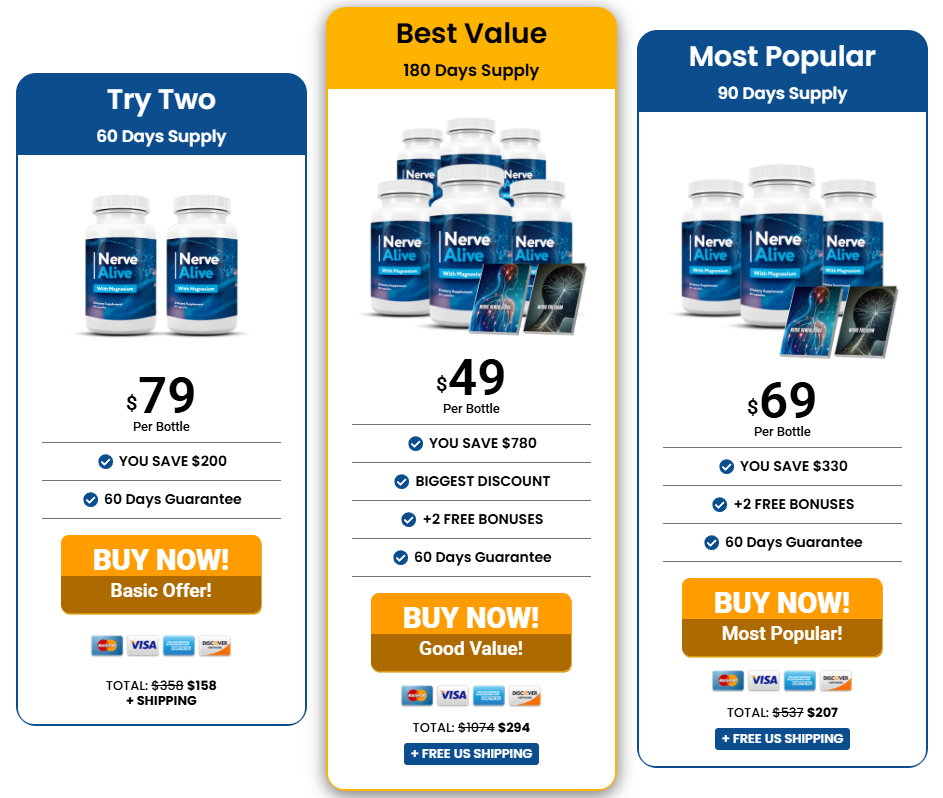
Per the brand’s official site as reviewed for this article:
| Package | Price/Bottle | Total | Shipping | Supply | Guarantee |
|---|---|---|---|---|---|
| 1 bottle | $69 | $69 | Extra charge applies | 30 days | 60-day money-back |
| 3 bottles (“Most Popular”) | $59 | $177 | Free (US) | 90 days | 60-day money-back, 2 bonus guides |
| 6 bottles (“Best Value”) | $49 | $294 | Free (US) | 180 days | 60-day money-back, 2 bonus guides |
Note a discrepancy worth flagging directly: the brand’s marketing describes the guarantee in two different ways in different places — as a 60-day money-back guarantee tied to each package, and elsewhere as an “industry-leading 180-day, 100% money-back guarantee.” Those aren’t the same policy. If the specific refund window matters to your decision, confirm the exact number in writing with the brand (or read the actual Return Policy page, not just the marketing copy) before ordering, since this article cannot resolve which figure is the operative one from the promotional materials alone.
The “savings compared to typical retail pricing” and “savings compared to individual bottle purchases” figures quoted in the brand’s materials are reference-price comparisons set by the brand; no independent third-party retail price for Nerve Alive was found to verify those specific savings amounts.
Bonus guides (“Nerve Health Nutrition Essentials” and “Lifestyle Strategies for Optimal Nerve Function”) are included with 3- and 6-bottle purchases per the brand; these are described as digital and were not independently reviewed for this article.
Manufacturing Claims
The brand states Nerve Alive is made in FDA-registered, GMP-compliant facilities, with batch-level third-party testing. As with other supplements in this category, it’s worth being clear about what that does and doesn’t mean: FDA facility registration is a food-safety recordkeeping requirement under the Bioterrorism Act of 2002 and the FSMA framework — it is not FDA approval of the product and does not mean the FDA reviewed Nerve Alive for safety or effectiveness. No specific third-party lab, certificate of analysis, or certification body (e.g., NSF, USP) was named on the brand’s accessible pages to independently verify the “third-party tested” claim.
Who This May or May Not Fit
Might be worth considering if you:
- Want a multi-ingredient formula rather than a single-nutrient supplement, and understand that “multi-ingredient” doesn’t mean each ingredient is equally well-studied for nerve symptoms
- Are comfortable with the fact that several of the underlying ingredients (ALA, ALC) have real but modest, and in ALC’s case quite weak, clinical trial support specifically for diabetic neuropathy — not nerve discomfort broadly
- Understand this is oral daily supplementation, not the IV administration used in the ALA trials that showed the clearest short-term benefit
Probably not a fit if you:
- Are looking for a documented, product-specific clinical trial — none was found
- Have diabetes and are hoping this substitutes for glycemic control or physician-directed neuropathy treatment — the brand does not claim this, and nothing here should be read as suggesting it
- Take medications that interact with any of these ingredients (notably: ALA can affect blood glucose levels and may interact with diabetes medications; NAC and Ginkgo have documented interactions with certain blood thinners) without first checking with a physician or pharmacist
- Are pregnant, nursing, under 18, or managing a diagnosed medical condition and haven’t consulted a doctor, per the brand’s own guidance
Things Worth Verifying Before You Order Nerve Alive
1. The actual refund window. The brand’s own materials state both “60-day” and “180-day” money-back guarantees in different places. Get this in writing before you buy.
2. Per-ingredient dosing. No milligram-level breakdown of each ingredient (ALA, ALC, curcumin, Boswellia, B-vitamins, magnesium, NAC, Ginkgo) was found on the brand’s accessible marketing pages. If you’re managing a health condition, comparing against a study’s dosing, or checking for interactions, request the full Supplement Facts panel directly from the brand.
3. Third-party testing documentation. “Third-party tested” is stated but not demonstrated with a named lab or certificate on the pages reviewed. Ask for the actual certificate of analysis if this matters to you.
4. The specific legal operating entity. The support contact listed is an email domain (institutoexperience.com.br) that differs from the product’s typical retail branding — worth clarifying who you’re actually purchasing from and which country’s consumer protection laws would apply to your order.
Frequently Asked Questions About Nerve Alive
Does Nerve Alive work? These statements have not been evaluated by the FDA, and the product is not intended to diagnose, treat, cure, or prevent disease. What can be said more narrowly: several of its ingredients (particularly alpha-lipoic acid and acetyl-L-carnitine) have been studied specifically in diabetic peripheral neuropathy, and the most rigorous available evidence — Cochrane systematic reviews — rates that evidence as low to moderate certainty at best, generally finding little to no clear symptom benefit from oral supplementation, as opposed to the intravenous ALA protocols used in some of the more favorable older trials. No trial has evaluated the Nerve Alive formulation itself.
What are the key ingredients? Alpha-lipoic acid, acetyl-L-carnitine, curcumin, Boswellia serrata, B-vitamins (B1, B6, B12), magnesium glycinate, N-acetylcysteine, and Ginkgo biloba extract, per the brand’s ingredient list.
How should it be taken? Per the brand, with a meal containing healthy fats, typically lunch or dinner, following the dosing on the product label.
Is it safe? The brand states GMP manufacturing and third-party testing, though no specific lab or certificate was found to verify that claim independently. Several ingredients here have known interaction risks worth discussing with a doctor if you take medication — particularly diabetes medications (with ALA) or blood thinners (with NAC or Ginkgo). Anyone pregnant, nursing, under 18, or managing a diagnosed condition should consult a physician before use, per the brand’s own guidance.
What’s the actual refund policy? Brand materials cite both 60-day and 180-day money-back guarantees in different places — confirm the operative figure directly with the seller before ordering.
Contact Information
- Support email: support@institutoexperience.com.br
- Order phone support: 1-925-231-0148
Disclosure and Compliance
Medical disclaimer. This article is for informational purposes only and is not medical advice. Nerve Alive has not been evaluated by the FDA and is not intended to diagnose, treat, cure, or prevent any disease. Consult a licensed healthcare professional before starting any supplement, particularly if you have a diagnosed medical condition, take medication, or are pregnant or nursing.
Material limitations. This piece is based on Nerve Alive’s publicly available marketing pages as reviewed for this rewrite, plus independently sourced peer-reviewed and Cochrane systematic-review literature on the individual ingredients named above (linked in the Scientific Resources section). No clinical trial on the Nerve Alive finished product was located, and none is claimed by the brand. Per-ingredient dosing within the formula was not confirmed. No specific third-party testing lab or certificate was named. Brand mechanism language (“microglia regulation,” “inflammatory nerve poisoning,” “targets nerve discomfort at its source”) is presented as marketing framing, not as independently verified clinical mechanism data.
Affiliate disclosure. Some links in this content may be affiliate links; a purchase made through them may generate a commission at no extra cost to the buyer. This does not change the ingredient research summarized above.
Forward-looking notice. Pricing, guarantee terms, and product specifications may change after publication. Confirm current details, including which refund window actually applies, directly with the seller before ordering.

Natural home remedies, skincare secrets, dental & eye health tips, and real product reviews to help you stay healthy the natural way.
1 comment
[…] Previous Post- https://homehealthyremedy.com/nerve-alive-review/https://homehealthyremedy.com/jellyfit-pro-review-ingredients-benefits/ […]