

A Comprehensive Research-Based Article on Age-Related Macular Degeneration (AMD)
Introduction: Understanding Macular Degeneration and Vision Health
Macular degeneration is one of the most common causes of vision loss in older adults, affecting millions of people worldwide and impacting their overall eyes and vision quality. If you or someone you love is experiencing problems with their central vision, or if you’re worried about your risk of developing this eye condition, this complete guide will help you understand what macular degeneration is, how it develops, and what treatment options are available to protect your eyesight.
In this article, we’ll explore all the important details about macular degeneration and how it impacts eyes and vision, including its causes, symptoms, whether it runs in families, what your vision looks like when you have it, and even how new technology like Tesla self-driving cars might help people with this condition maintain their independence and quality of life.
What is Macular Degeneration? How It Affects Your Eyes and Vision
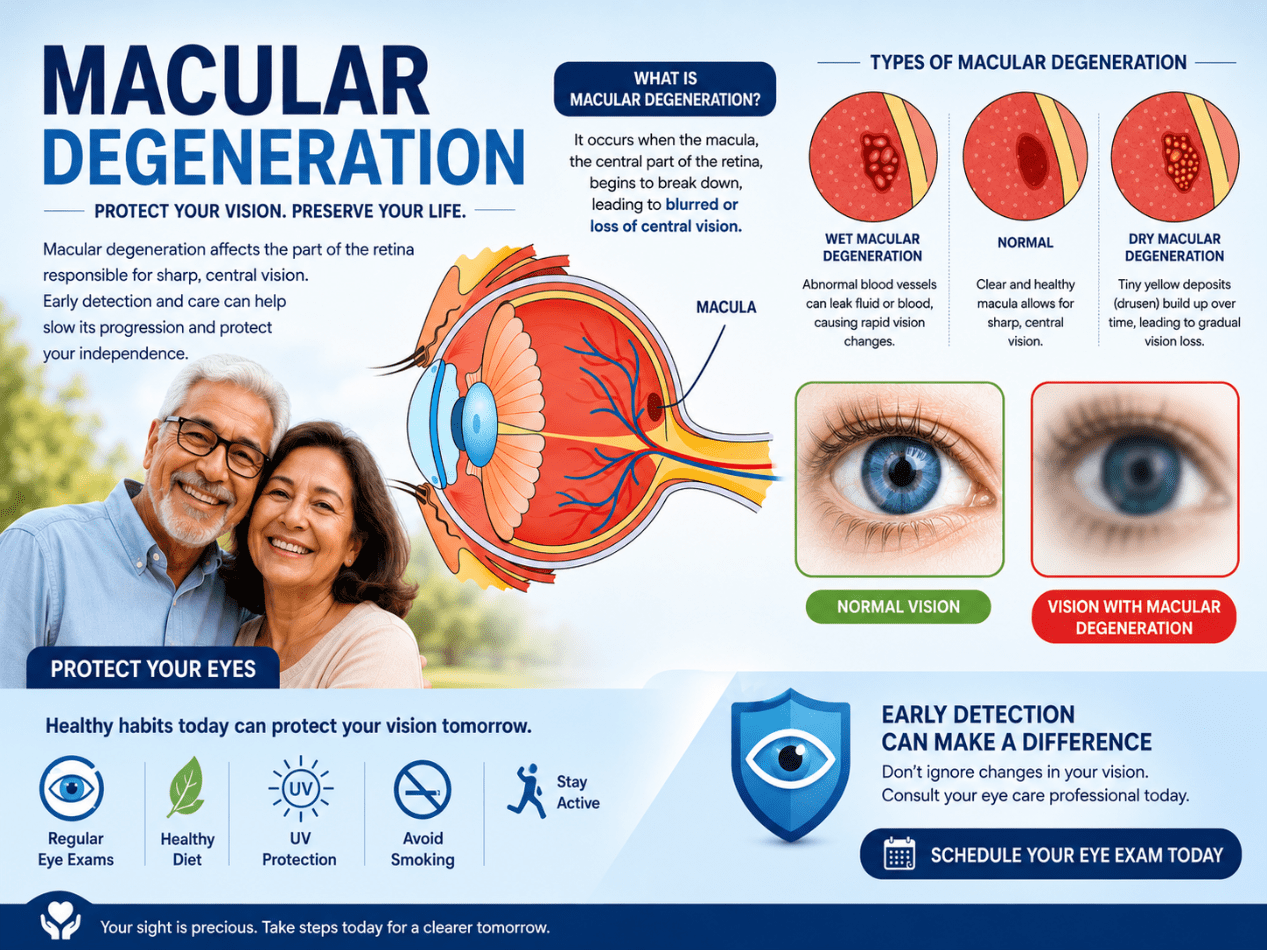
Macular degeneration, more formally known as age-related macular degeneration or AMD, is a progressive eye disease that affects the macula—a small but extremely important part of your retina located at the back of your eye. The macula is responsible for your central vision and your eyes and vision capability, which is what you use to see details clearly and recognize faces. When the macula begins to deteriorate, it causes gradual or sometimes sudden vision loss in the center of your visual field, affecting how you interact with the world around you.
The good news is that macular degeneration does not cause complete blindness. People with this condition retain their peripheral vision (the ability to see things off to the sides). However, the loss of central vision can make everyday activities like reading, driving, and recognizing faces quite challenging.
Currently, nearly 200 million people around the world live with age-related macular degeneration, and experts predict this number could reach 300 million by 2040. In the United States alone, AMD is the leading cause of vision loss in people age 60 and older, making it more common than other eyes and vision problems in this age group. Despite these staggering numbers, many people don’t fully understand what this eye disease is or what causes it.
Impact on Eyes and Vision Quality
The impact of macular degeneration on your eyes and vision extends beyond just blurred sight. People with AMD experience difficulty with tasks requiring clear central vision. Unlike other common eyes and vision issues like digital eye strain that you might experience after staring at screens, or temporary conditions like puffy eye from allergies, macular degeneration is a chronic condition that requires ongoing management and monitoring.
Two Types of Macular Degeneration: Dry and Wet AMD
There are two main types of macular degeneration affecting eyes and vision differently. Understanding the difference between them is important because they progress differently and require different treatments. Each type has unique characteristics that affect how you experience vision loss.
Dry Macular Degeneration (Most Common)
This is the most common type of macular degeneration, affecting about 80% of people with AMD. Dry macular degeneration occurs when the cells in the macula gradually break down and thin out. Small yellow deposits called drusen build up under the macula, and pigment changes develop in the retina. Unlike the acute symptoms you might get from puffy eye or temporary digital eye strain, dry AMD typically progresses slowly, sometimes taking many years before you notice significant vision loss. This gradual progression means early detection through regular eye examinations is crucial.
Wet Macular Degeneration (More Severe)
This less common but more serious form of AMD occurs in about 10% of people with the disease. Wet AMD happens when new, abnormal blood vessels grow under the retina and leak fluid or blood. Unlike dry AMD, wet macular degeneration can cause rapid and severe vision loss if left untreated, sometimes progressing within days or weeks. While wet AMD is more severe in terms of vision loss, it’s also more treatable with modern eye medications and therapies.
Is Macular Degeneration Hereditary? Understanding Your Family Risk
Yes, macular degeneration can definitely run in families. If your parents, siblings, or grandparents have been diagnosed with AMD, your risk of developing the condition is significantly higher. This is an important question to ask during your family health discussions, as knowing your family history can help you take early prevention steps to protect your eyes and vision.
Studies show that people who have a first-degree relative (parent, sibling, or child) with macular degeneration are about 12 times more likely to develop the condition themselves than someone without a family history of AMD. In some cases, if a parent or sibling has macular degeneration, your personal risk can increase by up to 50%, making family history a significant predictor of your eyes and vision health.
The Genetic Component Affecting Eyes and Vision
While macular degeneration is influenced by genetics, it’s not controlled by a single gene. Instead, scientists have identified at least 19 different genes that can increase your risk of developing AMD, with more than 30 genes potentially involved in the condition. This genetic complexity explains why some people with family histories never develop AMD, while others do. Two genes that seem to have the strongest influence on your eyes and vision health are:
Complement Factor H (CFH) Gene
This gene helps regulate inflammation in your body. Certain variations in the CFH gene have been linked to increased chronic inflammation in the retina, which contributes to AMD development and affects your overall eyes and vision health.
ARMS2/HTRA Gene
Variations in this gene can also increase your risk of developing macular degeneration and compromise your eyes and vision as you age.
However—and this is important—having these risk genes does not guarantee you will develop macular degeneration. Many people carry these genetic variations but never develop the disease. This is where lifestyle factors become crucial in protecting your eyes and vision.
Genetics Plus Environment: The Complete Picture for Eyes and Vision
Macular degeneration is what doctors call a multifactorial disease, meaning it develops from a combination of genetic and environmental factors affecting your eyes and vision. Even if you have a family history of AMD or carry risk genes, your lifestyle choices can significantly influence whether or not you actually develop the disease. This means you have more control over your eye health than you might think, and proactive choices today can protect your eyes and vision tomorrow.
What Causes Macular Degeneration? Complete Analysis of Risk Factors
Macular degeneration develops as a result of multiple factors working together. While scientists don’t fully understand every aspect of what causes the disease, they have identified several key risk factors that contribute to its development and impact your eyes and vision. Some of these you can control, while others you cannot.
Risk Factors You Cannot Control
These non-modifiable factors significantly influence your susceptibility to macular degeneration and your overall eyes and vision health:
- Age: The biggest risk factor for macular degeneration is advancing age. Your risk significantly increases after age 55, and continues to rise as you get older. AMD is particularly common in people over 60 and is the leading cause of vision loss in this age group, affecting their eyes and vision capabilities more than other conditions.
- Family History: As we discussed earlier, having relatives with AMD puts you at greater risk of developing the condition and experiencing vision problems affecting your eyes and vision.
- Race and Ethnicity: People of Caucasian descent are at higher risk for AMD compared to other ethnic groups, affecting their eyes and vision health differently.
- Gender: Women are more likely to develop age-related macular degeneration than men, with studies showing greater impact on women’s eyes and vision.
Modifiable Risk Factors: Protect Your Eyes and Vision
The exciting news is that many causes of macular degeneration can be modified through lifestyle changes. Taking action on these factors can help slow the progression of AMD or even prevent it from developing in the first place, ensuring your eyes and vision remain healthy for years to come.
- Smoking: Smoking is one of the strongest modifiable risk factors for AMD. Smokers have double the risk of developing macular degeneration compared to non-smokers, with severe impact on eyes and vision. If you smoke, quitting is one of the single best things you can do for your eye health.
- Poor Diet: A diet high in saturated fats and low in antioxidants and nutrients increases your risk of AMD and damages your eyes and vision. Conversely, eating a diet rich in leafy green vegetables, fatty fish, fruits, and antioxidants can protect your eyes and vision.
- Obesity: Being overweight or obese increases your risk of developing AMD and can accelerate its progression, impacting your eyes and vision quality.
- High Blood Pressure and High Cholesterol: These conditions put extra stress on your blood vessels, including those in the eyes, increasing your AMD risk and affecting eyes and vision function.
- UV Light Exposure: Long-term exposure to ultraviolet rays without proper eye protection can damage the macula over time and harm your eyes and vision. Always wear sunglasses with UV protection when outdoors.
- Digital Eye Strain: While digital eye strain from prolonged screen time differs from macular degeneration, it can compound vision problems and strain your eyes and vision. Regular breaks from screens and proper lighting help protect your eyes and vision health long-term.
- Sedentary Lifestyle: Regular physical exercise improves circulation and overall health, which supports eyes and vision health. Lack of exercise is associated with increased AMD risk.
What Vision Looks Like With Macular Degeneration? Understanding Symptoms
One of the most important things to understand about macular degeneration is how it actually affects your eyes and vision. Unlike complete blindness where everything is dark, AMD affects only your central vision. Your peripheral (side) vision remains normal, which is why people with AMD maintain their ability to see their surroundings—they just can’t see details in the center of their field of vision clearly. This unique pattern of vision loss distinguishes macular degeneration from other eyes and vision conditions like digital eye strain or temporary issues like puffy eye.
Early Stage Symptoms: Early Eyes and Vision Changes
Many people don’t notice any symptoms in the early stages of AMD. In fact, the disease may only be detected during a routine dilated eye exam performed by an eye care professional, who might see tiny yellow deposits (drusen) or pigment changes in the retina. However, as the disease progresses and affects your eyes and vision, you might begin to notice:
- Blurred or fuzzy central vision—objects directly in front of you may appear slightly out of focus, affecting your eyes and vision clarity
- Colors appearing less bright or vibrant than before—a sign your eyes and vision are changing
- Difficulty reading small print even with glasses—worsening of eyes and vision for near tasks
- Trouble adapting to low light conditions when reading or working—different from digital eye strain, this indicates changing eyes and vision capability
Advanced Stage Symptoms: Severe Eyes and Vision Loss
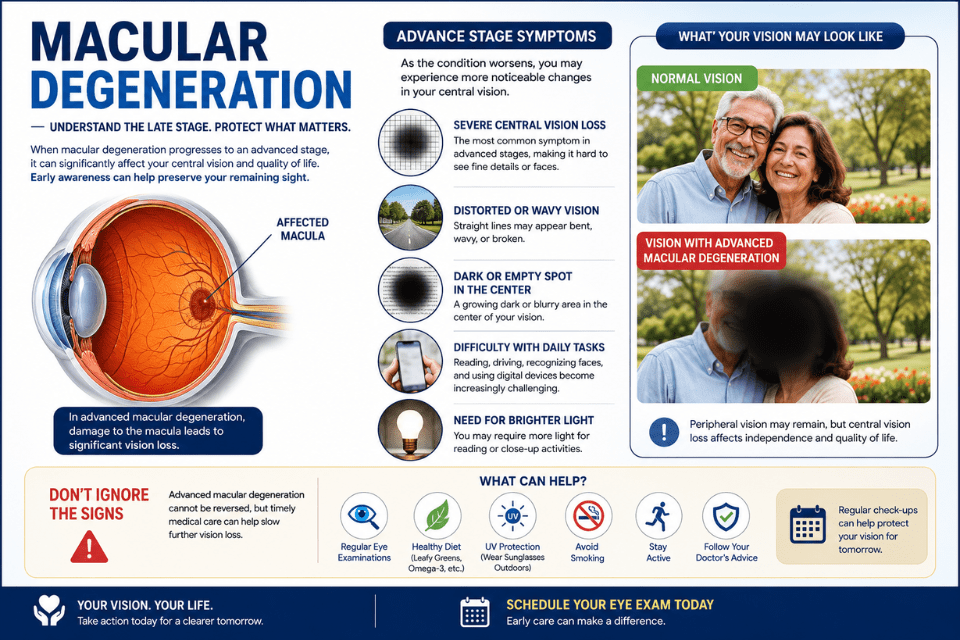
As macular degeneration progresses, the symptoms become more noticeable and can significantly impact daily activities and overall eyes and vision quality:
- Wavy or distorted lines—straight lines like doorways, street signs, or the edges of walls might appear bent, curved, or zigzagged (this symptom is called metamorphopsia), severely impacting eyes and vision perception
- Dark or blank spots in the center of your vision—areas that appear completely black or empty where you should be able to see details, indicating progressive damage to your eyes and vision
- Severe difficulty reading—even with large print or magnifying glasses, showing how significantly AMD affects eyes and vision for this crucial activity
- Inability to recognize faces of people close to you—a challenging impact on your eyes and vision in social situations
- Objects appearing smaller than they actually are—distortion of your eyes and vision perception
- Significant loss of central vision that may affect your ability to drive safely—one of the most concerning impacts on your eyes and vision independence
The Clock Analogy: Visualizing Eyes and Vision Loss
A helpful way to understand how AMD affects your eyes and vision is to imagine looking at a clock with hands. With normal eyes and vision, you would see both the numbers around the clock face and the clock hands in the center. With AMD, you might only see the numbers around the edge (peripheral vision) while the hands in the center (central vision) become invisible or blurry. The outer numbers remain clear, but the critical detail in the middle is lost—a perfect explanation of how macular degeneration impacts your eyes and vision.
Macular Degeneration vs. Other Eyes and Vision Conditions
It’s important to understand how macular degeneration differs from other common eyes and vision issues. Digital eye strain, for example, is a temporary condition caused by prolonged screen time that usually resolves with rest. Puffy eye, another common eyes and vision concern, typically results from allergies, sleep deprivation, or fluid retention and is usually temporary. Macular degeneration, however, is a chronic, progressive disease affecting your eyes and vision permanently. Unlike digital eye strain which affects your eyes and vision acuity temporarily, AMD causes lasting changes to your central vision that require ongoing management and monitoring.
Can People With Macular Degeneration Drive Tesla Self-Driving Cars?
New Technology: Innovative Solutions for Eyes and Vision Limitations
This is one of the most interesting and hopeful developments for people living with macular degeneration and concerned about their eyes and vision independence. While conventional driving becomes impossible or unsafe as central vision deteriorates, emerging autonomous and semi-autonomous vehicle technology, particularly in Tesla cars, is opening new possibilities for maintaining independence and mobility despite having compromised eyes and vision.
How Tesla Autopilot Works for Eyes and Vision-Impaired Drivers
Tesla vehicles are equipped with advanced camera-based vision systems and autopilot technology that can handle many driving tasks, effectively compensating for drivers with compromised eyes and vision. The Tesla Vision system uses multiple cameras and powerful neural networks to process visual information from the road environment. Tesla’s Full Self-Driving (FSD) capability, along with Autopilot features like Traffic-Aware Cruise Control and Traffic Light and Stop Sign Control, allow the vehicle to maintain lane position, navigate intersections, and respond to road conditions with minimal driver input—potentially allowing people with macular degeneration affecting their eyes and vision to maintain driving capability.
Real-World Success Stories: Preserving Eyes and Vision Independence
Clinical studies and real-world experiences have documented how people with significant vision impairment affecting their eyes and vision have successfully used Tesla vehicles to maintain their driving independence. One notable case involved a 53-year-old driver with Stargardt disease (a form of vision loss similar to macular degeneration) who purchased a Tesla Model Y with full self-driving capability. This driver shifted his primary role from actively controlling the vehicle to supervising the automation systems, effectively turning the vehicle’s camera system into an extension of his compromised eyes and vision.
The driver reported that driving confidence greatly increased and he was able to drive more frequently in situations he would have otherwise avoided due to his vision difficulties and compromised eyes and vision capability. He used traffic-aware cruise control, autopilot features, and other assistance systems to manage most driving tasks while maintaining supervisory control of the vehicle. This type of co-driving approach—where the driver and the automated system work together to compensate for compromised eyes and vision—can be transformative for people with macular degeneration.
Important Considerations and Limitations
However, it’s important to note several critical points about using self-driving technology with AMD and compromised eyes and vision:
- Not Fully Autonomous: Tesla’s current systems require active driver supervision and are not fully autonomous. Drivers must keep their hands on the steering wheel and be prepared to take control at any moment. This means a person with macular degeneration using these systems still needs adequate peripheral vision (which they retain) and ability to respond quickly to override the vehicle when needed.
- Legal Requirements: Drivers must still meet minimum visual acuity requirements mandated by state driving regulations. These regulations vary by location, so it’s essential to check what your state requires for eyes and vision standards when driving.
- Weather Limitations: Camera-based systems like Tesla’s vision technology can struggle in adverse weather conditions like heavy rain, fog, snow, or intense glare—situations where your own eyes and vision would also be limited.
- Continuous Development: This technology is rapidly evolving. More sophisticated autonomous capabilities are being developed that may eventually provide greater benefits for people with compromised eyes and vision like macular degeneration.
Prevention and Management: Protecting Your Eyes and Vision
While there is currently no cure for macular degeneration, early detection, lifestyle modifications, and medical treatments can slow the progression of the disease and help preserve your eyes and vision for as long as possible. Taking proactive steps now to protect your eyes and vision is the best investment in your quality of life.
Lifestyle Measures to Protect Eyes and Vision
- Eat a Healthy Diet for Eyes and Vision: Focus on foods rich in antioxidants including leafy greens like spinach and kale, colorful vegetables, berries, nuts, and fatty fish like salmon and tuna at least twice weekly. Proper nutrition is fundamental to maintaining healthy eyes and vision.
- Quit Smoking for Eyes and Vision Health: If you smoke, quitting is the single most impactful step you can take to reduce your AMD risk and slow its progression, dramatically improving your eyes and vision prognosis.
- Exercise Regularly: Aim for at least 30 minutes of moderate physical activity most days of the week to improve circulation and overall health, which supports your eyes and vision function.
- Protect Your Eyes and Vision from UV Light: Wear UV-protective sunglasses when outdoors, and consider a wide-brimmed hat for additional protection of your eyes and vision.
- Manage Chronic Conditions Affecting Eyes and Vision: Keep blood pressure and cholesterol levels under control through medication and lifestyle measures if needed, as these directly impact your eyes and vision health.
- Manage Digital Eye Strain: Take regular breaks from screens following the 20-20-20 rule (every 20 minutes, look at something 20 feet away for 20 seconds) to reduce digital eye strain, which can compound other eyes and vision issues.
- Maintain a Healthy Weight for Eyes and Vision: Obesity increases AMD risk, so maintaining a healthy weight is important for protecting your eyes and vision.
Medical Treatments for Eyes and Vision Loss
Recent advances in macular degeneration treatment are offering new hope for protecting your eyes and vision. The FDA recently approved the first-ever treatment specifically designed for dry AMD, a major breakthrough for eyes and vision care. Additionally, supplements containing antioxidant vitamins, minerals, and lutein may help slow vision loss in intermediate and advanced stages of dry macular degeneration and support your eyes and vision health. Your eye care doctor can recommend appropriate treatments and supplements based on your specific condition and eyes and vision status.
Regular Eye Exams: Monitor Your Eyes and Vision
Early diagnosis is crucial for managing macular degeneration effectively and preserving your eyes and vision. If you have risk factors for AMD or a family history of the disease, schedule comprehensive eye exams with an ophthalmologist at least yearly. These exams can detect early signs of AMD before you notice any symptoms, allowing for earlier intervention and better outcomes for your eyes and vision.
Frequently Asked Questions About Macular Degeneration and Eyes and Vision
Q: Will I go completely blind from macular degeneration?
A: No. Macular degeneration causes loss of central vision but preserves peripheral vision, so your eyes and vision in the outer areas remain intact. While this central vision loss can be quite disabling for detailed tasks, you will retain the ability to see your surroundings using your side vision.
Q: How quickly does macular degeneration progress and affect my eyes and vision?
A: Progression varies widely depending on the type and individual factors. Dry AMD typically progresses slowly over many years, while wet AMD can progress more rapidly and severely impact eyes and vision. Some people experience minimal vision loss, while others lose significant central vision. This is why regular monitoring of your eyes and vision is important.
Q: Can I prevent macular degeneration if it runs in my family and affects my eyes and vision?
A: While you cannot change your genetics, you can significantly reduce your risk by controlling modifiable factors like smoking, diet, exercise, UV exposure, and managing digital eye strain. A healthy lifestyle may prevent or delay the onset of AMD even with a family history, preserving your eyes and vision for longer.
Q: Is macular degeneration the same as digital eye strain or puffy eye?
A: No. Macular degeneration is a progressive eye disease, while digital eye strain is temporary discomfort from screen use that resolves with rest, and puffy eye is usually caused by temporary factors like allergies or sleep loss. AMD is chronic and requires ongoing medical management, whereas digital eye strain and puffy eye are typically self-limiting conditions affecting your eyes and vision temporarily.
Q: Is there a cure for macular degeneration?
A: Currently, there is no cure for AMD. However, new treatments, particularly for wet AMD and advanced dry AMD, can slow progression and help preserve your eyes and vision if caught early. Ongoing research shows promising results for future therapies including gene therapy and other innovative approaches to protect eyes and vision.
Sources and References: Research on Macular Degeneration and Eyes and Vision
This comprehensive article on macular degeneration and how it affects your eyes and vision is based on extensive research from reputable medical institutions and recent publications:
- 1. Mayo Clinic Proceedings: Innovations, Quality & Outcomes (August 2024) – Recent Updates on the Diagnosis and Management of Age-Related Macular Degeneration. Provides comprehensive clinical guidance on AMD management, risk factor modification, and how it affects eyes and vision.
- 2. Nature – Age-related macular degeneration in 2025 – Comprehensive research article covering opportunities and challenges in AMD treatment, emerging therapies, gene therapy approaches, and innovations in eyes and vision care.
- 3. National Eye Institute (NIH) – NEI Research News providing latest updates on macular degeneration research, DNA damage in aging retina, and new treatment candidates that could preserve eyes and vision.
- 4. WebMD Eye Health Library – Comprehensive information on AMD symptoms affecting eyes and vision, treatments, latest FDA approvals for macular degeneration therapy, and lifestyle management.
- 5. Optometry and Vision Science Journal (February 2022) – Clinical report on experiences of drivers with vision impairment using Tesla vehicles and autonomous driving technology to maintain independence despite compromised eyes and vision.
Medical Disclaimer: This article about macular degeneration and eyes and vision is for informational purposes only and is not a substitute for professional medical advice. If you suspect you may have macular degeneration or are experiencing vision changes affecting your eyes and vision, please consult with an ophthalmologist or optometrist for proper diagnosis and treatment recommendations. Do not rely solely on this article for medical decisions.
Published by Home Healthy Remedy
Your Trusted Source for Research-Based Health Information on Eyes and Vision Care

Natural home remedies, skincare secrets, dental & eye health tips, and real product reviews to help you stay healthy the natural way.