

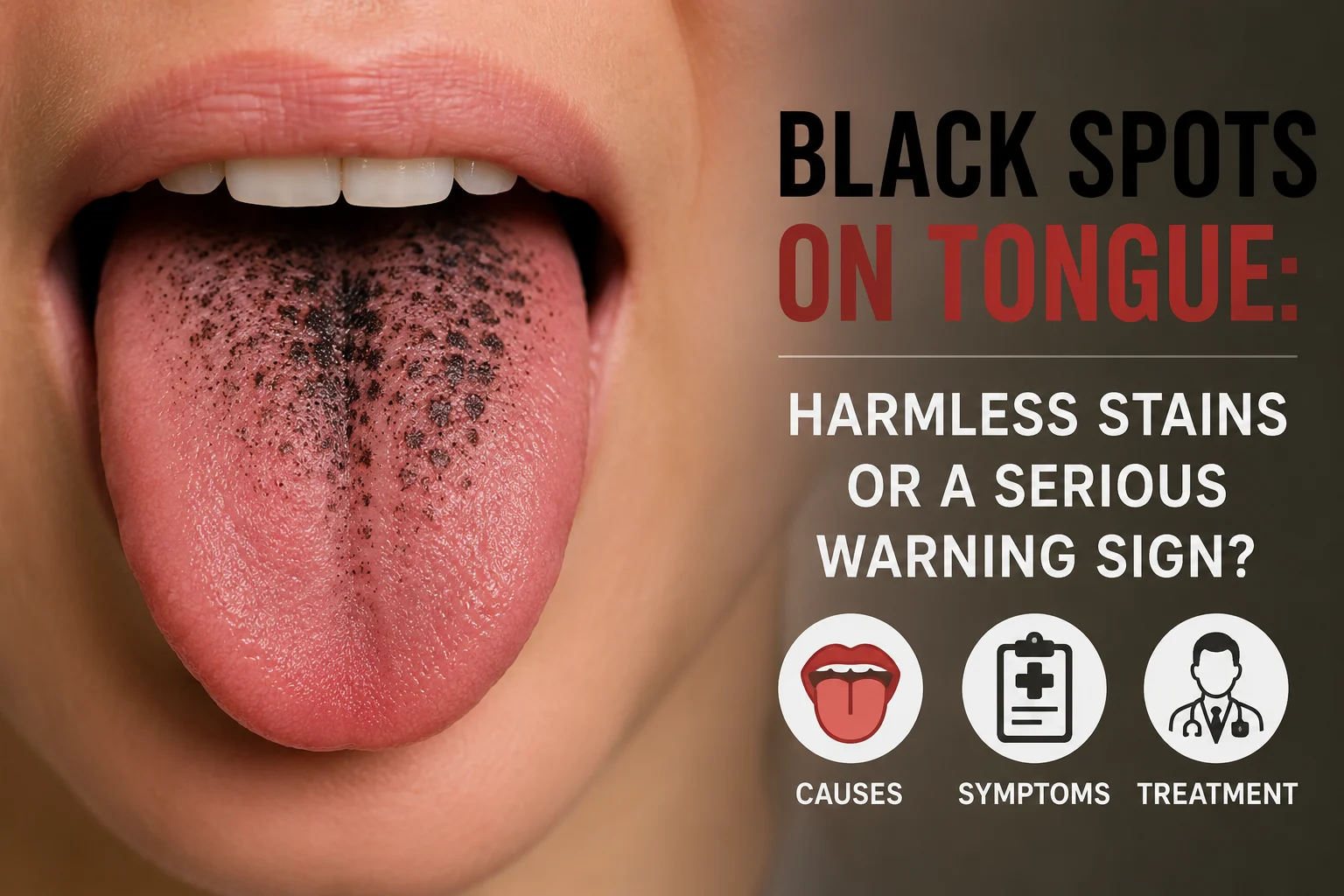
You’re brushing your teeth, you glance in the mirror, and there it is — a dark patch on your tongue that definitely wasn’t there last week. Your first thought is probably some version of “why is my tongue black” or “black tongue why is this happening to me.” Take a breath. In the vast majority of cases, black spots on tongue tissue are nothing more than a cosmetic surprise caused by food, bacteria, or a habit you can easily fix. But sometimes, a black spot really is your body waving a small flag that needs attention.
This guide walks through everything you need to know about black spots on the tongue: the everyday causes, the rare-but-serious causes, how doctors tell them apart, a real-world style case study from a patient in the United States, and a full FAQ so you’re not left Googling at 2 a.m. wondering, “why is my tongue brown” or “why is my tongue black.”
What You Need to Know: Why Is My Tongue Black?
If you’re short on time, here’s the simple version. Black spots on tongue surfaces are usually caused by one of these common culprits:
- Black hairy tongue — a buildup of dead skin cells on the tongue’s papillae that traps stains from food, drinks, tobacco, or bacteria
- Bismuth-containing medicine (like Pepto-Bismol) reacting with sulfur in your saliva
- Poor oral hygiene or a soft-food diet that doesn’t help scrub the tongue naturally
- Smoking or chewing tobacco
- Certain antibiotics, especially after a long course
- Coffee, black tea, or red wine staining the tongue’s surface
- Oral melanotic macules — flat, harmless pigmented spots, similar to a freckle
- Amalgam tattoos from old dental fillings
- Rarely, oral melanoma, a serious form of skin cancer that can appear in the mouth
Most people with black spots on tongue tissue are dealing with something completely benign. But because a small number of cases point to something more serious, it’s worth understanding the full picture rather than guessing.
What Exactly Are Black Spots on Tongue?
The tongue is covered in tiny, finger-like projections called papillae. These structures normally shed and regenerate constantly, keeping your tongue looking pink and healthy. When that shedding process slows down, or when something stains the surface, you end up with discoloration — anything from tiny black dots to a full, furry, dark coating across the entire tongue.
According to the Mayo Clinic, black hairy tongue happens when dead skin cells build up on the papillae, and food, drinks, tobacco, bacteria, or yeast get trapped and stain them, giving the tongue a dark, furry appearance. This is one of the most common reasons people search “black tongue causes” online, and it’s almost always harmless.
But “black spots on tongue” isn’t always the same thing as “black hairy tongue.” Sometimes the discoloration shows up as one or two small, flat, defined spots rather than a widespread furry coating. That distinction matters, because flat, isolated spots are more likely to be melanotic macules, amalgam tattoos, or — in rare instances — something that needs a biopsy.
Common (and Mostly Harmless) Causes of Black Spots on Tongue
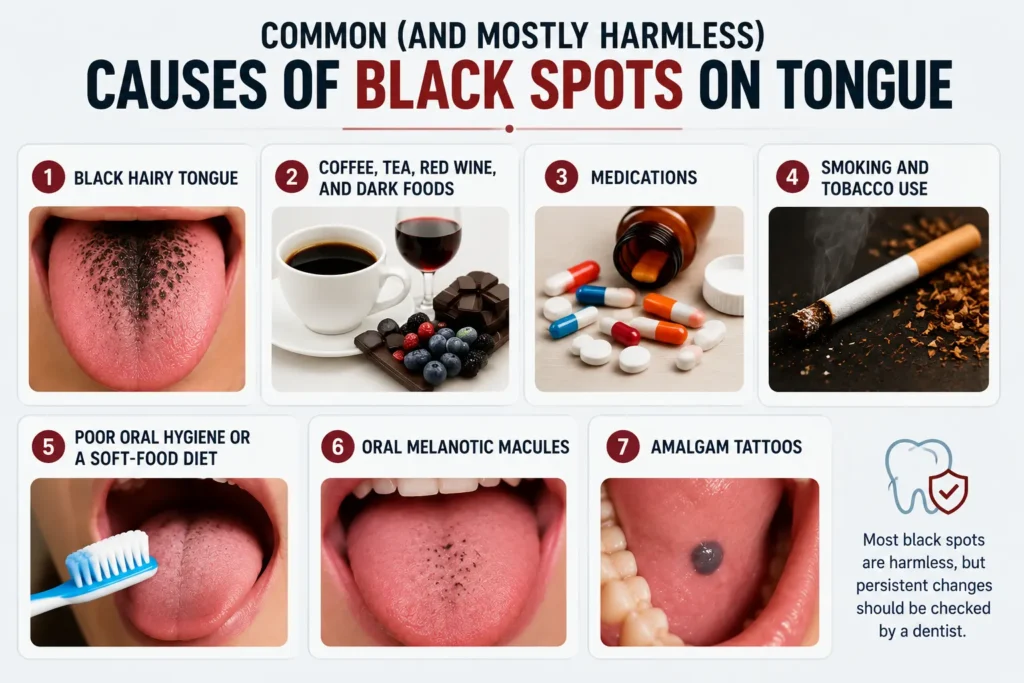
1. Black Hairy Tongue
This is the single most common reason for a black tongue. The papillae grow longer than usual, trap debris, and take on a dark, sometimes fuzzy texture. Cleveland Clinic notes that black hairy tongue is a temporary, harmless, and fairly common condition where the top of the tongue develops a hairy look, often triggered by poor oral hygiene, tobacco use, or certain medications.
2. Coffee, Tea, Red Wine, and Dark Foods
Chronic staining from dark beverages is a classic, low-drama explanation for why your tongue looks discolored. It builds up gradually, so many people don’t notice until the color is fairly deep.
3. Medications
Bismuth subsalicylate (the active ingredient in Pepto-Bismol) is famous for turning both the tongue and stool black temporarily. Certain antibiotics — including amoxicillin-clavulanate, doxycycline, and metronidazole — have also been documented in medical case reports as triggers for black hairy tongue, sometimes appearing weeks after starting the medication.
4. Smoking and Tobacco Use
Tobacco tar and smoke residue settle into the papillae and accelerate discoloration. This is one of the most preventable causes on this list.
5. Poor Oral Hygiene or a Soft-Food Diet
Papillae need friction to shed properly. If your diet is mostly soft foods, or if brushing and tongue-scraping aren’t part of your routine, dead cells accumulate faster than they’re cleared away.
6. Oral Melanotic Macules
These are flat, benign pigmented spots that look a lot like a freckle, but inside your mouth. Skinsight describes them as harmless dark lesions on the lips or inside the mouth that typically stay stable in size, shape, and color over time. They’re common, painless, and usually nothing to worry about — though any new or changing spot should still be checked.
7. Amalgam Tattoos
If you’ve had metal dental fillings, tiny particles can occasionally embed into nearby soft tissue during placement or removal, creating a small gray, blue, or black mark. These are permanent but completely benign.
When Black Spots on Tongue Could Signal Something Serious
This is the part most articles gloss over, but it’s the part that actually matters if you’re worried. In rare cases, a dark spot on the tongue can be an early sign of oral melanoma — a rare but aggressive cancer of the pigment-producing cells in the mouth.
Research published through the National Institutes of Health notes that oral melanoma can present as macules, patches, or nodules in shades of brown, black, gray, red, or purple, often with an asymmetric shape and irregular border. Unlike a stain from coffee or tobacco, a cancerous spot tends to grow, change color, or develop an uneven edge over time.
The good news: oral melanoma is extremely rare, involving well under 1% of all melanoma cases. But because it can be aggressive if caught late, dentists and doctors recommend paying attention to a few warning signs.
Red Flags That Warrant a Dental or Medical Visit
- The spot is growing, spreading, or changing color
- It has an irregular, asymmetrical, or blurry border
- It bleeds, ulcerates, or feels raised/nodular rather than flat
- It’s painful or tender
- It doesn’t fade or go away after a few weeks
- You also have unexplained swelling, loose teeth, or difficulty swallowing
- You’re over 60, especially if you’re male, since biopsy is more strongly recommended in that group for suspected melanotic macules
If none of these apply, your black spots on tongue are very likely one of the harmless causes listed above.
Black Spots on Tongue: Pros and Cons Table
Since “black tongue” covers such a wide range of causes, it helps to see the harmless versus concerning traits side by side.
| Feature | Harmless Cause (e.g., black hairy tongue, staining, macule) | Possible Warning Sign (e.g., oral melanoma) |
|---|---|---|
| Shape | Flat or fuzzy, even coloring | Irregular, asymmetric border |
| Growth | Stays the same size for months | Grows or spreads over weeks |
| Color | Uniform black, brown, or gray | Mixed colors — black, red, purple, gray |
| Pain | Usually painless | May be tender, may bleed or ulcerate |
| Texture | Flat or slightly furry | Sometimes raised or nodular |
| Common triggers | Coffee, tobacco, antibiotics, bismuth medicine | Unclear; linked to melanocyte changes |
| Resolution | Often fades with better oral hygiene | Does not resolve on its own |
| Action needed | Home care, monitor for a few weeks | Prompt evaluation and possible biopsy |
Black Hairy Tongue vs. Oral Melanotic Macule vs. Oral Melanoma: A Quick Comparison
| Condition | Appearance | Cause | Danger Level |
|---|---|---|---|
| Black hairy tongue | Furry, dark coating over part or all of the tongue | Buildup of dead papillae cells, staining | Harmless |
| Oral melanotic macule | Small, flat, evenly colored spot, like a freckle | Increased melanin, sometimes drug-induced | Harmless, monitor for change |
| Amalgam tattoo | Small gray/blue/black flat mark, often near old fillings | Metal particles embedded in tissue | Harmless |
| Oral melanoma | Irregular, asymmetric, possibly raised or ulcerated patch | Abnormal melanocyte growth | Serious, needs prompt care |
Case Study: A Real-World Scenario From the United States
To make this practical, here’s an illustrative case based on the kind of scenario dentists in the U.S. see regularly (details combined and anonymized for privacy).
Patient: Mark, 34, an office worker from Ohio.
Presentation: Mark noticed black spots on tongue tissue about a week after finishing a course of amoxicillin-clavulanate for a sinus infection. He also drinks two to three cups of coffee daily and had recently switched to a mouthwash containing hydrogen peroxide.
What happened: Mark assumed the worst and searched “why is my tongue black” late at night, landing on a mix of reassuring and alarming articles. He booked a same-week dental visit instead of waiting.
Diagnosis: His dentist identified a classic case of black hairy tongue, most likely triggered by a combination of the antibiotic course, coffee staining, and the oxidizing mouthwash. There was no irregular border, no bleeding, and no rapid growth — all signs pointing away from anything cancerous.
Treatment: Mark was advised to switch to a non-oxidizing mouthwash, gently brush his tongue twice daily with a soft brush or tongue scraper, cut back on coffee slightly, and stay hydrated. Within about three weeks, his tongue returned to a normal pink color.
Takeaway: This case reflects what most U.S. dental case reports describe — a benign, self-limiting condition that improves with basic oral hygiene once the triggering factor (medication, tobacco, or an oxidizing mouthwash) is removed. It’s also a good reminder that a same-week checkup is a smarter move than weeks of anxious self-diagnosis.
How to Get Rid of Black Spots on Tongue (When It’s Harmless)
- Brush your tongue gently every time you brush your teeth, or use a tongue scraper
- Cut back on coffee, black tea, and red wine, at least temporarily
- Avoid tobacco products
- Switch to a mouthwash without strong oxidizing agents like peroxide
- Stay hydrated and eat a diet with enough fibrous, crunchy, or prostate foods to encourage natural papillae shedding
- Ask your doctor whether a current medication could be the trigger, but never stop a prescribed antibiotic without medical advice
- Give it two to three weeks — most benign black spots on tongue tissue fade once the cause is removed
When to See a Dentist or Doctor
Book an appointment if:
- The spot hasn’t improved after three to four weeks of better oral hygiene
- It’s growing, changing shape, or changing color
- It bleeds or feels sore
- You have other symptoms like swelling, difficulty swallowing, or unexplained weight loss
- You’re simply not sure and want peace of mind
A quick visual exam is often enough for a dentist to reassure you. If there’s any uncertainty, they may recommend a biopsy, which is a simple, low-risk procedure that gives a definitive answer.
Frequently Asked Questions
1. My tongue has black spots on tongue, why is this happening?
Most cases of black spots on tongue are caused by a buildup on the tongue’s papillae combined with staining from coffee, tobacco, certain mouthwashes, or antibiotics. While these spots are usually harmless, a spot that grows, changes color, bleeds, or becomes painful should be evaluated by a dentist or healthcare provider.
2. Why do I have black spots on tongue after taking antibiotics?
Some antibiotics can disrupt the normal balance of bacteria in your mouth, increasing the risk of black spots on tongue caused by black hairy tongue. Although uncommon, this side effect usually improves after the medication is finished and good oral hygiene is maintained.
3. Why are my black spots on tongue brown instead of black?
Brown discoloration often has the same causes as black spots on tongue, but with lighter staining or pigmentation. Coffee, tea, tobacco, certain foods, and oral melanotic macules can all produce brown spots instead of deep black ones.
4. Are black spots on tongue contagious?
No. Black spots on tongue, including those caused by black hairy tongue or staining, are not contagious. They are usually related to oral hygiene, medications, smoking, or dietary habits—not an infection that spreads from person to person.
5. Can stress cause black spots on tongue?
Stress doesn’t directly cause black spots on the tongue, but it can contribute indirectly. Stress may lead to dry mouth, dehydration, or poor oral hygiene, all of which increase the chance of developing black hairy tongue and dark tongue discoloration.
6. How long do black spots on tongue last?
If black spots on tongue are caused by black hairy tongue, they often improve within 2 to 4 weeks after practicing good oral hygiene, brushing or scraping the tongue daily, and avoiding triggers such as tobacco, certain mouthwashes, or unnecessary medications.
7. Should I be worried about black spots on tongue?
Most black spots on tongue are harmless and temporary. However, you should schedule a dental or medical evaluation if the spots continue to grow, have irregular borders, bleed, cause persistent pain, or do not improve after a few weeks.
8. Can children develop black spots on tongue?
Yes. Although less common, children can develop black spots on tongue, often after taking antibiotics or due to changes in the mouth’s normal bacteria. Any unusual tongue discoloration in a child should be assessed by a pediatrician or pediatric dentist to rule out underlying conditions.
The Bottom Line
Black spots on tongue tissue are one of those symptoms that look far scarier than they usually are. In the overwhelming majority of cases, you’re dealing with black hairy tongue, medication side effects, or simple staining from coffee, tea, or tobacco — all of which are easy to manage with better oral hygiene and a little patience. Still, because a small percentage of black spots on tongue tissue can point toward something like oral melanoma, it’s worth knowing the difference between a stable, painless, evenly colored spot and one that’s growing, changing, or bleeding.
If you’ve been asking yourself “why is my tongue black,” “black tongue causes,” or “why is my tongue brown,” the honest answer is: probably something simple, but worth a quick professional look if it lingers, changes, or worries you. Your dentist would rather see you for a two-minute reassurance check than have you lose sleep over a symptom that’s easy to confirm.
Sources and References
- Mayo Clinic — Black Hairy Tongue: Symptoms and Causes. https://www.mayoclinic.org/diseases-conditions/black-hairy-tongue/symptoms-causes/syc-20356077
- Mayo Clinic — Black Hairy Tongue: Diagnosis and Treatment. https://www.mayoclinic.org/diseases-conditions/black-hairy-tongue/diagnosis-treatment/drc-20356080
- Cleveland Clinic — Black Hairy Tongue: Symptoms, Causes and Treatment. https://my.clevelandclinic.org/health/diseases/17918-black-hairy-tongue
- National Institutes of Health / NCBI Bookshelf — Oral Melanoma (StatPearls). https://www.ncbi.nlm.nih.gov/books/NBK513276/
- National Center for Biotechnology Information — A Case Report of a Co-Amoxiclav-Induced Black Hairy Tongue. https://www.ncbi.nlm.nih.gov/pmc/articles/PMC11105807/
- National Center for Biotechnology Information — A Case Report of Black Hairy Tongue (Melanotrichia Linguae). https://www.ncbi.nlm.nih.gov/pmc/articles/PMC11186574/
- Skinsight — Oral Melanotic Macule: Symptoms and Treatment. https://skinsight.com/skin-conditions/oral-melanotic-macule/
- Oral Cancer Foundation — Oral Malignant Melanoma. https://oralcancerfoundation.org/facts/rare/oral-malignant-melanoma/
- Colgate Oral Care Center — Black Hairy Tongue Causes and Treatment. https://www.colgate.com/en-za/oral-health/threats-to-dental-health/black-hairy-tongue-causes-and-treatment
- Journal of Family Medicine and Primary Care (PMC) — Black Pigmented Oral Lesion and Melanoma Risk Review. https://pmc.ncbi.nlm.nih.gov/articles/PMC12007754/
This article is for general educational purposes and is not a substitute for professional dental or medical advice. If you’re concerned about a black spot on your tongue, please consult a licensed dentist or physician.

Natural home remedies, skincare secrets, dental & eye health tips, and real product reviews to help you stay healthy the natural way.