

If you’ve ever watched your skin turn red after a bee sting, felt your throat tighten after eating shellfish, or broken out in hives after a new medication, you already know that an allergic reaction rarely happens all at once. It builds. It moves through phases, and each phase looks and feels a little different.
Understanding the 5 stages of allergic reaction isn’t just a nice-to-know fact for biology class. It’s genuinely useful information that can help you or someone you love recognize trouble early, react calmly, and get help before things turn dangerous. In this guide, we’ll walk through each stage in plain language, look at how this immune response shows up on the skin, in food allergies, and with medications, share a real-world case study based on a U.S. patient experience, and answer the questions people ask most often.
What Is an Allergic Reaction, Really?
Before we get into the stages, let’s quickly define the main keyword of this article. An allergic reaction happens when your immune system mistakes a harmless substance — pollen, peanuts, penicillin, pet dander — for a dangerous invader. Your body then releases chemicals like histamine to “fight it off,” and those chemicals are what cause the itching, swelling, sneezing, or, in severe cases, difficulty breathing.
According to the Mayo Clinic, allergy symptoms usually aren’t life-threatening on their own, but they can escalate quickly into anaphylaxis, which is the most severe form of an allergic response and requires emergency treatment. That escalation is exactly what the five stages describe.
The 5 Stages of Allergic Reaction, Explained
Doctors don’t always use identical labels for these phases, but for the sake of clarity, here’s the practical, easy-to-follow breakdown that most allergy educators and patient resources use when describing how this immune response develops from start to finish.
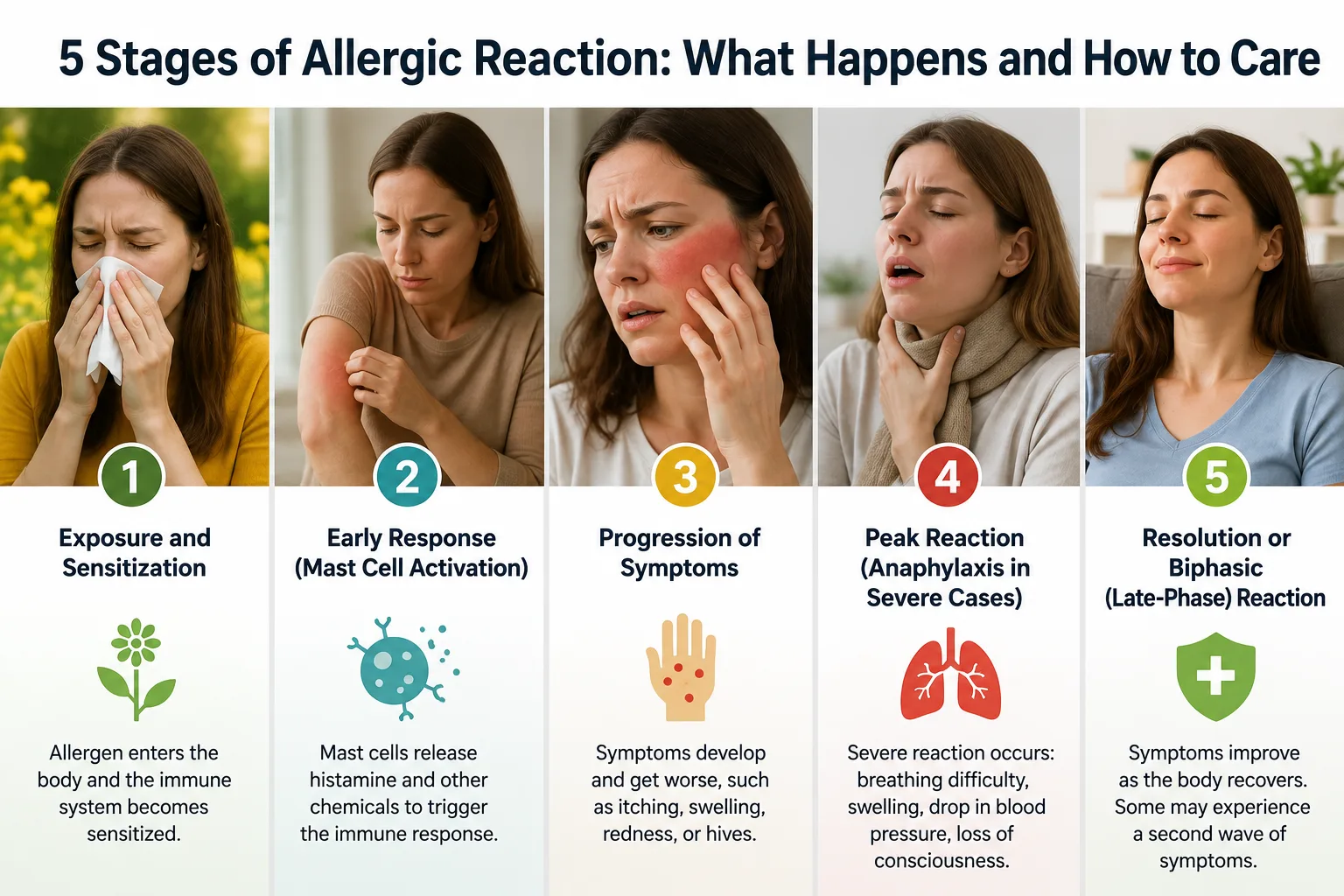
Stage 1: Exposure and Sensitization
This is the quiet stage. It happens before you even notice anything is wrong. Your immune system encounters an allergen — say, tree nut protein or a bee venom compound — and instead of ignoring it, it builds specific IgE antibodies against it. Nothing visible happens yet, but your body is now “primed” to overreact the next time it meets that same allergen. This is why a first exposure to a food or medication rarely causes a reaction, but the second or third time can be dramatic.
Stage 2: Early Response (Mast Cell Activation)
The next time you’re exposed, the allergen binds to those IgE antibodies sitting on mast cells and basophils. These cells burst open and release histamine and other inflammatory chemicals within minutes. This is the start of a visible allergic reaction — itching, sneezing, watery eyes, a tingling mouth, or the first hint of hives. This stage can begin in as little as 5 to 30 minutes after contact with the allergen, though food-related reactions sometimes take a bit longer to show up.
Stage 3: Progression of Symptoms
If the immune response isn’t interrupted, the reaction spreads beyond the initial contact point. Skin symptoms may expand into widespread hives or swelling (angioedema). Respiratory symptoms can appear — a scratchy throat, coughing, or mild wheezing. Digestive symptoms like nausea, cramping, or diarrhea may also show up, especially with food allergies. This is the stage where a mild reaction can either level off or tip into something more serious, so it’s an important window for taking action, using antihistamines, or preparing to use an epinephrine auto-injector if one has been prescribed.
Stage 4: Peak Reaction (Anaphylaxis in Severe Cases)
For most people, an allergic reaction never gets past Stage 3. But in a meaningful minority of cases, the reaction peaks into anaphylaxis — a whole-body, potentially fatal event. Signs at this stage include a rapid or weak pulse, a significant drop in blood pressure, swelling of the throat or tongue, severe difficulty breathing, dizziness, or a sense of impending doom. The Cleveland Clinic notes that anaphylaxis is a severe and life-threatening event that requires immediate epinephrine and emergency care, even if symptoms briefly improve on their own.
Stage 5: Resolution or Biphasic (Late-Phase) Reaction
The final stage is recovery — but it comes with a catch. Research published through the National Institutes of Health (NIH/PMC) shows that a portion of people who experience anaphylaxis — estimates range from roughly 1% to 20% of cases — go on to have a “biphasic” reaction, where symptoms return hours later without any new exposure to the allergen. This is why doctors recommend staying under observation for several hours after a severe allergic reaction, even once you’re feeling better. For milder reactions, Stage 5 simply means the swelling goes down, the hives fade, and the body returns to baseline, usually within a day.
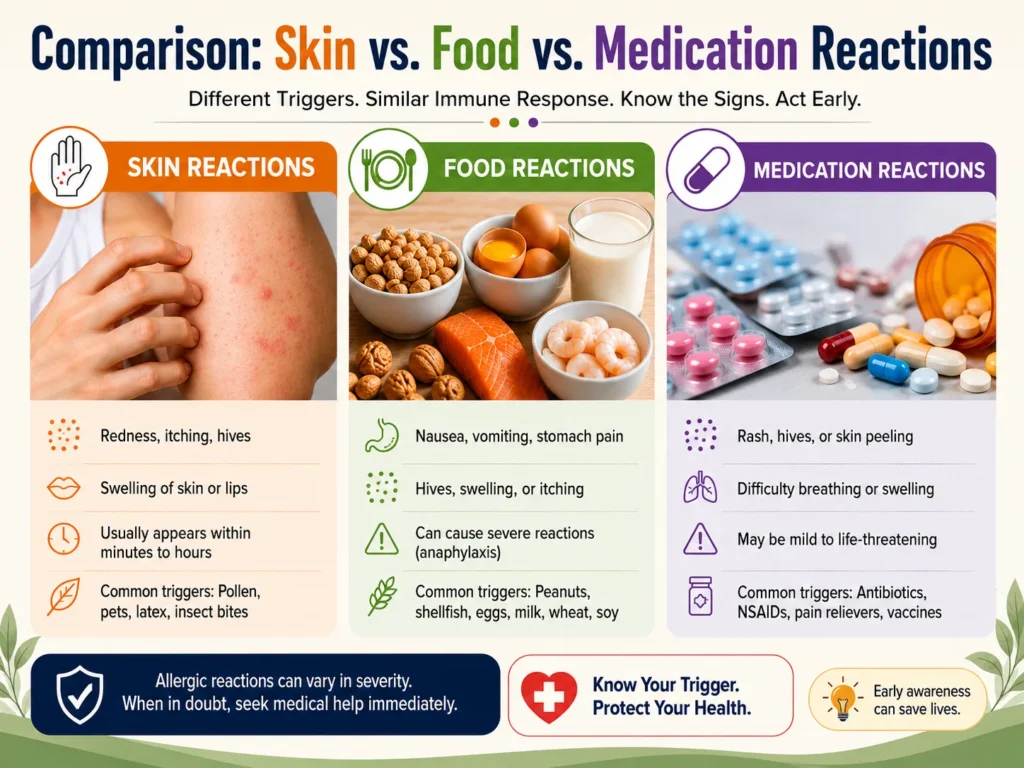
5 Stages of Allergic Reaction on the Skin
Skin is often the first place an allergic reaction shows up, and it tends to follow the five stages in a very visible way:
- Exposure: Contact with an allergen (nickel jewelry, a new lotion, latex, or a plant like poison ivy).
- Early response: Localized redness, itching, or a warm sensation at the contact site.
- Progression: Hives (urticaria) spreading outward, or a raised, blotchy rash developing edges.
- Peak: Widespread swelling, especially around the eyes, lips, or hands; in severe cases, skin symptoms accompany breathing trouble as part of full anaphylaxis.
- Resolution: Redness and swelling fade over hours to a few days, sometimes leaving mild flaking or dry patches behind.
A skin-based allergic response is usually easier to catch early simply because you can see it. That visibility is actually a gift — it gives you a head start before the reaction has a chance to progress further.
5 Stages of Allergic Reaction to Food
Food allergies follow the same five-stage pattern, but the timeline and symptoms have their own personality:
- Exposure — Eating or even touching a trigger food like peanuts, shellfish, milk, egg, or tree nuts.
- Early response — Tingling lips, an itchy mouth or throat, mild stomach discomfort within minutes.
- Progression — Hives, facial swelling, vomiting, or abdominal cramping as histamine spreads through the bloodstream.
- Peak — Difficulty breathing, throat tightness, a drop in blood pressure — this is food-triggered anaphylaxis, one of the most common causes of severe reactions in the United States.
- Resolution — Either gradual symptom fade after treatment, or, in roughly one in four to five severe food-allergy cases, a biphasic reaction hours later.
Food Allergy Research & Education (FARE) estimates that food allergies affect around 33 million Americans, including 1 in 13 children, making food-triggered anaphylaxis one of the most common medical emergencies seen in U.S. schools and households.
5 Stages of Allergic Reaction to Medication
Drug allergies can be trickier because the same five stages can unfold over minutes (with injected antibiotics, for example) or gradually over days (with oral medications):
- Exposure — Taking a new antibiotic, pain reliever, or other prescription drug for the first time or after a prior sensitizing dose.
- Early response — Itching, a mild rash, or flushing appearing anywhere from minutes to a few hours after the dose.
- Progression — A spreading rash, hives, joint discomfort, or mild swelling; sometimes a low-grade fever.
- Peak — Severe swelling, breathing difficulty, or a dangerous drop in blood pressure — This is drug-induced anaphylaxis, a leading cause of severe allergic response in hospital settings, according to data referenced by the American College of Allergy, Asthma & Immunology (ACAAI).
- Resolution — Symptoms fade once the medication is stopped and treated, though the reaction can sometimes recur if the drug (or a related one) isn’t fully cleared from the system.
Comparison: Skin vs. Food vs. Medication Reactions
Case Study: A U.S. Perspective on Recognizing the Stages Early
Consider “Maria,” a 34-year-old teacher from Ohio (a composite, realistic scenario reflecting patterns commonly reported in U.S. allergy clinics). Maria had eaten shrimp occasionally without issue for years. One evening at a work dinner, she noticed her lips tingling within ten minutes of eating a shrimp pasta dish — Stage 2 of the allergic reaction had begun. She initially brushed it off, but within fifteen minutes, hives spread across her neck and arms, and her stomach began to cramp — Stage 3.
Because Maria had read about food-related allergy patterns beforehand, she recognized the progression and took an over-the-counter antihistamine while asking a colleague to stay with her. Within twenty minutes, she felt her throat tighten slightly — a possible Stage 4 warning sign — and her colleague called 911 immediately rather than waiting to see if it would pass. Paramedics administered epinephrine, and Maria was monitored at the hospital for four hours because of the well-documented risk of a biphasic, late-phase episode. She was discharged the same night with an epinephrine auto-injector prescription and a referral to a board-certified allergist for testing, a common follow-up path recommended by U.S. allergy specialists.
Maria’s case illustrates a point echoed across American emergency medicine literature: recognizing which stage of the reaction you’re in — and not waiting for it to “resolve on its own” — often makes the difference between a scary evening and a genuine emergency.
Pros and Cons of Understanding the 5 Stages of Allergic Reaction
| Pros | Cons |
|---|---|
| Helps you catch a mild reaction before it becomes severe | Can cause unnecessary anxiety if over-applied to every minor itch |
| Supports faster, calmer decision-making in an emergency | Symptoms don’t always follow a clean, linear stage-by-stage pattern |
| Encourages people to carry and use epinephrine auto-injectors correctly | Some reactions (like alpha-gal meat allergy) can be delayed by hours, breaking the “typical” timeline |
| Improves communication with doctors, teachers, and caregivers | Self-diagnosis without medical testing can still miss the true trigger |
| Builds confidence for people managing food, skin, or drug allergies long-term | Awareness alone doesn’t replace having an allergy action plan from a doctor |
How to Care for Each Stage of an Allergic Reaction
- At the first sign (Stage 1–2): Remove yourself from the allergen if possible, take an antihistamine if appropriate, and monitor closely rather than assuming it will pass.
- As symptoms spread (Stage 3): Sit upright if breathing feels tight, keep your epinephrine auto-injector nearby if you have one, and don’t drive yourself anywhere — ask someone else to help.
- At peak severity (Stage 4): Use epinephrine immediately if you have it, then call 911 even if you feel a little better afterward. Anaphylaxis is a medical emergency, full stop.
- During recovery (Stage 5): Stay under observation for several hours after a severe reaction, since biphasic symptoms can return without warning. Follow up with an allergist for testing and a personalized action plan.
- Long-term: Wear a medical-alert bracelet if you have a known severe allergy, keep antihistamines and epinephrine auto-injectors current (they expire), and share your allergy history with new doctors, dentists, and pharmacists.
Frequently Asked Questions
What are the 5 stages of an allergic reaction?
The five practical stages are exposure and sensitization, early response (mast cell activation), progression of symptoms, peak reaction (which can include anaphylaxis), and resolution or biphasic reaction.
How fast does this process usually move through the stages?
It varies. Insect sting and injected-medication reactions often move through these stages within 20 to 40 minutes. Food-related symptoms typically build over 5 minutes to 2 hours. Oral medication reactions can unfold over hours to days.
Can the symptoms go away and then come back?
Yes. This is called a biphasic reaction, and it can occur anywhere from one hour to more than a day after the first reaction seems to have resolved, which is why medical observation matters after a severe episode.
Is a skin rash always a sign of a serious allergic response?
Not necessarily. A localized, mild rash is common and often stays at Stage 2 or 3. But if a rash is paired with swelling of the face, throat tightness, or trouble breathing, treat it as a potential emergency right away.
What’s the difference between an allergic reaction and anaphylaxis?
Anaphylaxis is simply the most severe stage of the allergic response — it’s systemic (affecting multiple body systems at once) and can be life-threatening without prompt epinephrine treatment.
Should I go to the ER even if my symptoms seem to be improving?
Yes, especially after a moderate-to-severe reaction. Because of the documented risk of biphasic reactions, doctors recommend follow-up monitoring even when symptoms appear to be fading.
Can food allergies develop later in life, even if I’ve eaten the food before?
Yes. Sensitization (Stage 1) can happen at any age, and some adults develop new food or medication allergies they never had as children.
Final Thoughts
An allergic reaction is never really a single event — it’s a process, and understanding that process gives you a real advantage. Whether it shows up on your skin, after a meal, or following a new prescription, the five stages give you a map: exposure, early response, progression, peak, and resolution. Recognizing where you (or someone you’re caring for) sits on that map can help you respond calmly rather than panic, and it can genuinely save a life when a reaction becomes severe.
If you or a family member has a history of severe allergic response, talk to a board-certified allergist about testing, an individualized action plan, and proper use of an epinephrine auto-injector. Being prepared is always better than being surprised.
References and Scientific Sources
- Mayo Clinic — Anaphylaxis: Symptoms & Causes
- Cleveland Clinic — Anaphylaxis: Causes, Symptoms, Diagnosis & Treatment
- National Institutes of Health / PMC — The Pathophysiology of Anaphylaxis
- American College of Allergy, Asthma & Immunology (ACAAI) — Anaphylaxis
- Food Allergy Research & Education (FARE) — Facts and Statistics
- Johns Hopkins University — Patterns of Anaphylaxis: Acute and Late-Phase Features of Allergic Reactions
Medical Disclaimer
The information provided in this article is for educational and informational purposes only and should not be considered medical advice, diagnosis, or treatment. While HomeHealthyRemedy.com strives to publish accurate, evidence-based health content, the information may not apply to every individual or medical situation.
Allergic reactions can range from mild symptoms to life-threatening anaphylaxis. If you experience severe symptoms such as difficulty breathing, swelling of the face or throat, dizziness, or loss of consciousness, seek emergency medical care immediately.
Always consult a qualified healthcare professional before making decisions about your health, starting new treatments, or using any medication. Never ignore or delay seeking professional medical advice because of something you have read on HomeHealthyRemedy.com.

Natural home remedies, skincare secrets, dental & eye health tips, and real product reviews to help you stay healthy the natural way.